

A British start-up that listens for drones rather than looking for them is preparing to deliver its first sensors to protect a secure airfield in the United Kingdom, as it moves from NATO trials towards real-world use.
Arcani, a company of eight full-time staff in NATO’s DIANA accelerator, told the UK Defence Journal at NATO Edge 26 in İzmir that it would deliver units to an undisclosed customer before the end of the year to help protect one of its secure airfield sites in the UK.
Huw Davies, Arcani’s Director of Mission and a former British Army officer, said the past few months had been “mad”, with NATO exercises across Europe, a trip to Singapore and the conference in Türkiye. “My wife’s wondering why I left the army, because I’m away more now than I ever was then,” he said.
Back to basic physics
The company, named after the Arcani, the scouts who ranged ahead of the main force in Roman Britain, is betting that as drones become harder to detect by conventional means, the answer lies in something very old. Davies said pilots had become better at using terrain to defeat detection, while fly-by-wire control, fibre-optic drones that trail a cable instead of using radio, and growing autonomy had all made drones harder to find through their radio signals. “I think we’re almost going back to noise and principles of basic physics to help overcome and defeat these really technologically advanced problems,” he said. Fibre-optic drones might not give off a signal, he added, “but they still emit a noise, and that’s where I think we close that gap”.
Being passive, the technology also has “huge dual use capacity”, he said, and the company is looking beyond drones at what else it can pick up by sound. “Be it armour, ballistics, which I know is a technique that was used throughout Afghanistan to find incoming artillery and mortars,” he said. “There is a lot we can do with a pretty simple sensor that is not only relatively easy to put together, but cheap and hopefully delivers a huge ROI for the end user.”
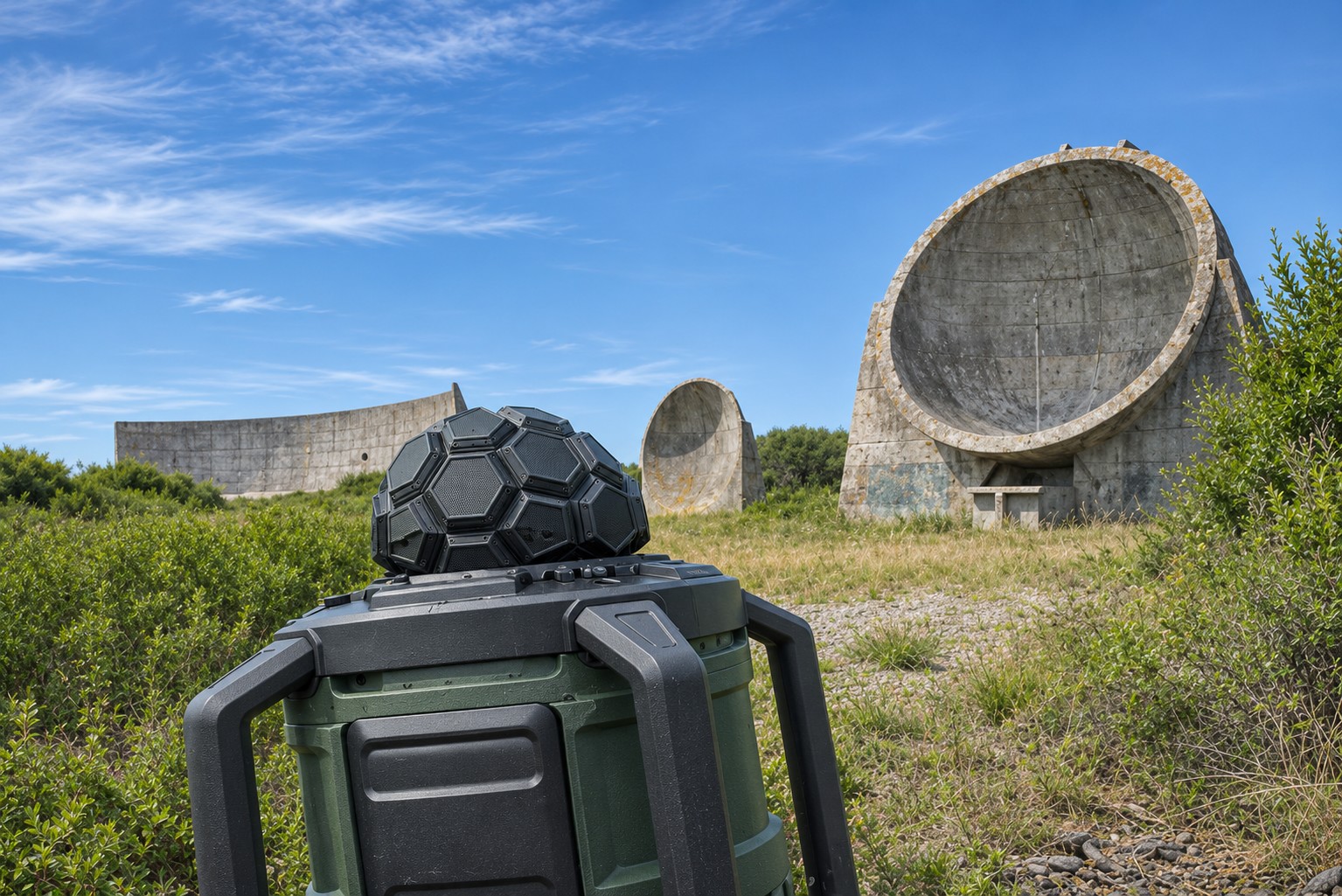
Its sensor, HARK, takes its name from the Old English word for listen, “but also working in defence, you’ve got to have an acronym, right?” Davies said. It stands for Hostile Acoustic Recognition Kit. Arcani designs and builds its own microphone array, which sits beneath a foam cover to cut wind noise and add waterproofing, and uses audio-spatial techniques developed by its director of acoustics, Mark Green, to locate a target. Davies said that was the key difference from many rival systems.
“A lot of other acoustic sensors on the market require two or three to work together to triangulate and localise an incoming threat, whereas we can do that with a single sensor,” he said, which was “better for the bank accounts, better for the end user”, with fewer things for troops to set up. The sensor then sends what is known as a cursor on target message to a soldier’s ATAK device or to a command post.
“It will give them the location of the incoming threat, and it will then track that threat as it moves around the battle space, albeit as long as it’s within the sensor’s detection range,” he said.
According to the company’s own figures, HARK detects small drones at around 400 metres and larger ones further away, identifies both the type and model of drone, and can follow several targets at once. Those numbers have not been independently tested, and acoustic sensors have a much shorter reach than radar, so they are likely to form one layer of a wider defence rather than replace other sensors.
Tested by Ukrainian drone teams
Arcani has spent the autumn on NATO trials. In Latvia, as part of a series of NATO experimentation events, it tested HARK mainly against fixed-wing drones, a change from its usual focus on FPV drones and quadcopters, driven by customer demand and “the emerging prominence and prevalence of that threat in Ukraine”, and Davies said the team came away with detections “well above a kilometre” of fixed-wing platforms, something it now plans to build on.
At the same time, he was in Bulgaria for a NATO special operations-organised exercise in which Ukrainian pilots and drone teams flew FPV and quadcopter drones against participants’ systems. “To get our sensor in the hands and in front of some Ukrainian drone teams was a real privilege,” he said. “Their feedback was absolutely instrumental.”
The company has also attracted interest from General Dynamics on both sides of the Atlantic. With General Dynamics Land Systems Canada, it is developing a counter-drone protective layer for the Grizzly 155mm self-propelled howitzer, unveiled at the CANSEC show in Ottawa this year. “Obviously, that’s a pretty expensive bit of kit, and it would be a shame for a cheap drone to do a vehicle kill there,” Davies said.
In the United States, General Dynamics Land Systems recently unveiled a modular counter-drone system that can sit on a Ford Ranger pickup or be dropped as a pallet to protect a site, in which HARK provides the first detection and cues a camera, before a weapon system defeats the threat. “We will do the initial detect, give an electro-optical or some sort of camera or optical sensor a point of interest in the sky. The camera does the final lock, and then the weapon system does the defeat,” Davies said.
Built in Buckinghamshire
Every sensor is built in the UK, at a site in Westcott on the Buckinghamshire and Oxfordshire border run by the Satellite Applications Catapult, a former RAF and BAE site. “We’ve got all the green space we like, and all the flying areas, so we can fly all day,” Davies said. Arcani moved there in July, and he credited its place in NATO’s DIANA accelerator, which it joined in February, with helping it grow. “We can certainly thank NATO DIANA for that,” he said. Founder Harry Howe had run the business largely alone for around 18 months, with Green’s support, before it scaled up to eight staff and a part-time chief financial officer. “We’ve come on a hell of a long way in the last six months,” he said. The company rates HARK at technology readiness level 6, meaning it has been demonstrated in a relevant environment but is not yet in service, and in its DIANA profile says it is seeking seed investment, procurement trials and integration partners.
Next year, the company plans to move into the maritime environment. “We very deliberately wanted to get really, really good in the land environment first to prove our credentials, prove the concept of this technology, before putting our swimming trunks and our armbands on and diving into that arena,” Davies said.
That, he said, would bring new acoustic challenges from noise reflecting off the water, as well as the need to make the hardware robust against salt water. It is also working on versions that can be dropped from the air or potentially fired forward by mortar or artillery, to get cheap sensors “as far forward as the FLOT is”, the forward line of own troops, versions for uncrewed ground vehicles to push sensors ahead of troops, and a smaller array that could be mounted on a drone. He said the message he had heard repeatedly at NATO events was that the most successful start-ups combined “really clever software in simple hardware”, and that Arcani was following that model.
Asked why anyone should buy it, Davies came back to physics. Drones, he said, had not reached the point where they could defeat its laws, “God help us that they ever will”. “That’s why this technology and acoustic sensing is not only the solution for now to meet the rapidly advancing threat of UAVs, but it will be there well into the future,” he said, adding that a single sensor doing the work of several meant “far less burden on the end user, which is perhaps the most important part”. As a former Army officer, he admitted he disliked talking about return on investment. “If you save a soldier’s life or save a person’s life, it’s worth the price,” he said. “But sitting on the other side now, I get that’s the reality.”
Arcani is one of a high number of British companies in DIANA’s 2026 cohort. Asked by the UK Defence Journal earlier this week why so many British firms had won places, DIANA’s James Orr said more British companies applied and that selection was “a meritocracy”.









A very sound idea as Trophy is expensive per shot.
So this can be on a support vehicle working with Challenger III?
So Trophy can defeat the ballistics and this can defeat small drones?