

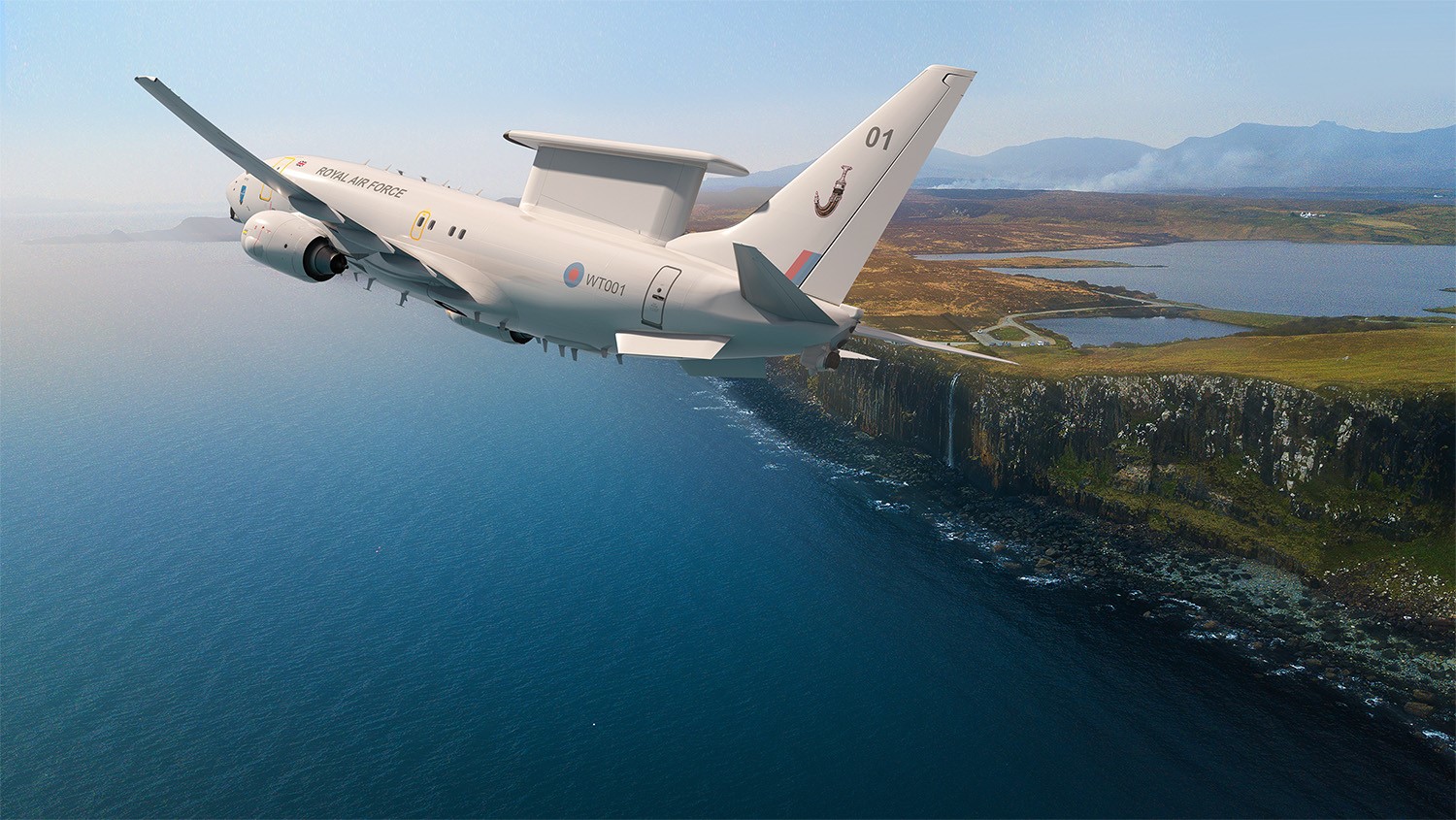
Both of the Royal Air Force’s delivered Boeing E-7 Wedgetail aircraft were flying at the same time on Thursday afternoon, the first occasion on which the two have been airborne together.
WT001 came south from RAF Lossiemouth for the orbit areas in the South West using the callsign Boeing 31, while WT002 was out of MOD Boscombe Down as Boeing 38. Between them they represent two thirds of the entire future British airborne early warning fleet. The second aircraft was still being outfitted by STS Aviation at Birmingham Airport as recently as January, so its appearance out of Boscombe Down marks its arrival in the flight test programme alongside the first aircraft.
The Wedgetail is built on the Boeing 737 Next Generation airframe, the same basic aeroplane as the RAF’s Poseidon maritime patrol fleet, and carries the Northrop Grumman Multi-role Electronically Scanned Array radar in the distinctive dorsal fin above the fuselage.
The array has no moving parts, which is the main departure from the rotating radomes of earlier airborne early warning aircraft, and it allows the operator to concentrate the radar’s attention on a particular sector while continuing to scan elsewhere.
#RAF Royal Air Force
Boeing E-7A Wedgetail AEW.1 2x#43C97A WT001 – BOEING 31#43C97B WT002 – BOEING 38
Both RAF Wedgetail AEW.1’s are currently airborne this afternoon.
WT001 made its way down from Lossiemouth for the orbit areas in the South West, while WT002 has departed… pic.twitter.com/jaTrS1apv1
— Armchair Admiral 🇬🇧 (@ArmchairAdml) October 8, 2026
The most recent milestone before this one came on 21 May, when WT001 landed at RAF Lossiemouth for the first time, flown by a mixed Boeing UK and Royal Air Force crew. The station has spent a long time preparing for it.
Group Captain Sarah Brewin, the station commander at Lossiemouth, said at the time: “We have been working hard to get ready to operate these aircraft.”
Stu Voboril, Boeing’s vice president and programme manager for the E-7, said: “We look forward to continuing test and evaluation as the aircraft moves closer to entry into service.”
That test and evaluation phase is split between Boscombe Down and Lossiemouth, which explains Thursday’s pattern of one aircraft working out of each. Boeing UK hands the aircraft over to the Royal Air Force once the phase is complete, at which point 8 Squadron takes them on.





I was just watching them both on Flightrardar24.. thanks for reporting! We need those two spare radars put on airframes too. And a couple more! But it’s exciting to see this programme moving toward IOC.
It would appear to be a no-brainer to put the Sky-Guardian capability onto UK MQ9bs to compliment the Wedgetails, which means it won’t happen.
3 more please MOD
Due to the size and weight of the radar’s antenna array and its power requirements, I do wonder if a smaller aircraft than the B737 could be used, that could be optionally manned? I suspect it will have to be limited to a twin jet regional airliner in the B737 class. Though I would love to see a project to fit the radar within the Airlander hybrid airship.
I’d argue that would be the wrong call. Instead of smaller versions, more of the same scale but with the ability to coordinate drones as flying command centres would be far more useful. One of the questions continuously asked is how to exercise control of unmanned assets in contested areas; AWACS aircraft are already doing that for manned aircraft, logically as unmanned aircraft develop more autonomy an AWACS crew could deliver the command input they need.
I’ve been meaning to get down to Boscombe to see the transports, an E7 as well would be great.
Does anybody know how long the first example spent there? It might give an idea how long the current one remains.