The Munich air defence company Tytan Technologies is building manufacturing capacity to turn out as many as three thousand low cost drone interceptors a month, a company representative told the Apex Europe conference in London on Wednesday.
Kerry Hoppe, who handles business development and government affairs at Tytan, was speaking on the European Industrial Leadership Panel and described the economics that led to the company being founded in 2023.
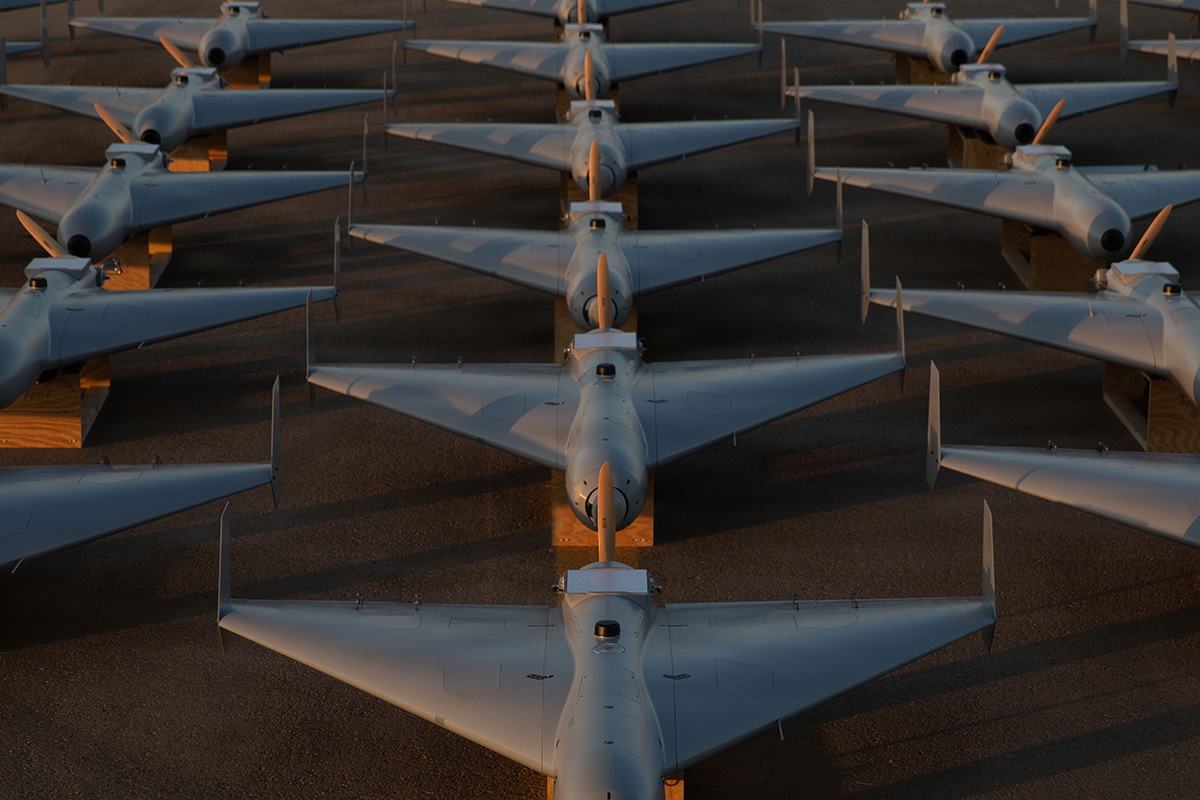
She said: “Our founders came up with the idea of drone interceptors in 2023, attending a hackathon in Kyiv against Shaheds. Because if you remember, that was a time where we were still combating Shaheds and Cannons with missiles, with IRIS-T, with Patriot, spending about a million per shot to defend from a system that costs maybe 30, 40, 50 grand, so a massive economic imbalance in a time where we’re seeing a massive proliferation of the subsonic layer.”
That imbalance has driven a good deal of European procurement thinking since, and it remains the central argument for cheap interceptors over exquisite ones. Tytan now has three interceptor types aimed at different threats in the NATO Class I and Class II categories, with locations in Munich, Berlin and Kyiv.
Ms Hoppe said the hardware is sophisticated but is not what distinguishes the company. “Really, what sets us apart is the high degree of autonomy that enables operators to operate multiple systems at the same time and doesn’t require manual steering,” she said.
Close contact with Ukrainian units shapes the development cycle, and she named the third army corps, the National Guard of Ukraine and the Ukrainian air force as sources of constant feedback that is taken back into prototyping in Munich.
Getting from prototypes to volume is the part she described as most exciting and most difficult. “It’s one thing producing very innovative prototypes and keeping that iteration speed when you’re making prototypes, but really keeping that speed on your scaling, because really no system is a real solution if it’s not available en masse,” she said. “So we’re building up our manufacturing to produce up to 3,000 per month, and keeping that speed using smart manufacturing technologies while always iterating on software.”
She was careful to place the company inside a wider architecture, and warned against anybody claiming to have solved the problem alone. “We always think of air defence as a multi-layer approach,” she said. “Any company saying we have all the solutions, we’re able to combat all the levels of threats that we’re seeing at the moment, it’s just not possible. It takes all kinds of different industry players, all kinds of systems, and we want to be part of that multi-layered approach.”
Ms Hoppe also noted the collaborative tone of the session itself, observing that the companies on the stage compete in the same market but are working towards the same European resilience, which she described as uplifting.