

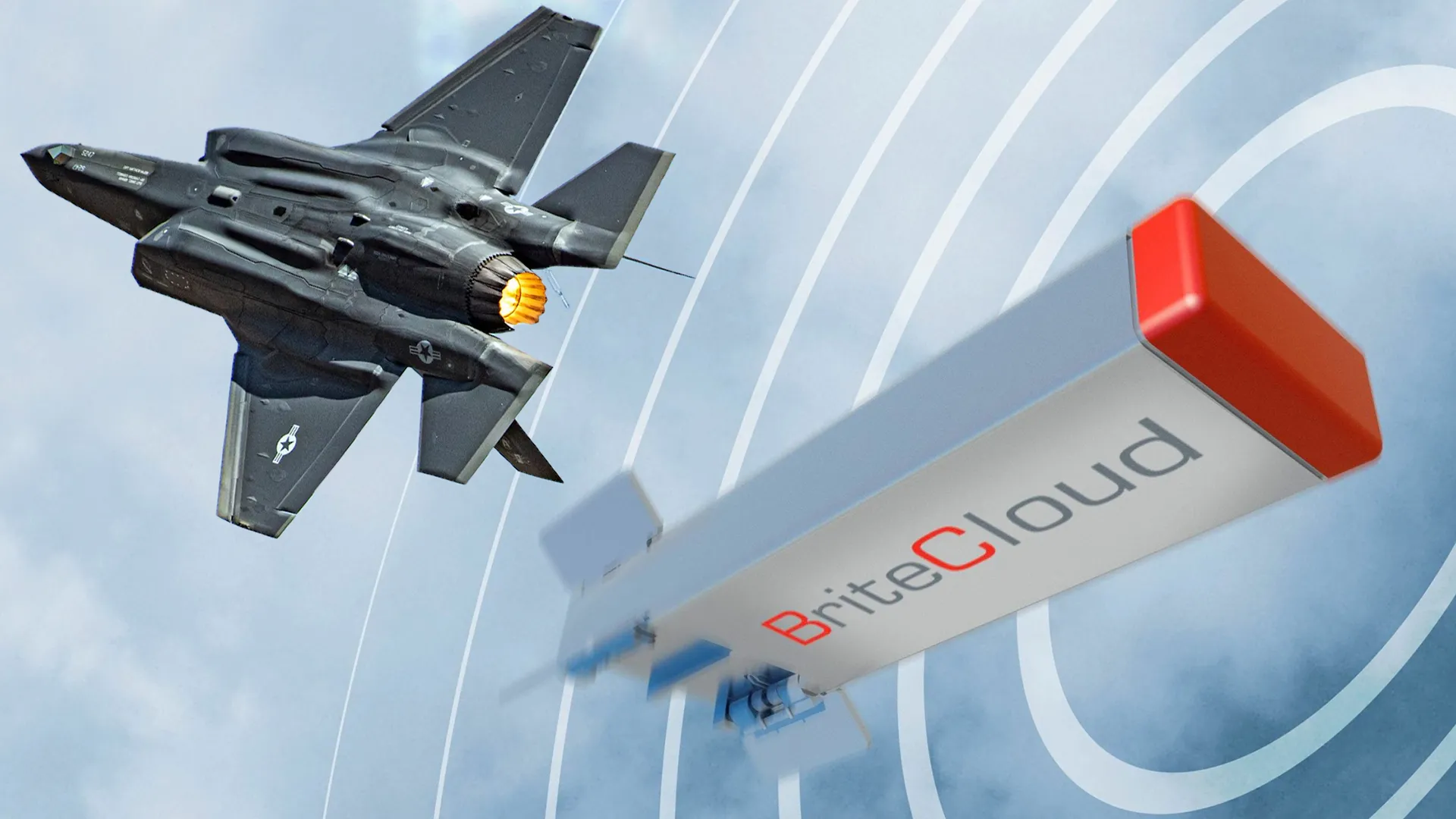
The US Navy has moved to sole source Leonardo UK’s BriteCloud active expendable decoy under the AN/ALQ-260(V) designation, according to a newly released Class Justification and Approval (CJ&A) document from Naval Air Systems Command (NAVAIR).
A newly released Class Justification and Approval document, signed by Naval Air Systems Command, authorises a sole-source contract to Leonardo UK for the manufacture of the AN/ALQ-260(V) and associated impulse cartridges and support equipment. The justification cites 14 years of joint US-UK development and warns that switching supplier would cause an eight-year delay to fielding.
The document states: “Award of this contract to any source other than Leonardo UK, LTD would result in an unacceptable delay of eight years… Any interruption in production would pose critical setbacks to current schedules and fielding requirements.”
The ALQ-260 designation applies to the 2:1:8 BriteCloud variant. That round adapts Leonardo’s original 55 mm cylindrical decoy into a 2×1×8 inch brick designed for US ALE-47 square dispensers. It is compatible with the dispensers fitted to platforms including F-35, F-15 and F-16, rather than the cylindrical launchers used by Typhoon.
Michael Lea, Vice President of Sales for Leonardo Electronics UK’s EW division, told reporters at DSEI: “We are now in a happy position where we can confirm that ALQ-260 is indeed BriteCloud, in the 2:1:8 format.” He said the round “works well on the ALE-47 dispenser fitted to F-35,” is being integrated on F-18 and has been assessed from F-16 with “a very positive fielding recommendation.” According to the firm, the US Air National Guard has already issued a positive recommendation following comparative testing on F-16.
Leonardo is framing the development as an inflection point for allied standardisation. Lea told UK Defence Journal earlier this year: “We should have a fleet wide Nato embodiment of BriteCloud onto F-35. After the US went public, we had a range of inquiries come in.”
This forms part of a wider effort the company set out in London. At DSEI 2025, Leonardo positioned itself as the business underpinning NATO’s return to serious electronic warfare mass, presenting BriteCloud alongside BriteStorm jamming payloads, and Typhoon’s ECRS Mk2 radar and EuroDASS upgrades as the foundations of a nascent electronic attack force. The thread is the idea of integrated combat air architecture rather than isolated national programmes.
Lea added that development continues at the top end of the product line. The higher power cylindrical 55T variant is in trials with “significant interest in the US” and the company “will probably have our first operational, customised frontline-deployed 55T capability during 2026.” The 55T retains the 55 mm form factor but is intended for larger aircraft with higher radar cross-sections and has been upgraded to NATO standards for self-protection systems, including communication with smart dispensers and support for automated logistics tracking.
The procurement decision gives Leonardo’s UK-built countermeasure a recognised US designation and formal backing from the US Navy. That, coupled with existing RAF integration and ongoing work with European partners, places the programme at the centre of an emerging interoperability effort among combat air users equipped with the ALE-47 dispenser family and F-35 fleets.
How does it work?
The BriteCloud 218 is an expendable electronic decoy built around Digital Radio Frequency Memory technology. Once dispensed from a standard 2×1×8 inch countermeasure slot, it powers up and captures incoming radar signals from tracking systems or missile seekers. It then retransmits altered versions of those signals with timing, frequency, and power profiles configured to appear as a valid target with its own radar cross-section and motion. This process aims to break the missile’s lock by presenting a more attractive radar return than the aircraft itself.
The decoy operates autonomously after launch, with an onboard processor, battery, and transmitter contained in a sealed unit. Its effectiveness depends on accurately reproducing threat radar characteristics, so the firmware is tuned around known emitter types and guidance modes. The 218 format was created to fit existing square dispenser systems like AN/ALE-47 and AN/ALE-57, which allows integration on platforms such as F-16s and F-35s without additional hardware. It represents a shift toward off-board countermeasures that project jamming and deception away from the aircraft, reducing the usefulness of home-on-jam seekers and increasing the chance of a break in guidance.











Wow, finally the USA has been forced to buy an actual product from someone other than Israel.
The US has been very big in talking about NATO standardisation of procurement much like France.
They just believe every one should standardised on their procurement 😀
Perhaps a purchase or Meteor now to keep their F35B&C in the game against the PL15 over the pacific.
CAMM missiles with their cold gas launch capability could also turn the FF X into an actual frigate rather than an OPV.
Well done Leonardo UK.
America won’t bother with the Meteor even if the AIM-260 is still in testing.
AIM-260 supposedly been in production since ~Oct 2024.. depending on sources its either missed ioc but is otherwise on track or is having integration issues. Given that its a LM missile and F-22/F-35 are LM jets.. we should bin F-35 because something is really borked
And replace it with what exactly?
That’s the issue, once we went down the VTOL route we limited our options to one.
Meteor will get integrated eventually and same with spear 3, certainly well before another option can be picked.
In the long run the f35 will be a significant asset, just might take another decade to get there.
Yeah obstructing Meteor integration while they perfect their own missile will go down well with their shareholders, but then the delays are so inherent in that programme probably pure coincidence. 😈
As a tier one partner, we should have had them nailed to the wall in contract, but clearly corruption or incompetence resulted in that not being the case. I suspect corruption as it happens too often to be incompetence. Even the slowest learner, learns from their mistakes eventually.
As the UK is the only country outside the US that has access to the F35 source code we could integrate Meteor ourselves. But everyone appears to be happy with yet more delays.
Is that correct? I thought I read that we didn’t have access to it.
No we don’t, we do have access to the mission data as the USA does but no one other than Lockheed Martin can integrate weapons.
The Israelis have a work around, it’s installed its own command and control software over the F35’s operating system but this prohibits it from taking part in the wider F35 program.
Not dure if that is correct + there was a big debate with the US and the UK about sovereign us and we insisted er shouls have access to the code so we could make our own changes if required, This was initialy blocked by the US but eventually as fare as I understand we got access as the only tier one nation.
So as fare as I understand we have got access.
There was certainly a debate and it was also had in parliament about the issue, but I thought we ultimately rolled on it.
If the US doesn’t trust us as an ally we really shouldn’t buy anything else from them after the F35. We are now stuck with that jet.
Israel has it. And we’ve have seen how that works. Uk just never bothered to do it and then b****** about the US.
As far as I understand Israel has replaced some the the F35 software with their own, I am not sure if they have access to the code or not,
Israel has access to F35 source code, which the USA refuses to supply to any other nation.
Hopefully that’s the last time we buy American crap.
Israel does not have access to the F35 “source code” and neither does the UK. Israel can modify the aircraft software, Israel was has permission to install its own C4 software that runs “on top” of the Lockheed Martin operating system.
We are tier one for development only. And for securing 15% workshare iof every F35 built.
Except we didn’t get 15%. I saw a much lower figure quoted on the latest batch being built.
But yeah we should have haggled harder to get our missiles integrated from the get go.
The MOD did also cut the budget back in 2018 which also had a big impact on UK weapons integration. StormShadow was also due to be integrated, and be in service on F35B by 2024, but back then the original out of service date for StormShadow was 2028. So they cut it became the cost wasn’t worth just 4 years of service. As we know now, StormShadow Out of service date is now 2034. F35 is a game changing capability. But its entry to service has been badly let down by many bad desicisions made over many years. Particularly before 2020.
The MOD needs a serious reform. So much money wasted over the years.
We have had the biggest budget in Europe for decades and now we are becoming the 4th largest military behind Germany/France/Poland.
Our military strength as given has political leavage over the years and now that is wasted.
🥱
Reality is kind of hard… Meteor doesn’t fit in the s*** box you ordered and the UK did not invest the money to develop their own weapons. So there you have it. You get what you get
And yet again you demonstrate you have shit for brains.
Meteor fits fine into the Typhoon.
Meteor fits fine into the internal bay of both F35A and F35B. Ground tests of these have completed, with flight tests for next year. Now if only LM could learn how to write software properly and deliver Block 4…
Interesting, given Typhoon does not have an internal weapons bay.
I thought there was a need for a fin adjustment to get them to fit into the internal bay.
Done years ago.
Wow was also my reaction. Guessing the US version is no where near as capable and so they had no choice.
Which is good news, as it indicates our jets are well protected.
Yes, also shows that the UK continues to perform well in EW.
Are you aware of the new American missiles?… You might want to study up on that sport
😆
You’re about 20 years behind Spock… UK is way way behind on everything.. but no worries. Tempest is going to save the world and make the UK relevant again.
Meteor.
Nuff said, arsehole.
More relevant than whatever shit hole you come from.
What ramjet powered missiles is the US working on then? What do you have in service beyond AIM 120?
Just a little FYI. Your goddamn ram jet missile does not fit in your s***** little vtoll fighter. You might want to look at the missiles that the US is developing two-star internally on their stealth aircraft. Or the ungodly long-range ones that they’re hanging off their other ones… Meteor is not really a big deal. I’m sure it is on the old generation fighters but it’s not really relevant at the moment
I sense much anger. 🤔
Try not to break that keyboard of yours Ray.
He does seem a tad tetchy doesn’t he.
Yes, I believe a Mexican took his job or a raccoon stole his baby
Either way he seems awfully upset 😀
He’s clearly not getting any. Such demented rage is characteristic of ‘incels’.
“Incels” 😂😂
I had to look that up.
Looks like another word Invented for specific Internet users.
Then how do you explain this photo of a Meteor in the internal bay of an F35B?…
wwwtwz.com/air/f-35b-has-flown-with-meteor-long-range-air-to-air-missile
(Inset dot after www)