

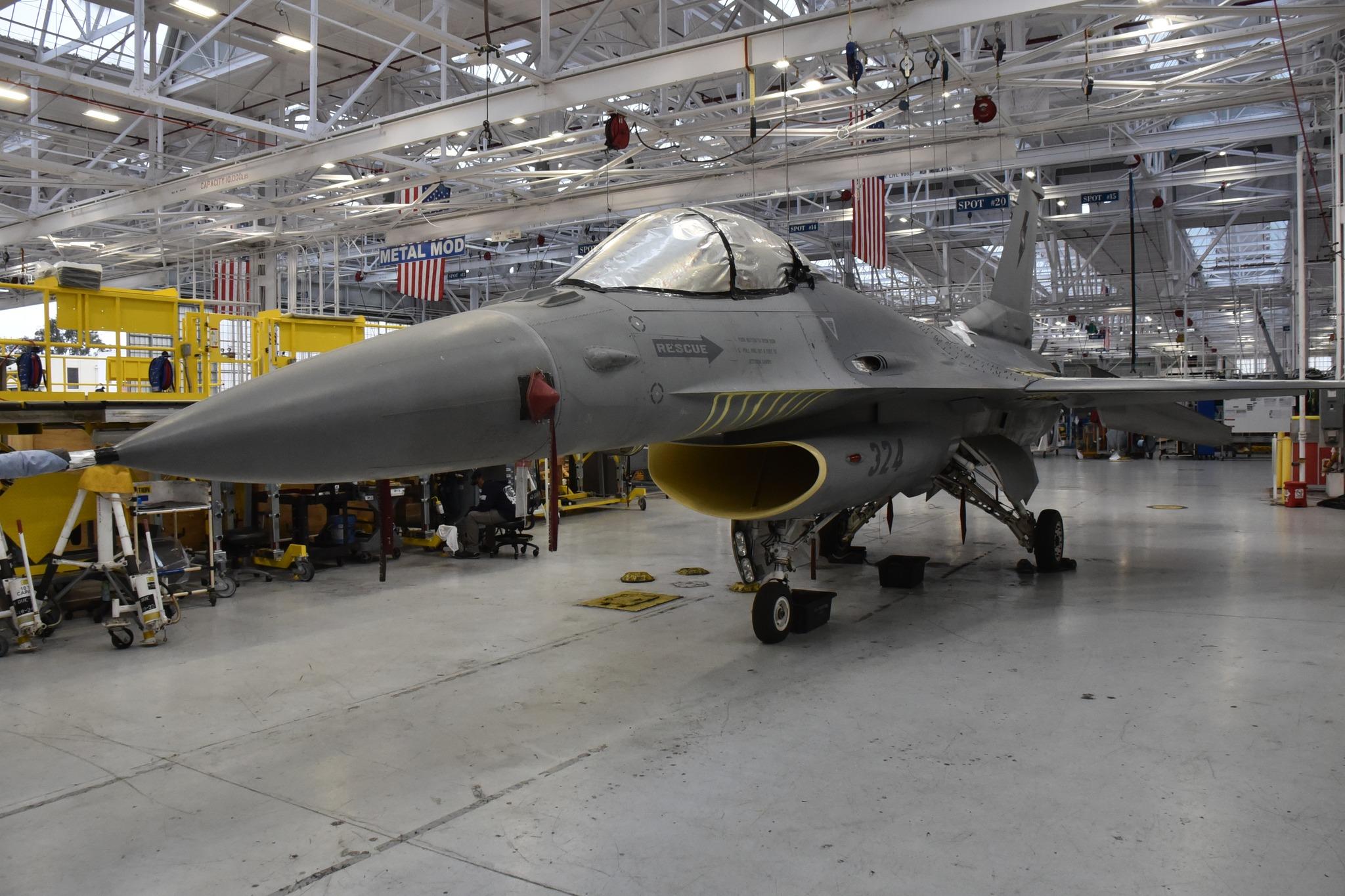
Fleet Readiness Center Southwest (FRCSW) has established a new depot-level maintenance programme for the U.S. Navy’s F-16 Viper aircraft, completing its first aircraft under the effort after standing up the capability in an 18-month timeline, the service stated.
According to the U.S. Navy, the new maintenance line was developed in conjunction with Program Management Activity 226 (PMA-226) and is focused on delivering Programmed Sustainment and Structural Repairs (PSSR) for Navy-operated F-16s. The Navy described the timeline as an unusually rapid depot activation process.
The U.S. Navy said the programme began after PMA-226 approached FRCSW with a requirement for additional depot support, with other facilities unable to take on the workload at the time. FRCSW subsequently assumed responsibility for establishing the capability. Under the programme, FRCSW is now the primary depot location for F-16 repairs related to PSSR. The Navy described PSSR as comparable to the F/A-18 High Flight Hour Inspection and said the work is intended to ensure the F-16 fleet remains available to support aggressor training missions.
Captain Jason Pettit, PMA-226’s Program Manager, said: “The strategic collaboration between FRCSW and PMA-226 to establish F-16 Depot Maintenance capabilities for U.S. Navy Aggressor F-16s has delivered accelerated readiness for the warfighter.” He added: “In just 18 months, both teams worked tirelessly to procure, train, and install the necessary equipment to stand up the F-16 Programmed Sustainment and Structural Repair (PSSR) capability, an unprecedented pace for depot line activation.”
Assigned primarily to the Naval Strike and Air Warfare Center at Naval Air Station Fallon, Nevada, the F-16s support high-end training for carrier air wings and other fleet units. In this role, the aircraft are used to simulate the tactics, performance characteristics and employment methods of potential adversaries, providing realistic opposition in complex air combat scenarios.
The U.S. Navy said the effort required procurement of new equipment, installation of specialised tools, and the creation of training programmes. It also highlighted that FRCSW personnel adapted existing F/A-18 equipment for use on the F-16, including wing removal and installation stands, as part of efforts to support the programme efficiently.






I wonder, what aircraft carrier does the navy’s F-16 operate from? I’d love to see that arrested recovery. 😂.
Aggressor squadron at NAS Fallon in Nevada flies the F-16.
I get the US Navy has a massive budget but it’s not limitless. Surely it would have been more cost effective to collaborate with the USAF on F-16 maintenance considering the relatively small numbers the navy operates in the aggressor role?
Possibly because all of the Navy’s F16s are A and B variants, whereas (I think) the USAF only operates C and D versions. ANG might operate some A/Bs though.
Not sure how much or little compatibility there is.
Mmm not quite – the USN uses a variant called the F16N,low numbers but tailored specifically for Aggressor Training.
F-16N was retired in 1994. USN they received some A and B variants from 2002 onwards, which is what these are.
Daniel,
Excellent question, uncertain re backstory, if any exists. 🤔👍