

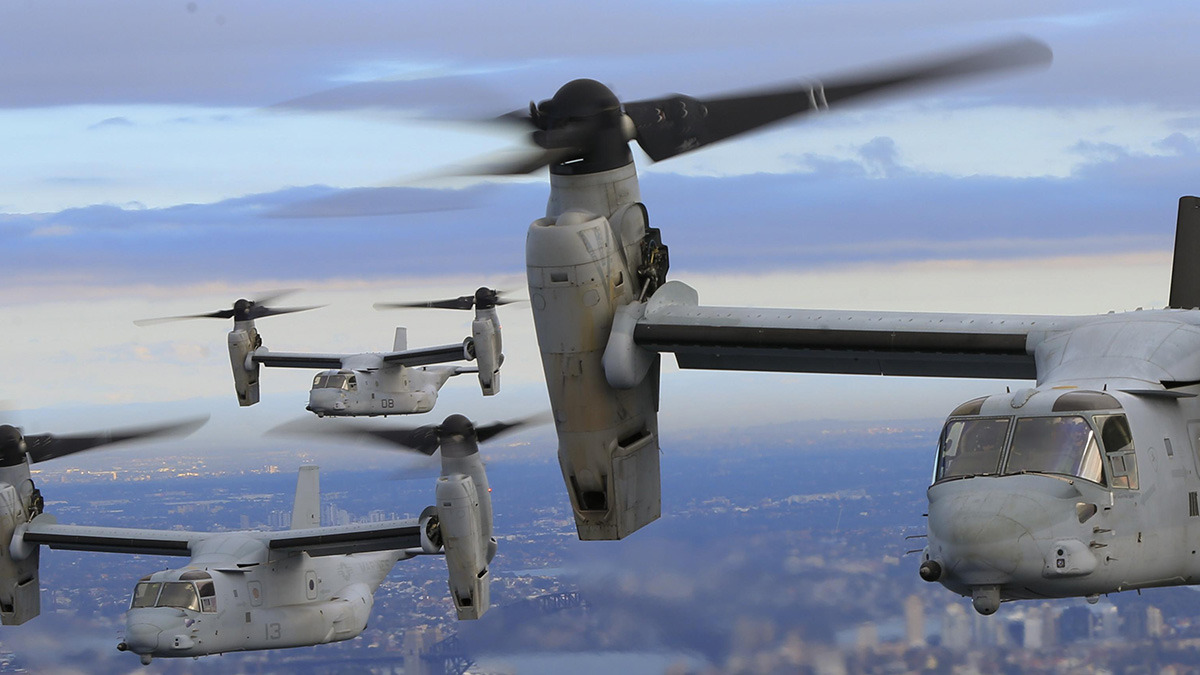
The US Naval Air Systems Command has released the findings of a comprehensive review into the V-22 Osprey, reaffirming the aircraft’s airworthiness and allowing continued operations across the US Air Force, Marine Corps and Navy.
Published on 12 December, the review was ordered in September 2023 to assess V-22 performance and identify measures to improve safety and readiness. NAVAIR said the aircraft remains airworthy under established controls and described it as a critical joint capability for US forces.
The review produced 32 recommendations, all of which are now being implemented by the Department of the Navy and the services operating the tiltrotor. These actions are intended to strengthen safety oversight, improve readiness and reduce the risk of future incidents.
Vice Adm. John E. Dougherty, Commander of NAVAIR, said: “In coordination with V-22 service leaders, NAVAIR has developed action plans to mitigate safety deficiencies. We are continuously evaluating procedural compliance to prevent mishaps as well as strengthening airworthiness controls to establish clear risk thresholds.”
NAVAIR said it is conducting regular progress reviews to improve cross-service coordination and ensure corrective actions are carried out effectively. Dougherty added: “Through ongoing analysis and targeted action, we remain committed to improving the V-22’s performance and safeguarding the warfighters who rely on this platform.”
While the findings were developed specifically for the V-22 programme, NAVAIR said lessons learned will be shared more widely across the military aviation community to inform best practice.
The command stressed that the V-22 remains central to US military operations and that maintaining its airworthiness is essential to national security. NAVAIR said it continues to monitor data and trends across all aircraft platforms to ensure personnel are provided with the safest and most reliable equipment possible.
The comprehensive review is available here.

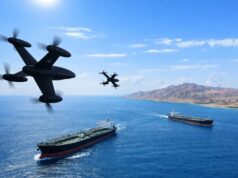






Sadly the V22 Osprey has an inherent design flaw. When the USN were setting out the requirements. The aircraft had to be capable of operating from the Wasp class LHD. But had certain constraints. Such as being able to taxy past the island, the outboard undercarriage must be x distance from the edge when taxying etc/. The aircraft was designed as a direct replacement for the CH47 Boeing Vertol Sea Knight (Baby Wokka). The cabin size was more or less a direct correlation.
These constraints meant the prop-rotor diameter and wing span had to less than desired sizes, which in turn meant the prop-rotor rpm had to be higher to make sure they generated the necessary lift/thrust, i.e. it has a much higher disc loading. What this means is, that when an engine fails, it can still fly conventionally. But it won’t be able to hover, or auto-rotate when both engines fail.
The new MV75 (V280 Valor) should be a lot safer in this respect, as the aircraft does not have the high disc loading (aircraft weight vs blade area). This is due to the blade area being more in line with the aircraft’s weight.
Question, Davey.
When one of these takes off, do they do so vertically or by a short rolling run and lift?
Vertically.
As Patrick says below, vertically. I’ve had the privilege to be picked up and dropped off by USMC V22s in Afghan. From places like Bastion and Khandahar with paved runways, they also did a STOL take-off. Where the engines were angled, we did a short run then lifted off. I can’t remember if we did the same coming in to land? When being dropped off or picked up in the sticks, it was always a vertical landing and take-off. The amount of downwash of these things is amazing. You’d literally get pummeled by stones and sand/grit. Eye protection was an absolute must.
Thank you. So with a runway available they can indeed take off and land STOL.
I’m aware of some very short runways that have beem built in the last decade or so, which I theorised were for these to use for max take off weight.
One thing is that the engine itself doesn’t really like being rotated like that when running due to the gyroscopic effects of spinny engine bits and the air intake no longer being pointed into the airflow. The new Valour instead rotates the prop while keeping the engines themselves stationary you may notice.
The ‘idea’ behind rotating the whole assembly was that there were no complex linkages to fail.
However, the issues lubrication and airflow made up for that simplification.
One of the major factors behind some of the crashes, is the clutch between the engine and prop-rotor gearbox. From my understanding it seems to be a Spragg type of clutch. Which is what a helicopters use. This clutch allows the engine to free wheel say up to 20% rpm, then bite above 20%. But it seems the clutch has disengaged when above 20% then bites again. Causing a huge torque spike, which some pilots couldn’t counter in time. Bell have been working on a software fix for this.
Davey,
The Bell MV-75 might prove to be a suitable acquisition for RN/RM in the 2030s, for ancillary support roles aboard CVs. Not certain re unit pricetag. 🤔
I agree the MV75 is probably the best solution to replace the Merlin. Pricewise Bell have said it will be competitive with the latest Blackhawk. Which if true, will make it it really hard to compete with.
There may be an alternative. This is the European future rotorcraft, based on the Airbus Racer. This is a compound aircraft. In that the main rotor is supplemented by a box wing that generates lift. On the ends of the wing are propellers that provide thrust and yaw control. Airbus have said Racer is designed to be 50% faster than a conventional helicopter. But with a designed cruise speed of 400kph (250mph), would make it considerably faster and nearly on jar with the MV75.
However, although the Racer prototype has flown. This is not a military prototype in the same context as the V280 Valor. Which means Bell has a significant lead in the market. It remains to be seen if the USMC do go down this path to replace their Huey Venom or if there’s going to be a version to replace the Seahawk. I think the MV75 is in a good place to replace the Merlin. But it will depend upon Bell marinizing it, plus having the USMC and USN buying into it as well.
Maybe it’s time to bring Rolls Royce in 🤔
I would like to see the RN get a small number of CMV-22 for ship to shore connection, for QE/PoW. They are expensive to buy ($120m) & operate, so we could not have many.
Running a small fleet would be a nightmare.
RAF would insist it owns them and they would have a myriad of other taskings.
Flight costs/hr are eye watering and funding won’t be prioritised to make them fly effectively.
The script can easily be written from the comfort of an armchair.
They still do things that Merlins cannot. Lean into the USN for training. Make sure UK CMV-22 are RN FAA only. For QE/PoW only. Only need 2 on each carrier.