

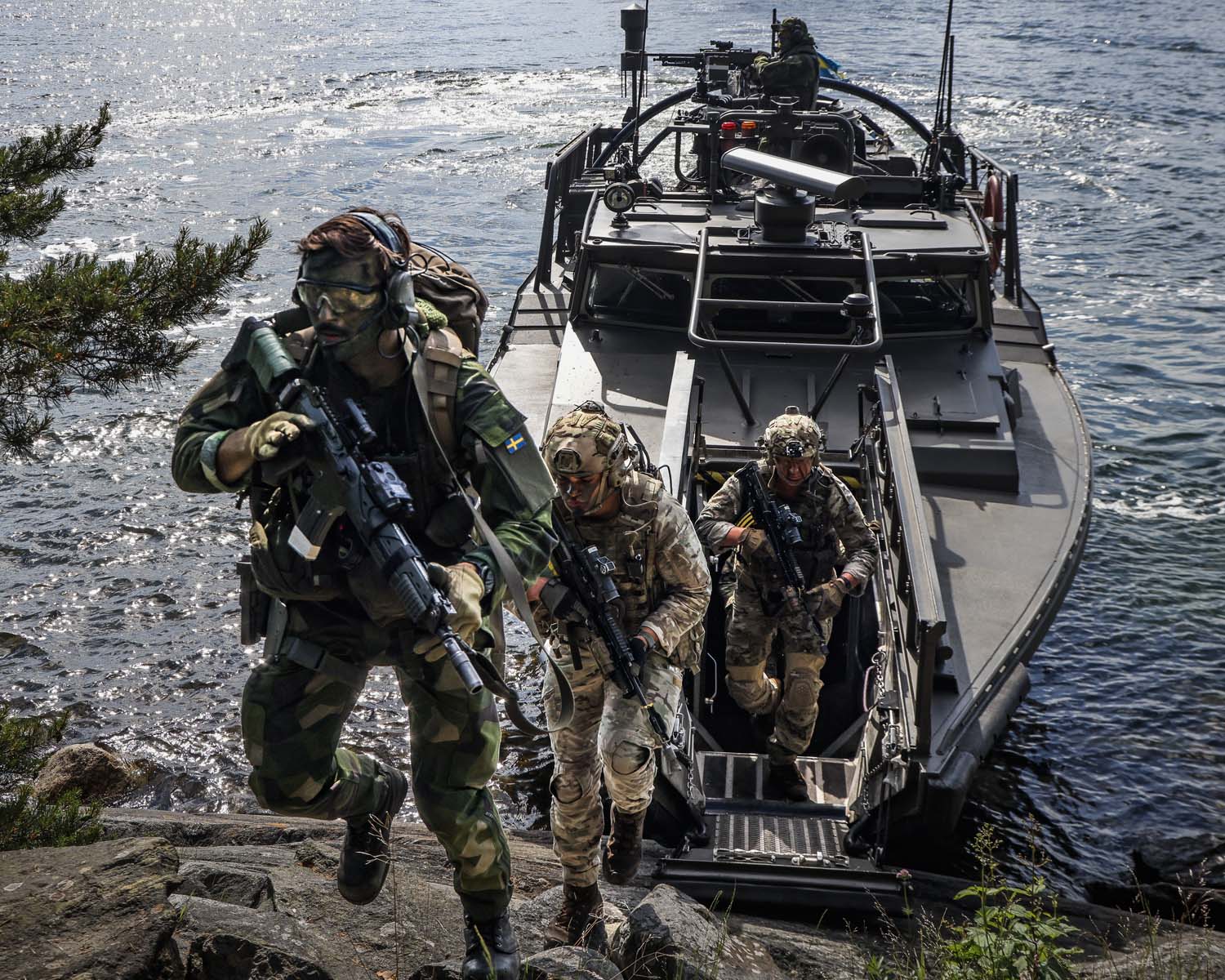
The United Kingdom and Sweden are set to intensify defence cooperation in the Baltic and High North as both countries respond to what the UK Defence Secretary described as a rapidly deteriorating security environment driven by renewed Russian military activity.
Speaking in Sweden on Tuesday, Defence Secretary John Healey said the two countries face shared threats and must respond collectively, pointing to Russia’s growing presence in the region, including the reopening of former Cold War military bases.
“Sweden is a critical ally of the United Kingdom. We have your back, you have ours,” Healey said, adding that both nations “share the same values” and now face “the same threats.”
Healey said the UK’s Strategic Defence Review had already identified Baltic and High North security as areas of increasing importance, warning that Russia is “re-establishing, rapidly, its military presence and activities in the region.” He argued that the scale of the challenge required a fundamental shift in how European nations approach defence.
“This new era of threat demands a new era for Defence,” he said.
Central to that response, Healey argued, was stronger European solidarity and closer operational integration. He said the UK and Sweden were aligned on the need to step up coordinated action, particularly to disrupt Russia’s so-called shadow shipping fleet, which he said was helping to fund Moscow’s war effort.
“The best way for European nations to step up our European security is to step up our European solidarity,” Healey said, adding that both countries want to do more together “to choke off the funds that fuel their war in Ukraine and help pressure Putin to come to the negotiating table.”
Healey linked Baltic and Arctic security directly to the outcome of the war in Ukraine, warning that a Russian victory would have wider consequences for European stability.
“For us, a secure Europe requires a strong Ukraine. And if Putin prevails in Ukraine, he won’t stop in Ukraine,” he said.
The Defence Secretary highlighted the role of the UK-led Joint Expeditionary Force in strengthening deterrence and improving crisis response across northern Europe. He confirmed that new planning work was underway and that the UK would chair a meeting of JEF Chiefs of Defence Staff the following day.
“We train together now so that, if we must, we know that we can fight together tomorrow,” Healey said, pointing to a programme of joint exercises planned across the Baltic and High North.
Healey also praised Sweden’s role in supporting Ukraine and its rapid integration into NATO following accession less than two years ago. He said Sweden had already become “an active, integral, important part of the NATO security operation,” citing joint UK-Swedish air policing missions on NATO’s eastern flank.
Beyond operations, Healey said defence industrial cooperation would form an increasingly important part of the bilateral relationship, with both countries looking to strengthen partnerships on innovation and production.
“Just as we deter together, we build together,” he said, describing industrial collaboration as an area he wanted to expand further.
Healey concluded by framing the UK-Sweden relationship as part of a broader shift in European security thinking.
“We are in the age now of hard power, strong alliances, and sure diplomacy,” he said, adding that he looked forward to closer cooperation between the two nations in the months ahead.



With the JEF and then the subsequent inclusion of Sweden and Finland into NATO the UK has played a real blinder in the high north against Russia. Since the mid 2010’s this is probably as close as the UK has come in recent times to grand strategy.
Russia is now absolutely f**ked in any conventional war with its main fleet base with in artillery range of NATO states , its second biggest city flanked on both sides.
The Baltic has now become a NATO lake and it’s now entirely feasible for NATO to fight and defend the Baltic states instead of just providing a trip wire force.
Remember the days when people thought Putin was playing 4 D chess 😀
Putin became overconfident in his abilities having read the various ‘analyses’ overstating his ability and achievements.
So he pushed too hard and at the same times exposed his total conventional forces weakness and tech deficiencies that we can all see so clearly.
We far too easily attribute the behaviour and decisions of Putin (and indeed others) as some form of genius at work. Yes compared to Trump he is playing 4D chess but then so could a monkey given a little practice. It baffles me at times why we slip into it, using totally warped standards of unthinking equivalence. Let’s just reverse the situation for a moment, what western nation (or alliance) stuck in the absolute mess that Putin is in now would have been totally slated at best putting it politely as strategically naive and at worst attract descriptions and words that it’s difficult to fully express the depth of on here, but would certainly generate outrage of indeterminable proportions, but we know no Govt or individual would ever survive it and many a history book would sell out on for decades detailing the crass stupidity of the act. Of course Putin will never be judged in this way and due to the environment in Russia (which many of us had hoped had been at least mostly dissolved in the 90s) he can get away with actions and survive such events, but is that strategic 4D chess or simply the advantage of a tyrant. If Trump becomes a tyrant as he clearly wishes he can use US might to achieve an awful lot a lot more than Russia indeed and greatly suppress internal descent to those actions, I wonder if that makes him a strategic genius or just a fundamentally stupid ‘naughty boy’ school bully exploiting the power at his fingertips to make stupid perhaps appalling actions personally beneficial, whatever the greater damage to his citizens and his Country. We may find out the answer to that, or at least those who come after us longer term but what it ain’t is 4D chess, it’s purely the exercise of the power of brutality over any moral reference.
Fact is unless Trump gives them a leg up, Russia is far weaker now than it was 4 years ago at every turn (except perhaps control over its people for now) and far more reliant upon China, (it’s bitch effectively) a Country that ultimately will want to eliminate it from its eastern regions. I believe that the strategic aim was to make Europe a client region and break the Atlantic Alliance which Putin believed would help him down the line against the US and ultimately China. It’s ironic that he can only come out with even a nominal ‘win’ if Trump actually enables that.
>With the JEF and then the subsequent inclusion of Sweden and Finland into NATO the UK has played a real blinder in the high north against Russia. Since the mid 2010’s this is probably as close as the UK has come in recent times to grand strategy.
“A blinder” is over egging it. We have benefitted from Putin’s mistakes outweighing the many made by the UK, off-hand these include:
* Down grounding 3Cdo Brigade from a major combat formation trained to operate in the High North to just an admin organisation
* The near complete demise of a UK amphibious capability and ATG that until a decade ago was second only to the USN’s.
* The foolish and unnecessary rundown over the last 5 years of the RN’s MCM capabilities
* The purchase of just 9 MPA’s
* The collapse of the SSN Hunter killer flotilla from probably four or five operational in 2021, to probably one now.
* The problems with RFA Proteus
And remember the decision to concentrate the remnants of RN in the NATO region, and particularly NE Europe, has resulted in the demise of its centuries long presence in the Arabian Gulf. Without hard power to support soft power, the pro-Britain inclination of many states in the Gulf and other parts of the world is or has been lost.
I agree with many of your points RB (particularly on the SSN, ASW and mine hunting front). That said, we have to be careful how we proceed given the limited resources we have available. We shouldn’t seek to just recreate the force structures we had in our youth without first having a good hard think about whether or not these things would still be still relevant for our future needs.
The UK’s interests and needs in the 2030s and later are likely to be very different to those of the 1980s.
Why does it matter that we experienced a ‘demise of its centuries long presence in the Arabian Gulf’? It is pretty obvious why we maintained a strong presence in the ME in the past: it was a key element of our defensive strategy to maintain our control of India, something we all know is no longer relevant. (Oil came along much, much later).
So, why would we seek to re-grow our ME footprint? I can’t see what’s in it for us but if you can explain how it benefits us here in the UK in concrete terms I’m all ears. I’m convinced that our current capability gaps are so great (along with the things you listed, we desperately need a proper functioning air defence system for the UK), we simply can’t afford to dilute our spending on things which aren’t essential (and maintaining a ‘presence’ or waving the flag don’t count as essential in my book).
In fact, I would argue that we should be focusing ALL of our attention on the NW European/North Atlantic theatre and only once we have cracked that, should we consider what else is in our national interests to do (AUKUS notwithstanding). Russia is the enemy and China is an important systemic rival and they should be our main focus. Cheers.
Personally I’d say even a decade ago out amphibious capacity was still lower than France and possibly Italy, definitely not 2nd only to the US.
1 mistral carries 8 times the aircraft, almost 2 times the vehicles and 1.5 times the troops as 1 Albion. Well deck fits 4 LCM against 4 LCU, 4 LCVP of the Albion, the well deck being their only advantage. Price comparisons (in 2018 USD) 493m for a Albion, 582m for a Mistral making them far more cost effective.
And France had 3 Mistrals against 2 Albion’s and 1 Ocean.
The Juan Carlos is even bigger, carriers more and can use fixed wing all for just 500m in the same price comparison, but Spain only has 1.
Italy’s San Giorgio carry 350 troops, 30 tanks, 18 helicopters, 3 LCM, 3 LCVP. So in everything but troop numbers those ships are roughly equal/better than an Albion.
The Bays are good for less dangerous work, but despite being the largest of the Enforcers, actually have the smallest capacity, no hangar, 350 troops compared to roughly 530 of the others, 24 tanks against 33.
The sad fact is, since the demise of the commando carriers in the late 60’s/early 70’s we’ve been plummeting in amphibious capability and were behind lots of Europe from even 2000.
And I think we both agree the current state is tragic, now being weaker in amphibious ability than even countries like Indonesia and Malaysia.
I would argue that until about 2017 the UK had a proven and demonstrable capacity for brigade level amphibious operations world-wide, which France and certainly not Italy could match, nor could China or Russia. Of course the story since then has been one of continuous decline, to the current situation of no having operational amphibious ships – RN or RFA.
I hope Healey was giving the big sales pitch of the T31 (Arrowhead 140) to the Swedes? As a strong contender for their frigate program, an extra push from the defence secretary wouldn’t hurt
I have a feeling Nato as we know it will fracture. Its replacement? A northern European Alliance. I hope to God we never find ourselves in a position of European troops facing off against the US in Greenland and The Pole. Pity the Orange Man cannot display some sensible traits rather than opening his yap.
We won’t face off with American troops over Greenland!! All the noise over Greenland is a distraction from Western European political leadership backing the wrong side in Ukraine