

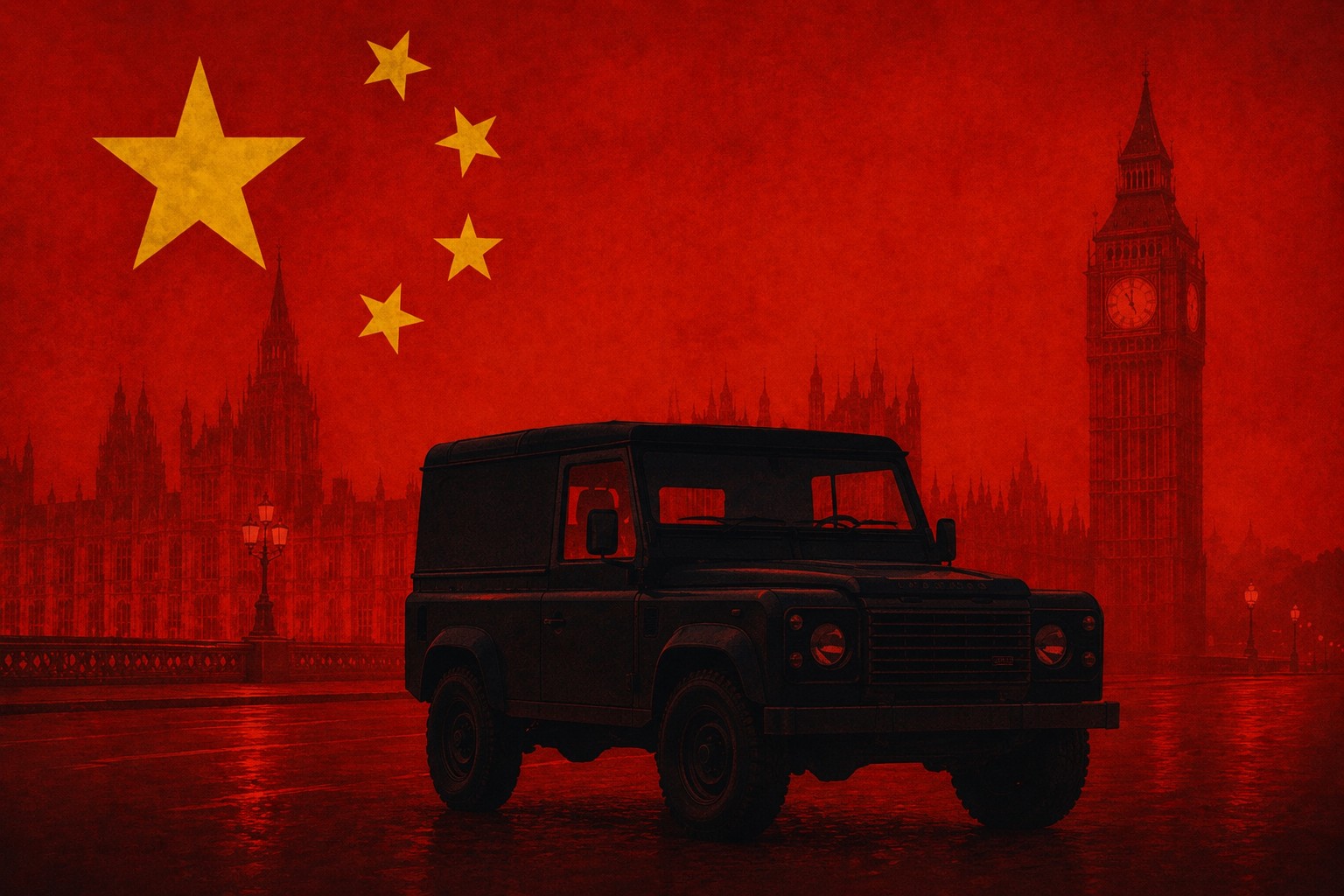
Chinese suppliers have been excluded from a Ministry of Defence competition worth an estimated £2 billion to replace the Armed Forces’ Land Rover and Pinzgauer fleets, with the department invoking powers under the Procurement Act 2023, according to a tender notice.
The notice, published on 31 July, covers the Light Mobility Vehicle programme and sets out the selection criteria that will be used to reduce the field to a maximum of seven suppliers invited to tender. Within that section, the department states: “In accordance with the Procurement Act 2023, the Authority is exercising its rights under Section 19 (3)b to exclude Chinese Suppliers from this procurement, for further details, please refer to the PSQ Technical Questions/Conditions of Participation.”
Section 19 of the Procurement Act 2023 governs how tenders are assessed in a competitive tendering procedure. Subsection 3(b) allows a contracting authority to disregard any tender from a supplier that “is not a United Kingdom supplier or treaty state supplier”, or that intends to sub-contract performance of all or part of the contract to such a supplier. Treaty state suppliers are those from countries with which the UK has relevant procurement commitments, principally parties to the World Trade Organization’s Government Procurement Agreement. China has never acceded to that agreement, having applied in 2007 and continued negotiations since without concluding them.
The provision is therefore a trade and market access mechanism rather than one of the Act’s national security exclusion grounds, which sit elsewhere in the legislation and operate through the excluded and excludable supplier regime and the central debarment list.
The estimated total value is £2 billion excluding VAT, or £2.5 billion including it, with a contract running from May 2027 to May 2036 and options that could extend it to 2047. The initial purchase carries options to increase the fleet “to in excess of 9,500” vehicles.
The requirement is built around a single Common Base Platform supporting nine variants, including a General Purpose Vehicle, Battlefield Ambulance, Tactical Mobility Vehicle, Enhanced Protection Vehicle, Command and Control Vehicle and Troop Carrying Vehicle. Defence Equipment and Support declined to divide the competition into lots, arguing a lotted approach carried a “high potential of a mixed fleet of solutions based on multiple platforms from multiple suppliers.”
Among the known risks it lists that could later prompt contract modification are “obsolescence, unavailability or export control restrictions affecting components, subsystems, software or materials requiring replacement solutions,” and new interoperability requirements arising from integration with UK, NATO or allied systems.
The Procurement Act 2023 consolidated and replaced the previous public procurement regime, introducing the competitive flexible procedure being used for this competition along with a national security exclusion ground and a centrally published debarment list. Defence and security procurement operates under a special regime within the Act.
The restriction is not the first sign of nationality-based limits on the programme. A market interest day for the Light Mobility Vehicle project, held at Warminster Garrison in January 2026, carried a notice stating that because of national security considerations relating to the programme, attendees who were nationals of or held passports of certain listed countries would not be permitted to attend.
Scrutiny of Chinese involvement in UK infrastructure and supply chains has intensified in recent years. The government ordered the removal of Huawei equipment from the UK’s 5G networks by the end of 2027, and in 2022 instructed departments to stop installing surveillance equipment made by companies subject to China’s National Intelligence Law on sensitive sites. Concerns have also been raised in Parliament about Chinese-manufactured components, including cellular modules, appearing in vehicle and equipment supply chains.
The Light Mobility Vehicle programme is the first of three Category A sub-programmes within the wider Land Mobility Programme, and was previously known as the General Support Utility Platform. Requests to participate close on 1 September 2026, with an estimated award decision date of 31 May 2027. Down-selected bidders will take part in UK-based vehicle trials, with the notice proposing that those failing the trials be eliminated immediately.
The Land Rover Wolf and Pinzgauer fleets being replaced have an out-of-service date of 2030, having already been extended from an originally envisaged 15-year service life. The Army began the phased withdrawal of the Land Rover at a ceremony at Bovington Camp in March 2026, after more than 70 years of service.











But allows the mega embassy to go ahead.
Yep strange but true 🙄
Is it strange? It’s much easier to keep an eye on them when they’re all in one place, rather than spread out across London.
For me personally it’s about not having the back bone to say no to China not wanting to upset trade and relations . Worth the risk in HMG eyes 👀
Yep strange but true 🙄
Yes, that can be mitigated.
Beat me to the comment. Made even worse by the Embassies location so close to all the “financial” institutions that basically fund the UK.
Yes, but cables can be rerouted. The vulnerability was highlighted and was no doubt long considered by the UKIC who according to reports advised HMG that it was OK to go ahead.
“Keep your friends close, and your enemies closer” is a saying that comes to mind!
I should stay on topic. I think this is a pretty obvious without a second thought, considering the MOD doesn’t want Chinese EVs within two miles of bases if staff have them, just like the Chinese don’t want Telsas near CCP buildings.
This will be a big ask.
Seriously……China makes so much of the products that every car company uses, I don’t see how this will pan out.
At some point we will need to weaning ourselves off Chinese products and we have to start somewhere.
Countries which employ slave labour in their industries are ultimately going to struggle.
But, China absolutely dominate every single domain, Virtually every product and tech we buy as consumers Is made In China.
Places like TEMU, Aliexpress, Alibaba and the likes, supply everything at vastly reduced costs and we as a nation of bargain hunting consumers, just don’t know the extent of their dominance.
It’s not just Military, It’s every single thing we buy.
I buy stuff that Is sold In the UK by our Big “Discount” Retail outlets, for a fraction of their prices, some purchases are shockingly cheap.
Chinese Cars are completely swamping the UK and Europe BYD, JAECOO, MG, Chery and Geely sales have shot through the roof from @250 cars sold in 2015 to @300,000 sold In 2025….. That’s just ten years and It’s just UK figures. It’s notable now, you see them everywhere and all because they are Cheap.
Yes but BYD are you happy in the knowledge of buying stuff using slave labour?
Would you rather not buy British from a factory which can work 24 hours a day using robots rather than slave labour.
It will probably be even cheaper and as a British citizen you could have share in the company.
China has given the world cheap labour which has closed our factories. We could open new ones with zero cost labour.
Ermm.
OK, I wasn’t being argumentative so I’ll leave you to it.
Sorry mate not my intention either. I was really just echoing some stuff which has been raising with me during discussions as soon as we wander onto anything to do with China. 🙂
Not quite sure you could churn out that many cars with slave labour, their car factories are the same as everyone elses. They’re also building a factory in Hungary.
Google BYD slave labour and see what you get. It seems to refer to Brasil.
Not delved into it too much myself as I wouldn’t dream of buying Chinese anyway. That said it is causing a lot of controversy in the UK. The UK Government could consider if imports should continue to be allowed.
An absolutely necessary decision by the MoD, especially given the rising scrutiny over Tier 2 and Tier 3 supply chains. The real challenge won’t just be the primary vehicle assembly, but stripping out deep-tier vulnerabilities like Chinese-manufactured cellular modules, semiconductors, and telematics that routinely sneak into Western military vehicle electronics. We saw the exact same security headache with Huawei equipment and surveillance tech on sensitive sites. Given how deeply integrated Chinese dual-use components are in global electronics, ensuring total sovereignty across the entire supply chain for this competition is going to drive up procurement costs, but it’s a price well worth paying for operational security
There will be tax clawback.
Exactly, Val. The economic return to the UK treasury makes the security premium much easier to swallow.
TEMU can supply cheap spares !
So how many for £2.5 billion, is this 9500, it sounds like less as this is an extension to contract. This is about £100k more than a top of the range Range Rover. Sounds like we will be getting good value as normal.
Are they not likely to be taking 10000 vehicle shells from some car manufacturer and completely re-designing for military use and then building a factory and putting the whole thing together. Sounds expensive to me.
Car manufacturers have to sell millions of vehicles to recover an investment like this.
At last! A common sense decision.