

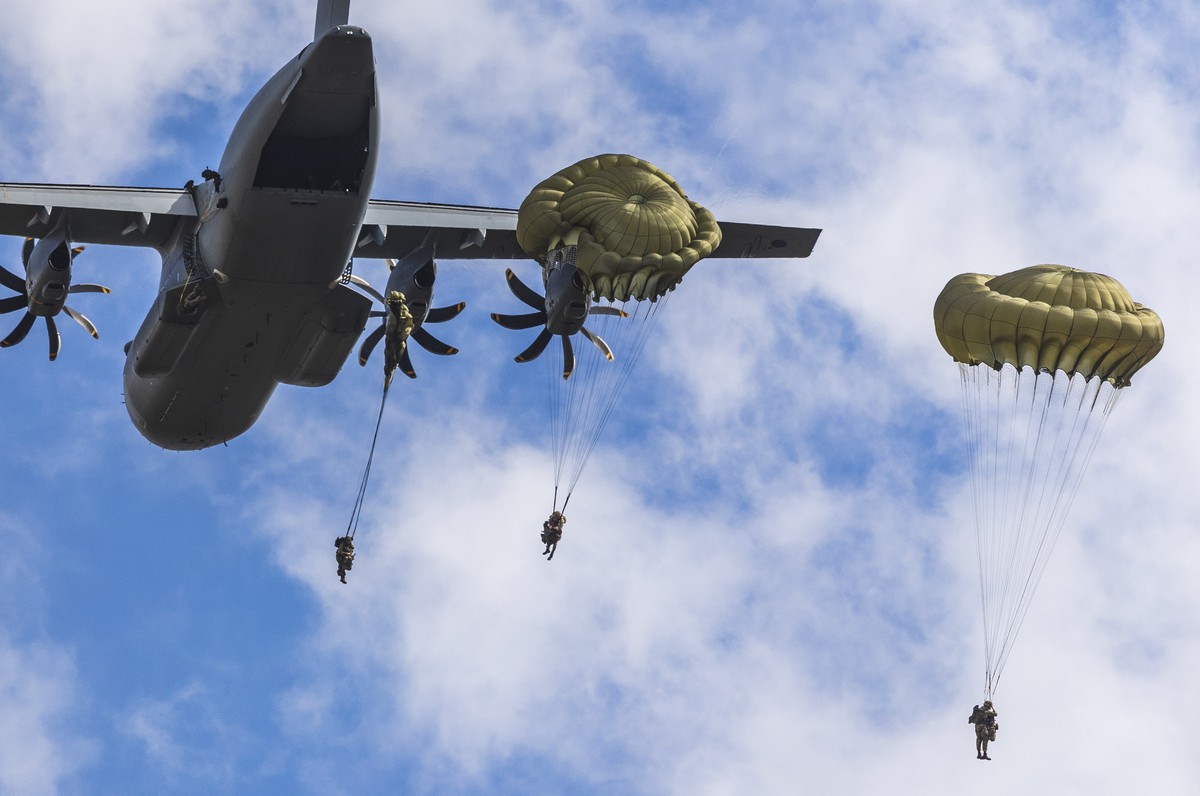
The Ministry of Defence has confirmed that the UK’s airborne parachute capability will be retained.
Correction (added 19/02/2026): Following further discussion, UK Defence Journal acknowledges that our initial interpretation of the wording in a written parliamentary response may have been incorrect. This article has been updated accordingly. We regret any confusion caused.
In a written parliamentary answer published on 16 February 2026, minister Al Carns said the Strategic Defence Review (SDR) “considered all aspects of Defence, including military parachuting capabilities” and concluded that “airborne parachute capability and capacity should remain focused on specialists and a single battalion group.”
The response was issued after Conservative MP Ben Obese-Jecty asked what assessment had been made of the potential negative impact of removing parachute infantry deployment as a capability. Carns said the government had accepted the SDR’s recommendations in full and that implementation details would be outlined in the forthcoming Defence Investment Plan.
“The Government accepted the recommendations of the SDR in full and will publish the Defence Investment Plan as soon as possible to set out the plan for its implementation,” he said.





Am I wrong but doesn’t 1Para support SF and it’s not a regular infantry para battalion? If so we will actually have NO para battalions for rapid deployment!
Still part of the SFSG as far as I know🤔
As for rapid deployment, it appears they need to find an alternative approach…
” 2nd and 3rd Battalions of The Parachute Regiment may lose their routine parachute jumping qualification”
So yep, what’s the plan!
Correct. 1 Para is the main part of SFSG.
Jacko, Rapid deployment and Parachute operations are two seperate things. 16AA will remain a high readyness formation capable of rapid deployment, it just means they’ll have to land instead of jumping.
👍
Trust Dern to put its in to words we can understand😉👌
Yes. SFSG.
To be honest, the battlefield is changing rapidly, and a drone can now knock a plane out of the sky on it approach to the drop zone!
Perhaps we are better off doing an air assault by helicopter with vehicles\ eqiuipment and keeping parachuting as an optional extra
Seeing some of the drone capabilities that I help fundraise for puts things into perspective…
But if we put the bloody defence budget up, then to be honest, we should keep the existing force and restructure and expand
We are, of course, in a sticky situation😒😤
On the modern battlefield deployment by helicopter is too dangerous, parachuting is near suicidal. I can’t even think of the last time anyone deployed by parachute (US Army Rangers in 2001) I don’t think we have done a combat parachute jump since Suez.
This move probably makes sense however I can’t help but think it will damage the standing of the parachute regiment.
Well they won’t be a parachute Regt if they don’t jump out of perfectly serviceable aircraft will they? Also say goodbye to 23 Engr Regt and 7 RHA!
Wouldn’t they just re-role?
Dern has laid it out above,instead of parachute regts they will probably become air assault regts!
Sorry, that was poorly worded. I meant 23 Engr Regt and 7 RHA.
Got you mate,at the moment it’s 23 Parachute Engineer Regt so they will probably change the designation.
Thank you, Jacko.
I sincerely hope they don’t take the opportunity to see this as an opportunity to cut headcount. I just wouldn’t understand that decision in the current climate.
Paul, they won’t cut headcount for 16AA. As a light, high readyness force that’s the governments go to for things like NEO’s or rapid interventions, 16AA is probably one of the last units to have cuts aimed at it (being a Air Mobile it’s also relatively cheap compared to, for example, an armoured Brigade).
I also don’t think there will be any redesignations any time soon, plenty of historic titles remain with units that have evolved away from their original title.
They already are an air assault regiment, they have been an air assault regiment since the 80’s. As are the 82nd and 101st.
Half the troops landing in d day were in gliders, no parachutes required.
They’d still be needed for 16AA Bde mate, whether they land by plane, helicopter, or parachute.
Yes they would,but an AA brigade that actually has no means to assault is pointless! As Dern has said they would be landing not jumping into any task and no one is going to be doing any assaulting from transport aircraft on the ground! Any light infantry battalion can be trained to deploy from aircraft actually on the ground and do the job!The whole point of the Para Reg and assigned assets is to JUMP into contact and secure those airheads for follow on forces! Yes it hasn’t been used in that role for yonks but it exists,for the paltry sum it must cost to keep them para trained it’s just another capability cut!
Back when we had a strategic reserve in the UK we had Spearhead,we had to make our vehicles airmobile and actually went to lynham to practice loading aircraft with said vehicles,this usually lasted a month and then the next units took their turn!16AA will just be the same only on a permanent basis instead of swapping around.
Hi mate.
Agree re the Para Regiment side.
It is s cut, saving on training, and it might well impact moral and ethos. Remains to be seen.
Of the supporting CS CSS of 16 Bde, only a fraction is jump qualified anyway as they are only needed for a Company Group, from the in role Para Battalion.
So that doesn’t change.
Half of 16AAs Infantry Battalions are not even para, 1 RI and a RGR Battalion.
I’m, as always, trying to find a balanced comment to counter the doom posts that 16 AA is screwed. It’s not, it remains our main HR global response formation.
Just s pity some IMBECILES thought it a good idea to reduce the RAFs ATF by 25%.
Jacko, 16AA has never once jumped into operations or assault at any scale (the last major Parachute operation was Suez, nearly 50 years before 16AA was created). They’ve always either landed from a transport plane and then moved by Land Rover/Pinz to Assault, or have used Helicopters to land close to the position. Jumping isn’t necessary for Air Assault, and usually comes with considerable risks with little reward compared to using a helicopter. You certainly don’t want to jump into contact of all things! Aside from the fact that being under canvas while in contact is lethal, and having to get out of the harness while in contact is not an easy feat, when Para units jump they generally end up disorganised and spread out. That is why tabbing is so important to them, after a jump you need to hoof it to the RV as quickly as possible to get organised and then assault whatever your objective is.
Agreed mate hence why we got the LLP, so operational jump would be 599 feet, no reserve (no time to operate and an extra 8kg of shit that wouldn’t be used, much prefer water or ammunition). What the LLP come out the RAF PJIs tested the concept of jumping at 450-500 feet over a lake, the canopy deployed as expected every time!
A DZ is fucking chaos, not many people understand how much it could be, with blokes tactical loaded but still all over, and others raving to the HD DZ etc, as you put it disorganised and a lot of tabbing needed! 👍
599 fuck me my rum fingers, should read 500!!!!
Well it’s what happened to the SAS even as far back as the war so maybe a different emphasis is the correct move, but we need to retain their elite capabilities nonetheless and think how best to exploit them.
Yes I do agree, even with helicopters its dangerous to insert troops
So if we are cutting the dangerous jumpy bit out for all except a battalion’s worth, then it seems it is now the end of an era!
What are the rest going to re-role as🤔🤷♂️
I’d be surprised at any sort of re-roll really. Parachute jumps are more of a capability than a role per say, so realistically I’d guess the only thing that will change is how many blokes do jumps at the end of P-Coy.
As you have said they will probably be-airlifted into anywhere they are going,is there going to be any need for the likes of P Coy if they are just going to get out of the back of an aircraft and not go tabbing for miles?Surely this would mean they are just another light infantry Regt only with an attitude and different colour beret?
Al Carns must be chuckling away as he was a marine and there is no love lost there!
The parachute regiment is a recruitment formation as are all UK regiments. The active part is 16 air assault brigade which has been based around helicopter insertion since it was formed in the late 90’s.
P Company remains, passing that is one thing that sets Paras apart.
From that, Paras go to the PTS at Brize, so with this, will be interesting to see how it’s streamed.
I mean they’ve effectively been a Light Infantry Regiment with an attitude and a different colour Beret since the 1950’s.
😂👍
A certain regiment and its sister, did a number of jumps in Afghan, both from Herc and Chinook.
Op Trent I think? At Sqn strength. Biggest in modern times.
A certain regiment and its sister, did a number of jumps in Afghan, both from Herc and Chinook..
Hmm, seems to have duplicated itself
Trump’s plan for Greenland !
Probably a reasonable rebalancing.. it’s probably better and more useful to have a decent dedicated air mobile brigade ( with protected mobility vehicles, decent artillery, air defence, and CCS than an air assault brigade..
There used to be one, 24 Airmobile Bde alongside 5 Airborne Bde, but the lack of helicopter support meant that only one could be operational at any one time so they were disbanded & 16 Air Assault was born.
Hi John.
Not how I understood it.
5 Airborne was fully para, it had a single AAC Gazelle Sqn allocated, frim memory?
24 Airmobile had double the number of Milan FP per Btn to be landed in the path of a GSFG breakthrough, so they had RAFGs helicopters.
When 24 and “merged” the Army got a 6th Mechanized/Armoured Brigade as part of Robertson’s 1997 SDR, so I fully supported it.
Hi Daniele, 5 AB had 2 Infantry btns as well plus support arms that relied on Puma & Chinook (same as 25 AM) & when I was in there were never enough of them! But it was the lessons learned & experience of Air Assault that gave rise to 16 AA Bde, so turned out to be a good thing mate!
Thanks for that John.
Welcome mate. Should be (24 AM)! There was also UKMF as well as ACE MF then as well, basically experimenting as a NATO Mobile Force that led to the ARRC so it’s always evolving I suppose.
I was young, but remember it! 1 Infantry Brigade at Bulford formed our contribution to the AMF (L) from memory?
I was there with 2RRF for a short time! Could be 1988 mate but not sure, I was in Gib in 89 with 1RGJ so sounds right!
Cheers. Respect and thank you for your service.
Proud to serve mate, cheers 🍻
RE AMFL troop from 22 Engr Regt as well,attached to 6 Fd Spt Sqn if memory serves.
And so the cuts begin
Not necessarily.
This was recommended in the SDR, which was generally regarded as a ‘good thing’, so maybe more of a reorganisation than a cut.
Probably said that when horses were removed from front-line cavalry regiments.
I suspect this is the Labour governments way of saying the RAF will not get the 6 extra A400M they wanted to replace the retired 14 C130J.
Last UK air dropped assault was in 1956 at Suez, it was a debacle.
Even operation Varsity in 1945 was brutally painful with heavy losses to AAA – the modern battlefield is vastly more lethal to transport aircraft flying in large, slow formations over someone else’s turf.
the way i see it and could be wrong, the In re parachute battalion, will be tge main force of a parachute Battalion group.
With the Battalion, either 2 or 3 Battalion rotating in and out of role, proberly on a annual ir more likely 2 yearly cycle.
With the usual increnent, of a Airborne Squadron/troop of Rotal engineers, a light gun battery from 7 RHA and medics, logistics etc.
Correct, that is a “group” when added to the in role Para Battalion, even if that Battalion can only be dropped in Company size.
The cost cutting is getting towards the smaller values further down the list. Every line is being evaluated and has to be justified. If we’re not going to (no longer can) paradrop a regiment then they don’t all need to do drop training with the expensive flying that goes with it. Or someone in the RAF has told the MOD that they’re not a bloody taxi service for the Army so it’s being cut.
Hostomel showed that even armed Police can put up enough of a determined resistance to stall an anir assault.
Unable to parachute battalions 🤦
Not for over a decade.
Nothing new.
Currently 16 AA Bde has Parachute Group in role, the AATF.
Not Battalions.
Last time the UK parachuted ‘battalions’ was in 1956 – it was a fiasco.
Where does that leave the Parachute Reserve units?
Probably the same as now.
Sounds to me like outside of of SFSG there will be no jump capability. Funny thing is that it’s probably a false economy because they will have to find a boat load more helicopters to insert the 2 current Parachute battalions worth of troops. And then support them, so extra logistics and REME.
Add on the auxhiliary units won’t need to be para trained, 32 Engr, 7 RHA, Logistics, 216 Signal Squadron etc so I guess no more P Company either.
That is assuming of course 16 AA Brigade doesn’t just go away which is a distinct possibility.
SAS.
SBS.
SFSG, so in bulk 1 Para.
SRR, unsure.
148 Battery, 29 RA.
Elements of 7 RHA, 24 RE, 16 RAMS, 13 RLC, to support the single AATF Para Battalion in role.
216 RS, you’d think some will still be jump qualified for same reasons as above.
Elements of 18 Royal Signals.
Pathfinder Platoon.
Elements of 30 Commando, such as the SRS.
2 Sqn RAF Regiment.
I’d add SPAG to that list as well. Various niche specialists will have to remain jump qualified alongside the SF.
Also if I was he Brigadier in charge of ASOB I’d be pushing to get jumps into the Ranger SQEP now. One of the reasons it isn’t in there is specifically because 16AA needed the jumps training slots (if I’m being kind) /because Paras are special boys that needed jumps to feel special (if I’m being less kind).
Also add to that list supporting assets to DSF such as the MSU.
Yes, good call, I was thinking some I’d overlook.
Bit of a grey area for me, but by my understanding of that area there are 3 MSUs, one for each formation, under the umbrella SF MG.
Training is with Training Wing of 16.
Dean theres only one problem with the ranger reg getting jumps. Thier current course to join the ranger reg isnt classed as an arduous course unlike commando course or P Coy. So they don’t qualify for jumps training.
Aside from the fact that that is really a manufactured admin issue, the ARC/RCQ has wavered between being considered an Arduous Course and not (for example, at present NATO considers it an arduous course, but we don’t). ARC/RCQ’s standards have gone up and down a bit depending on the whims of the individual Brigadier and the requirements the Regiment has. So if you make it a huge problem you just amend the RCQ going forwards.
Elements of 156 Pro Coy would be another one.
Wey! Another one. Quite a few CS CSS to enable the Brigade.
NMH boat load ?
Hi Spartan.
Re reading your post, elements of all those units will still need para capability, as when one talks of a Commando, Battalion, or Company “Group” that means additions from those enablers from the CS CSS you suggested won’t need drop capability. It is those add ons to the Infantry unit that make the “Group.”
Also, there isn’t a “distinct possibility that 16 AA Brigade will just go away” wherever do you get that from?
The Brigade remains in its Air Landing role, with elements at VHR to deploy out of area. That’s what it’s for, even if para capable elements reduce.
The bigger issues seem to be ethos and training pipeline if not all Paras gat their wings after P Company.
It’s pretty clear from the text that the intention is for 1 Para to retain the jumps qual and 2 and 3 Para will not.
A shame if so. I guess that also fits with SFSG ops tempo with one Company in role deployed.
Daniele, The big thing I am questioning is does 1 battallon mean 1 Para in SFSG or 1 Para PLUS another? If it is the latter then fine, but if it is the former then we won’t need all those other elements. Therefore bye bye P Company.
P coy is not going bye bye either way. The Para’s will keep it as an arduous buy in to the unit, whether you go on to do jumps quals after it or not.
These are from the Parliament website. So last year they were talking about 2 & 3 PARA, but not specifically in this latest answer.
17 October 2025
Ben Obese-Jecty:
To ask the Secretary of State for Defence, with reference to recommendation 45 of his Department’s Strategic Defence Review 2025, published on 2 June 2025, which battalion group of the Parachute Regiment will airborne parachute (a) capability and (b) capacity be focused on.
Al Carns:
Recommendation 45 of the Strategic Defence Review is a planning assumption to inform equipment, training and workforce readiness. The battalion group will be formed from across 16 Air Assault Brigade, predominantly 2 PARA and 3 PARA.
⸻
16 February 2026
Ben Obese-Jecty:
To ask the Secretary of State for Defence, what assessment he has made of the potential negative impact of removing parachute infantry deployment as a capability.
Al Carns:
The Strategic Defence Review considered all aspects of Defence, including military parachuting capabilities. The Strategic Defence Review recommended that airborne parachute capability and capacity should remain focused on specialists and a single battalion group. The Government accepted the recommendations of the Strategic Defence Review in full and will publish the Defence Investment Plan as soon as possible to set out the plan for its implementation.
Subtle change of wording, as usual, without making things clear.
Standard.
As Dern says, looks like 2 and 3 Para are gone as para qualified then, with the rest of the enablers too.
Certainly reads like that pal. Nobody likes change, but times change, and they’ll continue to be the Army’s rapid response formation. Also, we shouldn’t forget that SFSG was set up to take pressure off SF, but it’s benefited the Parachute Regiment as a whole, as well as the Royal Marines. Before SFSG was established, you had PF Platoon and SRS getting exposure to SF, but SFSG added a battalion to that. So when guys rotate out, they’re taking all of that tactical, planning, and operational experience back to their battalion or unit.
Yes, SFSG was a good result. The DSF has expanded considerably. I recall only that suggestion from General Jackson saved a Battalion from the chop.
Well I took it to mean one of 2 or 3 Para, plus 1 Para as SFSG.
Dern thinks it is only 1 Para, if so, 16 AA is an air landing air assault formation only.
If so, P Coy will still be needed, just as the AACC is needed for the RM. They set the standards to set them apart from the line infantry as elite units.
The other CS CSS elements still remain, para trained or just air landing. The priority must be that the Brigade remains intact?
Well, 16 Air Assault Brigade Grp will generally deploy by helicopter, so reducing the parachute desant role sounds reasonable enough.
However, I think it’s shortsighted. The dangers of a mass parachute drop are well known from WW2 times. However, if push comes to shove, landing in a remote part of Norway or similar might be tactically necessary where reinforcement by sea is too slow or there isn’t sufficient long-range rotary lift to onsert troops.. If the DZ is secured in advance and area GBAD cover inserted, then a parachute drop might be the only feasible option. Having just one battalion parachute-trained narrows the options considerably.
1 Para will be with SFSG so there will be zero parachute trained battalions. At least that is what it will sound like. And seeing as 1 Para only takes guys who have done 3 years in one of the other Battalions if I recall, then only Special Forces will be para trained. It also begs the question where 1 Para are going to get their guys from.
I think it means one of 2nd or 3rd Battalion Para Reg provide the AATF, or Parachute Group, for 16 AA.
1st Battalion remains in role and I’d think unaffected.
1st Battalion still get men from the other two, as of now.
1 Para operate much as SAS, SBS do, the whole formation isn’t deployed at once, but individual Sqns in role.
So in 1 Paras case, 1 Company will be deployed and in role, so should need the capability.
1 Company is assigned to support the UK CTF, so is UK based and on standby.
Other Companies training, contingency, or leave,
Hi M8, This really shouldn’t come as a shock to anyone as it was very openly and clearly laid out as one of the 2025 SDR recommendation’s (a lot of which seem to actually having the initial low cost prep work implemented before the upcoming DIP).
Section 7.3 Land Domain.
Recommendation 45.
Global crisis response at very high readiness in the land domain should be led by 16 Air Assault Brigade. Airborne parachute capability and capacity should remain focused on specialists and a single battalion group.
As for how they actually get deployed the idea of using an A400 to carry out a drop in a modern Battlefield environment is just ridiculous and TBH the same would apply to a C130 or any other medium or light transport. Manpads are the killer to mass parachute drops, it would be Crete all over again.
(FYI after starting off in The Cameron Highlanders my late uncle was one of the first members of 5th (Scottish) Battalion Parachute Regiment, 4 years later his little brother (my Dad) went straight in to the same Battalion which in 1948 became 2 Para).
What I think this is all about is maintaining the Parachute Trained Manpower pool from which SF recruits for their less obvious parachuting activities.
What is glaringly obvious is the complete lack of a modern Medium Helicopter for Air Assault (🤞🏻DIP).
On another subject.
As for the upcoming DIP, it would appear that Starmer and Co are in a huddle to figure out how to get up to 3% PDQ, rumour is last weeks Security meeting and his hard power talk, was after a very unpleasant message from the US / EU to get his finger out or sit at the back in future and feel very lonely.
So for us the real crunch day will be on Tuesday 2nd March when “Rachel from Accounts” delivers her Spring Statement.
My betting is she is about to do a 180 from her announced position of only one Budget a year (in Autumn) and instead of an update on finances and minor tweaks, she announces an accelerated increase in Defence spending to get us to 3% by 2028/29 and how she is going to fund it (with UK GDP growth being a disaster extra Tax isn’t an option).
Betting on what gets the chop to fund it is the remaining overseas Aid (which is tiny) and HS2 (unlikely due to contract penalty’s) or Ed Milibrain and net zero get a reality check by moving 2050 to 2060 and start drilling for Gas / Oil for revenue / Strategic energy reserve.
So DIP mid to late March 🤔
or move borrowing for military out side of borrowing rules ( like Germany)
Germany did that because they have extremely strict borrowing rules. We don’t, so moving Defence outside the rules will probably have minimal effect.
Hello mate.
Thanks for all that.
Whatever method of entry, 16 AA remains one of our few fully enabled Brigade strength formations.
As long as para capability remains for the enablers and SF that matter I can live with it.
A bigger concern is a lack of assets to lift said Brigade, be they land by parachute, or air landing, or helicopter.
You didn’t follow your Dad into a military career then?
On Starmer, and the DIP, I’ll get my hopes up when it’s real. They’re all talk, nothing more.
Suppose all that war footing fucking talk and increasing defence spend was a way to push out the news of cancelling elections, Labour Think tank smearing journalists and so on…
I don’t think so, the defence debate and funding issue precedes any little domestic news like some local elections being postponed (and then not).
I think a lot of this is due to lack of aircraft since we lost the C130, also a complete mis-understanding of how to operate and deploy personnel, too many civvies running the show who take their directions from the bean counters rather than the military requirement.
Typical.
But I bet no-one will be for the “High Jump” over this.
Tally ho chaps.
I would have thought that the ability to jump would be extemely helpful If only for the comradeship in the Para’s but training probably costs peanuts, so yet another cut..
It’s not about the actual jumping it will be about the ethos! It’s called the parachute regiment for a reason! It has been acknowledged that any jump bigger than Coy group is most likely never going to happen as Air Landing is already the main rapid insertion capability.
So you join the parachute regiment, and do P coy, finish training and go to Battalion without doing jumps at Brize. Then what, do we have the Parachute capable company with the other companies being penguins or just waiting/never expecting to get a jumps course (reduce the training liability for the RAF and you will never get it back) and you then have a two tier formation.
I also see large scale beach assaults being bloody rare but every RM is trained as a RM? It’s another cut, not in PIDs but in training liability, the pittance of Para Pay and the use of very scare RAF platforms. This will reduce the 16 Air Assaults options for operational deployments (no matter how rare a Bn drop would be) and cause quite a bit of concern (and drop in morale) in Battalion.
I was looking for you, the SME, to comment here.
Agree, it’s ethos above all, with only part of a Bn being in role as AATF at any one time.
I think it’s also the loss of 14 Hercules transports leaving the 22 Atlas And 8 C17 to do everything.
But some clever clogs here applauded that as “the Atlas can carry more and is bigger”
Never mind that assets cannot be in two places at once.
My analysis is that 1 Para remain unaffected? Given their role, but how will the training pipeline work after P Company if not all Paras go to Brize? And as 1 Para get their men, from the other two, how will that play out?
Spot on ref aircraft mate and I also think the RAF training pipeline could be reduced, less PJIs, less platforms to use in training and operations! I don’t think I have seen or been involved in a full Battalion jump since the 90s, (the old LPBG) lobbed into South of France, had 8 hercs for pax and I think same for the heavy drop, possibly more as two waves came in, (always remember a rigged Land Rover missed the Heavy DZ a bit and bust up and French power lines) but that was probably early 90s!
Nowadays it’s PF go in, lead Company jumps to secure an airhead and secure for the remainder to air land! I understand things change and we do have to move with the times, but once a capability has gone it is very very rarely recovered and re-established! Also 1PARA won’t be effected, in fact the rifle Companies in 2/3 will probably lose men who want to move to SFSG. Also there was also a time lads were going to 1 PARA straight from Catterick!
It’s a shit sandwich all the more galling as it’s mostly to do with reducing a capability for financial reasons in which the decision was made by politicians who have no clue about the effects it could have (also backed up by senior head sheds who should know better but are probably breathing a sigh of relief as their cap badge/Corp may be left alone this time. Cheers mate 👍
I get that a Herc/Atlas is a rare commodity for any one save SF and Pathfinder Platoon, who seem to have assets on tap.
So why were the balloons binned for initial jumps? That must have been cheaper?
No mate the balloon was a bit of an RAF gravy train and expensive. The balloons, the servicing and maintenance, the vehicles, staff, PJIs all the extra stuff added up! Different parachute harness as well, used the US T19 harness (if my memory serves me well) but with a PX canopy.They used to come down to Queens ave, or Hankley common for a period of time for continuation jumps etc, great laugh easy to do but a great bottler!
Then in someone’s great wisdom they decided it was cheaper to get a contract for a couple of skyvans, and let the contractor take all the costs with the contract price. Skyvan was also good fun, down at South Cerney, take off and within 5 minutes all 10 of you were tailgating out and rushing to the pan to grab another chute as the van was landing. Ag great days lol 👍
Should read T10 bloody rum fingers again lol
Interesting. I know about the Skyvans, but didn’t realise the support train for the balloons.
Was typical RAF in the old days lol
You’ll just have to lean into your history. Hussars don’t charge on Horse Back but still have the pride, ethos, and culture of a Cavalry Regiment. You’ll just have to work on keeping your history in mind.
Agreed but it’s always a bitter pill to swallow, especially when such decisions are made by politicians to save money and certain head sheds going along with it!
Nail on the head mate👌
PARA haven’t dropped in a Bde for ??? Since Suez?
However, the ethos behind that stupidity to jump out of a plane capable of landing is inestimable.
This ‘plan’ doesn’t begin to address the issues of scale and that is the ability to upscale in the event of war.
I’m no fan of PARA, but, we’ve lost our RM Bde and now we are losing PARA and other than ‘them’ having a strong influx from PARA, PARA just become light infantry ‘hats.’ That is wrong and inexcusable.
DW we aren’t loosing 16AA, just the capability for 2 of it’s Battalions to jump out of planes, as you said, something they haven’t done in 50+ years.
And the majority of the Brigade cannot anyway, including half of its infantry component.
Still a pity is that is the result of this, even Company sized would be another option.
Imagine the commentary on sites like this if we hadn’t used Tanks since 1953, but had dismounted the crews to operate jackals or fight as dismounts? People would be howling about it being a out of date capability.
Agreed mate but if over half the lads do not do parachute training then why even call those the Parachute Regiment ? I can see another cut coming, 1 in role Bn, 1 reserve Bn and SFSG!
But over half the Household Cavalry aren’t trained to ride horses, yet we still call them the Cavalry Regiment…
When is this stupid defence equipment plan actually going to be published rather than just used to hide behind. First it was mid 2025, then before Christmas and now we are late Feb and still no sign of it.
When HMG and MOD work out how to close the £28bn funding gap or narrow it to manageable proportions. It is not a simple little task, involves MOD re-estimates, equipment cost-juggling, review of government spend across other potential donor departments, Treasury study of alternative funding routes and so on – pretty serious national financial decisions. The defence industry and defence enthusiasts baying away in the background is unlikely to move anything forward right now.
That does seem to be the case, but in the meantime as are stuck between trump and Putin
Think of all the saving in “jump pay” 💰, and parachute packing etc. We will be able to buy new coffee machines for the whole of DE&S, for when they occasionally go into the office.
💰😀💰😀💰😀💰
Smilies added just to emphasise this is a mick take.
A lack of AT aircraft and fleet availability would have been a significant factor in this decision I would guess. IMHO this is a bad decision which is only going to get worse as the government will look to cut costs. I dread to think what is next.
So the DIP isnt being published by the cuts are going ahead.
Priceless.
Seems like the application of the same logic as to why we don’t plan on doing large opposed amphibious landings in future – the casualty rates balanced against risk of failure are believed to be simply unjustifiable these days. So RMs become a raiding force and drops reserved for SF missions.
Unfortunately with the development of drone warfare, the chances of survival of any serviceman on the battlefield – regardless of how he gets there – is diminishing considerably.
While all true of course, I’d like to see what other countries also follow the same path of negating entire capabilities over the fear of what might happen.
I’d prefer things kept as is, a Battalion in role, a Company Group of that Bn droppable, with enablers, depending on aircraft availability. Which we cut by 25% or so the other year.
Hey ho. Hopefully the Brigade will get some enhancement on the plus side.
Agree Daniele. Haven’t heard anything about the German, French, Italian, Turkish.etc para bdes cancelling parachute capability. We have about the right air dropping capability as things stand. We might never need to use it on a 2-battalion scale, but useful to have the option and the savings here must be marginal.
MOD has been talking about acquiring an extra 6 Atlas to get the force up to 28, so we could have the capability if push comes to shove.
Been talking about that for years, even before they took the Hercs away.
One thing A often mentions is options. It’s doable, as we don’t drop at scale, but if we wanted to, the capability ideally should be there.
In faireness the German Parachute capability is really weird, the 1st Airlanding Brigade has two Regiments under it’s command which each are a mix of Paratroopers and SOF, plus CS and CSS Companies attached. They’ve got jumps capability but their Wiesels can only be moved by CH-53, and even then they are due to be replaced by Boxer. So, yeah they can jump, but really how much does that factor into their doctrine compared to Helicopter Assault?
Italy’s Folgore Brigade has a Cavalry Regiment on Centauro, and each of the Parachute Battalions is mounted on Panther/Lince IMV’s, and the battalion organic fire support is 120mm Mortars. So again, yes Italian Air Assault can jump, but they’re equipment and organisation is set up for Airlift, Air Assault, or some rather Beefy Light Mechanised action rather than Parachute operations.
The French 11th Brigade, similar, Cavalry Regiment on ECRB Jaguar, Infantry mounted on VAB and Serval, Artillery provided by Caesar. So a very similar situation, they retain the jumps capability, but they are in practice a beefy light mechanised formation.
The option is there, but realistically nobody is doing operational jumps for conventional forces at any sort of scale, and haven’t for ages. I’ll also quietly point out we’ve gotten way more use out of Tanks than Conventional Forces doing Parachute jumps in the last 40 years, yet getting rid of tanks somehow is nowhere near as controversial as jumps.
Good examples, enlightening. Thanks….
A different way of thinking mate and a good example of how our allies do it, and not something i have spent much time looking and comparing to be honest. If we could get the same capabilities then it would a bit be an improvement and a way of mitigating and soothing ruffled airborne feathers methinks!
There isn’t much doctrine published in English on OS so hard to get a clear picture of their ConEmp, but it does feel like most Airborne formation in Europe are going less Parachute and much more general Elite Airmobile Light Mech forces.
I don’t see any mention of 4 PARA.
Do we know what’s happening there, if anything.
I’m assuming that a reduction in regular parachute infantry means that reserve parachute infantry are even more necessary.
I accept that my thinking may be way too simplistic, and for that matter a tad optimistic.
My way of thinking, if one of the Bns cannot parachute then it cannot be a parachute Bn, therefore it will be binned, and 16 will have 1 x in role Bn, 1 x reserve Bn and 1 x Air assault inf Bn and a few attached arms! Hope not but the Government has shown on many occasions it will reduce essential and important capabilities for an absolute pittance of a saving.
People seem to think that fighting the Russkis or Chinese are the only situations we are going to face. There are a number of scenarios when amphibious and/or airborne troops could be utilized. Afghanistan and 75th Rangers spring to mind. There were zero safe areas to land troops so an Airfield had to be secured. Tell me how that is supposed to be done in a land locked country? How about civilian extraction in a suddenly war torn country? Having the ability to enter hostile and/or inhospitable terrain, at short notice is a priceless commodity.
It would be done the same way Operation Rhino was intended to be done in the first place: Helicopter Assault.
Also you need a large safe space to land Parachute Infantry, one of the reasons the Rangers jumped onto the Airfield in Op Rhino was because they (correctly, despite last minute cold feet) assessed there was going to be minimal resistance.
NEO’s usually involve Helicopter or Strat-Air insertion rather than Parachute jumps
It seems to me then the whole high readiness concept is gone then. It will take weeks to get all those helicopters to where they need to be and everybody will know they are coming. And that is assuming we have a nice friendly airport nearby to park on.
You know Helicopters don’t need to park on a Airport right?
And no? The high readyness concept isn’t gone. You just have your helicopters rotating through readyness as well, just like you’d have your fixed wing assets having to rotate through readyness to enable a parachute jump.
You have to get your helicopters from A to B, set up a launch point then do the insert. What’s more if you have 2 more Battalions that need inserting by helicopter we need more helicopters. From that perspective it looks to me we are looking at “false savings”. What you save in jump pay and training you pay for more hardware, maintenance and logistics. Either that or the plan is a Market Garden type operation where half the Brigade is left out on a limb while we go back and get the rest, hoping they don’t get crushed in the meantime.
Then you have 1 Battalion on permanent standby? Oh joy.
Much of what has been said makes sense in isolation but I remain unconvinced. It sounds like another case of penny wise pound foolish while taking another step in the direction of competing with the Irish and Belgian army in terms of size and effectiveness.
Sigh. Okay
So lets start:
1) 16AA has always had 1 Battalion on permanent stand by. That is not something new. You can’t hold Humans at very high readyness for extended periods of time, they need to be stood down, have time to do promotion and training courses etc.
2) “What’s more you need to airlift two more battalions.” 16 Air Assault. Has never. Done an operational. Parachute Jump. The planning for deploying the Brigade has never assumed that half the Brigade would jump. It has always assumed either deployment by strategic air and then ground move or Helicopter drop or a combination of both. So no it’s not suddenly an increased burden on the Rotary assets, it’s the exact same as it’s been.
3) It’s hilarious that you bring up Market Garden, a *parachute jump* not a Helicopter Assault.
4) The RAF Chinook fleet on it’s own has a lift capacity of about 3,000 troops, before you add in Merlin and Wildcat (and of course NMH is/when adds another 500 seats to that lift capacity). 3 Air Assault Battalions and a Air Recce Battalion is about 2,400 troops. So no, you’re not going to leave 2 Battalions sitting there waiting for the two (even assuming you are planning a full brigade being dropped off by helicopter.
Like seriously. 16AA was created in 1999. The last conventional Parachute operation was in 1953. You are objecting to the way the brigade has operated basically since it’s inception (and yes when 16AA was created it was assumed it would be 4 Battalions)
Mate in fact it is looking like we are needing a bit of a 24 Airmobile Bde with enhanced Anti tank/Armour capability and light role vehicles, mmmmmmm I’m sure I have heard of that before……😂 I’m sure that would be a totally new concept and sold as so by this Government!!!!!
Now if only a Sqn of the HCR was still asigned to the Brigade with CVRT like that with 5th Airborne.
24 AM from memory had like 80 Milan FP per Bn or something, up from 24.
5th AB had a little more punch and flexibility than the current 16, and although we took the piss 24 air mobile had some serious AT punch, and even in those days got some LSV to rush about with Milan on the top! HCR lads and their CVRTs were bloody useful, but in all fairness Aghan did show the weakness of the CVRT range and its lightweight aluminium armour!
But, the Bde could and did drop all the kit on its MSPs, used to go to Lynham 3 days before a big ex to rig the platforms! But yet again the RAF had the aircraft and the Army had the ability!
Admittedly this is just me reading the tea leaves, but I think that’s the direction 11 Brigade is going. Low on Rifle Coys, but with extra Support Assets, Mortars, ATGM’s, MG’s and Snipers
The brigade operates on a tiered readiness model, not a single mass insertion concept. At the top end you have the Lead Assault Force, essentially a lead company group with Brigade HQ elements and PF Platoon, held at the highest readiness. Behind that sits the Air Manoeuvre Battlegroup, built around either 2 or 3 PARA. Then you’ve got the Air Landing battalion, and finally the remaining PARA battalion further back in the rotation.
The design is phased and modular. A battalion battle group goes first, follow on elements build combat power behind it, and the brigade scales as required. It’s not a Market Garden style all or nothing lift, because we don’t hold the whole formation at the same readiness, nor do we have the lift to move it simultaneously. That’s been the model for years, high readiness spearhead followed by layered reinforcement. Whether insertion is by parachute or helicopter, the structure itself is already tiered.
A bit like SFSG, 22 and the SBS.
Well explained.
I’m out of date with my AATF terminology?
I’m not sure of the terminology used today as these things change too much and I left the military years ago, so you’re probably more up to date. I often have to Google acronyms I see you and others use.
But whether it’s called AATF, AMBG, LPBG or ABTF, the model itself should be the same as it’s a proven system:
R1: the Lead Assault Force (LAF).
R2: AATF-1 / AMBG-1, the in-role Para battalion.
R3: the Air Landing Battalion, whatever non-Para battalion is currently in that role.
R4: AATF-2 / AMBG-2, the other Para battalion.
And yes, SF work with a similar system. For 16AA, R1 might be two days’ notice to move, although elements of the LAF can deploy much quicker than that. For SF, the timings obviously tighten significantly.
Just seen Dern has already covered readiness. Should have refreshed the page before posting.
Yeah but you added meat to the bone.
not all conflicts will be like Ukraine. Parachute infantry is still an important capability for fast deployements and key to take over and defend airfields so that other units can move in.
problem is when you cut a capability, it takes a lot of time to rebuild/retrain.
weren’t defense budgets supposed to increase to meet the 5% NATO pledge? It seems all we hear arr cuts or delays, instead of increased numbers and procurement. All I remember is that Starmer said he would order F35A with B61 nuclear bombs, and that contract has not been signed yet.
I don’t get it, what am I missing? is the UK secretely using a large part of its defense budget to create a sovereign nuclear program?
“Parachute infantry is still an important capability for fast deployements and key to take over and defend airfields so that other units can move in.”
That happened in 2003, when SF took those airfields in Northern Iraq. Now the SFSG exists, so 1 Para, that is ready made for them so 22 don’t have to.
“All I remember is that Starmer said he would order F35A with B61 nuclear bombs, and that contract has not been signed yet.”
Won’t be for some time, apparently we are to get no more F35B tranche 2 for some time, never mind A’s.
“I don’t get it, what am I missing?”
Nuclear capability, AUKUS, GCAP, existing black holes, industrial stimulus, and a whole lot else shoved into the “Defence” budget.
There is little interest from HMG in actually increasing the size of the conventional military, regardless of the spin at all the % they claim they will be spending.
If there was, why not commit to it with expanding training pipelines over x number of years, as it would not happen overnight. For the Army, ATR Winchester as an example is to close and most trainees sent to the ATR/Soldier Academy at Pirbright.
That is not expansion, it is desperately saving every penny and consolidating in one place. We then here that forms a “Centre of Excellence.”
There is saving going on everywhere to save money.
This is just anouther example of our ability to project power being eroded, we are after all still an island race, so need the ability to deploy quickly by sea and by air the RM’s are taking a hammering with the loss of the amphibious fleet and reduces down to just 2 Cdo units now the Paras are getting it in the neck with the loss of the C130 and now being reduced down to 1 parachute deployable unit. This also has a knock on affect with the SF as 60 to 70% of the SF come from the Para’s and the RM’s. The British para’s may not have jumped into action for some time but that is not an excuse to give them the chop. If you look at the 2REP (Foreign Legion Parachute Regiment) they are the 1st choice for out of area operations mainly in Africa but will drop any were they are told to go, In 1978 the REP recued over 120 students held as hostages in Kolwezi, only a parachute unit can be on the ground within hours of it kicking off any were in the world.
The ability to deploy a bunch of nutters half way around the world at a moment notice keeps the foriegn nutters guessing. The UK’s armed forces are being decimated from within, Putin will have such a rye smile on his face right about now.
Post on X by Para Reg this morning denying the recent media reports,and says capability remains unchanged from SDR plans.
16 AA still providing drop capability with 1 Battalion and all 3 Battalions, 2,3,4 trained for the role.