

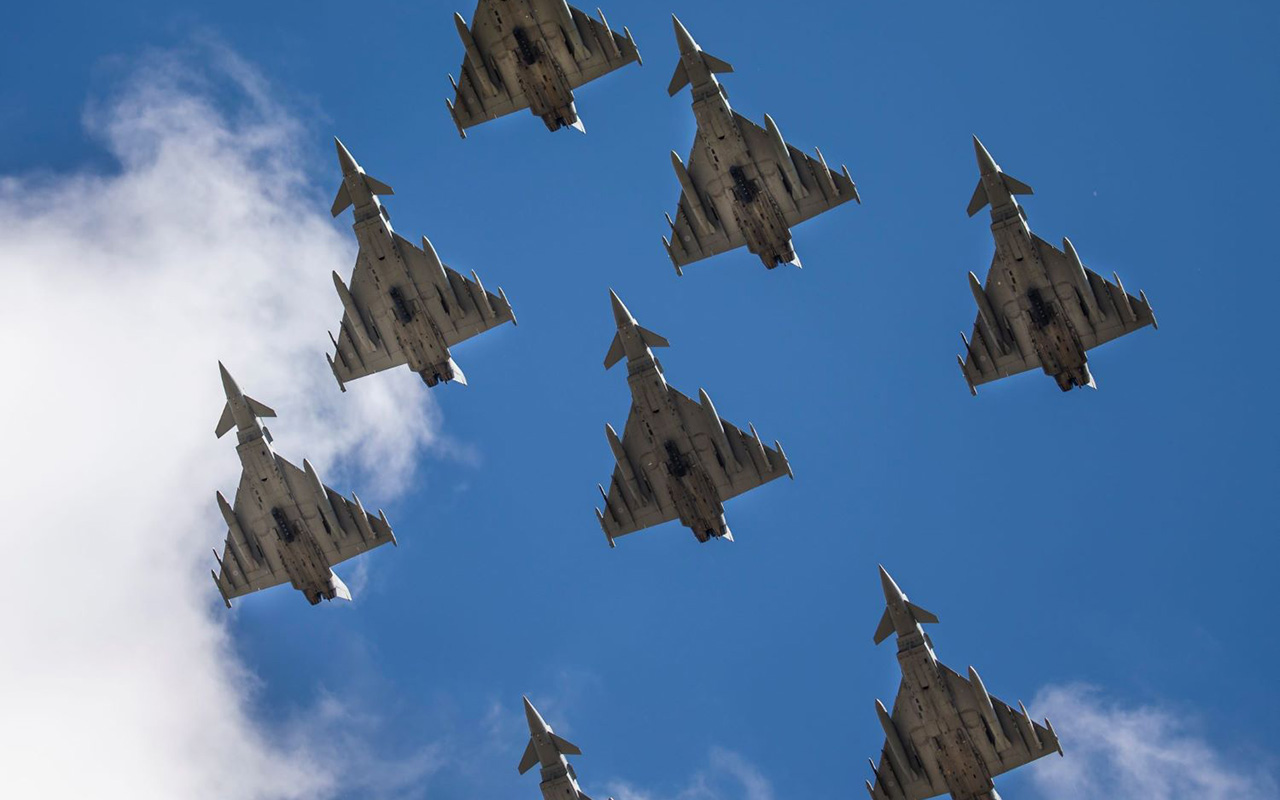
The Ministry of Defence says UK defence exports have exceeded £20 billion in 2025, a figure it expects to stand as the highest annual total since current records began more than 40 years ago.
Officials link the growth to two headline contracts: a £10 billion agreement with Norway for at least five Type 26 frigates and an £8 billion deal to sell 20 Typhoon fighter jets to Türkiye. The MoD claims these sales will support more than 25,000 jobs in shipbuilding and aerospace supply chains.
Luke Pollard, the minister for defence readiness and industry, framed the figures as evidence that defence is becoming a tool of industrial policy. He said: “We are showing again how this government is delivering on our pledge to make defence an engine for economic growth across the country while boosting our security and that of our allies.”
Pollard linked the Norway frigate sale to joint naval strategy in the North Atlantic, arguing that it “better equips our combined navies to counter the threat from Russia”. On the Typhoon agreement, he said it “secures high skilled jobs in Lancashire, Scotland and across the UK whilst helping strengthen NATO’s southern flank.”
Beyond the flagship sales, the MoD lists 12 C 130s sold to Türkiye, valued at more than £550 million for the UK and Marshall Aerospace, and a smaller land systems export to Czechia. Longer term, ministers highlight AUKUS submarine cooperation with Australia, which they suggest could generate up to £20 billion in export value.
Rupert Pearce, the National Armaments Director, said the current approach is designed to link exports to alliance strategy rather than treating them as purely commercial acts. He argued that
“these export successes reflect the NAD Group’s mission to strengthen international partnerships while driving economic growth at home.”
This aligns with the Strategic Defence Review’s claim that defence production can offset rearmament costs. Avril Jolliffe, director general for international collaboration and exports, emphasised the shift in institutional structure:
“This is not just about selling equipment. It is about building defence partnerships that support collective security and UK economic objectives.”
Ministers also point to the UK joining the Agreement on Defence Export Controls with France, Germany and Spain, which they say should streamline licensing for future deals.









Surely the £8 billion for the Typhoon sale has to be split between the 4 nations that produce it – we don’t make the whole thing ourselves 🤔
No that’s not how it works, we imports the components then export the final product. It does mean however our imports go up but that’s not the headline 😀
The figure is seriously fudged and has no link to actual benefit to the Uk or the tax man, as they are including headline figures and not what parts of them deals are provided by companies in the UK or linked to extra jobs or tax. Some of it will be, but needs to be read for what it is, purely a PR stunt to justify tax breaks that the firms get.
I wonder how are the C-130s considered as an export?
Export of second hand goods still counts as an export.
Really puts it in perspective when the best defence exports the UK defence industry has ever achieved (£20 billion) is equivalent to 2.2% of UK exports for the year.
Politicians and the media need to stop looking at defence as a job creation program and start looking at its value as actually defending the UK and its allies.
I may be being ultra critical here but around £18 billion of the total seems to be in two projects literally announced in the last few months. While that is very much to be celebrated it does, to my cynical mind not look particularly good upon what little else we exported, or how sustainable such a figure might be longer term. Or am I missing something here. So what was the last ‘record’ figure and what did that include I wonder. I think it’s important to have nuance and substance here before we celebrate too much if we are going to evaluate not only how important our military exports are, but how sustainable any underlying trends are. I remember how the years long Saudi arms contract completely skewed the underlying trends, certainly in comparison to say French military exports.
Yes I agree even ignoring the above qualification on the subject, 2.2% is not exactly mind blowing. One further qualification here perhaps would be the direct and indirect influence military industrial efforts and research (often joint research) influences what’s available to innovate, develop and export for civilian use. Probably impossible to accurately quantify, but I suspect it has a fair influence. Either way we should not be resting on our laurels glorying in ‘records’ that have underlying subjective and objective stories to be explored.
And yet people get worked up into a frenzy about fishing which amounts to a tiny fraction of 2.2 percent at 0.02 to 0.03 percent ……..
The arms export of our UK friends are a good news, you are so right to consider the jobs created, the know how, the skills it entails. Having a strong industrial capability in weapons market is important, because later, the skills acquired can be reused in other civilian markets.
Allies will do what they have to do. If Norway did not have frigates, they would be in difficult to contain Russia in the North Atlantic. Are you better off having sold to them these frigates, certainly. Will UK have tousands of skilled workers with this? certainly as well. So cheers!
I’m assuming that a significant percentage of the remaining 97.8% is financial services.
While I am not against that, I do think that industry, and defence industry as a part of that, needs to be developed and utilised by government. I’ll give a couple of reasons, but I imagine there may be more. To be clear, I’m not advocating we go back to ‘the old days’ where the UK was manufacturing and industrial power house, I don’t think that’s possible. But I do think the economy needs a bit of a rebalance (proportional) away from financial services.
Financial services is very high return for the number of people involved- it doesn’t create a lot of skilled jobs the way that industry does. Developing and growing industry increases the number of skilled job slots that can be filled by people- particularly not based in the south east/ London.
Financial services are relatively volatile- as at least a fair slice of them follow the global markets, we have seen what that means for boom and bust cycles and austerity etc. Industry, particularly higher-end industries like defence are less vulnerable to those peaks and troughs- or at least the peaks aren’t as high and the troughs not as low. If the economy had a reasonable slice of high quality industrial and engineering (in the right fields), then these could service to smooth the extremes that we’re otherwise somewhat vulnerable to.
That’s my tuppence: 2.2% is not great, but we should be looking to grow that to achieve greater long-term financial stability, rather than discount it as a non-starter.
Is the UK rearming? We arr slowly replacing ships that should have been replaced years ago. But i wouldn’t define that as in any way growing our ineffective armed forces.
Agree, I noted that passage as well.
Where are we “rearming” beyond contracts with industry for extra munitions and the new factories that, by HMGs own words, cannot rely on orders from HMG?
Announce the structures being put in place with the intention to recruit a thousand more people each for the RN and RAF, and maybe 3 thousand for the Army, then I’ll believe it.
Till then, money to the MIC.
DM yes the ammo factories have uncertain future after uk stockpiles replenished. Think you posted that uk ammunition can’t compete for overseas sales on price. We have possibly rightly have more checks & balances.
I see this as positive news, in theory the more people buy our weapons, the more people get employed and maybe new facilities are built or current ones expanded.
Only if big headline contracts are sustainable well into the future however. We have gutted our capabilities primarily because we have pursued boom and bust headline projects without any real commitment to longer term sustainability.
True and the longer we leave it the more costly its going to get, we should be ramping up the infrastructure. Great thing about building loads of factories for defence, when its truely peacetime and you dont need to build arms, the factories can be used for civilian use.
We are not rearming nor expanding nor upping spending we are just treading water in the maelstrom as the government kick the can ever further down the road and cross fingers and toes that Putin and Emperor Trump don ‘t do anything too deranged. The next election will be full of pie in the sky promises of tax cuts no massive increase in defence spending just more welfare and NHS spending as usual and on it goes. Either Starmer knows something we don’t or he is a dangerous idiot gambling with our futures like the rest of them. Answers on a postcard please. Meanwhile I have to get on, digging a bunker by hand is hard work.
Does not make sense to me. The stockpile of weapons you have at the start of a war certainly has value. The industrial base you have assure you of replacement weapons and possibility to ramp up. UK not being at the front line must arm it’s allies and have a strong industry. Allies can fight, UK can send immediate reinforcement and ramp up. Same thing applies to France. Military planners in Moscow can take notes and recalculate the recalculation. If they attempt something stupide, they will face an industrial base ready to face the threat they carry. And the industrial base in Europe has nothing to envy to Russia. The army does somehow, but I think we have seen what works in Russia’s favor: large bomb carried by SU 34. Will they have the possibility to approach the frontline with the threat of Typhoon, Rafale and Grippen? Time will tell. Are veterants of Russia a real threat? Certainly. But we are not weak either.
Good news.
Export or die used to be the mantra after the Second World War.
Record breaking exports indicate that the UK’s defence industry is winning the battle for overseas business.
Excellent news, now lets get up to this figure or more based on a more sustainable system – based on multiple projects rather than just a couple of big money projects.
Until the early 2010’s the UK was consistently the No 3 defence exporter after USA and Russia but a collapse in aerospace orders – particularly to the Middle East and Saudi Arabia – resulted in just £6 bn of defence exports in 2021. However, the last few years have seen a much needed rebound. In 2024 £14.5 bn of orders brought the UK back up to seventh, overtaking Israel and Spain – although still behind the USA, France, China, Russia, Germany and Italy. The increase also kept the UK ahead of South Korea and Sweden.
However, the UK’s lack of competitive and largely locally produced military aircraft and helicopters is a big problem. I found it very disappointing that a few years ago BAE Systems decided not to risk a few £100 million developing a next generation advanced jet trainer to replace the Hawk T.2, in the hope that once a demonstrator was flying the MOD would find it almost impossible not to then fund the programme. Instead BAES is reduced to touting the final-assembly of a licence built version of the Boeing/Saab T-7A Red Hawk for the RAF – and even that is reportedly dependent on an unrealistic minimum order of 60 aircraft (albeit probably negotiable downwards to perhaps as low as 40).
The 🇬🇧 needs to keep going and not resting on the laurels of 2025. Hopefully some new orders for AH140/T31 at least.
This does highlight another area of deficiency in the UK – Joe makes the point about financial services providing the bulk of exports and yet, when I was being dragged up, you could see quarterly media reports on our exports broken down into sectors and for all the information that is out there, the Government does not routinely highlight all exports to provide balance to the reporting.
What might be noteworthy, is the potential for exports of Rolls Royce SMRs (Rodders?) because I wonder what is the cross-over between military innovation for the next SSN/AUKUS reactors and the SMRs? Is there a sharing of some technology/researchers/engineers?
The Babcock mantra on Type 31, if achieved, would provide a drumbeat of exports either full platforms or technology that would improve our finances however, the Government allowing key companies to be sold to the US for example deducts from our export success on the other hand, does BAE repatriate any profits made on its US operations, or do I already know the answer to that one.
As to factories, in Latvia, I watched an Irish company take over a former hall for double glazing manufacture and re-shore to European waters former Chinese production of scaffolding systems and turn it into a final assembly for re-export; halls can be repurposed including some staff.
What the public need is data sets, showing exports broken down by sectors, to be published more often.
An internet search unearths freely available UK export data already published monthly by the ONS broken down by country and sector.
I miswrote – the information needs to be put into mainstream media to awaken public interest, something that the general public are sorely unaware of such as the role Defence plays in Economics and turning exports into a public good.
However, thank you for pointing out my mistake.
That’s a problem with a lobotomised mainstream media.
Unless it is less than 100 words in words of under 2 syllables, and numbers under 5, forget it.
Note that the figures are very distorted, e.g. both BAE Systems and Rolls-Royce actually complete the vast majority (80% ?) of their F-35 contracts in the USA e.g. the Electronic Warfare system and F-35B Fan Jets respectively. Although the revenue is booked by UK registered companies, reporting these as UK defence exports is VERY misleading given that the work was actually done in the USA.