

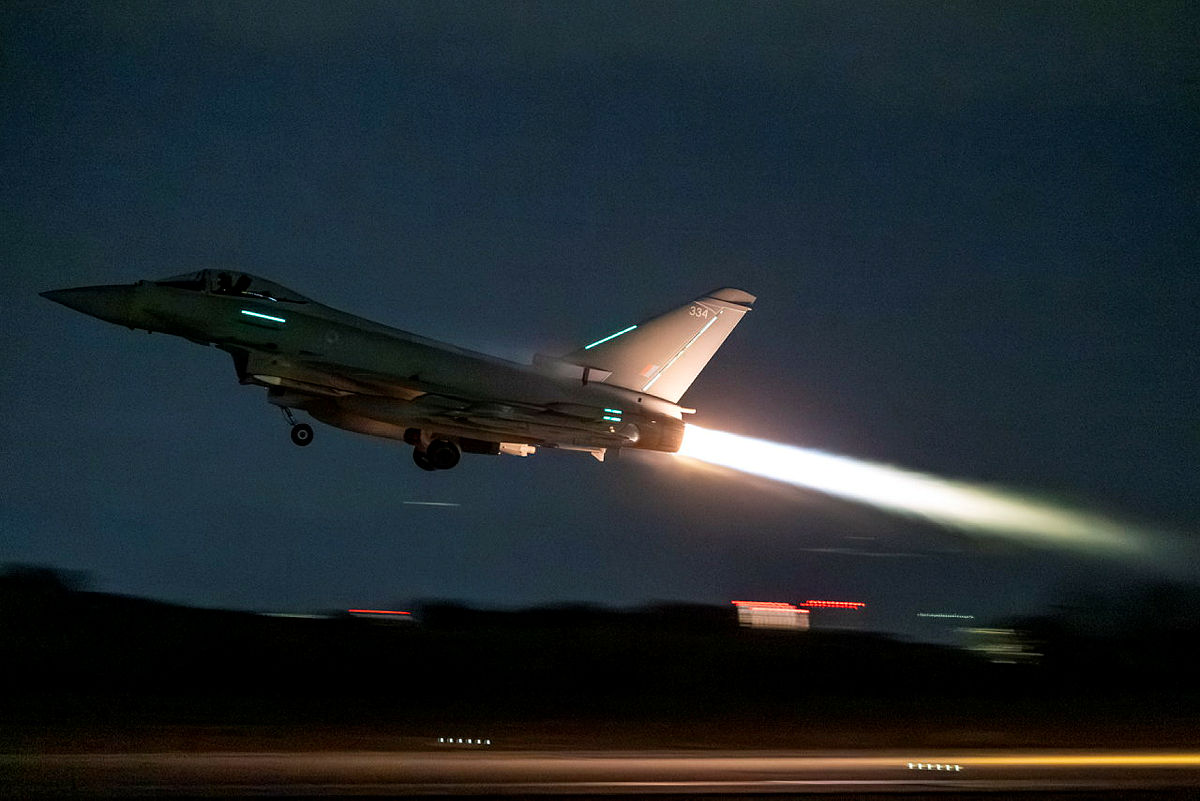
British fast jet activity in the Middle East has reached its highest level in more than a decade, with the Ministry of Defence confirming an increase in aircraft deployments and operational tempo across the region.
According to the MoD, UK pilots have now completed more than 550 flying hours on defensive operations aimed at protecting British personnel, bases and regional partners.
The department also confirmed that the UK currently has more jets deployed in the region than at any point in the past 15 years.

What’s where?
Six F-35B aircraft were deployed from RAF Marham to RAF Akrotiri in Cyprus in early February, reinforcing the UK’s existing fast-jet presence in the eastern Mediterranean. These joined RAF Typhoon aircraft already based at Akrotiri, giving the UK a combined detachment operating from Cyprus.
In parallel, additional Typhoon FGR4 aircraft were deployed to Qatar. Four jets were sent from RAF Coningsby to join the UK’s existing Typhoon presence in the Gulf, operating alongside the joint UK-Qatar squadron. A further four Typhoons were subsequently earmarked for deployment as part of the same reinforcement.
The aircraft have been operating across multiple locations rather than from a single base. RAF Typhoons and F-35s have flown from Cyprus and Qatar, with activity extending over areas including Jordan and the wider Gulf. This has included interceptions of drones by both Typhoon and F-35 aircraft.
Supporting assets have also been deployed alongside the fast jets. Voyager tanker aircraft accompanied the F-35 deployment to Cyprus to provide air-to-air refuelling and support longer-range operations.




RAF Akrotiri 1968:
No. 6 Squadron: Operated Canberra B.15/B.16 bombers as part of the Akrotiri Strike Wing.
No. 32 Squadron: Operated Canberra bombers, specializing in strike and reconnaissance.
No. 73 Squadron: Operated Canberra bombers, providing conventional/nuclear strike capability (CENTO).
No. 249 Squadron: Operated Canberra bombers (part of the strike wing).
No. 56 Squadron: Operated English Electric Lightnings, which took over air defence duties from Javelins.
No. 84 Squadron: Operated rotary aircraft, including Whirlwinds and later Wessex HAR2s for search and rescue.
What happened in 1968? Turkey thought about invading Northern Cyprus. Its recce Thunderflash aircraft were intercepted by 56 Squadron and the invasion was called off.
That is deterrence at work, a great deal cheaper in the round than the shambles going on today.
Deterrence is, of course, a tri-service undertaking. At the moment, we are observing the limitations of air power alone on a daily basis.
Here’s how we used to do it effectively:
‘Britain had accepted responsibility for Kuwait’s military protection and quickly sent a strong naval task force, which included Royal Marines from 42 Commando on HMS Bulwark, aircraft carrier HMS Victorious, destroyers HMS Camperdown, HMS Finisterre, HMS Saintes and HMS Cassandra, frigates HMS Chichester, HMS Loch Fyne, HMS Loch Ruthven, HMS Loch Insh, HMS Llandaff, HMS Yarmouth, and HMS Lincoln, amphibious landing ship HMS Messina, and the 108th Minesweeper Squadron.
The Royal Air Force sent 2 Canberra Reconnaissance aircraft, of 13 Squadron based in Cyprus.
A troop of 42 Commando arrived by helicopter from Bulwark at the airport as a squadron of Hawker Hunters arrived. By 1 July Britain had half of a brigade group in Kuwait ready for action. These included 42 and 45 Marine Commandos and two companies of 2nd Coldstream Guards. 3rd Carabiniers’ “C” squadron landed with their Centurion tanks from HMS Striker. The two Commando groups occupied high ground on and around Mitla Ridge, near the Iraqi border, in fierce summer heat. Brigadier Derek Horsford, Commander, 24th Infantry Brigade Group was rushed from Kenya to Kuwait to take command of the assembled British land forces.
In the following days, there were further reinforcements; an artillery battery of the 33rd Parachute Field Regiment, and the 11th Hussars with Ferret scout cars; 2nd Battalion, The Parachute Regiment arrived after a delay through difficulties over-flying Turkey. On 4 July, the 1st Battalion, Royal Inniskilling Fusiliers and the 34th Field Squadron arrived from Kenya.
The 1961 planned Iraqi invasion of Kuwait was quickly called off.
With the US becoming increasingly unreliable we really need a massive expansion of our fast jet force. If we just focus in the basics we can’t afford a substantial increase in RAF numbers. Ordering 70 F35A to match our existing orders of 74 F35B and pulling back all the tranche 1 typhoon airframes could get the RAF up to nearly 300 fast jets, an airforce which would easily be the most powerfully Airforce in Europe and a force that could completely dominate the Russian airforce.
That would give us far more security than an army of 100,000 or a navy with 30 escorts for much the same price.
For a nation of our size and responsibilities with the budget we have, what you said and on the last paragraph should be affordable, that is the problem.
Unreliable ally and ordering more F35s is a bit contradictory isn’t it?
If you look at production capacity and aircraft capability there is little choice but to go with F35. The US is unreliable but unlikely to try and block NATO Allie’s from using the F35 in a war with Russia.
The UK on its own could cripple US F35 production for a number of years if it ever found itself kicked out the program and permanently halt F35B production. The UK has the capability to update mission files which is the most critical component of the source code debate. Israel has also shown that it’s possible to get around most software issues especially if you’re willing to void the Lockheed Martin warranty.
I’m not massively concerned on the F35 issues as the UK holds a significant number of cards.
F35A is the plane that is best able to eradicate Russias air defence. With no air defence Russia has nothing more than a third world army of half trained mercenaries.
For the price of Ajax (£6billion) you could buy 70 more F35A. With nearly 200 a year coming off production lots you could bet them with in five years (We already have them pre ordered as part of our 138)
That is easily the most bang for the buck the UK could get for a small achievable budget increase. £800 million more lets you get the tranche 1 back with the same basic upgrade that Spain did for their tranche 1.
This is how countries like Finland think and that’s how they get so much bang for the buck. We don’t need more transporters , tankers, helicopters, VIP transports or ISTAR platforms . Just much more basic combat power.
“We already have them pre ordered as part of our 138”
We really don’t have that many on order ATM.
That said LM would have little issue in supplying the remaining F35B and 74 F35A to UK.
All that said Typhoon is massive overmatch to current Russian junk. Even more Typhoon would be useful and sensible.
Personally I’d like to see the 74 F35B bought – so that CSG and old Harrier uses can be covered off fully – that said part of the close ground function of Harrier GR is taken by Apache combined with the M270
RAF can then have 74 F35A or Typhoon balanced with the numbers that can be bought at what rates
Full fleet of Typhoon upgraded with the new radar/EW etc.
Part of the issue with sustainment is how small our fleets of anything are. This massively affects the costs statistics of keeping the long tail parts to hand. So increasing fleet size will decrease costs per flying hour as well as increasing the depth of specialist service personnel. There is also the issue of service teams being trained for the once-in-a-blue-moon parts swaps and again this makes much more financial sense with a larger pool of aircraft and maintainers. Sometimes playing the statistical reductionist pool game is counterproductive to unit costs as opposed to global costs. Currently constraining the global cost is driving up hte unit costs of flying hours.
Problem with ordering more typhoons is production slots. BAE already has a full production line up to the mid 2030’s. Maybe we could get 20 or so Typhoons before 2035 but that’s about it.
F35 can be produced much quicker. We don’t have firm orders for 138, we have 48 firm and 24 being negotiated but our initial expectation order with LM is 138 and they keep expecting us to meet that commitment. It’s not that difficult for us to add 70 to our existing order and get them in the next 5 to 7 years or sooner if the US pulls back on its orders.
It is all about the correct mass that reduces the cost per hour of flying time. Right now RAF is on the wrong part of that curve. Really the argument needs to be based around the optimal fleet sizes to get cost/hr to a minimum.
I agree – it will play well with The Tangerine King as well….Big Beautiful Order from King Charles.
Personally I think we should be working to have the tranche 1s returned to service.. they have less hours on them than the tranche 2s..
The comment on Typhoon production is not correct. BAE/Eurofighter now has enough orders to close the time gap to when GCAS production is due to start, but this does not mean the production lines are full. Far from it. Further orders can be taken and delivered to normal lead times.
Wow nothing left? Think your missing something really important. That third world army has the ability to create rather large mushroom clouds if it feels like it has lost.
And we have the same ability to end them. Neither side is likely to use it unless they feel an existential threat. Stopping a Russian invasion of Finland or taking Kaliningrad off then is not an existential threat.
I agree in concept, in reality in a shooting war with Russia I can’t get beyond the prospect that on day 1 it’s entirely possible that all of our air and naval bases and fixed radar sites are taken out by ballistic missiles/ cruise missiles and practically the entire navy and air force are destroyed in port / base.
Look at how long it took Dragon to get underway.
If Russia decided to attack us tomorrow with cruise and ballistic missiles from the sea I think we’d be done for.
It’s absolutely essential that we get some permanent missile defence and have a navy large and well maintained enough to make the GIUK gap impenetrable without us knowing exactly who’s coming through and for a lethal number of ships to actually be at sea at any given time ready to respond.
For the RAF to be effective it absolutely needs more maritime recon, AEW and tankers and if you want to forward deploy your going to need huge amounts of airlift to get weapons and spares to them.
It would be nice to see a modest fast jets, but we have ‘grey’ vulnerabilities which Putin will exploit. These need to be addressed: undersea communications, space based communications, cyber attacks, sabotage (physical and institutions) on UK and foreign assets. Ukraine and Iran show us that large numbers of relatively inexpensive drone and ballistic constitute a strategic threat in the sense that they are capable of undermining a society and economy and putting you in a very weak negotiating position. So I think sovereign GBAD against launched drones and missiles a high priority so Bastion is important. Agree QRA is part of this. M-346 and CAMM could be. Ability to deter ballistic missile attack is easier than defending against it, so initiatives like Nightfall and the Anglo-German 2000km missiles are important. A European Leonardo Michaelangelo ‘Iron Dome’ might be a long time coming.
If the Iran war has shown anything it is that GBAD is a waste of time against drones.
Typhoon and wildcat with laser guided weapons and the new drone interceptors is probably a much more effective way to guard the UK although it’s really hard to see how Russia can pose a substantial drone threat from over 2000km away with no direct line of attack at the UK.
I’m all for us having two Arrow 3 batteries and four SAMP/T batteries that could provide comprehensive coverage across the UK from IRBM’s
Agree low probability of direct ‘slow drone’ attack on UK. But its not zero and could be launched from subs or ‘Q ships’. I think I saw a Chinese concept of chucking drones out of sonething like a C130. I see GBAD as a more generic defence against aerial attack, so not limited to ballistic missiles. I agree Lasers / Wildcat / Martlet etc and maybe M346 with APKWS would be good. I’m not qualified to give an opinion on SAMP/T. At a guess I think the govt would prefer a sovereign solution or a German one. But point taken on the need to protect a handful of key targets. The big argument in favour of more F35A is that, if they carried a long range cruise or hypersonic missile it would give us a further means of retaliation without going nuclear. But we would be dependent on a US missile.
GBAD, utilising ground launched interceptor drones, has proved to be extremely effective against drones.
‘…at $3,000 to $5,000 apiece and an average success rate over 60%, interceptors are now changing the calculus of war’
‘One in every three Russian aerial targets destroyed over Ukraine is now brought down not by a missile or a gun — but by interceptor drones that each cost less than a used car, Ukraine’s air force says.
Over the capital, the new class of interceptors is even more effective. Drones were credited with more than 70% of Shahed downings in February’
The Unmanned Systems Forces were created as a separate branch of Ukraine’s military in June 2024. The units operate within a single chain of command, with a defined structure and a common vision of unmanned aerial vehicle (UAV) tactics.
The problem, for this country, is that we don’t presently have any GBAD interceptor drones or, for that matter, much in the way of an integrated GBAD sensor array that incorporates acoustic sensors.
As a proponent of RN, RAF, Intelligence first, I agree regards the RAF.
But I’d prefer a smaller expansion of fast jets if it meant the enablers were increased in tandem, with ISTAR assets top of the list. And equal improvements to the other 2 services.
More P8. (3)
More E7. (2)
More Protector. (8)
A Shadow replacement and expansion. (6)
A RC135 replacement and expansion.(4)
More Chinook.(20+, tranche 2 of CSP )
More NMH. (7)
More Atlas.(6)
More C17. (2(
A Herc SF role replacement. (6)
Second tranche of F35B accelerated, there are zero jets now on order for years. Again, by design of HMT.
More RAuxAF Regiment Hybrid Sqns of reservists and regulars to operate a UK GBAD system.
All fantasy, HMG have little interest beyond the jobs that defence creates and the grandstanding it allows them, and I’ve seen no evidence from this government that will change.
An expansion to 300 FJ would mean thousands more personnel, weapons, and refurbishment of redundant HAS, opening of old airfields in some cases, and an expansion of the training fleet that seems impossible to comprehend given the time it takes to train pilots with 13 Texan and 28 Hawks, if they all worked!
Really it should be worked, as I said upthread, from the PoV of getting cost/flying hr to a minimum which is achieved at a critical fleet size for any platform or commonality.
If you look at the typhoon squadrons.. indicative airframe hours vs actually usage, it’s getting profoundly tight.. by the 2040s the RAF will be retiring out typhoons with almost no indicative hours left on the airframes.. it’s never ever done that before… the Tonka fleet was retired out with about 40% of its indicative hours left.. tranche 1s are gone with over 50% left.
And a clever opponent will simply get proxies to throw low value problems our way in such a way we have to respond and thereby wear out our minimal fleet without a shot being fired – which is what is going on right now and why Russia invests so much into probing missions.
While I agree that the numbers we have need to be increased significantly, from what I’ve read, one of the biggest problems is the number of pilots for the fast jets.
Given the engine problems with the Hawks, we need more fast jet trainers urgently or we’ll have nobody to pilot the new aircraft.
And what do we do about those nasty russian SSGNs and SSNs sinking all our ships, cutting our undersea infrastructure.. putting an exclusion zone around the UK or just lobbing cruise missiles at us for fun?
The RAF needs to take the lead regarding defence of our overseas territories and the UK. Increase the number of maned and unmanned aircraft significantly, initially with Typhoons and some F35A versions before ordering the new fighter currently in development (development of new fighter needs to speed up delivery of initial airframes 2030). The royal navy is too small and does not have the working hardware required for the job so get the current boats working and recruit the people to man the new ships on order. The army needs to increase in size inc reserves and become far more agile to support as required 10 – 15 thousand regular personnel should be enough.
To sum up – It’s not difficult, get the current hardware working increase the serving personnel numbers and up the budget initially by half a percent. Then review the situation and respond to events as required.
The UK really should send Trump an invoice for this. Oil price going up is going to destroy our economy and cost of defensive operations is not going to be small. All that for no objective or really any value. The Iranian regime is no closer to being removed. Friends like that, who needs enemies.
I want the UK to stay out of offensive operations, but defence is OK. As well as the fast jets in theatre, we should also consider/offer a few helicopters to be based in Northern Oman/UAE, to help escort tankers. A mix of Merlin ASW, Wildcat/Martlet & Apache/Hellfire. Purely to defend civil shipping passing through the Straits of Hormuz.
Great effort by the RAF!
Add in the ATF and AAR force that are deployed in support.
Wow, why are the numbers so precisely publicized ?
Whatever happened to “I counted them out and I counted them in” ?
Well yesterday you were bemoaning a lack of ships regards the Gibraltar Drone article. And we all highlight lack of assets.
So if HMG grandstand that we have plenty of air assets out there, assume more than all other NATO nations save the US, then isn’t that something to be positive about?
The RAF is very happy to give flight hours.. I can tell you the flight hours of every RAF fast jet as of June 2025 if you like.
The only way to reopen the Straits of Hormuz is with a Land/Air campaign. That is, to a certain extent, already happening:
‘The strategic logic connecting Ahvazi insurgency to Hormuz is straightforward. The IRGC cannot simultaneously suppress an armed uprising in Khuzestan and Hormozgan provinces and maintain the coastal surveillance, drone operations, and fast-boat patrols required to enforce the Strait closure. Every IRGC unit redeployed to suppress the Ahvazi revolt is a unit not available to threaten commercial shipping. Every oil pipeline sabotaged in Khuzestan is infrastructure the regime cannot use to sustain its war economy, and every engagement with Ahvazi fighters in the littoral zone degrades the IRGCN’s shore-based threat architecture.
The longer the IRGC focuses on Hormuz, the more it loses control of the oil assets that give Hormuz its value.
This is not a hypothetical, as it is already happening. The question is whether the coalition treats Ahvazi Arab mobilization as a sideshow or recognizes it as a decisive operational variable in the Hormuz equation. SOF liaison, communications support, and intelligence sharing with Ahvazi resistance forces, conducted through existing regional partners, could transform a spontaneous insurgency into a coordinated littoral campaign that systematically degrades the IRGC’s ability to project power into the Strait.
The geographic specifics reinforce the logic. The IRGCN’s coastal defense assets are distributed across three provinces: Khuzestan in the northwest, Bushehr in the center, and Hormozgan in the southeast. The IRGC must maintain surveillance and response capability along roughly 1,500 kilometers of coastline, including the islands of Qeshm, Larak, Hormuz, and Kharg. An Ahvazi insurgency in Khuzestan does not need to threaten Hormuz directly. It needs to force the redeployment of IRGC ground forces, intelligence assets, and logistical capacity away from Hormozgan Province, where the Strait narrows to 21 miles and where the IRGCN’s remaining drone and fast-boat capability is concentrated.’
The Land campaign would be great deal more effective with coalition forces launched and supported from UAE tasked with clearing the Northern tip of the Straits.
The limitations of air power deployed in isolation are apparent for all to see on a daily basis.
We should keep out of this foolish war. The USA started it in order to cover up trump’s use of little boys and girls for his sexual gratification, to boost his income from stolen Venezuela ln oil and help his mate putin out. We should leave the yanks to it. Christ they started it by killing kids. Iran is an unpleasant regime, but the Russians kill their own and Ukrainians, north Korea do the same, Israel have slaughtered hundreds of thousands in Gaza. hell even the yanks are busy killing their own with trump’s ice Gestapo. No, regime change may have been needed in Iran but it is needed elsewhere but. They are all nuclear powers where Iran never was
Just for context on those 550 flight hours in the middle east over 2.5 weeks. In a normal year the RAF flys about 25,000 hours or 480 a week.
Why are we deploying so many jets to defend super rich countries? to defend our bases and deployed personnel i fully under stand but we a skint run down divided country are protecting super rich counries why can’t they do it. Why can’t they step up and get tankers protected. Yes we are an end user of oil, and it deeply effects our economy, but it come accross as we protect other why they get rich at our expense.