

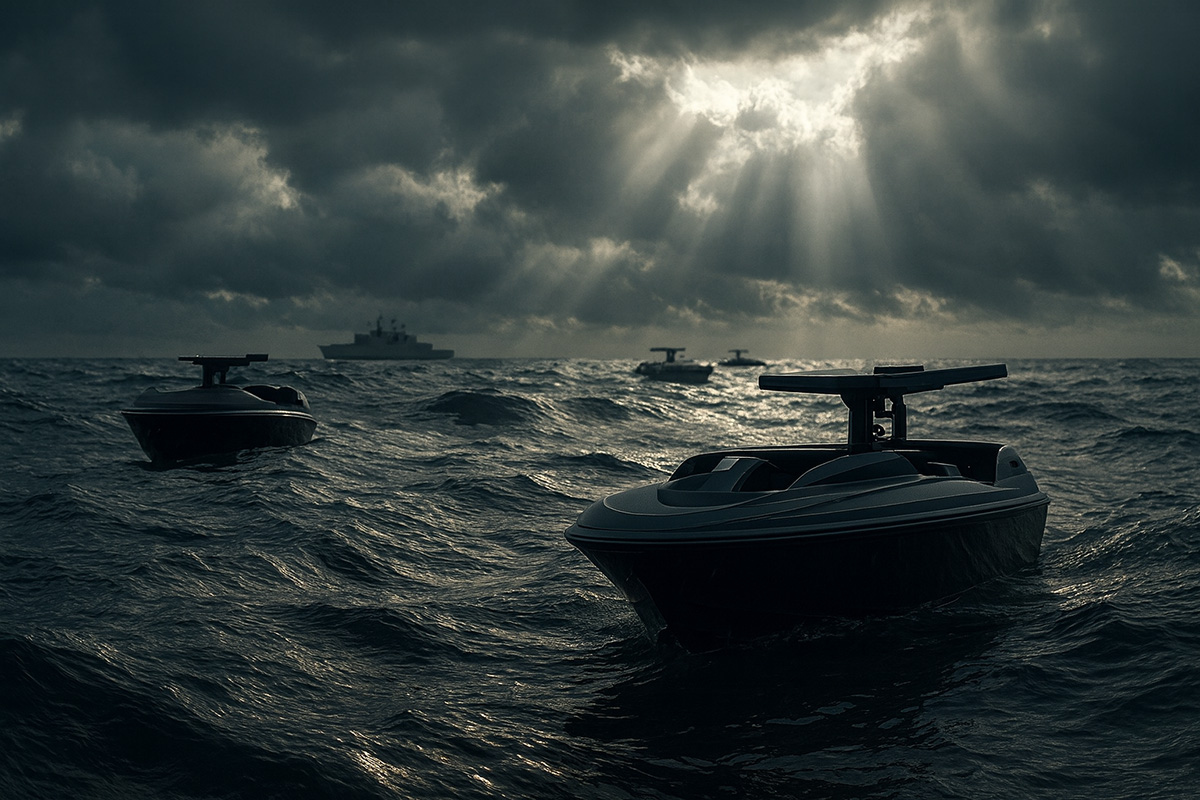
In a written answer to Conservative MP James Cartlidge, defence minister Luke Pollard said the Warfighting Ready Plan 2029 has already been published internally across government and is actively shaping engagement within Defence, as well as with international allies, industry and academia.
Pollard made clear that the plan does not follow the traditional model of a programme building towards a single declaration of full operating capability. “Rather than having full operating capability being defined as a single milestone, the Plan is iterative,” he said. “It is designed to deliver significant transformation over the next four years whilst responding to emerging threats, novel capability and confirmed resource allocation.”
The plan sets out how the Royal Navy intends to improve readiness using existing assets while prioritising capabilities needed for future conflict. It reflects a broader shift in defence planning towards speed, adaptability and continuous transformation, rather than linear procurement cycles.
That approach mirrors messaging already delivered publicly by senior naval leadership. The First Sea Lord has described the Warfighting Ready Plan 2029 as a live framework rather than a future aspiration. “This is not future technology. This is stuff that is here now, and we have a plan to deliver it,” he said when launching the plan. “It goes live within the Royal Navy as I’m speaking.”
According to the First Sea Lord, the plan has been shaped by extensive wargaming designed to identify strengths, weaknesses and areas where allies must fill gaps. “We have built this plan on the back of extensive wargaming to understand our weaknesses and our strengths, to understand where we can complement our allies and where they can complement us,” he said, adding that the Navy must be prepared to “discard the old and leap to the new.”
The Royal Navy has moved away from previous concepts for replacing its Landing Platform Docks, instead pursuing smaller, more distributed platforms with greater autonomy, aligned with the transformation of the commando force. “More distributed, smaller with more autonomy, our landing force will match the commando capability we’re creating,” the First Sea Lord said.
The Warfighting Ready Plan 2029 underpins a series of near-term shifts as rom next year, the Royal Navy expects new sensors in the Atlantic and the issuing of Bastion contracts delivered as a service. The commando force is completing its transition to dispersed, technology-enabled teams designed for operations in the High North, while wider naval reforms are being accelerated under the plan.
Senior figures have argued that ‘warfighting’ must be treated as “a discipline for action”, with an emphasis on stripping away bureaucracy that slows decision-making. The Navy has pointed to the removal of administrative processes that saved around 200,000 person-hours in a matter of months, time that is now intended to be reinvested directly into readiness.
Industry is being drawn in as a co-investor, with naval leadership stating that for every pound invested by Defence, industry has contributed four. Allies are equally critical, particularly for protecting undersea cables, energy routes and global supply lines that the UK cannot secure alone. Rather than a finish line, the plan is intended to provide a framework that evolves alongside threats, resources and technological change. As naval leaders have framed it, the alternative to moving at pace is unacceptable. “We are moving out because we have no choice,” the First Sea Lord warned. “The alternative is not worth thinking about.”









Who says politicians can’t learn, they’ve just managed to get out of being held to a date.
“The Royal Navy has moved away from previous concepts for replacing its Landing Platform Docks, instead pursuing smaller, more distributed platforms with greater autonomy, aligned with the transformation of the commando force. More distributed, smaller with more autonomy”
So we are ditching the 29,000 ton MRSS idea then?
At this point we might just drop them off frigates and destroyers….
Arrowhead 140 variant with stern ramp and side loading vehicle ramps to the area below the flight deck.
If we want to deploy these CIC the marines want it’ll need to be bigger than that
So where does that lead us….something like the Ellida Strike ~12-15,000 ton ‘frigate’ with a well dock?
No much smaller 4K tonnes
How in the world do you end up with that conclusion
Looks like it’s back to the littoral strike frigate concept.. putting a T31 back to what it was like in its very first iteration.. I’m sure Denmark will still have the blueprints.
Sounds like we are copying the USMC and going with LST 100 from Damien, not a bad idea for affordable mass and the second Queen Elizabeth can be used as a giant LPH.
I’m happy with this solution if it means more escorts and planes.
The LST100 are also perfect for low end security missions and at less $200m each we can probably get a decent sized fleet of them.
The latest in Scottish island ferries? Better than a River OPV for Caribbean, Falklands and West Africa duties? You would have to launch one of the futuristic CIC designs with the crane? Affordable and could be built by small yards in the UK or, since it is a non-complex warship, by Damen. You would have to take a few jerry cans to reach the Falklands but it ticks a lot of boxes. Could you fit one out as a casualty receiving ship to replace Argus? A couple of cheap extra 2 spot flat tops might also be handy.
LST and “greater autonomy” do not go together
Blether blether blether. So now war plans have a 2029 date on them, I wonder how much further that can be pushed back ?
It sounds like instead of having a plan, we will wait and see what we have available and working when whatever hits the fan.
Labour: “The UK will be ready for war in 2029.”
Intelligence services: “Unfortunately we’ll probably be at war in 2027.”
Six Absalon AH140 derivatives for MRSS then, backed up by a more capable Point class replacement?
Might not actually be too bad, and would solve the Rosyth drumbeat problem. H&W might be able to build Points as RFAs, or would that be too expensive?
Unless we scrap CIC a Absalon variant isn’t large enough for those landing craft
CIC is still a concept.. will have to see how they take it forward.. but your correct as conceptualised to would not fit with a strike frigate.. sounds to me like there is still a lot of debate going on.. no wonder the DIP is MIA.
Given a suitable handling system, like twin stern ramps leading to rows of floor rollers for example, I see no reason why an adapted Absalon design couldn’t carry four 20x8m CICs (ie Leidos, BMT and BAE but not Griffon) in the flex deck, plus various RHIBs, USVs and raiding craft to the sides or in the T31 boat bay spaces. You might even be able to carry two more CICs in davits there, depending on weight and whether we kept the propulsion arrangement from Absalon or T31.
The CICs are massive, you’re not putting those in a boat bay and you’re certainly not getting 4 on a T31
The Absalon design is a hybrid LPD-frigate, it has a full-height vehicle deck three lanes wide and 90m long. That’s plenty of room for four of the current CIC concepts (which as I said are all currently 20m by 8m apart from Griffon’s monster), and we wouldn’t have much trouble getting the design back off the Danes.
Boat bays might be trickier, but we manage for fully loaded LCVPs, it all depends on how adaptable that amidships space really is.
its a vehicle deck, not a well dock, how do you plan to launch and recover those CICs.
The same way Steller were planning to with Fearless, and exactly what I said up the thread, to use twin stern ramps leading onto floor rollers, so that two CICs can use each ramp.
That’s quite a common arrangement for large RHIBs on coastguard vessels, because stern ramps are useable in heavy weather and stern width is often limited.
I mean youd probably only have 1 ramp, the larger stellar only had 1. And it eliminate the option for larger landing craft.
Using a frigate sized vessel also eliminates the use of mexeflotes so in general doing a small ship would reduce out options quite significantly.
That wouldn’t be too big a problem as long as there was a suitable handling system, and it might also allow a vehicle ramp on the other side.
Yes a strike frigate would reduce flexibility and incidentally I don’t think it’s the best option, but it’s definitely a major one and certainly feasible.
Yes, it does look like the debate is ongoing. There’s a spectrum of cost and capability. At one extreme there is the 29,000 ton multi-role frigate cum LPD – San Antonio on steroids. At the other end is the LST100 – cheap landing craft that does one thing. In the middle are designs like the Ellida Strike, the BAE Strike frigate and the T31 / Absalon clone.
We can’t afford a meaningful fleet of all singing and dancing 29,000 ton MRSS.
The ‘strike frigate’ designs could be expensive compromises – neither fish nor fowl. How many would we get?
The LST is affordable and is optimised for the one thing we are really looking for – it lands troops and equipment. And we have other assets to do other roles in an assault; Point class, LSS, frigates, QE
The LST is simple and we could afford and build a meaningful fleet more quickly than the other options. If there is a build program we could spread the cost and get a few quickly. The LST also could double up as the Falklands and Caribbean ship.
LST is hardly what they’re looking for, they want increased landing craft and help capacity, not a giant landing craft that has to waddle up to shore
Per my ‘spectrum’post above…if the 29 000 ton Rolls Royce solution has been abandoned and if the waddling LST not the desired answer then we are looking at the strike frigate designs. From what I”ve seen the most ‘ LPD like’ of these are the BAE and the BMT concepts.
LST did fine in WW2, Korea and in the Falklands. It’s modern landing craft and LPD’s that have never conducted a major contested landing.
This so why the USA and Australia are opting for them.
Australia has far less distance to travel than we do. Everyone agrees Americas LST idea is suicidal, even they admit the LSTs and their attached units will probably be destroyed.
I see the Damien 100 LST and I agree if backed by a more capable point class it’s not a bad overall solution.
Am i the only one to think that we’ve gone full circle back to Normandy 1944 with the LST100??
It’s certainly full circle but it worked then, why not now.
No one in the RN is looking at LSTs
LST seems to be what the minister is describing.
“with greater autonomy” does not describe LSTs, theyre defenceless tubs
I’m not a fan of LST at least for MRSS, they are slow and less capable of the type of fighting the Marines have been training for, for better or worse.
Where they might be able to break into the RN is as a more numerous and aggressive Point replacement, if somebody finally convinced the Army they should be able to deploy by sea. There is a choice between a helo hangar and more EMF, but they would be able to lift a good number of heavy AFVs ashore fit to fight.
There’s also Caimen 1700 as a UK alternative, though we probably wouldn’t be able to build them here.
For all this spin, read we’re not getting the ships we need anytime soon so we have to work with what we have left to see if we can get enough ships together to fight
Still no urgency. Ukraine/Russia ow heading for 4yrs
Yet we signal it will take us another 3yrs yo be ready to fight Russia
Ok so in short, we are not getting much new kit, the old shite we have we will keep running as long as we can, and just change how we use them, mainly because they are old and worn out? Oh, and the plan to do this should be complete in another 4 years! Shit the bed, every day we hit a new low but ever so much more spin!
I suspect there is probably a plan to give the old sods like you a shotgun and a deckchair… with instructions to defend the beach.
Optimistic, I like it!
Old? I prefer the term mature….. ;0)
Well seasoned 🤣
Warfighting ready plan 2029 “will be delivered” ….sometime in the future, perhaps, subject to a budget maybe.
A plan that seems intended to justify discarding long standing core naval capabilities such as amphibious warfare. Ten years ago the UK was the only country other than the USA that had a world-wide Brigade level amphibious landing capability. Today, we have nothing!
I also sadly prophesise that the replacement of manned platforms with supposedly much cheaper AI powered unmanned platforms for the Atlantic Bastion is going to prove to be a disaster, although a huge attempt will be made to hide that.
The whole reason for this plan being implemented iteratively is because we will only have two T-26 in service by 2029, along with two or three T-31. God knows what state the T-23s will be in by then.
And bt 2029 all of the T45s I think.
That buzzword ‘war fighting’ weaved into a word salad! The only plan I can see is cut cut cut to hulls and disposal of the few capabilities we have left
Not sure I have a problem with this concept. Many who contribute to this site will measure success or failure by how long it takes to build specific pieces of kit.
ality.
In this case I’m pretty sure absolutely nobody has the slightest concept of where the RN will be in the next few years. Loads of designers will start prototyping kit and demostrating it’s potential. Some of this stuff might be quite small and would be available in weeks or months. Once we have something useful, the ability to mass produce, may be key. The RN must understand that quantity might well become as important as quality.
No naval vessel, which is what we need, will be available in weeks or months of construction
True no traditional warships are likely to be built in weeks or months. However if we continue to only build traditional kit we will get nowhere.
We need new types of kit which can be prototyped quickly. The RN needs to evolve or it will die.
Try again.
Not sure I have a problem with this concept. Many who contribute to this site will measure success or failure by how long it takes to build specific pieces of kit.
In this case I’m pretty sure absolutely nobody has the slightest concept of where the RN will be in the next few years. Loads of designers will start prototyping kit and demostrating it’s potential. Some of this stuff might be quite small and would be available in weeks or months. Once we have something useful, the ability to mass produce, may be key. The RN must understand that quantity might well become as important as quality.
I actually think the 1SL is doing ok. The navy needs to get its house sorted and this is a modest ( and hopefully achievable) staged plan to give some order to things. I like it talks sbout existing assets. Yes T23 sitrep is looking dire but fingers crossed the issues regarding subs getting to sea improves.
I wish the army could gets its act together so at least it could have some semblance of comptence. Putting together a useful fighting division with what’s available would be a useful first step – and instructive – then work up from there.
Someone on the Aukus article said we won’t see a 2nd sub active till 2027
I see lots of talking and PowerPoint slides.
I see no new orders for ships, planes, submarines, Helicopters, Armoured Vehicles and GBAD, beyond what was already in place under the previous government and 12 more Sky Sabre Launchers or Systems, it’s not confirmed which.
I see no announcement to in time expand the number of personnel, even by a few hundred.
I see excuses for dropping LPD other nations are happily using, and plans for sensors on boats and submersible while SOSUS IESS seems to have vanished, or is compromised.
No wonder so many are sceptical.
As for the CDS and his speech to get “wider society” ready for war, come off it.
Hi Daniele from all my reading IESS is expanding greatly with some pretty innovative stuff occurring such as the use of biological sensors ( marine life reacts to the presence of underwater vehicles in predicable ways).. but in the end it’s American not ours.
Sorry, my phone autocorrected, it’s IUSS, not IESS.
Lots of things are American, which we will still rely on, such as 5 Eyes and the nuclear co-operation, C17s, Chinooks, F35, the list is endless.
To me, this is highlighted as a distraction that we have hardly any real warfighting assets.
Key phrase is “as resources allow”
What about the 7000 ton multi purpose vessel that the Portuguese bought from Damen?
Piece of junk tbh
According to the above, only the Navy will be involved in ‘war fighting’ (another Americanism). Won’t the Army and RAF fight in the next war? Or have I missed something?
Nevermind. Doesn’t have loading ramp from what I can see.