

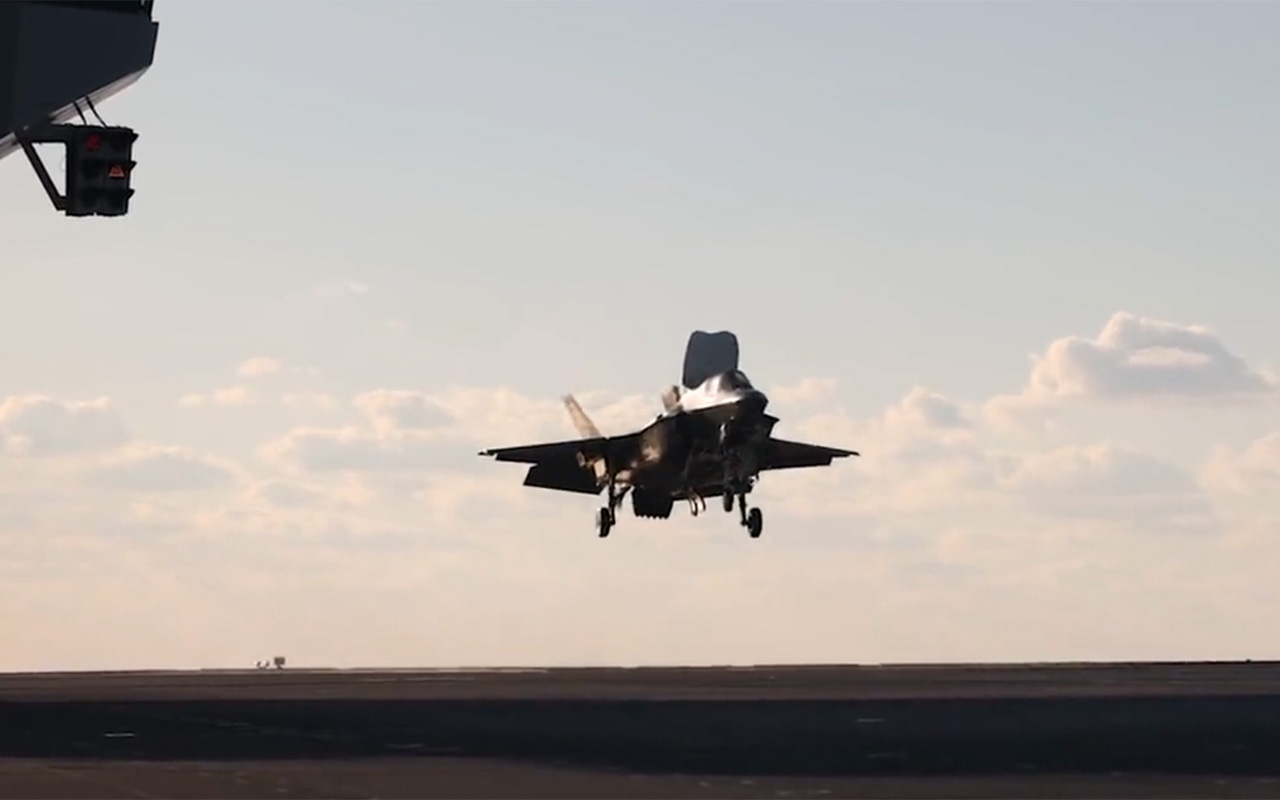
The Ministry of Defence has moved to clarify the status of the Shipborne Rolling Vertical Landing system for the UK’s F-35B Lightning II jets, after a series of written questions from Conservative MP James Cartlidge.
The UK Defence Journal understands that the capability has been delayed rather than cancelled, despite wording in the 2024 to 25 defence accounts that triggered reports suggesting it had been abandoned.
Across three separate answers, Defence Minister Luke Pollard restated that the SRVL system remains in development and that equipment already installed on HMS Prince of Wales is unaffected. Pollard said the system underwent initial trials in 2023 and that a commercial partner is still examining the results. “The results of those trials continue to be analysed by a commercial partner, and when complete will enable the Ministry of Defence to make an accurate assessment of the benefits and cost of further developing the SRVL system for operational use,” he told Parliament.
SRVL is intended to allow the F-35B to recover aboard a carrier with a higher bring-back weight by combining a short rolling landing with the jet’s vertical lift system. Earlier concern centred on jets potentially needing to jettison ordnance or fuel before landing if the system were removed from the programme.
The confusion stemmed from an entry on page 140 of the MoD’s annual accounts describing a “SRVL upgrade cancellation” of about £300,000. Pollard said this referred only to the planned fitment of SRVL equipment to HMS Queen Elizabeth in 2025. “The SRVL upgrade cancellation listed on p.140 of the MoD Annual Report and Accounts 2024-25 refers only to the fitment of SRVL equipment to HMS Queen Elizabeth in 2025,” Pollard wrote. “There is no impact to the equipment already fitted to Prince of Wales, and the MOD retains the ability to fit such equipment to Queen Elizabeth when the outcome of trials in 2023 are fully understood.”
Pollard repeated that the decision reflected a resource judgement rather than a reversal of policy. “This represents a Defence Choice; weighing up costs and benefits to prioritise the MOD’s resources effectively,” he said when asked what the term meant. The clarification aligns with earlier statements on 25 November 2025, when ministers confirmed that SRVL “has not been cancelled” and that the schedule was being re-profiled to align with wider weapons-integration work.
What is SRVL?
Shipborne Rolling Vertical Landing, or SRVL, is a carrier landing method that lets jets touch down with greater weight by combining forward motion with vertical thrust. Instead of slowing to a hover, the aircraft keeps some speed on approach so its wings generate lift while the engine provides controlled thrust. This combination allows pilots to land safely without discarding fuel or weapons before reaching the deck.
The process occurs on an aircraft carrier at sea and blends elements of both vertical and conventional landings. The jet rolls onto the deck with forward momentum, uses wing lift to stay stable, and relies on vertical thrust to settle precisely. The technique is especially valuable for aircraft like the F-35B because it supports returning to the ship at higher all-up weights.










Blah blah blah, bull&^%£ etc and soforth-should read… We do not have the money right now. Please bear with us, and we try to confound, bullchit and bamboozle you all, with total garbage.
🥱
I still feel that during construction, the carriers should have had the angled deck built, regardless of the carrier being CATOBAR or STOVL. To my mind doing a SRVL on a through design is inherently risky, especially in crap weather and heavy seas. The RN invented the angled deck for a reason, to separate landings from parked aircraft.
But Stovl and Catobar are completely different layouts. The angled deck just wouldn’t be used because we don’t even need to do SVRL
You are missing the point. You need to watch Kelly’s Heroes, and listen to the wise words from Oddball.
Again with the negative waves ….
Totally agree, an angled deck is a necessity to fully realise RVL, also future drone operations.
You need a clear route for potential bolters and it would also allow higher speed RVL’s.
You’d reduce the risk of crashing into parked aircraft and also avoid any failed landings from being caught under the bows, but are go-arounds even possible with SRVL?
Also having a parallel deck is apparently much easier for the pilot to line up on and land on in heavy seas, which was part of the reason for CVA-01 having one. I don’t know how that translates into automated landings but it certainly removes one of the variables.
Had to look up what you meant by a parallel deck on the CVA-01. Every day’s a learning day. The angled deck has a narrower angle compared to what I was expecting. But its the taxiway down the side of the island that got me. Where the island is basically a roundabout, allowing aircraft to taxi down the side, whilst not interfering with landings or take-offs. I wonder if it would have worked in practice?
Have I finally found a topic you don’t know inside out? (!!!!!)
The only reason CVA-01 wasn’t supposed to have a perfectly parallel deck out on the sponson was that they drastically reduce the beam available for the deck at the bow as they don’t end over the side of the ship. A more extreme example would be the tiny space available to starboard of the ramp on the QEs. A bigger carrier would have been able to have a perfectly parallel through-deck which was apparently one of the extremely early QE STOVL options, at least according to the NL article on their development.
The ‘Alaska highway’ outside the island is very interesting, and slightly controversial. The idea was that jets could be brought from the aft deck-edge lift to the forwards catapult, which was offset a long way to starboard, completely separated from the landing circuit which would be happening at the same time (jets being arrested near the front of the landing runway and turning aft onto the forwards lift). Apparently it might have been quite hairy in heavy weather out on the sponson, and I imagine any pilot in the cockpit would want to lock his nosewheel steering, but it would have enabled a faster rate of continuous ops as opposed to a cycle of large flights, which is a much more useful concept now with 5th gen jets than it was in the 1960s.
Mate know next to nothing on the CVA-01, like I said every day is a learning day.
One thing I’ve not really understood about the QE carriers, is that when taking off, there’s no pop up blast deflectors? At full load the F35B starts its take off level with the flight ops tower. Meaning there is a lot of very fast exhaust air traveling backwards along the deck. Is the aft landing spot far enough away, will this faster air affect a vertical landing? I can’t recall seeing a simultaneous take-off and landing?
I beleve the blast deflectors were an early cost cutting exercise victim.
Cut along with torpedo bulges and much more.
To be fair re torpedo bulges, I believe modern sophisticated torpedos do the mirror image of a ASM attack profile, were they suddenly climb and dive at the last minute, torpedos dive and aim up for keel to cause maximum damage.
The rear nozzle of the F-35b is not horizontal in takeoff. The blast is angled at an angle towards the deck and to the rear. Most of it will be deflected and dissipate in multiple directions.
“UK F35 Jets operate from HMS Queen Elizabeth in the North Sea” video on YT shows this.
Your are correct in that the 3BSM is not horizontal on a short rolling take-off. As with the lift fan the combined thrust is used to lift the aircraft whilst it accelerates. Which is fine to give the wings time to generate the necessary lift.
However, the 3BSM must be straight for the engine to use reheat. As far as I’m aware the nozzle can’t be angled whilst using reheat and is limited to run max dry.
If the line of recovery is ‘clear’ all the way to the ramp and the pilot or ship aren’t happy, one or the other can surely just call ‘bolter’ (or a modern equivalent) increase thrust change the thrust angle and roll through thus ‘launching’ off the ramp again. Could a partially loaded F35b do that without a ramp (from an angled flight deck)?
When the F35B does a vertical landing or SRVL, the engine is ran up to max dry, i.e. the reheat is not used, as it would melt the deck. If the aircraft is coming in to land using SRVL and is either waved off, is doing a touch and go or needs to bolt for some reason. The aircraft is already travelling at 70 knots, so putting the aircraft into forward flight configuration and engaging the reheat, will allow it to “bolt”. The additional thrust from reheat will sustain the aircraft’s weight, as lift generated by the wings at these speeds will be relatively low.
Is that viable?
The VTOL system would have to return to full forwards before turning afterburner on, because otherwise there would be a massive forwards pitching force.
How quickly can the 3BSM return to horizontal and the top door close?
I think so, I’m judging it based on air show demos. Where I’ve seen them transition from the hover, with a bit of forward flight for the 3BSM to get straight, then into a vertical climb on full burner. The time it takes for the transition is a good question. The air show move is fairly benign, the pilot conducts it at their pace. Whereas on the carrier, things need to happen more quickly. So I’m going to say yes it can be done (for now), until proven otherwise.
Hmm. I’ve thought more about what I said above and IF the afterburner works even when the nozzle isn’t horizontal (which doesn’t seem likely from what I’ve read), then there might be an intermediate nozzle angle where the moments from the extra thrust and the fan lift cancel out.
I think if there was any question of a failure on landing the obvious thing would be to dump load and land vertically.
It’s about cost. The only time it could have been done was right at the start. Later when they looked again it would have involved ripping out and re designing several decks below the flight deck because of the electromagnetic aspect of the launching system
Showing the continuing costs and sub optimal decisions resulting from the decision not to install catapults, so that ships with a nominal service life of 50 years are tied to a single fixed wing manned combat aircraft type.
🥱
Apart from not having the crew to operate a Catobar ship we would not have been able to afford all the additional aircraft types to make Catobar worth the cost
It is sensible enough, but also another translation, we are so cash strapped even £300k goes a long way when added to lots of other in year savings ( cuts. )
I agree the decision in itself is sensible: given the glacial pace of new weapons integration we’re unlikely to need SRVL for at least another five years! However, this clearly shows that the services are still being asked to find savings. This, given we have a war on our doorstep and other potential (maybe not even “potential”) enemies all over the globe, beggars belief.
Let’s face facts: this government is kicking the can down the road in the hope they’ll never have to honour the promised increases in defence spending.
Don’t say this government, endless promises for things we couldn’t pay for was always going to come home and bight eventually.
Perhaps if we could get the 122 million back from the Tory grifter lady mone for the substandard PPE, it might help
1. The cost of a few F-35B’s having to dump ordnance in order land back on will quickly make £300k look like petty cash
2. I strongly suspect that UK carrier based F-35B’s operate in hot weather with minimal ordnance in order to avoid 1.
3. HMS Queen Elizabeth commissioned in 2017 and conducted the first SRVL trial in 2018. Over 7 years later and we still have no idea if the capability will ever be implemented.
4. Safety concerns seem to be a key issue. A VL is highly automated and can occur on a busy flight deck. SRVL requires significant pilot input and a clear runway.
5. The supposed advantages and affordability of SRVL was one of the factors used to justify configuring the QEC as STOVL rather than CTOL. Cancelling SRVL would again call in to question that dubious but twice made (2002 and 2012) decision.
To add though, I read that F35Bs bring back ability is greater than thought, and for heavier weapons it doesn’t yet use anyway?
It is installed on PoW, yes? The Bedford Array?
Yes, POW is fitted with the Bedford Array. QE was intended to get an improved and fully stabilised version in her current refit period. Also, a prototype version to test the SRVL concept with Harrier’s was fitted to Illustrious way back in the 2000’s!
SRVL supposedly adds up up to 7000 lbs to F-35B bring back capability, albeit dependent on wind over deck velocity. For a heavily loaded F-35B that can make all the difference between able to bring home or having to dump expensive and scarce ordnance, e.g. a single AMRAAM missile costs over £1 million.
Indeed RAE Bedford’s last major tasking before it was closed.
I think people would be surprised at how much UKIP went into F35B – particularly the automated landing.
DL,
Feareth not, installation of SRVL on QNLS is well w/in the rounding error of expenditures in the forthcoming DIP. Father Christmas may not choose to deliver this to the RN this year, but there is always next year’s Christmas gift list. 🎁😉
Cheers!
DM,
Am obviously guilty of indulging in liquid holiday cheer a little too early—Internariinal Call Sign for HMS Queen Elizabeth is GQLZ. 🙄
What struck me was statement that, “the system underwent initial trials in 2023 and that a commercial partner is still examining the results.”
That’s a long time isn’t it, or am I missing something?
If the commercial partner in question is Lockheed Martin, are you surprised?
The Bedford Array was developed by QinetiQ
I’m aware of that. I was thinking that some of the results that were being examined would be stresses on the brakes, landing gear &tc which would put it in the hands of LM.
TBH given that time that LM has spent on Block 4 I’d have hoped they’d have completely automated the rolling landing, rendering the Bedford Array redundant…
‘The cost of net zero for the UK is estimated to be around £1.4 trillion over 30 years, with the Office for Budget Responsibility (OBR) estimating £800bn over the next two decades’
There is your urgently required defence budget right there.
What is the absurd idea of ‘net zero’ based on? It is based on a few dodgy models incapable of getting even close to replicating the real world data recorded climate that actually happened since the models were constructed.
Drop the profoundly silly ‘net zero’ and concentrate on the very real and immediate threats to national security that confront us right now.
Another idiot who doesn’t understand basic science outs himself.
Slinging insults at someone who does not see it as you do? Well throw some my way mate. There are millions of us.
Millions of idiots yes, but thankfully only a small minority of the population on this round earth. Maybe things are different on your flat one.
Read these and come back when you know what you are talking about:
Scaffeta, N (2023) CMIP6 GCM ensemble members versus global surface temperatures. Climate Dynamics
60, 3091–3120 (2023).
Spencer, R. W. (2024). Global warming: Observations vs. climate models. Environment Backgrounder The Heritage Foundation.
Vogelsang, T. and N. Nawaz (2016). Estimation and inference of linear trend slope ratios with an
application to global temperature data: Journal of Time Series Analysis 38.
Santer B D, P.W. Thorne, L Haimberger et al. (2008) Consistency of modelled and observed temperature
trends in the tropical troposphere International Journal of Climatology 28 1703–22
Connolly, R., M. Connolly, W. Soon, et al. (2019). Northern Hemisphere snow-cover trends (1967–
2018): A comparison between climate models and observations. Geosciences 9, 135.
Christy, J. R., R. T. McNider (2017). Satellite bulk tropospheric temperatures as a metric for climate
sensitivity. Asia-Pacific Journal of Atmospheric Sciences 53, 511-518.
Quotes a few studies that can be misinterpreted to claim manmade climate change isn’t happening… versus every other peer-reviewed research study for the last 30 years which shows that it is happening. 😂
You’ll have to do better, shill.
No quotes, only references….which you haven’t read….
Come back when you’ve read something…anything…even if it’s written by Enid Blyton…
Don’t forget that good science includes modest claims and self criticism on the limitations of each study.
Further 100 years of propaganda by big oil and big automotive has no difficulty spinning the self criticism of science as uncertainty and unproven.
Category 4 storms, tornadoes and diverse climate crisis artefacts are not enough to overcome the confirmation bias and greed of the general population who can be exploited for billions of profit.
The same oil oligarchs have a massive self interest in business as usual continuity, and the leverage it gives them geopolitically. Rosneft and Lukoil sanctions are a good start to remove hydrocarbon leverage and improve renewable energy freedom from the oligarchs.
The FP-5 Flamingo cruise missile is not just effective in burning the terrorist state hydrocarbon infrastructure, it’s helping to promote the switch to renewable energy so the health of our environment.
I hope that Rolls Royce success in small modular nuclear reactors will not only minimise the nuclear levy but enable more resilient energy in countries like Germany where foreign interference has funded useful idiots to decommission their legacy nuclear power so making them depend on the terrorist state hydrocarbon economy.
‘Climate catastrophe rhetoric now seems linked to extreme weather events……difficult to identify any role for human-caused climate change in increasing either their intensity or frequency….the IPCC AR6 decision NOT to include values derived from climate models (which have dominated previous IPCC reports). They implicitly acknowledge that climate models are running too hot and that you can pretty much get whatever value of climate sensitivity that you want from a climate model….
In addition to an insufficient number of solar and volcanic scenarios, the climate models ignore most solar indirect effects, and the climate model treatment of multidecadal and longer internal variability associated with ocean circulations are inadequate. While in principle these factors could go either way in terms of warmer vs cooler, there are several reasons to think these natural factors are skewed towards cooler during the remainder of the 21st century:
Baseline volcanic activity since 1850 has been unusually low.
Most solar researchers expect some sort of solar minimum in the mid to late 21st century
Solar indirect effects are inadequately treated by climate models, which would act to amplify solar cooling
A shift to the cold phase of the Atlantic Multidecadal Oscillation is expected in the next decade, which influences not only global temperatures but also Greenland mass balance and Arctic sea ice.
Once you include alternative scenarios of natural variability, temperature change by 2100 could easily be below 2oC and even 1.5oC. Recall that this warming is with reference to a baseline of 1850-1900; 1.1oC warming has already occurred.’
👍🏻
The point is, assuming we could spend our entire GDP on “net zero” (assuming that’s even possible), reduce the UK’s greenhouse emissions to 0 almost overnight… That would not stop climate change. No amount of spending by the UK will stop it.
China, USA, India and Russia make up HALF of the world’s greenhouse emissions. Unless those countries stop polluting, anything the rest of us does is almost futile. The UK championing net zero without the top polluters in the world matching or exceeding that, is not pracitical, but an exercise in virtue signalling. A very expensive one at that!
So instead of spending nearly £50bn/year on “net zero”, but in the process ham-stringing our economy compared to countries who continue to pollute AND build up armies to invade and subdue the free world… Maybe we should spend half as much on climate change and the rest on countering the post-cold war peace dividend cuts, which have laid waste to our defence capabilities… Plus give Ukraine everything they need to win.
Climate change is not going to be a problem if Russia starts a full-scale war in Europe and things go nuclear. Our TOP priority should be stopping them yesterday, and maintaining a proper deterrance force.
Once Europe is safe and protected, China is deterred from starting a war in the Pacific, we can bring them all to the table and make sure we all tackle climate change ON A LEVEL PLAYING FIELD.
China going to net zero couldn’t stop climate-change. It’s not a question of stopping it, it’s too late for that, it’s already happening. The point is to minimise it as much as possible to ensure the survival of the current ecosystem and human civilisation.
If you bothered to do any research you’d know that the country with the world’s largest wind-generating capacity is… China with 580GW. That’s been the situation for the last 15 years. China installed 200GW of solar and 50GW of wind generation in the first 5 months of this year. It is planning for net-zero, and making huge profits by being the world leader in renewable electricity generation.
The second largest generator of electricity by wind-power is… the USA. Sure the Trump regime hates it and there is a huge fossil fuel industry in the USA, but given the lower cost of renewable electricity, people, companies, and states are investing in renewables despite the Mango Mussolini.
Russia? It doesn’t actually emit that much, it doesn’t really have the population or industry to. However, its entire economy relies on income from fossil fuels. Which makes reducing global fossil fuel consumption also a strategic goal to engineer the collapse of the Russian Federation.
Stop pretending. Your proposal is to never do anything about climate change unless everyone agrees, which will never happen. That’s like saying you won’t make murder illegal until everyone agrees not to commit it. Alas there’s always going to be a fruitcake who will kill.
I’d hope humans are more intelligent than lemmings, but you make a good case against that.
Its a scam end of. Some are coining it, the public? Question it and you are in the “climate denial” brigade. Cannot upset the faux science can we?
And the greatest threat to Britain’s national security, leaving us incapable of living up to our international defence commitments to our allies; in particular incapable of living up to the security assurances that we gave to Ukraine in 1994 in return for their surrender of their nuclear warheads.
I look at the WEF agenda for my answers.
Liar.
🤣
Idiots are always easily amused.
Not the scammers and grifters that are trying to maximise their profits being the real world impacts of climate change become undeniable.
Even as the impact of climate change is beginning to become undeniable, you conspiracy theorists are blaming “chem trails”.
It’s the same tactics as during pandemic; deny and then deflect.. First the tin-foil hat brigade claimed there was no pandemic. Then when it was so obvious that they were wrong, they blamed it on death rays from 5G masts.
Pandemics happen every year.
the classical epidemiological definition of a pandemic.
1 A pandemic is defined as “an epidemic occurring worldwide, or over a very wide area, crossing international boundaries and usually affecting a large number of people”.
2 The classical definition includes nothing about population immunity, virology or disease severity. By this definition, pandemics can be said to occur annually in each of the temperate southern and northern hemispheres, given that seasonal epidemics cross international boundaries and affect a large number of people.’
NIH
Only fools overreact.
Climate change has been happening every day since the beginning of time.
You know the rest…
An idiot who doesn’t understand the difference between natural climate change and anthropogenic climate-change.
An idiot who can’t tell the difference between a novel viral outbreak and the annual flu. Also thinks 19 million deaths acceptable (thats the lowest estimate).
Probably also believes like all other conspiracy theorists that the earth is flat and Putin is a nice guy who’s just had bad press.
How do you tell the difference between the very real changes in climate, happening all the time, with different causes and how are you identifying those different causes?
In your answer, please cite references evidencing that part of climate change caused by minute increases in atmospheric CO2 levels.
It’s easy, you read the thousands of peer-reviewed published scientific experts on the subject of climate-change. That’s how I know.
I don’t have doctoral degrees in climate science/ meteorology, etc and neither do you. I simply accept the facts as identified by the scientific community.
Whereas you don’t, and prefer instead to live on your flat earth where pandemics are caused by mobile phone signals.
Please cite ONS figures showing the number of deaths in Britain from (not with) covid and the average age of those dying from covid in order to evidence your comment.
You do t know how to use Google? How big an idiot are you?
You’re also obviously not very observant either – comments on this site containing URLs go into “pending review purgatory” never to be published.
The figures I quoted were global figures, and were on the conservative side. The death toll could be up to 36 million.
And yet I can manage citations……
See my comment below….
The wind whistles….tumbleweed rolls by……
Okay. Let me help you out.
‘The aim of this paper is to simplify the method of achieving a figure for climate sensitivity not only for CO2, but also CH4 and N2O, which are also considered to be strong greenhouse gases, by determining just how atmospheric absorption has resulted in the current 33K warming and then extrapolating that result to calculate the expected warming due to future increases of greenhouse gas concentrations. The HITRAN database of gaseous absorption spectra enables the absorption of earth radiation at its current temperature of 288K to be accurately determined for each individual atmospheric constituent and also for the combined absorption of the atmosphere as a whole. From this data it is concluded that H2O is responsible for 29.4K of the 33K warming, with CO2 contributing 3.3K and CH4 and N2O combined just 0.3K. Climate sensitivity to future increases in CO2 concentration is calculated to be 0.50K, including the positive feedback effects of H2O, while climate sensitivities to CH4 and N2O are almost undetectable at 0.06K and 0.08K respectively. This result strongly suggests that increasing levels of CO2 will not lead to significant changes in earth temperature and that increases in CH4 and N2O will have very little discernible impact.’
‘The Impact of CO2, H2O and Other “Greenhouse Gases” on Equilibrium Earth Temperatures’, International Journal of Atmospheric and Oceanic Sciences (Volume 5, Issue 2)
Congrats. You found a single paper, published by fossil-fuel industry shill that goes against the full weight of scientific evidence.
I assume you’ll also be quoting the tobacco industry shills from the 1950’s who showed that cigarettes didn’t cause cancer and were actually good for you….
‘Historical temperature data over land has been collected mainly where people live……how to filter out non-climatic warming signals due to Urban Heat Islands (UHI)…..If these are not removed the data might over-attribute observed warming to greenhouse gases. The IPCC acknowledges that raw temperature data are contaminated with UHI effects’
Jones, P. D., P. Y. Groisman, M. Coughlan, N. Plummer, W.-C. Wang, and T. R. Karl (1990),
Assessment of urbanization effects in time series of surface air temperature over land, Nature, 347,
169 – 172
Soon,W.; Connolly, R.; Connolly, M.; Akasofu, S.-I.; Baliunas, S.; et al. (2023) The Detection and
Attribution of Northern Hemisphere Land Surface Warming (1850–2018) in Terms of Human and
Natural Factors: Challenges of Inadequate Data. Climate 2023, 11, 179.
‘There is growing recognition that climate models are not fit for the purpose of determining the
Equilibrium Climate Sensitivity (ECS) of the climate to increasing CO2….because of concerns about model tuning and the high sensitivity to cloud parameterizations, AR6 (2021) did not rely on climate model simulations in their assessment of climate sensitivity, relying instead on data-driven methods.’
‘The combination of overly sensitive models and implausible extreme scenarios for future emissions yields exaggerated projections of future warming. Most extreme weather events in the U.S. do not show long-term trends. Claims of increased frequency or intensity of hurricanes, tornadoes, floods, and droughts are not supported by U.S. historical data’
Liu, Pengfei et al. (2021) “Improved estimates of preindustrial biomass burning reduce the magnitude of
aerosol climate forcing in the Southern Hemisphere” Science Advances 7(22) May 2021
Schoeberl, M.R., Y. Wang, G. Taha, D.J. Zawada, R. Ueyama and A. Dessler, 2024. Evolution of the
climate forcing during the two years after the Hunga Tonga-Hunga Ha’apai eruption. Journal of
Geophysical Research., 129.
Wickham C, R Rohde , RA Muller, J Wurtele, J Curry, et al. (2013) Influence of Urban Heating on the
Global Temperature Land Average using Rural Sites Identified from MODIS Classifications.
Geoinformatics and Geostatistics: An Overview 1:2.
Lan, X., Tans, P., & Thoning, K. W. (2025). Trends in globally-averaged CO₂ determined from NOAA
Global Monitoring Laboratory measurements. NOAA Global Monitoring Laboratory.
Sherwood, S. C., Bony, S., Boucher, O., Bretherton, C. S., Forster, P. M., Gregory, J. M., & Stevens, B.
(2020). An assessment of Earth’s climate sensitivity using multiple lines of evidence. Reviews of
Geophysics, 58(4).
And so on and so forth.
Plenty more where that came from. Have a good long read of all of it and then come back when you know what you are talking about.
In a spirit of helpfulness:
Office for National Statistics figures
England and Wales median age of death due to covid: male 81 female 85
England and Wales life expectancy pre covid (2019): male 79.7 female 83.4
So covid increases your life expectancy.
I’m sure everyone on here appreciates you outing yourself as being totally stupid with your comment “Corvid increases your life expectancy”.
Of course everyone who had lost family, friends, or colleagues now utterly despised you for the stupidest comment of the century.
Intemperate language invariably indicates the wrong end of the argument. Your inability to even spell covid simply confirms it.
If you read nothing, you will continue to make a fool of yourself.
‘Between 2 March and 12 June 2020…..28,186 “excess deaths” were recorded in care homes in England, representing a 46% increase compared with the same period in previous years…the government in mid-March adopted a policy, executed by NHS England and NHS Improvement, that led to 25,000 patients, including those infected or possibly infected with COVID-19 who had not been tested, being discharged from hospital into care homes between 17 March and 15 April—exponentially increasing the risk of transmission to the very population most at risk of severe illness and death from the disease. With no access to testing, severe shortages of PPE, insufficient staff, and limited guidance, care homes were overwhelmed…..4,300 care home deaths were reported in a single fortnight during this period.’
‘As If Expendable’ care home report 2020
If the NHS conducted itself during every bad Influenza Like Illness season as it did in March-June 2020, the results would be similar.
The fact remains that the average age of mortality from covid is certainly no worse than average life expectancy in Britain; a novel common cold coronavirus whose best form of treatment was summed up by Britain’s Common Cold Unit in 1992:
‘It is therefore arguable that in the case of infections like coronavirus or rhinovirus colds, which are normally quickly self-limited, the best approach would be to relieve the patient’s discomfort and disability and leave their immune system to take care of the virus.’
🤣🤣
Without pitching into a heated debate, we can all agree on a couple of things..
If the UK was carbon neutral today, it wouldn’t make a jot of difference to climate change, so small is our contribution.
The counterpoint is that we all benifit from a clean environment, even modern petrol and diesel vehicles today are incredibly clean and the air we breathe in our Towns and Cities is far clearner than it was 20 years ago.
Modular nuclear reactors are absolutely the answer to our energy security, we should roll them out ‘extensively’ as our primary power source.
Though they have there place, I don’t want to see our beautiful countryside covered in bloody wind turbines and solar farms.
Except you then posted a load of utter tosh.
(a) If they U.K. was carbon neutral today then it would make a difference, both material and by example. The latter is especially inportant given we lead the world in exploiting fossil fuels by beginning the Industrial Revolution.
(b) Petrol and diesel are as damaging to the atmosphere as they have always been. Yes we don’t stick things like lead into petrol which was directly dangerous to human health, but the carbon dioxide produce is as bad as ever. That is the pollutant that matters the most.
(c) Modular reactors are a great idea, but let’s not repeat the mistakes of the fast. They need fuel, which leaves us dependent on the countries that produce it.
(d) That’s a straw-man argument. Nobody is suggestion covering the countryside with windmills and solar farms. Even if they are, it’s nothing to do with you unless you own the land.
Spock, I tried to be nice, but you really are talking a load of boll#ks.
The UKs emissions are inefectual, we produce a tiny amount of the Co2.
Try getting your facts right, modern cars are extremely clean, producing a tiny fraction of the emissions cars did 30 years ago.
That’s a fact, only an environmental fundamentalist would say otherwise.
Grow up and live in the real world.
Discussion over, don’t bother replying.
A nice idiot, that’s a change around here.
The U.K. lead the world into the consumption of fossil fuels. If it’s sensible it can lead the world away from them – and dominate the future energy market.
The U.K. now contributes 1% of greenhouse emissions. You’ll say that’s nothing, but that’s on par with the difference between ape DNA and human DNA. (In your case, perhaps 0.5% difference?)
Modern ICE cars are not clean. They may burn less fuel but their inefficient engines still produce as much carbon-dioxide as they ever did. Catalytic converters actually increase the amount of carbon dioxide and nitrous oxide produced by cars.
But a climate-change denying conspiracy theorist ignores facts like these, in fact you ignore science in general when it’s disagrees with you’re fundamentalist political world view.
Is there anything about don’t bother replying, you didn’t understand.
Listen Mr Spock, if you wish to live in the woods and wipe your arse with nettles, you crack on, but keep you climate religious zeal to yourself.
The rest of us grown-ups will live in the real world, where actionable change takes decades, (so it doesn’t destroy the economy).
Im guessing you are about 10, so a little reality check from someone rapidly approaching 60. The air we breathe is vastly cleaner than it was 30 years ago, positive change is happening, if thats not at your preferred pace then thats just tough luck.
Realty and dreams rarely dovetail together, as you will find when you’re older…
Now your fascist side is showing, telling people who can and can’t reply. Or rather who can’t debunk your disinformation and lies.
As per usual, you equate abandoning fossil fuels with descending to living in a cave. When in reality moving away from them should raise living standards. But what is certain is that not addressing climate-change will result in a collapse in civilisation and you wiping your hairy spotty arse with nettles.
Actually I’m 58 next month, and while I appreciate that we have less pollution now, I’m sure if you’d been born a few decades earlier you would be dismissing the danger of lead in petrol, asbestos in housing, or cigarette smoking as “religious zeal”.
I’ll leave you too your ranting and wish you all the best…
Good bye 👋
That was the obvious interpretation from the start.
But the doom-mongers had to make more of it 🤦🏻♂️
In isolation agree it seems sensible. It was included in quite a list of cancellations though which didn’t make happy reading alongside the governments words and the reported demand for 2 billion saved this year before more money becomes available later?
We seem to have a big increase in articles and content coming from George and UKDJ, which is appreciated.
But in reading them all I’ve noticed something missing which I’d become accustomed to…..half, quarter, or full Witt!
Where is he?
I wondered, hip replacement? He seems my age lol
Thankfully the slow news streak seems to be coming to an end, hence some nice helpful articles with (mostly) good news.
I hadn’t noticed, TBH, though the comments have been quiet now I think about it. I last got a reply from him on the 25th of November, maybe just a holiday?
How is the road to an engineers job in the MIC going?
You know our Chariot Rider was such for DRA or the RREs once, he’d approve.
My Cambridge interview is next week, I’m bricking it slightly 🙂
My main question is, what would be the best companies for summer/year placements (all of my options do either year in industry or support summer placements)? I don’t want somewhere too big, so I was thinking somewhere like HAV or maybe ACUA down in Plymouth.
Ooo Cambridge….my Uncle and Cousin went there.
Good luck!
I’m one of the last posters on here to give advice there.
Yes I noticed that to.
Trails in 2023, still awaiting the results, ok, seems normal no rush to get any thing done. Just have some more coffee mornings and round table chats about it, and all the other trials and projects going nowhere as we are skint.
I think most Aeronautical engineers on this forum are taking cancellation/postponement of SRVL as being important and a major strategic setback, but it isnt. Back in 2005-2010 time frame when the QE was being designed and F-35B being in beast mode most of the time it probably was. But since the development of DF-21 type weapons and long reach GBAD systems the reality of the F-35B being able to fight naked (non-stealth) has become less and less a reality. in stealth mode F-35B has a VTOL bring back weight of 5000lbs so SRVL really isn’t needed, there was never going to be a need to dump AMRAAM or Meteors so for people to say this is stupid. In beast mode bombs would of been dropped before Meteor and Asraam, 4 x Meteor and 2 x Asraam is around 2100 lbs leaving around 2900lbs of fuel and pylons. It just means we cannot practice in beast mode without dropping our paveway IV, let’s assume 6 external Paveway IV at £63,000 each is still cheaper than dropping 1 x Meteor. Also thinking about it, even if SPEAR was available which it isn’t does SRVL make any sense, guys on here blame LM about SPEAR but it’s still in development. People on here need to have a reality check. Would a lesser beast mode config be possible to train with? 4 x Meteors, 2 x Asraam and externally 2 x Paveway IV leaving circa 1900lbs of fuel and pylons. There’s still a margin of 3000lbs of extra thrust with the F-135 engine. The biggest issue is organic Air to Air refueling and depot maintenance that we have penny pinched not the lack of SRVL!!