

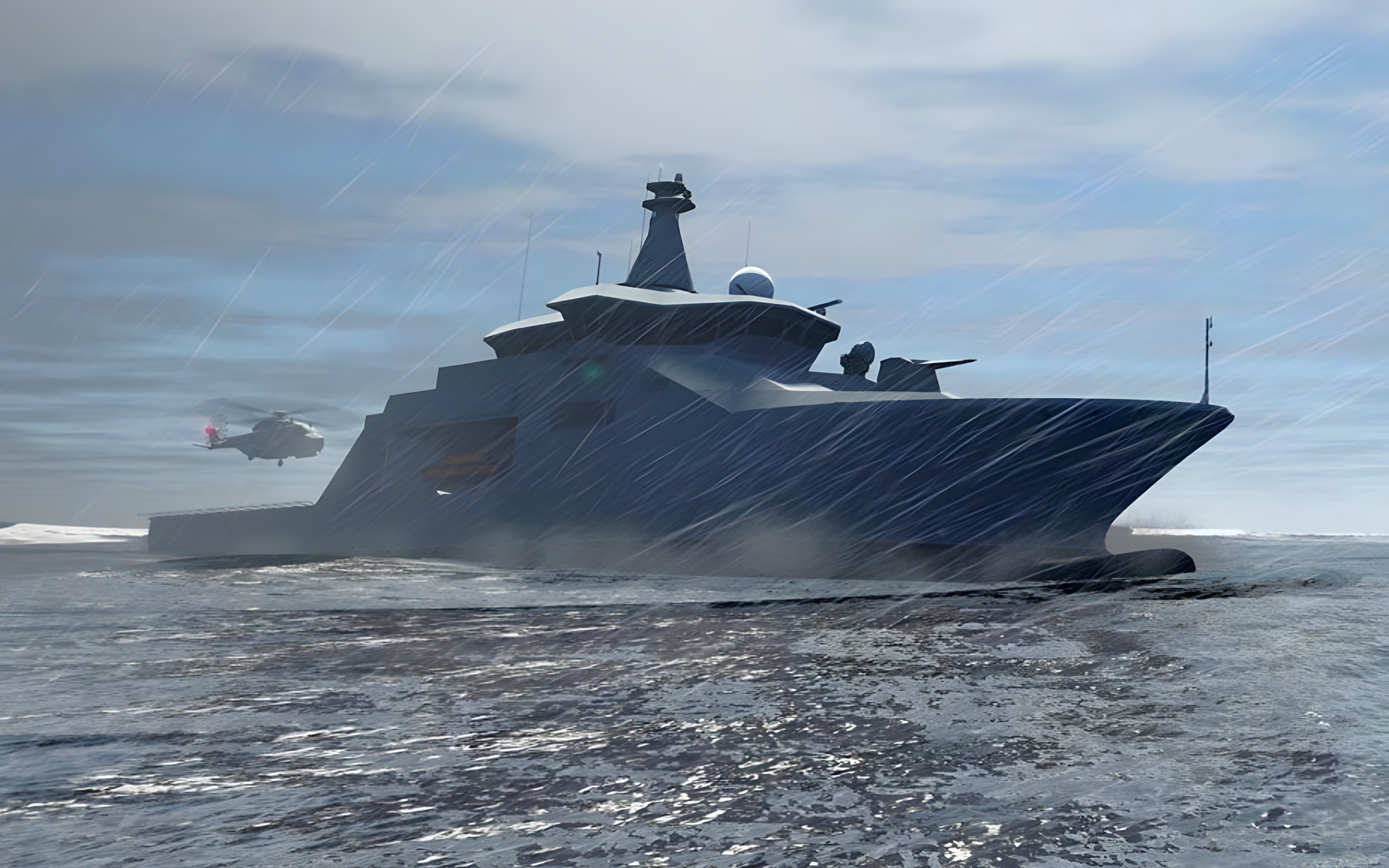
The UK will join Norway’s programme to develop offshore support vessels designed to deploy uncrewed minehunting and undersea-warfare systems, the Ministry of Defence stated.
The collaboration forms a central element of the new Lunna House Agreement, announced as Prime Minister Keir Starmer hosted Norwegian Prime Minister Jonas Støre at RAF Lossiemouth.
According to the MOD, the agreement is intended to strengthen protection of critical North Atlantic infrastructure amid what it describes as a 30 percent rise in Russian vessels detected near UK waters over the past two years. Both governments said the pact deepens long-standing cooperation and aligns with NATO priorities.
The press release confirms the UK’s entry into Norway’s unmanned support-vessel programme, stating that the agreement will see the “UK joining Norwegian programme to develop motherships for uncrewed mine hunting and undersea warfare systems.” This sits alongside wider industrial and operational cooperation on Type 26 frigates, naval strike missiles, torpedo stockpiles and Arctic training.
Prime Minister Starmer said the agreement strengthens the UK’s defensive posture. “At this time of profound global instability, as more Russian ships are being detected in our waters, we must work with international partners to protect our national security,” he said. “This historic agreement with Norway strengthens our ability to protect our borders and the critical infrastructure our nations depend on.”
Defence Secretary John Healey spoke on the shared approach to countering Russian submarine activity. “In this new era of threat and with increasing Russian activity in the North Atlantic, our strength comes from hard power and strong alliances,” he said. “Through this Lunna House Agreement, we will patrol the North Atlantic as one, train together in the Arctic, and develop the advanced equipment that will keep our citizens safe now and into the future.”
The mothership element expands on work both navies are already pursuing. The UK is replacing traditional minehunters with autonomous mine-countermeasure systems operated from larger support vessels under its Mine Hunting Capability programme, the broader plan here will require several hulls to act as motherships.
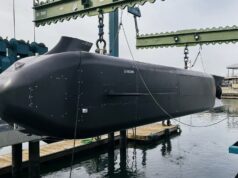
The agreement ties these efforts together, creating shared development pathways and shared operational concepts. It also links directly to existing industrial cooperation between BAE Systems and Kongsberg Defence and Aerospace, which are exploring potential support-vessel options. One candidate is the Kongsberg Vanguard concept, which offers modular bays and launch facilities suited to uncrewed underwater systems.
The MOD said the combined approach supports NATO’s broader push for autonomous capabilities in the High North and gives both navies a more persistent way to monitor seabed infrastructure, track threats and conduct mine-countermeasure operations without relying on traditional crewed platforms.




If you want to know more look at the Vanguard page on Kongsberg’s website. There is quite a lot of info there on the design and application.
Hopefully the design is mature enough to allow construction in the not too distant future.
is this going to being stead of the type 32 or is it the type 32 but not in name.
That’s a good question. I wonder that myself. It seems to fit the remit, or at least will be backed into the remit and called the Type 32 maybe
Or type 33 just to make it look an upgrade. To be honest this if it is a competent and reasonably well armed design is probably the right move for the T-32. Then if we can balance that and more T-31s to focus upon our relative needs. Confusion of role could distract from capabilities.
Why would it be well armed, its an MCM mothership.
Looks like their “blue water” variant can take a fair few missile options in containers plus the gun mounts. Relative, but that’s well armed if fitted. Someone will want TLAM, nuclear depth-charges and terminators of course.
Thank you GED for some intelligent insight, that’s probably more well armed than I anticipated, but flexible options are always helpful, these ships inevitably during conflict will be playing quite a dangerous role a lot of the time and as there is focus on taking out aviation tankers to effectively restrict operations these ships will be of similar interest to the enemy.
Well Hugo as I suspected was inevitable, you clearly failed to register the qualifying word ‘reasonably’. I didn’t qualify that term especially because until we know what exact form it will take what is reasonable for that guise is rather difficult to define. But for a ship of this nature not to have some reasonable (there’s that word again in case you missed it) self defence capabilities would be plain and simply stupid unless we expect it to be protected by much needed and scarce frigates. These vessels whatever form they take will undoubtedly be lone wolves for much, perhaps most of their time and you can damn well figure (unless you are a MoD committee at least), that they will be targeted by whatever enemy we face especially if vying the north east North or Arctic Seas where if we are working with Norway there is a very good chance they will actually operate. Hopefully that’s common sense enough an explanation.
I suspect the T32 is one dead and what ever it was will be replaced by this.
Well it should be a very mature design as it is based on the same very popular UT design as HMS Stirling Castle which was designed by Rolls Royce Commercial Marine here in Derby ! RR sold the business to Kongsberg in 2019 and pretty well moved it to Norway.
The interesting bit is that Norway doesn’t build many ships themselves due to their high labour costs, so where could they be built ?
IMHO this is a very sensible move and it could be they get built by VAARD in Romania due to cost and most of our facilities are rammed out !
cheaper I suppose than g build minesweepers.
If we get it it will have to be built in the UK under procurement rules as it’s an RN vessel.
There is a simple way round that one, you buy it as RFA realise you can’t crew it and then commission into the RN (or change the rules). Neither Proteus nor Stirling Castle are U.K. built (both VARD in Romania), it’s all well a fine insisting on high end stuff being built here but we need these, we need them to be affordable and we are all tapped out ship building wise !
Fergusons ?
Could do with them this Century mind.
Since the RN is merging with the Norwegian navy the rules might change 🙂
We’re probably still only getting 3
Hugo coffee and sugar now.. then repeat after me.. good things do happen and good thing happen all the time, I will embrace good things.
Lemme know when they stop delaying the DIP and maybe I’ll believe you
I will give you that one as long as you promise to think some positive thoughts..
To me this is good news as it’s possibly 5 hulls ( OSV and mine ) that are deployable and could essentially act as a 21c patrol frigate… but also not taking up building space in UK yards which cannot handle the work for at least the next 5 years..
Mirror image of the T26 deal. We take alternate deliveries of the Norwegian ship. Something like the Icelandic Thor 👌 5 off.
I too understood it to be 3, to join Stirling to get to the 4 mothers.
Build more, great! I’ll believe it when I see it, sadly.
Hi M8, Not even our Government is stupid enough to renage on a deal like this, you are looking at way less than £1 Billion for 5 which is peanuts to keep Norway happy. Now set that against the £10 Billion (or 12 if they go for the 6th T26 option), Norway is spending here.
If they are smart they will put together a joint programme, build the hulls abroad to keep costs down and outfit here and in Norway.
Trust me just because HMG can’t get its Political Double Speak in gear to make the DIP announcement doesn’t mean industry isn’t getting nods ! Long lead items often proceed before anyone says anything 😉
Besides which as “Rachel from accounts” has added £18.1 Billion in extra equipment budget over the next 4 years they need to get it announced ! 2024 budget for Defence (not inc SIA) was £56.9 billion (£60.4 actual) 28/29 is £73.9 Billion.
My guess is the service Chiefs are having a spat about who gets what and the leaks about Ajax aren’t doing the Army much good !
Hi mate.
I did read in the media that there is a bunfight ongoing between the RN and Army.
Are you sure? What is the source? How much of that extra is for equipment and people?
AFAIK all the extra vanishes into –
AUKUS.
GCAP.
Afghans.
Chagos payments.
Ukraine ongoing payments billions a year.
DNE overspend.
Money to the MIC………sorry!
Drones.
“new” munitions factories they won’t guarantee regular UK buys from.
And then the 4 billion plus SIA.
What is left?
And so much of that list should not be defence spending at all, but the FCDO…
Ah yes, SSN dismantling too.
M8 the source is the HMG Budget Policy report from last week it’s all there in black and white you just need to do the sums. Section 8 is Government Spending for the next 4/5 years, you just add 8.1, 8.2 and 8.3 together and it’s all there.
As for the bit about the Security Services budget coming out of the Defence Budget it doesn’t, it’s a completely separate budget and called the SIA. We lump them together for the NATO figures !
People, running costs, wages, pensions, maintenance etc is what they call Resource (DEL) what we call Opex in business). It goes up about £3.4 Billion pa over the next 4 years (38.6 to 42 Billion)
Equipment is what they call Capital (DEL) and it gradually goes up to an extra £10.1 Billion Pa over the next 5 years (23.1 to 33.2 Billion Pa) which is nearly 50% more.
What you have to remember is a lot of the existing projects are at or over the top of their cost curves so there should be more money available.
Hi mate.
Thanks, not areas I’m comfortable with, only what is in service, where, who, how many, and the orbat it fits in.
On the SIA, yes, Single Intelligence Account, followed it for years through my other interest, our intell agencies.
The HoC I&SC publications were most interesting.
It is added to the NATO figures, yes, but so is the 2.5 2.6 3.5 they are also NATO figures, no?
And so, 4 billion or so less on conventional kit as the SIA is added as it is indeed defence related.
One part I believe must have always been included though, the 4th intell service many never speak or seem to have heard of, our own DI, part of the MoD.
Your last paragraph you’ve said before, especially regards Dreadnaught, I need to remember that.
What are your predictions on DIP with this influx of money?
Hi Daniele
ABC Rodney’s summary on Capx is a great synopsis. I’m really keen to discover what this means for actual force level expansion are i.e. more aircraft, ships etc. Or is to early for that kind of detail? No doubt these Capex numbers must have been pre -allocated to respective projects before hand for budgetary approval.
I m struggling with the current reality in that across the RAF and RN (in particular) we see an ongoing reduction of force numbers. The sceptic in me thinks that much of this capex increase is for existing projects that are currently under funded. Keen to hear your insights you may have on force expansion .
Good insights ABC, thank you. I am keen to understand where and how this CAPEX expansion is being allocated, Also, are existing weapon/ship/aircraft/ upgrades and refits allocated to to the CAPEX or OPEX line?
With a circa 50% capex growth, Id like to understated where the actual force level expansion are i.e. more aircraft , more ships etc.
Hi Chris.
So would I! I mostly only see cuts, I’m not aware of any great force expansions beyond:
The most trumpeted, including by HMG, 4 billion on Drones. The Army have some thousands already, both Modini 250 long range strike types and the smaller FPVs.
Increases in ammunition stockpiles.
M270 Deep Fires, expanded to around 70, forming possibly 3 extra Batteries, 2 Regular, 1 Reserve,1 per Regiment.
SHORAD was said to triple.
MRAD to double, no details released apart from 12 more Sky Sabre, whether launchers or complete systems is murky as MoD HMG swap the terms repeatedly. Talk of a 3rd GBAD Regiment forming and 7 AD Group moving to Bde status.
“Cyber” area which they keep secret but which is taking on more money, pouring into the building site at Samlesbury.
Agree, how much of this uplift is going to get swallowed by existing under funded programs, probably plenty.
They will probably reconfirm the extra F35Bs and As for the umpteenth time, as part of an uplift.
I’ve probably missed out some areas, and of course there will be stuff that isn’t made public, I have heard of a few purchases and uplifts for certain SF areas for example.
I study our basing infrastructure extensively, have done for years. Every one I’m aware of. Lots of building work going on, so not highlighted in the fancy popular things that go bang but the all important enablers, especially on the intell side.
On force level expansion, how can you expand a force that was still shrinking? Even though recruitment has improved it seems by a few hundreds for the RN and the RAF.
We need thousands, not hundreds.
Where are the extra several thousand bodies the Army needs, for example.
Not for fantasy fleets of Armoured Divisions, but for rebuilding lost CS CSS to properly utilise what we have.
RAF wise, they talk of greater emphasis on dispersal. So….getting more old stations usable that have HAS and the people to enable dispersal. Where are they? To big for HAS, but the P8s are lined up like skittles at Lossumouth last time I looked.
Sensible?
Fast Air…Leeming, Leuchars ( still usable ) at least, Leeming not sure.
On the munitions front, several missile programs are underway, whether they become reality rather than government fantasy who knows.
Where are the people and bases to.operate them?
I’m afraid I hold a deep seated cynicism of anything HMG say, and that they are only interested in two areas. Nukes, for poltical reasons, and industry and jobs.
Not any military expansion.
They say so themselves with every statement,
sorry.
ABCR,
Greetings from the Colonies! Are the CAPEX and OPEX values listed in your post predicated upon a 2.5% of GDP expenditure rate, or an incrementally changing rate, increasing to 3.0% by the next Parliament? If the former case, the estimates listed could be significantly undervalued. It would be a truly remarkable event, if the MoD ever received adequate funding. 🤞
I do think we will get these.. the T26 deal was a deal that had 12 billion of reciprocal orders with Norway.. this would go some ways to burning into that and getting the RN great ships for autonomous capability but also some hull that can be patrol frigates ( they can be equipped with a short range air defence missile, medium gun and NSM) .
I get that logic from Rodders, and I agree, 12 billion though…what will we buy for that much?
M8 Norway are paying BAe, HMG makes £££ on the Tax and the knock on effects in the GDP plus the increase in orders lowers costs of what we buy for ourselves due to economies of scale.
TBH it’s irrelevant for this project, we need the ships, we want them as cheaply as possible and lumping our order in with Norways ticks that box.
FYI Belgium and Netherlands teamed up to design their Town Class MCMV Mother ships, they are being built in France and now the French are ordering their own version.
I read of the NSM as well being included, which is old news, and also the NMH being joint.
I think that 12 billion is not all reciprocal in defence I believe it’s any industrial….
Thanks J.
Yes, ABC explained that to me to relieve my ignorance!
I was thinking…hmmm , how to spend that till he explained these financial industrial realities.
Lets buy 8 of these then! I read they can be adapted in size and fit for varied roles?
I still expect just the 4 mothers planned sadly.
It seems that there are wider plans for Norway to also adopt stingray as its light torpedo and for the RN to focus on NSM as a bit more than an interim.
I honestly think there is more opportunity than 4 mine warfare hulls as the original scoping was also for a combined OSV as well for sea based surveillance. This goes back to a very old requirement for the RN to replace its mine warfare and patrol capabilities with 10 good 2000 all round patrol vessels.. for a long time the RN got sidetracked with the autonomous mine warfare game but now releases it needs actual ships not just some in shore boats. This is a great opportunity to get hull numbers up.. using 1 very cost effective programme without impacting on UK warship building capability.. because those 5 extra T26s means the UK really can provide 15-20 years of work for all its yards just on large combatants.. and building small combatants will just get in the way of the live and therefore efficiencies driven large combatant lines.. instead we get to buy a load of smaller surface combatants from a large open efficient line.. win win.
I think we many see 4 orders for the mine warfare, 2 for ocean surveillance up until 2035 then maybe a follow up order for a rivers 2 replacement.. it would make sense going into the 2040s with a single medium combatant for all patrol and mine warfare taskings.. the fact it will be designed to be modular and upgraded with NSM, medium gun and short range AAW missiles is gravy. Because if the convert all the T31s into high end combatants ( as they seem to plan to) they still need a patrol frigate option.
@J.
Like the old Black Swan thing?
Or were they called GCS class 2 or 3s?
It all seems great, I’ll enjoy the order HMG place.
Hi Daniele
For some unknown reason, I could not respond to your reply on my question as to where the xtra CAPEX is being invested (refer thread above). Anyway, thanks for the detailed reply. It was interesting reading (though sobering).
I think your point on the lack of secondary RAF bases is of particular concern.
The DIP isn’t delayed. I believe they said by the end of Autumn and we’re still in Autumn, just. Of course, later in the month they might turn around and say: “Did you think we were talking about Autumn in the Northern Hemisphere?”
They couldn’t confirmed it would be this year 2025 now so time will tell!
However we have been getting more news about investment this past week so Prehaps we will still get it within 3 weeks
It’s 2 weeks Parliament breaks up on 18th !
So they release it the day before and vanish before there’s time to hold them to account?
A bit like burying bad news on 9/11? 😉
Depends how you define Autumn, by at least one measure it finished 2 days ago… though other measures are available.
This seems like a good move, pinning MOD down to actually getting the minehunting motherships we need, and many commenters on this site speculated that we’d order Vanguard in reciprocation for a Type 26 order. It’s interesting that the article shies away from saying explicitly that it would be Vanguard, given that MOD already publicised a small, cheap study on the suitability of Vanguard for this purpose about 18 months ago. What was the result of that study?
I assume that these will not be deemed suitable for MRSS by the RN, who want MRSS to be more suitable for fighting. However, will the government fall into line or count these as amphibious platforms?
They’re far too small to do anything amphibious
Perhaps far too small is overstating it. Vanguard is a modular system rather than a particular ship, and even the example ships are supposed to be 130m long and 5,000 ton displacement, so not tiny. If I said three 30K ton strike amphibs (which is the size builders are currently offering, presumably after RN hints) and three upsized 10K ton Vanguards to make up the MRSS “fleet”, I think it could be considered a reasonable mix, sizewise, contrasted with 6 strike ships all at 20k, which would be significantly more expensive, even though the overall tonnage is the same.
If you look at how Damen did the through-deck 7,000 ton multi-purpose ship for Portugal and announced it alongside alternative 9,000 ton design, perhaps the idea of a Vanguard upsized to 10K isn’t too outlandish.
The platform Portugal is getting is a useless tub, we don’t need a derivative of that
They are two separate things. MRSS have been funding and are going to be large scale for amphibious jobs.
I know they wanted 3 drone/motherships but if these can be build cheaply we could have 5-10 of these for the North Sea. That would allow 3 to be out to see all the time
The designs on Kongsberg’s website clearly show this as a small ship specifically designed to launch and control drones and small teams. It has no amphibious capability. How they tie in with RFA Proteus and HMS Stirling Castle I am not sure. Do they complement each other or will Vanguard replace them?
MRSS will be a different class of ship entirely, much larger, with a well deck and potentially fit with Mk41 VLS for CAMM and FC/ASW. The last time I heard Radakin talk about them this was his thinking. Whether that comes to fruition is anyone’s guess.
The funded study was for mine warfare and for the OSV capabilities so it looks like the RN wants one hull type for both activities which makes sense and gives you five hulls..
It’s pretty clear proteus and castle were all about concept work and are not likely to be deployable beyond that in the local EEZ.
Proteus is not a stop gap it’s a permanent capability, Stirling castle is the trials platform but there were no plans to decommission it either
Let’s see how long they last.. if the RN looks for 5 ships for the OSV and mine roles that’s a decade to produce the final programme really.. 5 years to the first then 1 per year I doubt very much they planned to have either P or Stirling to be operational beyond the early to mid 2030s
Hi M8, It will be tied in with Norway and they do not hang around, their procurement system is blitzed lightning compared to ours and they will get very good value for money. The advantage of being a small country with very, very deep pockets !
Yes, the UK could do much worse than forming a closer alliance w/ a nation w/ Viking ancestry and a $2+Tn sovereign wealth fund. The only downside the Norwegians have is sharing a border q/Mad Vlad and the Orcs.
Replace the batch 1 Rivers.
There’s no plan to
The study for this has been going on for some time now, I think the government handed over 300 million at the beginning of the year for a review of this vessel type to cover its OSV requirements and mine warfare requirement in one vessel type.. so we are probably looking at 5 in total, that would make sense as that would with the Rivers 2s make for 10 patrol type vessels that can cart around autonomous systems ( the RN always wanted 10 ocean going patrol craft) .. I would imagine if the RN is being clever it could then in 15 years retire out the Rivers 2 for 5 more of these for a single cogent patrol mother ship fleet..
What is also interesting is these are modular beasts that can its seems be made up to a patrol frigate armament ( medium gun, short range air defence missiles and NSM)… which means the RN would be able to modify them depending on threat.. if one is deployed in local EEZ just the gun.. if it’s the Falklands guard ship or deployed east or suez it could have a patrol frigate configuration.
It’s worth remembering the RN did love a light patrol frigate and they have their uses… as long as you don’t throw them into the deep end.
DIP is definitely coming soon, these are a series of pretty important decisions that are being taken.
I like the more general collaboration with Norway as well.
I recall it being significantly less money, and I found an article on UKDJ (July 12, 2024) saying it was between £150K and £300K. Have you slipped three decimal points or are we taking about different studies?
I may have been wrong as I was writing from memory.. so I knew it was 3 with lots of zeros 😂
And as Paul says above if they replace the B1s it could be class of 8 straight up.
A few more T31s for spreading the RN presence could be useful or could the Land Attack or MRNP AH140 fit part of the MRSS bill?
It would be nice to but the R1s were replaced by the R2s
cheaper I suppose than g build minesweepers. id rather not know what starmer says about anything. I don’t trust him as far as I can spit a rat. he’s a typical labour prime minister writing cheques that the nation cannot afford to pay. promises of all those submarines e. etc we know, will not happen..
Ah good another project we were short of them. We might have a small Army, old kit and next to no SP Arty but we top the world in dead end, filler, may be may, be not projects and meetons we are the world leader.
The army is in dire straights for sure, but we have an immediate direct threat to the UK’s infrastructure, specifically undersea cables and pipes. These ships are needed and should be a priority imo.
The army is not in a good way – but the SP artillery is already in action in Ukraine, just with Ukrainian crews instead of British and it’s the Navy that is the most important part of the armed forces.
Yes the RCH 155 is in Ukraine but thats no good to us is it, we have 14 older style Archers thats it. And i have to agree the Navy is the main force though sure others will disagree. The Army is sdad joke a total mess.
Wonder why they can’t even order an additional 14 new style Archers for an interim if that’d be useful as the UK doesn’t have any towed 155mm? If they’re on the MAN chassis that’s already in the Army’s fleet.
i have a feeling the Archers will go to Ukraine if and when finally order new SP Arty, but why they only ordered 14 older style ones i do not know seems a kind make do and mend stop gay.
Agree we do need to get our artilley sorted, but fact is that Ukraine is wearing down Russia’s military capabilities and making it less likely that they will be able to attack other European countries. Like it or not it’s a proxy war – so it is of use to us to send equipment to Ukraine. Better that than have Ukraine over run.
We have sent too much, the cuboards are now empty we have no really heavy Arty we gave it all away, there is helping Ukraine and there is robbing Peter to pay Paul, We drag our feet on every thing let our own army turn to a shambbles and still do nothing to fix it. That is a dangerous thing to do hope other fight the battle so we do not have because we can not even if we wanted to. 14 older style Archers is not enough likely only 8 to 10 are ever deployed as unit s not deployed need them to train on We have no up graded MLRS to deply we gave the B1’s away and only have 2 new A2’s as far as i know.
We could not fight a war, that is disgraceful nothing to be happy about.
🥱
Totally agree deal with treath in order and as you can, but its just seems a lot open projects but nothing else big lack of orders or even to be honest lack direction. The MOD and very much the Army seem to be incapable of doing any thing but talking, releasing wind bag statments and having projects. Not sure why is it a lack of money, or a lack of leadership? or just are things behind the scenes that bad no one is really in control?
Theyre all waiting for the DIP to see what we can actually pay for
i know but its delayed was just asking why, will be some smoke and mirrors statment about some thing or other, mixed with half truths and deception i guess as always. No will get what they want and we will pay more in the long run or just go with out.
Good news . The more we can do with the JEF countries the better.
This is another good news story in the last few days. I know many on here are frustrated at the lack of big orders, but my reading of the problem is that there is a lack of industrial capacity across Europe and the UK which will take time to rebuild. The stark reality of our situation only really came to light for the politicians when Russia invaded Ukraine and it quickly became clear that the NATO, including the US, could not match the Ukrainian’s artillery munitions needs..! There were guns in the firing line with no shells!
Rebuilding the industrial capability is the first step to rearming. That does indeed mean more skilled jobs and they will need to be pretty well paid if they are to be reattained. Most of the good news has been focused on industrial issue, for example, the development of a new ballistic missile and an increased produtin rate for the Chally 3 MBT. For me shows that rearmament is been taken seriously because you don’t build new factories, buy expensive new machine tools and, crucially, take on 1000’s of apprentices. Add it all up and the industrial investment in the UK must be into the billions when you factor in the full supply chain.
Navantia have just announced first steel cut on the first FSS ship having invested over £100m so far in the H&W group (in addition to the purchase cost of the business (?) ) and that is just one example. The amount of effort and financial resources being invested by industry would not be forth coming without some kind of procurement signal from the market, i.e. the MoD / HMG / partners.
I agree that there will have been hold ups in the MoD, inevitable given the way in which it works and given human behaviours but there will also have been a huge capability gap in our industrial gap. Efforts to fix those industrial issue seem finally to be yielding results.
Fingers crossed the MoD / HMG doesn’t blow it by not ordering stuff… The Defence Investment Plan will be a key document, although I do not expect too many hard numbers to be honest.
Cheers CR
Why is the D.I.P still delayed? is it still seeing what is needed, lack of money, lack of the the capicity to build what might be ordered or just lack of direction in what to get? I agree building up the industry to supply is a first as it was found wanting. When ever the MOD delay things its not ever a good thing. Some Arty regets have no kit empty gun parks, That is not a great way to run things. Give every thing away then do noting about replacing it but have endless meetings and projects.
Any delay in ordering effects in service dates in a rush a bit of kit when deliverd tested and trialed the acceptted and not like Ajax will take over a year to enter service So really at least 2 to 4 years and build rates are so slow its 10 years to build a fleet or even longer all going well.
Don’t get your hopes up. Do people REALLY believe the DIP will be some sort of shopping list??? I think it will be a rehash of what is already known, a few financial vows that won’t be kept, and a few small carrots thrown in for public impact, like 12 F35A and the 12 SSNs.
Exactly, some people are living in a fantasy i fear.
ha ha oh i know it will be a dispointment, not much will be ordered and what is confirmed is years away. Those on here expecting a new IVF/loads of RCH 155 and long range air defence etc will not be happy. It will be a money or lack of it, driven fudge. All that was needed can never be paid for so it really just to see what is finally ordred and what is left out or gapped and kicked in to the very, very tall MOD long grass. The spin and whaffle will intresting to watch though. MOD is expert at talking up nothing and rehashed things and projects.
Further evidence that the RN is returning to its Cold War focus on the North Atlantic, and I’m can’t complain. Norway going forward will be our more important European ally.
Are these planned to be RFA or RN operated?
No idea, but I’d hope by the RN. RFA Stirling Castle had to go over to the RN, and should not be RFA. The RFA should be about supplying the fleet at sea, the Bays it operates are LPD”A” for Auxiliary, they were not meant to be our primary amphibs, no more than the Sirs were when they were in service.
Develop. Fine. Especially with the Norway, great allies.
But, we needed them years ago. How long before they are actually built and cans stop being kicked down roads?
Good news. The level of military cooperation with Norway is set to become extraordinary. But the UK needs to be seen to be buying some stuff from Norway in order to make it politically easier for them to keep selecting expensive UK equipment, e,g. the expected order for AW101 helicopters for their T26 frigates – an order which is badly needed by Leonardo UK.