

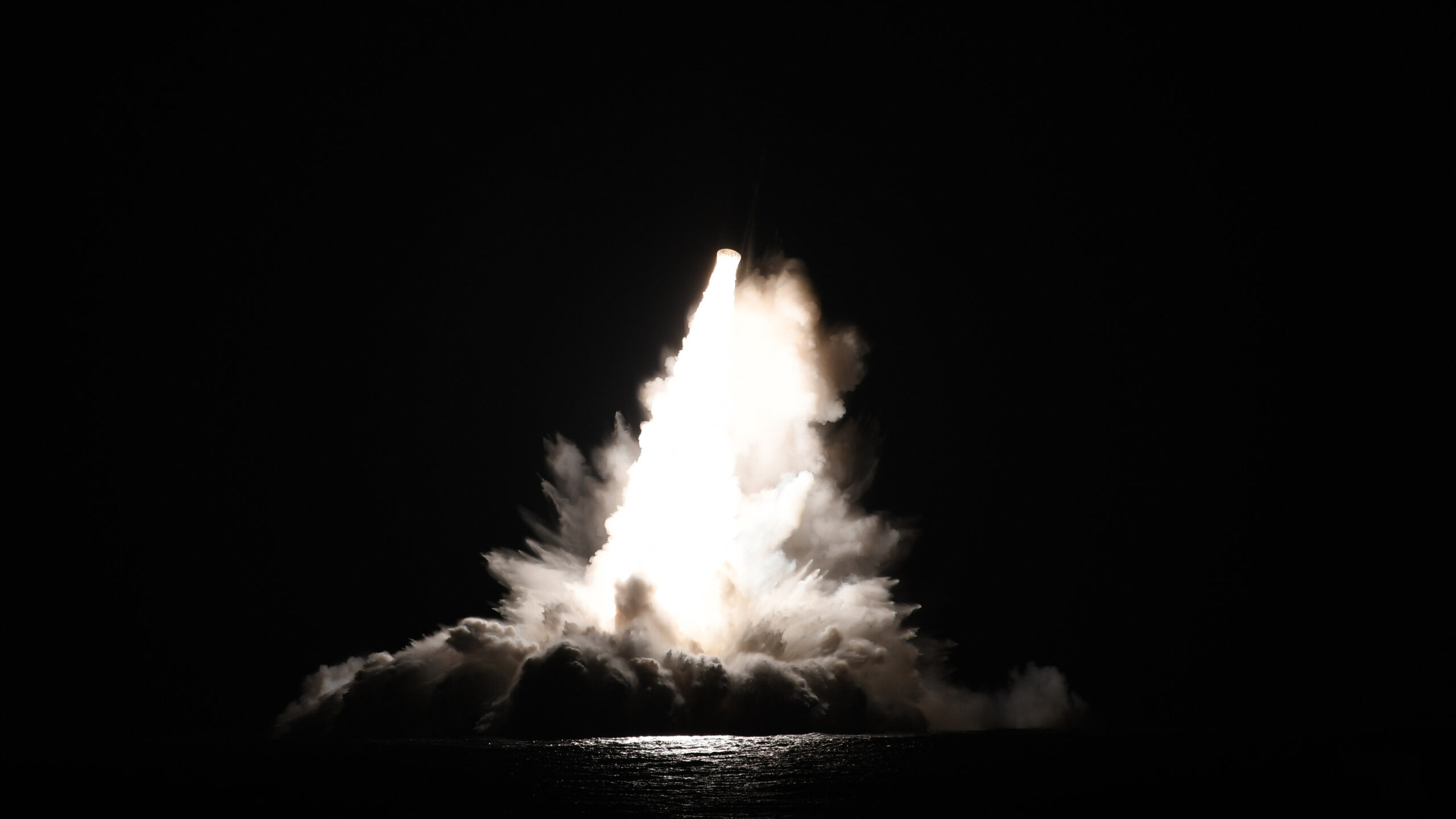
Minister says UK remains committed to Trident system despite deepening nuclear cooperation.
In response to a parliamentary question on potential collaboration over France’s M51.4 submarine-launched ballistic missile, Defence Minister Luke Pollard reaffirmed that the UK will continue to rely on the US-supplied Trident II D5 system.
“The UK and France work closely together on a range of nuclear research and technology matters, including as part of the 2010 Teutates Treaty,” Pollard said.
He added that cooperation is also expanding under the 2025 Northwood Declaration, which includes closer alignment on nuclear policy, capabilities and operations.
However, the minister made clear that this does not extend to adopting a joint missile system.
“The UK will continue to rely on its Trident II D5 submarine launched ballistic missiles, which we procure from the United States,” he said.
“The Trident missile system remains the most reliable weapons system in the world and the government has absolute confidence that the UK’s deterrent remains effective, dependable, and formidable.”
The United Kingdom’s Trident system and France’s M51 are both submarine-launched nuclear missile systems designed to provide a constant at-sea deterrent.
The UK uses the Trident II D5 missile aboard its Vanguard-class submarines, with a new Dreadnought class set to take over in the next decade, and the missiles themselves are drawn from a shared pool with the United States, fitted with British warheads.
France operates its own M51 missiles on Triomphant-class submarines, with newer versions such as the M51.2 and the upcoming M51.4 improving range, accuracy and the ability to get through defences.
In practical terms, both systems do the same job, ensuring each country can respond even after a surprise attack, but they are developed and supported in different ways.
Most reliable?
A key reason Trident II D5 is still seen as one of the most successful strategic weapons systems is the depth and consistency of its testing record over several decades. Since entering service in the late 1980s, it has been test fired more than 200 times, with the vast majority of those launches successful, giving it a reliability rate well above 90 per cent.
There have also been long runs of consecutive successful tests, which is notable for a system of this complexity. Set against that, the two recent Royal Navy test failures are significant but remain rare in the overall record. They are generally understood to relate to specific circumstances during those trials rather than a fundamental issue with the missile itself.
The evidence still points to a system that has performed with a high degree of reliability over time.




Swapping reliance on France would be just as bad if not worse than swapping reliance on the USA, both have ultra nationalist political factions on the verge of obtaining power. The M51 is also slightly too wide to fit inside our existing vanguard and future Dreadnaught class submarines.
Nothing to stop us though getting MBDA to work along with Ariane Group to build our own SLBM. The technology is no longer particularly difficult, France paid €4 billion to develop M51 a further €3 billion to procure. These sums are well with in our capacity. If your spending £50 billion on boats and warheads why not spend the extra £7 billion to ensure a completely independent system.
Then we can stop listening to that orange sack of s**t across the pond.
Developing an independent SLBM and a UK tactical nuclear cruise missile should be the main two national priorities. Europe can provide everything else in a square off with Russia. We are the only ones willing and able to do nuclear.
The problem is that the way UK does and costs things would be 3-5x that.
French costs are very reasonable mainly because the entities are monolithic and realise that if the costs are not palatable then the projects won’t happen. In the UK our subcontracting culture amplifies costs and increases delays multiplied by the stop start nature of MoD funding.