

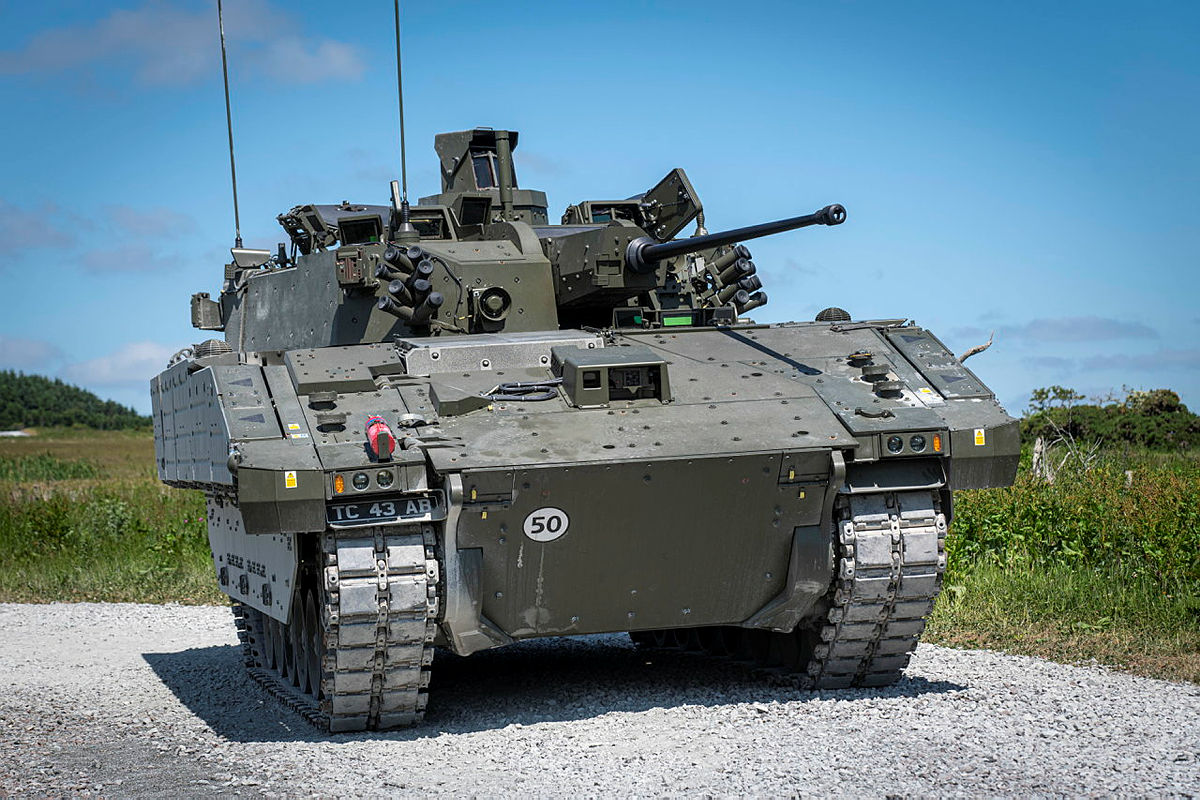
The Ministry of Defence has said that General Dynamics is not currently in breach of its contract for the Ajax armoured vehicle programme, despite renewed concerns over safety, vibration issues and operational viability raised in Parliament.
Appearing before the Defence Committee, the National Armaments Director Rupert Pearce told MPs that investigations into recent incidents involving Ajax vehicles were still ongoing and that any contractual action would depend on their findings.
“At this stage, General Dynamics is not in breach of its contract,” Pearce said. “The investigation will give us further facts and details, which may give us rights under the contract. We will cross that bridge when we get to it.” Pearce added that the Ministry would not pre-judge the outcome. “We rule nothing in and nothing out. We have strong rights in our contract, and we will enforce those rights in the relevant circumstances.”
The comments came after MPs questioned how Ajax vehicles had been declared operationally capable given reports of severe vibration, illness among crews and equipment failures. Pearce confirmed that deployments had been halted after personnel were injured.
“When we saw our colleagues injured, we immediately stopped the deployment and brought the Ajaxes back to base,” he said. “We are very committed to safety and looking after our warfighters.”
The MoD has launched four parallel investigations into the issue, including reviews by the Army, the Defence Accident Investigation Branch, a ministerial review and independent oversight. According to Pearce, the aim is to build a clear, verified picture of what went wrong. Lieutenant General Anna-Lee Reilly told the Committee it was too early to draw conclusions. “We need to wait for those investigations to bear fruit and then we can make a judgment on next steps,” she said, adding that work with General Dynamics was continuing as part of what she described as a “whole-force effort” involving industry and academia.
Pressed on who would ultimately bear the cost of fixing any defects, Jim Carter, Director General Commercial and Industry at the MoD, said the Ajax contract was firm-price. “General Dynamics is responsible for delivering,” Carter said. “Subject to the investigation, we will be applying the contract terms to make sure that it is carried through.”
Pearce also cautioned that safety alone would not be sufficient if the vehicle proved impractical in combat. “It is not enough that the Ajax is safe; it also has to be operationally capable,” he said. “We are putting brave men and women on to the battlefield in this vehicle, and they have to be able to deliver their operations effectively and safely.”
The Ajax programme, valued at around £6.5 billion, has faced repeated delays and scrutiny over testing and reporting culture. Pearce acknowledged criticism from previous parliamentary inquiries into what was described as a culture of over-optimism within both the department and industry.
“It is very easy to get over-optimistic on long-term programmes,” he said. “We must have a culture where people are actively encouraged to stick up their hand and say, ‘We have a problem.’”
The MoD has said it will return to Parliament once the investigations conclude, at which point it will decide whether contractual remedies are required.





Meanwhile Labour spunks £570m a year on Erasmus, despite us being on a war footing and all.
If there is that on a money tree the army could get 50 CB90s per year or some other needed kit.
Yep, but it’s only £8.5 billion so that students can tarvel abroad !!! Also gives Starmer an excuse to fly off somewhere.
It brings in a lot of money and talent for universities but I guess that doesn’t conform with your world view.
Agree,
Rather depends on what they are coming here to study doesn’t it? I don’t quite see why the cost to the taxpayer is so high. hard to see it is a priority now other than greasing the wheels of EU relationships but hey what do I know.
Wait and see, the modern Britain motto. Waiting has become a national pastime.
It always was, Geoff. Love of queueing is in our British genes. Football is coming home…but probably not in our lifetime 😂
True enough. I just never expected to spend my life queing on the phone… “you are number 16 but your call is important” Bit like defence orders.
May be they should ask Scania or Ford design engineers to take a look too! The motor industry know how to sort NVH issues better than most and how to search out banks and rattles. One option could be to find a base vehicle that can fit the Ajax gun turret temporally (if such a vehicle exists) that is available on the reserve lists such as the US Bradley? In the short term, only a cobbled up solution appears to be feasible if the CVT function is to be quickly restored to the field units.
To go for Bradley we would need the M3 scout not the M2 IFV! Apparently there are around 800 M3s in storage! Would the cousins allow many of them to go?
There are new plans for a Bradley upgrade to meet the US Army’s needs, so this could muddy the waters, yet I’m sure a lease/lend programme, say over ten years, would allow for the Ajax gun vehicles to be replaced. However, any deal is going to take at least two years at full pelt to make good and train crews all of which, is yet more delay. That said, what choices does the MOD have???
I would imagine it’s the sensors and equipment on the vehicle, We don’t know what they’re experiment in with, how they work and what they are. All we know is it’s very sophisticated, and designed for reconnaissance. I can’t believe it’s just the vehicle itself, as we’ve been building tracked vehicles since the 1900s!
The sensors are not what is making everyone sick. Armoured Reece is not unique to UK. This thing is so far behind schedule that any advantage it might have once had has long since disappeared.
Scrap Ajax and go for CV90 like every sensible European nation has already done!!
I would guess there is no CV90 capacity due to their current order book, and establishing a manufacturing plant in the UK would take at least two – three years, and another eighteen months before the vehicles could be issued to units. Can the Army function without the recon element for four + years?
BAE offered to manufacture the CV90 near Newcastle during the initial competition
Coll, my understanding is that BAE offered to build CV90 Recce in this country after the contract had been awarded to GDUK!! Dozy beggars missed the boat.
I believe you are correct Graham, although would it have mattered with the anti BAE view we discussed previously. Even then Graham was it more than just assembly kits for CV90 that they have eventually allowed elsewhere.
Graham, whichever route it’s more delay. I may have mentioned this to you but could CVT hulls be converted to remote recon drones as they are still in plentyfull supply in private hands and are probably in better condition than at the time of withdrawal? These could augment Ajax(or another) where there is a high risk to manned crews.
This Ajax mess is unforgiveable and is having some serious ramifications in Whitehall and rightly so as the Army is without a vital component at a worring time in our history. A lease/lend of Bradley may be on the cards, which would allow time to buy another vehicle and build it in the UK, but that would be a 3-4 year programme.
Maurice, I was once the technical staff officer at RARDE Chertsey in the division doing R&D on UGV and we had a technology demonstrator recce vehicle that was based on an Alvis STORMER – all an age ago (early late 80s/90s).
CVR(T) mostly, if not completely disposed of. Its not at all feasible buying back 50-year-old Scimitars from private owners. It would cost a small fortune to buy them back, convert all to Mk2 spec, put them through a Base Overhaul and then convert them to unmanned operation. I can’t think of any advantages at all. I doubt the new ISTAR kit would fit in such a small vehicle anyway.
Currently a number of Warrior have been reroled as an interim recce vehicle between Scimitar and Ajax era. Why not continue with that for now and perhaps transfer some Ajax kit to those interim Warriors.
Quick study on whether to do proper fixes on Ajax or to cancel. If we stick with Ajax suitably reworked then interim Warriors hold the fort.
If we bin Ajax, then look at whether a better engineered job can be done for Warrior recce or buy surplus Bradley M3 CFV or second hand CV90 and convert to recce (give the job to BAE). Other options may present themselves but I cannot see new vehicles being purchased.
Don’t build a brand new recce vehicle in the UK – it would take 10 years, not 3-4.
Graham, thanks for your response on CVT conversion. I can’t see Ajax being axed, there are too many cost and political issues involved. However, the manufacturer may be found wanting if litigation is pursued by MOD. Once Ajax orders are completed, which may be more protracted than planned due to ongoing mods, any likely follow-on orders may be ditched in preference for CV90? This option could take a few years to realise if a UK based factory is demanded by the Government. I feel sure CV90 could be the basis for a partial Warrior replacement too, however the MOD insist this vehicle in its current role will be gone by 2027.
Maurice, I too think it less likely that Ajax will be cancelled for several reasons that I won’t bore you with. So if Ajax is properly fixed, and Ajax orders are completed and the vhehicles fieleded, I do not see that there are any follow-on orders. MoD has ordered 589 Ajax family vehicles and that would seem to be the lot for armoured recce and variants.
It is doubtful whether GDUK with its assembly hall in Wales will get any more AFV orders – they should stick to making avionics and comms systems, if they stay in business as a viable company.
The next question, as you say, is how to get a proper IFV for the army, very quickly, to replace Warrior. CV90 IFV and its variants is one option. They could be asembled at one of BAE’s UK sites.
HMG always demand UK jobs feature in any contract for platforms.
BAE offered to manufacture the CV90 near Newcastle during the initial competition..
Bit late now
Apologies for the duplication.
Colin, who is going to ask the Treasury for another c£5.5bn?
Say its for DEI & you will get the money straight away.
🥱
DEI doesn’t exist in the UK so that would be pointless.
That’s actually really quite strongly worded.. if I had written that in a report on a provider that was failing, they would know that that they were just about to get their ass handed to them and to be found in breach and issued a formal breach notice… and that I was just dotting my i’s and crossing my T’s ready for legal proceedings.
Indeed – curiouser and curiouser.
All we need is a White Rabbit and a Top Hat….maybe a small bottle labelled ‘drink me’ and a key.
I’ve gone into more detail below, but to summarise: after years of ongoing issues, the MoD surely knows where they stand legally, so coming out with “At this stage, General Dynamics is not in breach of its contract” doesn’t look good for us taxpayers.
The AJAX vehicles are in breach of the sale of goods act, they neither meet satisfactory quality or fit for purpose. The problem is GD UK are a limited company with no money, only asset is the factory in Wales, they made 6 k loss in 2023 and 10k loss in 2024. Profits would be limited by project overrunning for years, expect they charged a lot for Spanish hulls and US I.P. and consultants etc to transfer money out the country.
I’d -yet again- just like to point out that it’s almost 2026 and we are still discussing this issue on here- seemingly ad infinitum..It’s like de ja vue all over again.
Indeed, the initial deliveries were supposed to be in 2017. Since they are eight years late perhaps some lawyer here or someone with more up to date knowledge of the law of contract can explain why GD are not in breach since they are so late in delivery
It is quite impressive how it’s 8 years delayed and still surprisingly poor build quality with major engineering issues. Most could accept the delay if they were getting a well designed and built end product.
I’d like to know what the additional 8 years actually bought. If they’d known and cancelled by sticking with targets they could still have had many vehicles from a replacement program delivered.
Can’t upset the MIC can we?
Wtf do they have to do in order to be in breach then? Second question which halfwit signed this contract?
it was said by John Hartley on one of the other threads about Ajax , that is 2016 the Army decided on a change of specification. not good it that is the case
Yes, I fear that will be the GD defence in any lawsuit. Meanwhile, I would like to see one Ajax given rubberised tracks & the most heavy duty models of the Spanish rotary dampers, to see if that fixes it. (i.e replace AR01 & 02, with AR29T &/or AR35).
thanks for the confirmation. lets hope they look at your solution
Simon, of course the army made spec changes. That always happens on a long procurement. It apparently was just the once, in 2016.
Some might say they should have made another spec change after Feb 2022, ie to specify an integral anti-drone system.
True, but how much of change and what has been the effect ? suddenly load on a huge amount of extra kit and increasing the weight, may not have been a good idea
General Dynamics are of course in breach of contract, unless that contract had a built-in clause, allowing them to injure/kill or maim the ‘end-user’.
The MOD will however continue to accept this wreck into service, as there are no funds available to do otherwise.
To clarify once and for all, the defence review that liebour carried out last year, was to determine where and how £2billion worth of savings could be made.
If the contract is ‘firm-price’, and GD are ‘*not currently* in breach’ (i.e. status is still officially an overrun/failure to meet IOC, further evidence pending) I would venture:
a) GD are liable for any and all program costs,
b) due to there being 4 separately targetted inquiries, there might be a lot of blame to go around
c) It is highly likely that GD will be the genesis of some of these failings as they designed and built the thing
The program has been a disaster, but there’s hope it might at least be one the taxpayer won’t have to fund.
Nate, MoD declared IOC barely a fortnight ago!
Which is why I included b) in my list above – blame to go around in many departments no doubt and for many different reasons, but the fact remains that the vehicle doesn’t work – GD designed and built it
Nate, I’m not sure it’s quite that straightforward. Even with a firm-price contract, liability depends on whether the vehicle demonstrably fails to meet contracted requirements, not simply whether the programme has had problems or public setbacks. As Graham mentions, declaring IOC, even recently, complicates the argument that the platform “doesn’t work” in contractual terms.
It’s also worth separating design responsibility from requirements and risk ownership. GD designed and built the vehicle, but they did so against MoD-defined requirements and constraints, including the decision to base Ajax on an ASCOD-derived chassis and push it into a much higher weight and capability class.
Whether the taxpayer avoids further cost will depend less on optics and more on what the contract actually specifies around performance, mitigation, and remediation. If the MoD truly had this fully covered contractually, you would expect vehicles to be rejected or returned. Instead, the MoD has absorbed costs associated with mitigation measures, extended trials, and programme delays, while also accepting vehicles and declaring IOC.
Finally, these issues have been ongoing for years, so legal teams have had plenty of time to review the situation. Surely both sides know who took on the risk legally. I would argue that the MoD accepted the risk at the time, rather than paying for a clean-sheet design and all the R&D that would have come with it.
Hi Greg, while I get all of your points and understand tht of course this is a long running, very multilayered program with many overlappping responsibilties etc, it is prima facie a failed system as it currently stands – i.e. GD have NOT met the requirements. Where is my evidence? The fact that the vehicle is injuring a high proportion of those using it. There will need to be a line by line investigation to find out what happened where and when, and by whom for ‘the official record’, but the fact remains, the vehicle is unusuable.
At some point it really is as simple as saying: we asked you for a vehicle, you gave us a vehicle, that vehicle cannot be used because it damages the user, ergo you are liable for its cost.
Although MOD must have run interferance between GD and HMG at various points (“I was given assurances…”), they were running interferrance because GD have fucked up and/or MOD have been adding requirements – if they couldn’t deliver a functioning vehicle that met all the requirements while using the specified ASCOD-chasis, that meets budget and safety requirements, then this should have been disclosed before the program started, or, in the case of ballooning requirements set ad-hoc by the MOD, there should have been a redrafting of the contract and a design re-think.
At the end of the day, even if MOD pressured GD to accept new requirements, it is down to the company to say ‘hey, we can’t do that, sorry not in the contract’. If they didn’t and blundered on with their sinking ship, then they are liable for the cost, whilst those responsible at the MOD should be fired and potentially face some level of legal consequences.
Nate, it is very common for the spec to be changed by the customer on a long running procurement. Things change. It happened only once on Ajax, in 2016, which I think is remarkable. A formal Contract Amendment is done and GDUK would be paid extra big bucks.
Some might say a further Contract Amendment was required after Feb 2022 to include an anti-drone capability.
The issue appears to be major design floors, so contractually they may be building it as designed and agreed albeit poorly and even if build quality improved the design issues would persist.
It is becoming more apparent further redesign is needed, certainly of the hull and suspension/tracks, which will be outside the scope of the manufacture, several estimates put out by commentators seem to indicate this could be between £1.5 bn and £2bn alone and still would not fix all the design issues. Its almost costs only ever seem to go up so it could spiral very quickly, especially with the MOD.
Hi AT, if you give an architect an unsound plan for a building and they sign a contract saying they’ll deliver it, and then the building falls down – they should be held responsible. There will be others who contributed to the cock up, but if the company signs a contract knowing it is unachievable, or are too incompetent to realise it is unachievable, then they deserve to be held liable. If the contractor runs interference between the architects, the construction company and the client, then they should be held liable as well.
Hi Nate, you would think that’s how it would work, how it should work, but defence is its own set of rules, essentially the MIC always wins, it’s a rigged game.
There doesn’t seem to be a shortage of people who knew about the issues and could have done something earlier on, but all know there is no accountability so there is no need to do something about it.
With how limited funds are, more than ever every failure needs to be accounted for so they stop happening.
GD UK would simply go bankrupt, they are like a shell company with only a factory of value.
In my view, the core problem with Ajax stems from the decision to adapt the ASCOD chassis (adding 12–14 tonnes) rather than start with a clean-sheet design. Compressing development onto a pre-existing platform meant R&D was limited and, by the looks of it, relied on optimistic assumptions. A purpose-built design, though more expensive upfront, would have been engineered from the ground up to carry the additional weight they wanted over ASCOD.
Hindsight is a great thing. If the vehicle had no serious issues now, cutting corners might have been justified. But that is the risk the MoD went with at the time.
If at the start, the British Army had been told very firmly, that they could increase Ascod weight from 28 to 32 tons, but no more, then all would have been well. Instead they put every shiny new toy they could think of on it, & ended up with a 38-42 ton porker.
Follow the money and see who took it to overlook this blatant theft.
Start sacking generals, civil servants and politicians banning them from the industry completely
Sadly nobody will be held accountable
Can’t say I know anything on the contractual side of things. But tbh regarding IOC acceptance MOD should recind it due to ‘ further testing shows significant safety issues etc etc’. Then hit GD for breach of contract and such.
Then this is yet another fracked MoD contract managed (sic).
.
.
.
Give the Services a Merry Christmas and sack the complete MoD, splitting the defence budget on 40% RN, 25% BA & 25% RAF. Simple solution.
The power of non executive Directorships
I wonder how this program would have gone if accountability was a thing in defence procurement, because it doesn’t seem to be at any level of management or stage of the program, as if results do not matter, just make decisions then it’s someone else’s problem.
The key questions here apart from allegedly the CTA40 main armament jamming, what other systems are failing and why? Is if GD knew of vibration & noise issues in 2010, and the Army& GD knew that the early vehicle hulls did not meet design & quality standards with multiple major quality failings, total lack of repeatability between hulls affecting certainly the first 150 hulls. WHY & WHO signed them off for acceptance? Or insisted they were accepted? If it was one or a combination of the many ex General Staff,REME, ATDU, DE&S personnel now residing in GD then an immediate SFO/NCA corruption investigation is warranted.
The sad truth is, that everyone involved in this project has known of the issues since the outset. However, for reasons unknown, those that tried address the issues were bullied, intimidated, brow beaten or ignored.
Major quality failings identified in GD Spains work went unresolved and appear to have been accepted regardless of known quality, dimensional, and build r standard failings. If there are not Court martial proceedings for the military and criminal charges against civilians involved it will prove that HMG, MoD, Army have learned nothing from this debacle and seek to preserve the status quo.
The vibration is said to have damaged bowman radios and electronics, shut down the fire control system. The high recoil of the CTA 40 through short springs is said to cause problems, the muzzle brake would have halved the 20,000lbs of recoil. Rumours of French CTA 40 not being that accurate due to barrel wobble induced by recoil. It clearly breaches the sale of goods act being of satisfactory quality and fit for purpose.
Just ditch it befotr the money pit opens wider! If it looks like a lemon… etc, it’s a lemon. How can it be fixed when crews have to perminently have specialis hearing protection! Who are they kidding. At this point tge MoD it soing the oldthing of ‘ we cannot cancel it as we have spent so much already”. More good money after bad. Just buy CV90 like everyone else… it works and will give more comonality.
Throw this garbage in the bin and order CV90, which is what should have been 15 years ago. The never ending 30 years mess that’s FRES is still ongoing.
Well that’s not going to happen besides isn’t the problem it’s weight if so shouldn’t it just be a case of upgrading the suspension
If they’ve openly said “At this point they’re not in breach” then wouldn’t they have to prove any breaches came AFTER this point?
Which means everything that’s gone wrong so far cannot be held against them?
I take it that english in not your first language.
“At this point they’re not in breach” because the findings are yet to be “found”.
As of 19 December 2025, the UK Ministry of Defence stated that General Dynamics is not in breach of its contract regarding the Ajax armoured vehicle program. Officials indicated that while investigations continue, THEY WILL NOT PRE-JUDGE THE OUTCOME OR ENFORCE CONTRACTUAL RIGHTS UNTIL FURTHER FACTS ARE ESTABLISHED. In a broader legal sense, a party is “not in breach” if they have fulfilled their part of a contractual agreement
OR IF their actions do not yet constitute a violation of law.
“ … General Dynamics is NOT CURRENTLY in breach of its contract for the Ajax armoured vehicle programme.”
“… The MoD has LAUNCHED FOUR PARALLEL INVESTIGATIONS into the issue, including reviews by the Army, the Defence Accident Investigation Branch, a ministerial review and independent oversight. According to Pearce, the aim is to build a clear, verified picture of what went wrong. Lieutenant General Anna-Lee Reilly told the Committee it was TOO EARLY TO DRAW CONCLUSIONS. “We need to WAIT FOR THOSE INVESTIGATIONS TO BEAR FRUIT AND THEN WE CAN MAKE A JUDGMENT ON NEXT STEPS,” she said, adding that work with General Dynamics was continuing as part of what she described as a “whole-force effort” involving industry and academia …”
The UK Gov. ain’t suing anybody yet, as it might turn out that the UK is at fault.
Please, do not represent yourself or anybody else in a court of law.
Whatever points you tried to make were drowned out by arrogant superciliousness, so thanks for the text wall which I’ll never read but I’ll let someone with the human touch inform me in future, and leave the whining for the playground.
So be it, although, I imagine you read it through as you needed the abstraction laid out for you.
No need to be tautologous, being supercilious comes naturally in your presence.
Just a little tickle to remind General Dynamics of which playground they’re rolling around in.
Fail to see how there not in breech if the system isn’t fit for use (kinda like this website that’s getting more and more difficult to read due to the vast number of adverts shoe horned into everything I’m finding I’m reading the story and then veer off into a advert for the love of god stop with the level of adverts u have it’s crazy )