

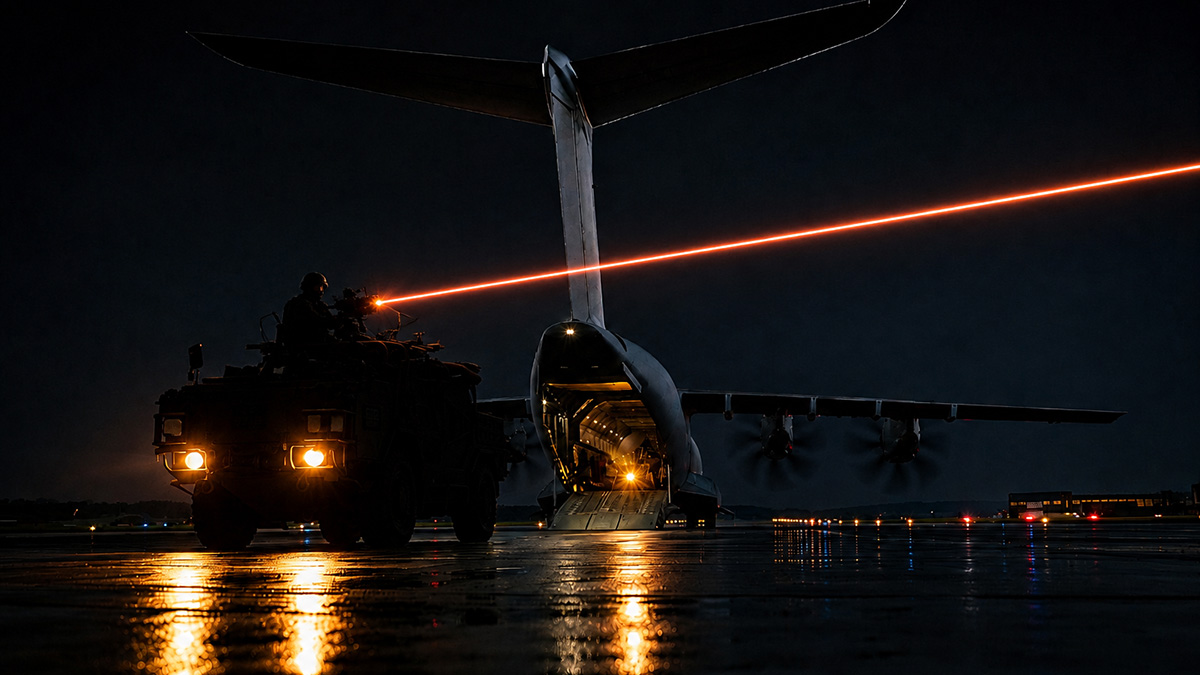
The Ministry of Defence has opened a competition for new counter-drone technologies intended to protect deployed troops from mass and low-cost aerial threats, with particular interest in laser directed-energy weapons and a requirement for an eventual system capable of autonomous operation from an Army vehicle, the UK Defence Journal understands.
The tender notice published on 2 September begins an iterative procurement process through the Commercial X Dynamic Market. The wider procurement carries an indicative value of £125 million excluding VAT, or £150 million including VAT, although the MOD makes clear that this funding has not yet been approved and later stages will depend on future funding decisions.
Setting out the operational requirement, the MOD stated: “Defence seeks additional capacity to detect, track, identify, decide and defeat mass and low-cost threats in a cost-effective manner and without being overwhelmed or exhausting stockpiles. This is particularly acute for deployed land forces, but the problem is applicable to the protection of defence fixed infrastructure in the homeland.”
On existing counter-UAS approaches, the notice states: “Current approaches are constrained by limited magazine depth, high cost-per-engagement, limited manoeuvrability, workforce intensity and the difficulty of adapting capabilities at pace as UAS threats evolve.” The MOD added: “Based on research, the Authority is particularly interested in capabilities centred on Laser Directed Energy Weapon (LDEW) effectors but is open to submissions relating to credible alternative novel approaches.”
The first phase will focus on technologies which already exist and could be accelerated towards a deployable system rather than procuring a finished counter-UAS capability immediately. The MOD stated: “The scope of Phase 1 is to identify and support organisations to accelerate development of their existing technology towards a final deployable system. It is not intended for the Phase 1 competition to seek delivery of a complete operational C-UAS system.”
For later phases, the department said: “Over later Phases, the Authority’s intent, aligned with their Integrated Procurement Model, is to identify and rapidly mature promising technologies as demonstrable Minimum Viable Products (MVPs). The Authority may then, at its discretion (and the criteria detailed below) select projects to be iteratively developed, integrated and proven as Minimum Deployable Capabilities (MDCs) for an initial operational user group.”
The notice continues: “Capabilities that demonstrate operational benefit may subsequently be developed further for wider adoption as part of a future Programme of Record. Suppliers will be notified of the criteria, selection processes, and competition format as these Phases arise.”
The intended configuration is also set out in the requirement. The MOD stated: “To address the challenge described above we are looking to deliver an integrated C-UAS force-protection capability capable of autonomous operation, mounted on an Army vehicle.”
On the attacks the system is expected to counter, the department said: “The capability should protect deployed troops against complex and saturation attacks designed to overwhelm existing defences or deplete conventional munition stocks. It should deliver more affordable combat mass against emerging air threats than legacy systems, and should exploit open architectures, platform-generated power, modular design and capable of autonomous operation.”
The initial threat focus is on representative Class 1 uncrewed aerial systems and related small aerial threats, covering single attacks as well as repeated, sequential and simultaneous profiles. The notice states that this includes threats intended to disrupt operations, conduct surveillance, target fixed or mobile assets, overwhelm local defences or force the disproportionate use of high-cost munitions.
The MOD also plans for the system to move beyond a crewed Army vehicle. It stated: “Integration of the capability onto a future uncrewed ground vehicle (UGV) is a planned objective. The solution should provide a scalable pathway towards future Army and Joint Ground-Based Air Defence (GBAD) capabilities as well as considering possible export opportunities.”
Stage 1 will assess whether industry proposals can meet the problem statements, with suppliers required to submit an evidence-based high-level programme plan supported by demonstrations, modelling, analysis and testing where appropriate. The MOD states: “No contract shall be awarded at this stage, but success is required to continue to Stage 2. All suppliers who demonstrate achievement of the threshold criteria shall be invited to Stage 2.”
Stage 2 will require successful suppliers to develop their initial proposals into fully costed and contractable projects running for around six months. Contracts at this point will be awarded according to evaluation scores and available funding within a £5 million limit, with technical factors expected to account for between 60% and 80% of the assessment and commercial factors between 20% and 40%.
Stage 3 could involve either a further competition or negotiation of a single direct award depending on how many suppliers remain. The MOD says contracts at that stage will cover scaling and production alongside testing, assurance, safety and security, with break points where aspects of the system cannot be demonstrated within the required timescales.
The department states: “The stated figure in this notice of £150,000,000 inc. VAT is aligned to the current understanding of the Strategic Defence Review, but this does not mean that this funding has been approved and is an indicative figure only.” It adds: “The intention is to begin Stage 1 with immediate effect, but future stages will not proceed until funding has been allocated and approved.”
The MOD also warns suppliers that later funding is not guaranteed, stating: “There is no guarantee that future funding will be allocated or approved and the Authority may cancel the procurement process at any time. Bidders proceed knowing and accepting this risk that no effort shall be compensated.”










Another jumble of meaningless words from the MOD.
This seems like a rather convoluted development process, starting out with taking down a little Class 1 drone then expanding to some future sunlit uplands of protecting deployed troops, UK GBAD, and unmanned ground vehicles.
The primary need right now is to have something that can swat drones and drone swarms out of the sky, and also helicopters, low-flying aircraft and cruise missiles. There must be a dozen allies working on the same and generally a good bit ahead of us, not sure why we are coming late to the party and starting from scratch.
Germany has a straightforward answer, the Sky Ranger turret. It has a 30 or 35mm cannon to knock out the low-flying threats and a light missile similar to Starstreak or Martlett to reach fast, higher altitude attackers. Simple enough.
If we think the former role can be handled by a laser, and that we can generate enough power for it without ending up with a 38-tonne radar-equipped behemoth, great, swap the Sky Ranger’s cannon for a laser DEW. Mount it on a tracked vehicle for 3 Division – tracked because it will need to keep up with the Challys and Ajax it is protecting – and on a Patria 6 x 6 CAVS for 1 Division.
By UK GBAD, it seems they really just mean point defence of UK military bases. A static Dragonfire unit should surely suffice, if Dragonfire proves to be any good.. But honestly what real chance do we have of a acquiring enough to man a dozen or more troops or batteries? That surely is a far-distant wishdream? No doubt a Dragonfire lookalike could be mounted on a redundant Warrior and programmed to operate unmanned. But the MOD is never going to accomplish all this on a £150m budget!
They need to focus on a Stormer replacement that can do C-UAV as well as LLAD, that is the basic capability our manoeuvre brigades will be screaming for if we have to get involved in a hot war. The spec here seems far too wide and focused on what can we do with a laser DEW rather than what do we need right now. The issues of laser + radar weight and cost may anyway prove to be a dead-end.
Catch up! – Lasers have been around for the ~40 years and in some UK universities their destructive effects were experimented by lively research students. Beam spread was understood and complex radar tracking was in its infancy. What do those highly paid in MOD do all day? – they get more like our MP’s every day – arguing about opinions while contributing little of consequence.
Dragonfire on unmanned Warrior?