

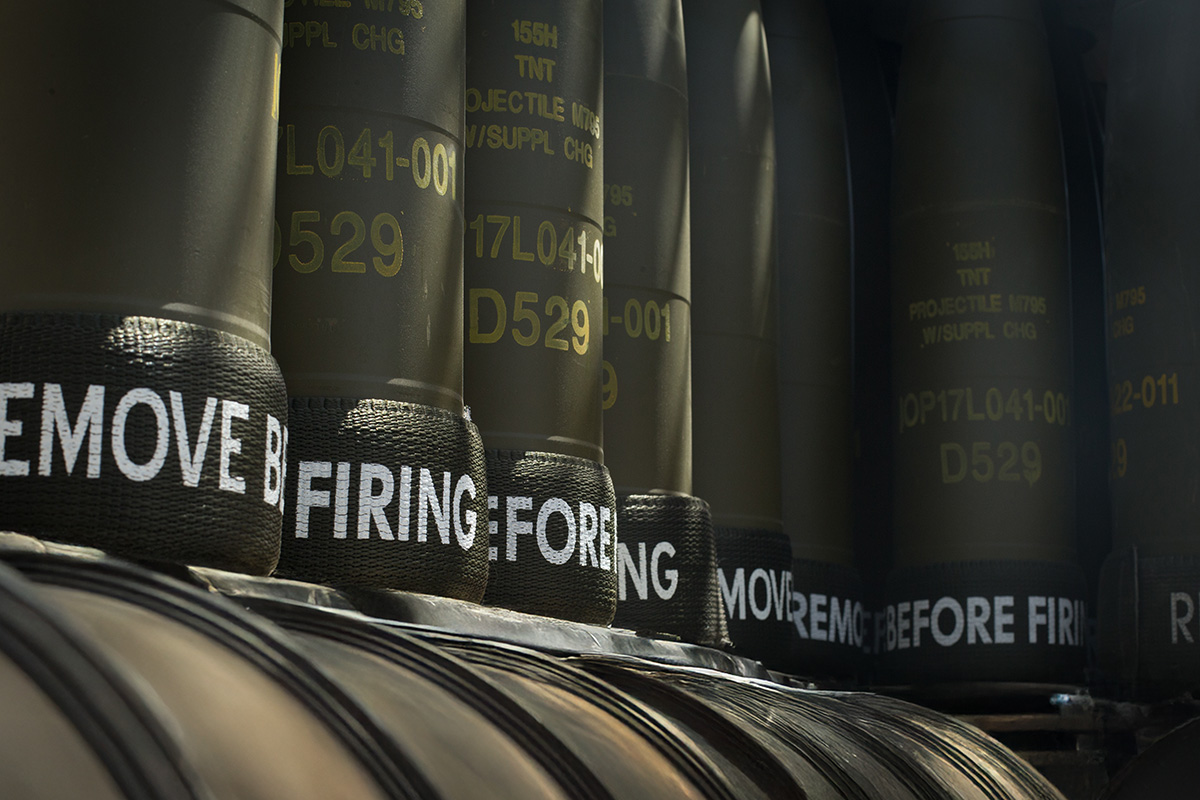
The Ministry of Defence has issued an updated early engagement notice outlining plans to support the construction of new UK energetics and munitions manufacturing facilities.
The notice, published on 2 April 2026, replaces an earlier version issued the same day and sets out how industry can access government funding for new production capacity. It forms part of a wider effort to establish what the MOD describes as an “always on” pipeline for munitions, including plans for up to six new facilities across the UK.
Under the proposal, the MOD intends to open a series of “investment windows” during which companies can bid for capital grants to support construction of energetic materials manufacturing plants. The first window is expected in the third quarter of 2026, followed by further rounds in the second and fourth quarters of 2027.
Each funding window is expected to remain open for around three months. Companies will be able to apply regardless of prior engagement with the MOD, including those not selected for earlier feasibility studies announced in November 2025.
Funding is expected to be capped at GBP 45 million per proposal, or 50 per cent of total project costs, whichever is lower. Final allocations will depend on value for money and affordability assessments, subject to approval through the Full Business Case process.
The programme is being managed by Defence Equipment and Support and is open to small and medium-sized enterprises. The MOD says the investment will sit alongside wider government support mechanisms aimed at strengthening domestic industrial capacity.












‘The notice, published on 2 April 2026, replaces an earlier version issued the same day and sets out how industry can access government funding for new production capacity.’
Here’s a quick and free way of encouraging the private sector: deregulate, slash taxes on business…
Slash taxes… you do know taxes fund the military? 🤦🏻♂️
You’ve never heard of the Laffer curve, have you?
You don’t understand the importance of Defence exports foreign currency earnings to Britain’s balance of payments or the tax revenue that they generate (Laffer curve refers)
In 2025, the UK secured over £20 billion in defence exports, marking the highest value since records began over 40 years ago. These deals are expected to directly support more than 25,000 British jobs.
The defence industry is a significant contributor to UK GDP and economic activity, with the sector supporting over 272,000 jobs in total.’
You have no idea how much more successful a low regulation low tax economy could be, do you?
‘The administration of President Javier Milei has implemented drastic public spending cuts, which contributed to a trade surplus and GDP growth of 5.7%… Milei administration in Argentina is implementing significant business tax reforms aimed at reducing the state’s footprint and fostering economic growth, effective largely in 2025–2026. Key measures include reducing export duties on agriculture, eliminating import withholdings, setting a 25% fixed income tax for large investments (RIGI), and offering tax incentives for SMEs…’
Basic stuff.
The Laffer Curve 🤦♂️
You will be banging on about supply side economics next, didn’t work in the 80’s won’t work today.
As for Argentina, they had little choice but to go with extreme austerity much the same as we were forced to do in the 70’s and 80’s
They have child poverty rates of 67%, perhaps your ok living in a country with such extreme poverty among children but I am not and if the cost of that is a few more quid in tax then I’m happy to pay.
It’s happening in front of your eyes but you refuse to see it…pure bigotry…
‘The Milei administration in Argentina is implementing significant business tax reforms aimed at reducing the state’s footprint and fostering economic growth, effective largely in 2025–2026. Key measures include reducing export duties on agriculture, eliminating import withholdings, setting a 25% fixed income tax for large investments (RIGI), and offering tax incentives for SMEs…’
‘The administration of President Javier Milei has implemented drastic public spending cuts, which contributed to a trade surplus and GDP growth of 5.7%…’
‘Argentina and the evidence of a paradigm shift are reflected in recent tax revenue data. In the third month of the year, the government reduced or eliminated taxes such as the PAIS Tax and certain export duties. Against all forecasts based on traditional fiscal models, revenue increased by 7% in real year-on-year terms…’
Not sure how your reading skills are as I suspect you come from a low HDi country,
But my point was on child poverty.
I can put that in all caps if you like CHILD POVERTY!!!
But you don’t seem to have mentioned it in your reply you just seem to have called me a bigot
Your point: ‘The Laffer Curve 🤦♂️’
My answer: ‘Argentina and the evidence of a paradigm shift are reflected in recent tax revenue data. In the third month of the year, the government reduced or eliminated taxes such as the PAIS Tax and certain export duties. Against all forecasts based on traditional fiscal models, revenue increased by 7% in real year-on-year terms…’
Your point: ‘You will be banging on about supply side economics next, didn’t work in the 80’s won’t work today.’
My answer: ‘It’s happening in front of your eyes but you refuse to see it…pure bigotry…The Milei administration in Argentina is implementing significant business tax reforms aimed at reducing the state’s footprint and fostering economic growth, effective largely in 2025–2026. Key measures include reducing export duties on agriculture, eliminating import withholdings, setting a 25% fixed income tax for large investments (RIGI), and offering tax incentives for SMEs…‘The administration of President Javier Milei has implemented drastic public spending cuts, which contributed to a trade surplus and GDP growth of 5.7%…’
I didn’t answer the rest of your point because it was complete nonsense.
Milei can only address Argentina’s problems once he obtains the necessary tax revenue from economic reform, growth.
Sounds familiar?
Shouting CHILD POVERTY like it’s your socialist invisible armour.
Hilarious
Research and statistics released last June, stated that Child poverty in the UK has been hovering around 30%.
Wait until Monro raises it to Argentine levels of 57%…
How does increasing tax revenue by reducing tax rates raise ‘child poverty’? Ridiculous nonsense.
On the other hand, we know, beyond any doubt, that socialism, particularly totalitarian socialism, occasioning, as it invariably does, economic weakness, endangers ‘world peace’.
Slashing taxes in the U.K. has zero impact upon the success of defence exports.
At best you’re delusional, at worst disingenuous and dishonest.
If you want Argentine levels of medical care, education and benefits (eg pensions) I suggest you try living there. But nobody else in the UK will find them acceptable.
What nonsense is this? Reducing taxes on defence SMEs allows them to be more competitive in the export market, increasing sales, exports and revenue for the treasury…
‘Argentina and the evidence of a paradigm shift are reflected in recent tax revenue data. In the third month of the year, the government reduced or eliminated taxes such as the PAIS Tax and certain export duties. Against all forecasts based on traditional fiscal models, revenue increased by 7% in real year-on-year terms…’
You’re clearly ignorant of the actual facts of life in Argentina, how bad life is there. Yet you want to reduce the standard of living in the UK to the same poverty stricken levels. You really hate the UK that much?
How to fix those problems?
Tax revenue from economic growth…exactly everything your own government is trying and failing to achieve…
Another idiot that jumps to the conclusion that Labour are ‘my government because’ you’re too stupid to see anything in terms other than black or white, friend or foe.
You are not a British citizen then?
Yet we find child poverty in the UK at 30% acceptable.
The Laffer curve is very real and obviously so. Theres clearly a tipping point at which increased taxes decreases revenue and nobody serious denies thats the case. Thats what laffer is. As an obvious example increased personal tax rates decreases the incentive to work extra hours, so then workers do exactly that.
Cameron and Osborne drastically lowered corporation tax and the tax take went up after a number of years because of increased economic activity. Its basic stuff.
Unfortunately simpletons think increasing rates increases total tax take, it never does. British GDP growth is essentially static because those clowns have taxed the economy to a standstill.
Offcourse it is a curve right, you and Munro seem to have it as a linear relationship.
Intemperate comments invariably indicate the wrong end of the argument.
Far better to leave them out and make some kind of contribution, even if it is only to shout ‘Happy Easter!’
We we dont, its a fucking curve and the clue is in the name.
Credit due to the MoD on this foresight.
At least twelve years too late…
The writing was plainly on the wall when Russia invaded Ukraine for the first time in 2014.
Agreed. No doubt we are on the negative side of the curve. The left should be explaining how they will be funding tax rises as no doubt in the medium to long run they will be reducing government revenues. We already see it in practice, ever increasing taxes and ever lower services.
It’s an odd business. Ability to manufacture and store munitions that may or may not get used. Ability to manufacture munitions suddenly after a long dwell time at pace in times of need.
I had a chat with an ex-MoD employee who worked on munitions and specifically propellants. He described how the Blair Government let all that accrued expertise in propellants disappear. Now they’ve got to resurrect that knowledge and I suspect some long-retired civil servants will be offered some ‘consultancy’ work!
Sounds familiar…..
The big problem is that any kind of chemicals manufacturing suffers from three things;
– lack of expertise in HSE explosive which leads to enormously controlling; and
– ludicrous energy costs; and
– lack of feedstock as our chemicals industry is decimated in the quest for net zero.
Well we could abandon net zero and let humanity risk extinction 🤷🏻♂️
It’s perfectly possible for the chemical industry to transition and not be ‘decimated’
https://royalsociety.org/news/2024/05/chemical-industry-must-defossilise-to-reduce-carbon-emissions/
Well we could abandon net zero and let humanity risk extinction 🤷🏻♂️
It’s perfectly possible for the chemical industry to transition and not be ‘decimated’
royalsociety.org/news/2024/05/chemical-industry-must-defossilise-to-reduce-carbon-emissions/
Which might work *if* carbon taxation on imports levelled the playing field.
All that is happening now is that the messy bit is exported to low environmental regulation countries.
I agree that we need to look at carbon pricing to take into account imports, both manufacture ring and transportation. It would also see the added benefit of onshoring more manufacturing back to the UK.
Unfortunately things like this require international cooperation, something which humanity isn’t very good at at the moment.
By just pushing back our net zero target by a decade or so, we could avoid the absolute worst of the economic effects. The net zero nazis are forcing us to pay the costs of development of the technologies, whilst other countries just wait it out until the technology matures and becomes economical.
And you’ll end up with a population more supportive of the whole thing, which will be better for the environment in the long run.
(a) The majority of the population already supports the push to bet zero as currently planned, in fact a majority of the British public don’t think it’s fast enough.
(b) We may not have a decade, there’s already evidence that AMOC is slowing, which would have catastrophic effects for the U.K. alone.
(c) The technology for renewable energy generation is already there, which is why China is the largest installer of wind and solar power generation. Carbon capture isn’t a mature technology yet, but it certainly seems good enough.
Better hurry up. Support is sinking like a stone…and no wonder…
‘Professor Bobby Duffy, Director of the Policy Institute at King’s College London, said: “This research reveals a striking decline in the public’s sense of urgency around climate action.”
“The proportion who think we need to reach net zero sooner than 2050 has nearly halved since 2021, and support has fallen for every climate policy we’ve tracked over this period.’
March 2026
And yet again you’re being dishonest by selective quoting him Professor Bobby Duffy. You omitted:
“This doesn’t represent a wholesale rejection of climate action. Nearly two-thirds of the public still support reaching net zero by 2050 or earlier”
“The proportion who think we need to reach net zero sooner than 2050 has nearly halved since 2021, and support has fallen for every climate policy we’ve tracked over this period.’
Dropping like a stone…
Where is your evidence for any risk of extinction…?
Crickets…
How about that new lefty-militant organisation, the Royal Geographical Society?
http://www.rgs.org/media/ejbmyqdd/cyrus-chang.pdf
How about that new lefty-militant organisation, the Royal Geographical Society?
rgs.org/media/ejbmyqdd/cyrus-chang.pdf
Priceless excerpt from the (lightweight) references: ‘What do we learn from the weather?
As the man says: Climate policy needs nuance not panic…
and: Natural climate solutions.’
‘The climate system cannot be fully understood through a single explanatory lens. The prevailing attribution framework is the one currently advocated by the Intergovernmental Panel on Climate Change (IPCC). It assigns nearly all post‑1850 warming to anthropogenic forcings. However, this assessment rests on computer global climate models (GCMs) that, while sophisticated, still struggle with fundamental aspects of natural variability…
If models cannot capture the natural background variability of the climate system, then attribution regarding the global warming from 1850–1900 to the present becomes inherently uncertain, because any unmodeled natural contribution to the warming (for example due to solar activity increase during the same period) necessarily reduces the fraction of warming that can be confidently assigned to anthropogenic forcings. And if the anthropogenic contribution to past warming is smaller than assumed, then its contribution to future warming — and therefore the associated climate risk — must also be proportionally reduced.’
(a) I find that very hard to believe. Regardless, a technical majority is very different in politics to a near-consensus. Energy costs decimating family finances and industry is only becoming apparent in very recent years, so I suspect your polls may be out of date. I think people are ‘generally’ supportive contingent on it not breaking their own or the country’s finances.
(b) I find such predictions highly spurious and politically motivated rather than based in any scientific fact. I studied physics at a red brick university around 15 years ago and (surprisingly) there were multiple professors who didn’t tow the line on man-made climate change (or at least primarily man-made). Every single change in the climate is being linked to humans, whereas in reality much of it is likely to be coincidental. Claiming definitive knowledge on the subject is a massive red flag. We have created a system where we have incentivised the climate hyperbole, especially in the academic sphere. So much like the military industrial complex, we should be very wary of this.
(c) Some technology is there and some isn’t. Solar is more mature than wind, and thus more efficient. Unfortunately our climate is more able to benefit from wind than solar. Also, the relative economics is different for different countries. China can manufacture all its renewable needs domestically, using cheap labour, including extracting the raw materials needed, has vastly greater solar potential than the UK, and does not have bureaucratic environmental impact assessments to do as part of planning processes. Its energy (transmission) infrastructure is also much newer than the UK’s and was built and designed with renewables in mind. To claim that others are doing it so we should too is a very simplistic way of looking at it.
In general I am supportive of renewables as I don’t want our economy to be leaking/donating vast amounts of money each year to hostile regimes who control the world’s oil resources. But it must be done in a pragmatic and sustainable way that doesn’t kill the country in the process.
(a) What you claim to find hard to believe is irrelevant when discussing facts. If you want to ignore facts, that’s your choice. But it’s not very scientific of you.
(b) It’s hilarious you warn about the military industrial complex, yet ignore the fossil fuel industry which is financing climate-change denial. Even assuming you’re telling the truth, why would you ask a physicist about the climate? That’s like asking a medical doctor to plan a space mission or a geologist about the pain in your back. Assuming you went to university the most basic thing you would have learned is to consult those who are specialists in the relevant discipline.
(c) As for you claims about technology maturity, I’ll debunk them for you. Wind-turbines, for which the UK has a huge advantage due to the North Sea, convert up to 50% of wind energy to electricity, with a theoretical maximum (Betz limit) of 59%. By comparison solar converts 15-23% of sunlight into electricity. Gas fired power-stations average 40% efficiency in generating electricity.
The UK could slash energy costs tomorrow if it decoupled the contractual cost of generating electricity from natural gas generation. Medium term scrapping NIMBY planning objections would see faster expansion of the grid along with resolution of the housing crisis (and HS2 fully-built for half its current cut-down route).
Where is your evidence for any risk of extinction…?
The number of conflicts for scarce resources perhaps; water, oil, food?
That is the history of mankind…little change in 300,000…still the same bunch of monkeys…
All over the f@cking internet in scientific papers, idiot.
Yes, available in the various media for as long as there have been scientific papers.
Another thing the Blair government did wrong 🤦♂️
Not to worry, BAE restated explosive production last year already using completely different technologies from anything in the Blair years, no old civil servants required.
Yes, they are using dynamic synthesis.
This does obviate the need for huge amounts of pre manufactured fill.
But does mean that the plant and monitoring aren’t simply batch scalable.
Is there such an instrument as ‘The Emergency War Act’ that permits the immediate funding of war preparations? If there is, it should be implemented NOW! This coming week may change all our lives for the worse and begin a domino effect across the world due to Trump’s threats to obliterate Iran. Even if he ‘u-turns’ yet again, the current situation is having dire consequences, and yet our government makes all the right noises regarding defence; it does nothing. Whether we like it or not, the UK is effectively at war on two fronts in terms of force commitments to allies in the Middle East and Ukraine, and they are witnessing immediate results; however, regarding our homeland, just words.
And how do we finance this? More borrowing?
We still pay higher interest rates on government debts due to the ‘moron premium’ arising from Truss’ disastrous unfunded financial plans.
If we borrow more, we may well see even higher rates charged.
Simple. Get rid of the unevidenced and absurd net zero targets
‘In the period 2002 to the present, the total cost to the electricity consumer of those renewable electricity subsidy schemes that we can quantify has amounted to approximately £220 billion (in 2024 prices), equivalent to nearly £8,000 per household.
The annual subsidy cost is currently £25.8 billion a year, a sum equivalent to nearly fifty per cent of UK annual spending on defence.
Subsidy to renewable electricity generators now comprises about 40% of the total cost of electricity supply in the United Kingdom
The total subsidy cost per unit of renewable electricity generated has risen by nearly 50% in real terms since 2005 and now stands at approximately £200/MWh. This contradicts government and industry claims that renewables are becoming cheaper but is consistent with expectations from the physics of energy flows, the empirical study of the capital and operating costs of both wind and solar, and the grid expansion and reinforcement and system management costs known to be imposed by renewables.
It should be borne in mind that about one third of this total cost, £77 billion (2024 prices) has hit households through their electricity bills, with the remaining £153 billion being first paid by industrial, commercial and public sector consumers and then passed through to households in the form of increased prices for goods and services, in taxes, and in reduced wages and rates of employment.
There can be little doubt that renewable electricity subsidies are a significant factor in the much-discussed cost of living crisis and are very likely to be an important element underlying the weak growth in productivity in the UK economy since the financial crisis of 2008.
Renewable electricity generators have now enjoyed generous financial support for over twenty years without showing any significant progress towards independent economic viability. On the contrary, the requirement for such support seems to be rising. The public is surely entitled to ask when government will bring this extraordinary and insupportable level of subsidy to an end.’
So you finance it through lying…
I foresee ‘double moron premium’ 😂
Numbers never lie…
Yet another entirely evidence free and atmospheric response. Surely you and those like you believe that there is too much hot air already…but you create more and more of it seemingly without end; ridiculous nonsense…
Spock/Jim, by some means, the UK must attain a higher level of defence spending in a manner similar to the preconditions pertaining to the periods before both World Wars. How we achieve this outcome is complicated, yet if we avoid urgent spending, we could expose the British people to witnessing a similar fate to our Gulf friends. Missile and drone attacks on principal towns and cities would create an immediate drawdown of our way of life, which for many would be difficult to assimilate. The answer is blunt: something we enjoy in peacetime may need to stop. Sadly, the choice is chilling; it’s either welfare or food queues and A&E waiting rooms due to explosive injuries. Imagine that only a few months ago, the people of Dubai received warnings about missiles and explosive drones raining down on their magnificence; they would have most likely laughed at such a prospect.
There is no such act in the UK.
The Treasury does operate a contingency and can spend pretty much what it likes with cabinet approval or limited parliamentary emergency acts.
The issue is the bond markets won’t absorb any more UK borrowing unless the Bank of England halts unwinding QE and there is little way to make them do that without causing major economic ramifications and a run in the pound.
In my mind war bonds and getting foreign allied countries sovereign wealth funds to buy them is probably our best bet.
We can make minimum investments in UK bonds a requirement on ISA’s and SIPP’s as well.
The UK has a high savings rate at the moment and very low net debt, problem is so much of that cash is flowing into the USA.
Yes the U.K. owns more US government debt than even China. At $900billion only Japan is owed for than the U.K.
Better late than never. 4 years since full scale warfare returned to the continent and 12 years since Russia’s first attack. And only now setting out the finance for a few factories. If the Tories or Labour had a brain cell between them we should be in the middle of full scale rearmament by now.
To be honest, I thought the Laffer curve was something I’d heard about, whilst watching the Curling… during the recent Winter Olympics.
That’s the McLaffer curve…