

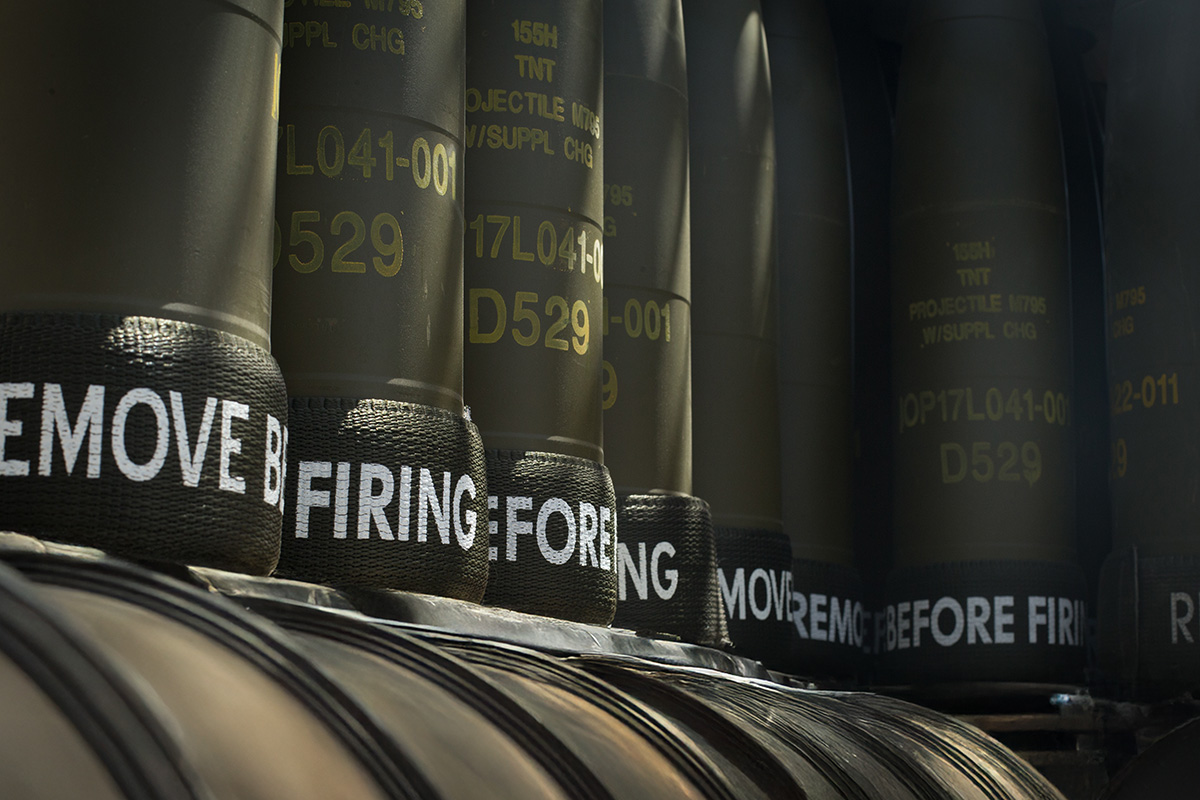
The Ministry of Defence has issued an updated early engagement notice outlining plans to support the construction of new UK energetics and munitions manufacturing facilities.
The notice, published on 2 April 2026, replaces an earlier version issued the same day and sets out how industry can access government funding for new production capacity. It forms part of a wider effort to establish what the MOD describes as an “always on” pipeline for munitions, including plans for up to six new facilities across the UK.
Under the proposal, the MOD intends to open a series of “investment windows” during which companies can bid for capital grants to support construction of energetic materials manufacturing plants. The first window is expected in the third quarter of 2026, followed by further rounds in the second and fourth quarters of 2027.
Each funding window is expected to remain open for around three months. Companies will be able to apply regardless of prior engagement with the MOD, including those not selected for earlier feasibility studies announced in November 2025.
Funding is expected to be capped at GBP 45 million per proposal, or 50 per cent of total project costs, whichever is lower. Final allocations will depend on value for money and affordability assessments, subject to approval through the Full Business Case process.
The programme is being managed by Defence Equipment and Support and is open to small and medium-sized enterprises. The MOD says the investment will sit alongside wider government support mechanisms aimed at strengthening domestic industrial capacity.












‘The notice, published on 2 April 2026, replaces an earlier version issued the same day and sets out how industry can access government funding for new production capacity.’
Here’s a quick and free way of encouraging the private sector: deregulate, slash taxes on business…
Slash taxes… you do know taxes fund the military? 🤦🏻♂️
You’ve never heard of the Laffer curve, have you?
You don’t understand the importance of Defence exports foreign currency earnings to Britain’s balance of payments or the tax revenue that they generate (Laffer curve refers)
In 2025, the UK secured over £20 billion in defence exports, marking the highest value since records began over 40 years ago. These deals are expected to directly support more than 25,000 British jobs.
The defence industry is a significant contributor to UK GDP and economic activity, with the sector supporting over 272,000 jobs in total.’
You have no idea how much more successful a low regulation low tax economy could be, do you?
‘The administration of President Javier Milei has implemented drastic public spending cuts, which contributed to a trade surplus and GDP growth of 5.7%… Milei administration in Argentina is implementing significant business tax reforms aimed at reducing the state’s footprint and fostering economic growth, effective largely in 2025–2026. Key measures include reducing export duties on agriculture, eliminating import withholdings, setting a 25% fixed income tax for large investments (RIGI), and offering tax incentives for SMEs…’
Basic stuff.
The Laffer Curve 🤦♂️
You will be banging on about supply side economics next, didn’t work in the 80’s won’t work today.
As for Argentina, they had little choice but to go with extreme austerity much the same as we were forced to do in the 70’s and 80’s
They have child poverty rates of 67%, perhaps your ok living in a country with such extreme poverty among children but I am not and if the cost of that is a few more quid in tax then I’m happy to pay.
It’s happening in front of your eyes but you refuse to see it…pure bigotry…
‘The Milei administration in Argentina is implementing significant business tax reforms aimed at reducing the state’s footprint and fostering economic growth, effective largely in 2025–2026. Key measures include reducing export duties on agriculture, eliminating import withholdings, setting a 25% fixed income tax for large investments (RIGI), and offering tax incentives for SMEs…’
‘The administration of President Javier Milei has implemented drastic public spending cuts, which contributed to a trade surplus and GDP growth of 5.7%…’
‘Argentina and the evidence of a paradigm shift are reflected in recent tax revenue data. In the third month of the year, the government reduced or eliminated taxes such as the PAIS Tax and certain export duties. Against all forecasts based on traditional fiscal models, revenue increased by 7% in real year-on-year terms…’
Not sure how your reading skills are as I suspect you come from a low HDi country,
But my point was on child poverty.
I can put that in all caps if you like CHILD POVERTY!!!
But you don’t seem to have mentioned it in your reply you just seem to have called me a bigot
Your point: ‘The Laffer Curve 🤦♂️’
My answer: ‘Argentina and the evidence of a paradigm shift are reflected in recent tax revenue data. In the third month of the year, the government reduced or eliminated taxes such as the PAIS Tax and certain export duties. Against all forecasts based on traditional fiscal models, revenue increased by 7% in real year-on-year terms…’
Your point: ‘You will be banging on about supply side economics next, didn’t work in the 80’s won’t work today.’
My answer: ‘It’s happening in front of your eyes but you refuse to see it…pure bigotry…The Milei administration in Argentina is implementing significant business tax reforms aimed at reducing the state’s footprint and fostering economic growth, effective largely in 2025–2026. Key measures include reducing export duties on agriculture, eliminating import withholdings, setting a 25% fixed income tax for large investments (RIGI), and offering tax incentives for SMEs…‘The administration of President Javier Milei has implemented drastic public spending cuts, which contributed to a trade surplus and GDP growth of 5.7%…’
I didn’t answer the rest of your point because it was complete nonsense.
Milei can only address Argentina’s problems once he obtains the necessary tax revenue from economic reform, growth.
Sounds familiar?
Shouting CHILD POVERTY like it’s your socialist invisible armour.
Hilarious
But, but, but …. it’s for the children! Isn’t that the mantra when you have nothing else to say?
What’s more to “quote history” in the UK we had tax cuts, supply side economics and contrary to the previous OP, it did work. The problem was when subsequent Govts used that newly acquired affluence to buy votes with Social programs and Engineering. Instead of saying my work is done and not fiddle, they fiddled. And, as anyone with an ounce of common sense knows, once you create a benefit, it’s nigh on impossible to get rid of it. When this slowly undid the gains of the 80’s they had to raise taxes to pay for the largesse they created, which in turn undid more of the 80’s gains which then necessitate more tax increases which …. well, you get my point!
🤣🤣🤣
In reply to Douglas.
Life expectancy in Argentina is 77 in the UK it’s 82.5 we can slash our tax bill but the majority of the burden relates to increased life expectancy…
The point is to increase government revenue and decrease government size, expense, so allowing more available revenue to be spent on, in particular, defence.
Systemic reform is required of the public sector, particularly Whitehall (550,000 doing the jobs of 380,000 in 2019) and the NHS (continental systems outperform the NHS on most metrics at less cost to the public purse).
Britain’s tax code is over complex and all agree that it requires radical reform.
Argentine is used not as an example of a well performing state but as an example of a poorly performing state where cuts to regulation and taxes are improving economic performance, growth and, hence, the tax take required to fund necessary reforms…
Sorry the continental healthcare systems are hugely more costly than the NHS… the french and German systems are 30-40% more expensive.. many of the other systems that are cheaper don’t provide the universal care that the NHS does.. as an example in Spain a relative or friend is required to stay with the patient when in hospital to provide care..
Germany has spent literally trillions more on its healthcare system than we have.
Difficult to compare NHS funding with funding of social health insurance systems (SHI). The key point is that, in most SHI, individuals pay more by choice for better outcomes.
‘There has been a huge shift in public opinion, with Britons now increasingly likely to say the NHS is worse than healthcare systems in other European countries.
In the last year before Covid, the UK had the second-highest rate of treatable avoidable mortality Western Europe.
The NHS has consistently ranked poorly in international comparisons for decades.
In terms of clinical outcomes, other systems tend to outperform the NHS, and they have done so for as long as we have data. This is not simply the result of better funding.
Countries including the Netherlands, the Czech Republic, Slovakia, and (the former) East Germany have already reformed NHS-type systems into SHI systems.’
You don’t even understand the meaning of the word bigotry, so the chances of you having a grasp on economics is slim
Yes I did study economics
You have concealed that well, Mr fibble.
In a spirit of helpfulness…
Bigotry:
Stubborn and complete intolerance of any creed, belief, or opinion that differs from one’s own
Key Characteristics:
Unreasonable Beliefs: The opinions held are not based on reason or evidence.
Intolerance: A refusal to tolerate or respect others’ viewpoints.’
Research and statistics released last June, stated that Child poverty in the UK has been hovering around 30%.
Wait until Monro raises it to Argentine levels of 57%…
How does increasing tax revenue by reducing tax rates raise ‘child poverty’? Ridiculous nonsense.
On the other hand, we know, beyond any doubt, that socialism, particularly totalitarian socialism, occasioning, as it invariably does, economic weakness, endangers ‘world peace’.
It’s obvious if you actually engaged your brain. But you’ve obviously not done that for years.
Having a welfare system does not make a country ‘socialist’. 🤦🏻♂️
How does increasing tax revenue by reducing tax rates raise ‘child poverty’?
Are you really do stupid? Wow!
You add nothing to the discussion by writing gibberish.
How are you going fund those tax cuts?
Argentina has, in the last two years reduced certain rates of tax on business with a consequent increased tax yield, icreased revenue from those taxes as tax avoidance reduces.
Government revenues from.North Sea production will increase in similar fashion as tax rates fall.
Increased defence spending can also be funded by removing taxpayer subsidies to renewables.
‘In the period 2002 to the present, the total cost to the electricity consumer of those renewable electricity subsidy schemes that we can quantify has amounted to approximately £220 billion (in 2024 prices), equivalent to nearly £8,000 per household. The annual subsidy cost is currently £25.8 billion a year, a sum equivalent to nearly fifty per cent of UK annual spending on defence. Subsidy to renewable electricity generators now comprises about 40% of the total cost of electricity supply in the United Kingdom. The total subsidy cost per unit of renewable electricity generated has risen by nearly 50% in real terms since 2005 and now stands at approximately £200/MWh. This contradicts government and industry claims that renewables are becoming cheaper.
There can be little doubt that renewable electricity subsidies are a significant factor in the much-discussed cost of living crisis and are very likely to be an important element underlying the weak growth in productivity in the UK economy since the financial crisis of 2008.
Renewable electricity generators have now enjoyed generous financial support for over twenty years without showing any significant progress towards independent economic viability. On the contrary, the requirement for such support seems to be rising. The public is surely entitled to ask when government will bring this extraordinary and insupportable level of subsidy to an end’
So if Argentina tax cuts is raising so much extra revenue why are slashing budgets of government departments and allowing child poverty to rise by to over 60%
So if Argentina tax cuts is raising so much extra revenue why are slashing budgets of government departments and allowing child poverty to rise by to over 60%
There now numerous subsidy free wind farms and solar farms being built across the entire country.
‘When Milei took office, he inherited the world’s highest inflation rate of 211% from the previous Peronist government. Currently, at 31%, it is at its lowest level since 2018. Forecasts for 2026 predict a further decline to 20% on average.
The budget is showing a surplus for the first time in 14 years, achieved through significant cuts in government spending, in particular by merging ministries and abolishing agencies, reducing subsidies and laying off 56,000 civil servants to date, many of whom had been hired by the previous government at short notice as a welfare measure for loyal party cadres despite empty coffers.
Despite these savings, the Argentine economy is growing this year: the IMF expects 4.5% growth on an annual basis, the highest growth rate in Latin America.
The positive economic development also explains why poverty in Argentina is now actually declining despite the reduction in government spending. According to independent figures published last week by the Catholic University of Argentina (UCA), the poverty rate is at its lowest level since 2018, at 36%. This decline was achieved, among other things, through more targeted assistance for large families, which Milei has even increased compared to the previous Peronist government – focused aid for those who are truly in need instead of aimless, expensive subsidies for everyone. As a result, according to UNICEF, 1.7 million children have been lifted out of poverty.
Argentina attractive for investment again
With the consistent dismantling of regulations and bold liberalisation from the housing market to air transport and the reduction of customs duties and price controls from imported goods to the national drink mate tea, by Deregulation Minister Federico Sturzenegger, Argentinians now pay lower prices and enjoy a better selection, and domestic and foreign companies are investing in the country again.
With the RIGI programme, the Argentine government is promoting large foreign investments of over USD 200 million with 30-year tax, customs and regulatory relief. In the mining sector alone, with its rich deposits of lithium and copper, among other things, investments totalling USD 31 billion have been announced to date.’
Ill pitch in here, whats actually regarded as Child poverty these days, no food, no shoes, leaking roof???
Or No 55″ TV, no dish washer, children ‘forced’ to share bedrooms’ (the horror), no car???
What is the child poverty metric these days?
It would probably be best if you went away and researched the subject a little, as your knowledge thus far seems to stem from Dickensian novels, which you probably watched as a child.
I don’t have any knowledge on the subject Tom, thats why im asking..
I did read a good a good of Dickens ( occasionally still do), I guess you were mainly stuck in front of the TV?
Slashing taxes in the U.K. has zero impact upon the success of defence exports.
At best you’re delusional, at worst disingenuous and dishonest.
If you want Argentine levels of medical care, education and benefits (eg pensions) I suggest you try living there. But nobody else in the UK will find them acceptable.
What nonsense is this? Reducing taxes on defence SMEs allows them to be more competitive in the export market, increasing sales, exports and revenue for the treasury…
‘Argentina and the evidence of a paradigm shift are reflected in recent tax revenue data. In the third month of the year, the government reduced or eliminated taxes such as the PAIS Tax and certain export duties. Against all forecasts based on traditional fiscal models, revenue increased by 7% in real year-on-year terms…’
You’re clearly ignorant of the actual facts of life in Argentina, how bad life is there. Yet you want to reduce the standard of living in the UK to the same poverty stricken levels. You really hate the UK that much?
How to fix those problems?
Tax revenue from economic growth…exactly everything your own government is trying and failing to achieve…
Another idiot that jumps to the conclusion that Labour are ‘my government because’ you’re too stupid to see anything in terms other than black or white, friend or foe.
You are not a British citizen then?
More crickets…but interesting ones…
Born and bred British, with the previous 4 generations of my family having served, fought, and bled for this great nation: DLI, Northumberland Fusiliers, XVII Squadron Bomber Command, RAF Regiment, Queens Royal Hussars, and BRIXMIS.
But like most assholes, you think anyone that disagrees with you must be anti-British because you’re so…
well, stupid 🤷🏻♂️
Then, like it or not, ‘Labour’ is definitely your government.
Rudeness really does just make you look very silly indeed, which is a great shame for someone who claims connection to such a distinguished body of men as Britain’s senior Light Cavalry Regiment.
I’ve been to Argentina many times. It’s just fine. The UK is a s*** box and no longer relevant. You think you’re relevant, but you’re not.
More relevant than frickin Argentina mate. Relevant in Europe but no one’s really relevant in South America because SA is irrelevant. UK is pretty damn relevant still but jealousy gets you nowhere. Least we don’t have to suck up to trump and join the board of peace. You think that makes you relevant. The opposite is true. Just wanna dictatorships shining each other off. I would rather be UK if was irrelevant than Argentina even if it was relevant which it is far from relevant.
Why did 40 countries come to London to discuss opening the strait of Hormuz why didn’t they go to Argentina 😂
Well you’ve previously been shown to be a liar, so I’m not surprised you’re doing that again. As a redneck I doubt you’ve ever been outside your county let alone the state.
I have friends living in Argentina for over 20 years, tango fans who bought and run a small chain of hotels there. So I know the reality of life there.
Yet we find child poverty in the UK at 30% acceptable.
The Laffer curve is very real and obviously so. Theres clearly a tipping point at which increased taxes decreases revenue and nobody serious denies thats the case. Thats what laffer is. As an obvious example increased personal tax rates decreases the incentive to work extra hours, so then workers do exactly that.
Cameron and Osborne drastically lowered corporation tax and the tax take went up after a number of years because of increased economic activity. Its basic stuff.
Unfortunately simpletons think increasing rates increases total tax take, it never does. British GDP growth is essentially static because those clowns have taxed the economy to a standstill.
Offcourse it is a curve right, you and Munro seem to have it as a linear relationship.
Intemperate comments invariably indicate the wrong end of the argument.
Far better to leave them out and make some kind of contribution, even if it is only to shout ‘Happy Easter!’
We we dont, its a fucking curve and the clue is in the name.
Peak pseudo-intellectual nonsense. It’s called the laffer curve, nobody pretended it was linear.
You are possibly the best example of the Dunning Kruger effect that I have ever come across.
A linear relationship, is that a new one Ive missed?
I do miss the latest ‘ trends’ due to an utter lack of interest.
My wife (thanks to her dreadful taste in tv) was explaining to me why three freaks on the E4 programme she was watching, probably green votors, were in a thrupple, or a thripple or somthing like that, I was on route to the kitchen at the time so took no heed.
Anyway, what was the question again Jim?
Happy Easter everyone.
Jesus has conquered the grave. Hope that was lost, now stands renewed.
Have a great weekend and a pleasant rest these few days.
Yes it’s a curve which also has a too low figure.. and it differs per society as well.. we live in an old society heading to a retired population of 23% and a life expectancy of 82… that’s the vast lump of government spending.. pensions, wider benefits, social care and NHS spending on the pension age population is about 270-280 billion pounds a year.
Our tax burden has gone up and we get less from it because more and more of us are retired and we live longer and longer via more and more expensive healthcare and social care interventions.. in 1980 we died on average at 72…
Unless we are all wiling to take a pill at 72 government health and social care and pension costs will go up and up…( and no we did not pay for our state pension, it’s a benefit).
The tax burden goes up without growth. That is the problem, not increased life expectancy. Individuals work to a greater age now, still paying income tax etc.
Argentina is a failing state that has finally accepted systemic reform, lower taxes, less regulation. The point is that the resultant improved economic growth, increased tax revenues, can now fund improved life chances for its citizens.
Britain following the same path will have the same result, more growth more tax revenue, better services for the population not least of which is defence, supposedly the first duty of government.
It’s all life expectancy, your not understanding why because you don’t understand health.. we are not working longer compared to our massive increase in life expectancy.. because we have not increased healthy life years in any real way, just life expectancy we essentially live a decade longer in ill health supported to stay alive by healthcare interventions.. the cost of healthcare in the Uk for a person under 60 is less than 2000 pounds per year.. when you hit your ill health in your mid to late 70s it goes up to £10,000 per year.. that’s why 22% of the population are now approaching 50% of the budget for healthcare.
‘More than one in nine people (11.5%) now work past age 65, double the rate in 2000’
The point is that Britain requires economic growth to improve healthcare generally.
Economic growth in a democracy comes from deregulation, lower taxes, a smaller public sector.
Britain requires systemic reform in order to fund more defence spending…but a quick fix would be to abandon the net zero nonsense.
The ‘benefit’ paid as a state pension was stated to be a payment from the National Insurance Fund and was intended to be understood as a ‘benefit’ only in that context.
‘The general provisions of Part I. may be stated thus : — A direct tax is laid upon all employers of men and women..The fund so collected constitutes the National Insurance Fund, out of which benefits are payable to the insured persons’ (National Insurance Act 1911)
It is imprudent and irresponsible (at best) politicians, public servants, that have severed the link, without having put that policy alteration into any manifesto.
Yes but it’s bollox because there was no fund, there never was. It’s a tax on the present workforce that pays for the pensions of the retired population.. as that population goes up so the burden increases..the greatest generation did not pay into a fund they paid for their parents pensions and so it went on.. it was fine up until the baby boomers got old because they did not replace themselves and are the longest lived generation ever.. while also being very unhealthy.
‘Unlike other taxes, most of the money raised through NICs does not go into the consolidated fund (the government’s bank account), but a separate pot of money, the National Insurance Fund (NIF). Money in the NIF is reserved exclusively for spending on social security benefits, such as the State Pension. A portion of money raised through NICs is allocated to the NHS before the rest is transferred to the NIF.
The NIF works as a pay-as-you-go fund. Therefore, receipts from contributions in one year are spent in the same year for contributory benefits. While there is a link between someone’s record of paying NICs and their entitlement to contributory benefits, there is no direct connection between the amount of NICs they pay into the NIF and the value of contributory benefits they are entitled to claim.’ 2025
And it’s all spent in year it’s not a real fund.
The ‘benefit’ paid as a state pension was stated to be a payment from the National Insurance Fund and was intended to be understood as a ‘benefit’ only in that context.
‘The general provisions of Part I. may be stated thus : — A direct tax is laid upon all employers of men and women..The fund so collected constitutes the National Insurance Fund, out of which benefits are payable to the insured persons’ (National Insurance Act 1911).
It is imprudent and irresponsible (at best) politicians, public servants, that have severed that link, without having put that policy alteration into any manifesto.
“For the drop in inflation is certainly not a victory for Argentine productivity. It’s a byproduct of a deliberate and engineered collapse in people’s wages.
Milei hasn’t fixed the engine of Argentina’s economy, he has simply turned it off. Since he took office in 2023, the country’s manufacturing output has dropped dramatically, with over 2,000 businesses shutting down and 73,000 jobs lost.
In the automotive sector, factories are operating at just 24% of capacity.
These aren’t just dry statistics. Real wages have been crushed so hard that demand for Argentine goods has evaporated. If a manufacturer is only using a third of its machinery because nobody can afford their goods, they lose their ability to put up prices, and inflation rates stop rising.
By drastically reducing demand, Milei has not solved the inflation puzzle. He has simply removed some of the pieces, by making the population too poor to participate in the Argentine economy.
On top of this, the fear of mass unemployment means workers have no choice but to accept an ever smaller share of the nation’s economic pie. Again, low wages serve to prevent the upward spiral of prices.
So the supposed victory over inflation is actually the institutionalisation of lower wages and a lower standard of living for most people.
For this level of wage suppression is a stark reminder of Argentina’s economic crisis of 2001, a period of total state failure, sovereign default, bank freezes and 20% unemployment that left a permanent scar on the national psyche.
To have surpassed that level of wage suppression today is a damning indictment of Milei’s approach. But while 2001 was a sudden collapse of a monetary system, the 2026 reality is a slow, institutionalised asphyxiation.
The question for the coming years is how such a model can possibly be sustained. Milei has left the country with no economic levers to pull for a genuine recovery.
With negative net reserves, a domestic market in ruins, and multi-billion dollar IMF and private debts hanging over the country, the government’s path is now dictated entirely by a desperate need for dollars that turns every domestic policy into a plea for foreign capital.
This has created an economic vacuum in which there is no credit for small businesses, no surplus for public investment and no consumer demand to entice private capital back into the real economy.
That is why the administration’s pitch to New York investors in March was essentially a desperate plea for capital to fill this void. But Wall Street is not generally in the business of building factories or creating jobs in Argentina.”
🤣
Yes…I mean, things must be really bad in Argentina…you have to feel for the Argentinians. But it’s still a democracy so they have the chance to vote Milei out…Oh! They just had some mid term elections:
‘Argentina’s President Javier Milei has led his party to a landslide victory in Sunday’s midterm elections, after defining the first two years of his presidency with radical spending cuts and free-market reforms. His party, La Libertad Avanza, won nearly 41% of the vote’ Voters are not always right but, in a democracy, they are never wrong.
You have copied several paragraphs from ‘The Conversation’, mainly written by academics who are not noted for their support of market economics. The reality in Argentina is somewhat different to the portrait painted by ‘The Conversation’. Five years of research indicate the following:
‘The (Milei) administration is shifting from a consumption-driven, state-supported economy toward export-led growth, productivity, and private investment. Key measures include fiscal stabilization, deregulation, and labor reform aimed at reducing hiring risk, expanding formal employment, and restoring credibility with global investors.
Strategic sectors show mixed outcomes. Agro-industrial exports, lithium, and shale gas have boosted output and revenues, but employment gains remain modest due to mechanization and capital intensity. The knowledge economy has shown resilience, while domestic-demand sectors, manufacturing, and construction have contracted, raising unemployment concerns.
…long-term success depends on ecosystem collaboration across firms, universities, regional governments, and institutions, turning capital-intensive growth into broader social and economic benefits. Historical lessons, such as the Malbec wine industry’s transformation, highlight the value of coordinated innovation, skills development, and trust-building for sustainable development.’
‘Milei´s fiscal stabilization, deregulation, and a recently approved labor reform cleared this week in the Senate after months of political battle, signals a shift from a consumption-driven, state-supported economy toward one centered on exports, productivity, and private investment.’
This is the truth of the matter:
‘Argentina possesses many of the ingredients required for transformation: world-class natural resources, expanding energy capacity, globally competitive talent in technology and reforms aimed at improving the investment climate. But ingredients alone do not guarantee outcomes. Argentina’s future will be decided not only in Congress, but in its regional ecosystems and leadership that transform natural advantages into sustainable integral development.’
Rome was not built in a day but it was burnt down in a week. We cannot know the future of Argentina, but we can know what the people of Argentina think because they have already spoken
“Milei didn’t have 15% of Congress in his favour. Now, with many more deputies and senators, he’ll be able to change the country in a year…Our province was devastated by previous governments…Now, thank God, freedom has won. We want our daughter to grow up in this beautiful country.’
Yes because as always, there are different takes depending on where you copy and paste.
But the key takeaway in a democracy, as I am sure you will agree, is the popular vote.
‘‘Argentina’s President Javier Milei has led his party to a landslide victory in Sunday’s midterm elections, after defining the first two years of his presidency with radical spending cuts and free-market reforms. His party, La Libertad Avanza, won nearly 41% of the vote’.
Voters are not always right but, in a democracy, they are never wrong.
I couldn’t care less about the popular vote in any country, democracy is flawed it has been since Hitler got 37%
The key takeaway is tangible results in improving the country for everyone, which is yet to happen.
‘The key takeaway is tangible results in improving the country for everyone’
That is the whole point of democracy. Of course it is flawed. But it is the least worst system of government.
But there was nothing flawed about the German election victory for socialism in 1932.
‘Democracy is the theory that the common people know what they want and deserve to get it good and hard.’
We cannot know the future of Argentina, but we can know what the people of Argentina think because they have already spoken. Like so many others, they have tested socialism to destruction. They believe in what Milei is doing…and they live there.
“The German election victory for socialism” 🤣
You can’t be serious?
And good for them, I hope it works out for them I really do, but like I said, it’s not been done yet so not sure why you’re copy and pasting stuff celebrating an election victory in South America.
Fascism is simply totalitarian socialism. National Socialism was, in essence, a totalitarian socialist movement.
‘Germany on the eve of Hitler’s appointment as chancellor in January 1933 continued to have a socialist-oriented political culture…Almost without exception, the Nazis emphasized all kinds of socialist attitudes…’
‘Hitler’s True Believers’, Robert Gellatelly
‘…it’s not been done yet so not sure why you’re copy and pasting stuff celebrating an election victory in South America’
If you don’t read replies, you will remain confused:
‘Like so many others, they have tested socialism to destruction. They believe in what Milei is doing…and they live there.’
Credit due to the MoD on this foresight.
At least twelve years too late…
The writing was plainly on the wall when Russia invaded Ukraine for the first time in 2014.
That was the time of no return.. the red flags were in place around both Russia and China at around 2009… that’s why Cameron was so foolish.
Agreed. No doubt we are on the negative side of the curve. The left should be explaining how they will be funding tax rises as no doubt in the medium to long run they will be reducing government revenues. We already see it in practice, ever increasing taxes and ever lower services.
Experiments indicate that the peak of the Laffer curve is likely somewhere around 70%. Ie nowhere close to our current level of taxation, or in fact, any nation’s level of taxation.
In general, it is brought up because people want a too-good-to-be-true answer to difficult problems.
I doubt 70% is correct, that’s not far off communism and that’s never worked. I would argue simply raising taxes endlessly is the ‘easy option’.
70 percent would be a disaster, agreed – but the purpose of government is not to maximise revenue, after all.
Raising taxes is decidedly not easy for the government, given the difficulty of getting elected on that platform and the outcry when it occurs. If any government thought it could lower taxes and yet increase revenue, they would take the “low hanging fruit” in a heartbeat.
I’m not so sure, I think lowering taxes for left wing parties is difficult due to ideological reasons. In the short term lowering taxes need to be plugged with cuts before the benefits of the tax cuts kick in. Left wing parties would quickly lose their base support if they make cuts.
We had up to 90% in past decades for some of the richest part of the population.
The same era we went bankrupt and had to take an IMF bailout. But I think you are talking about the upper band of income tax rather than total tax revenue to GDP ratio. If the ratio was 90% we would be North Korea.
An they paid it, and US had similar bands and their richest paid and they were at their most prosperous.
It’s an odd business. Ability to manufacture and store munitions that may or may not get used. Ability to manufacture munitions suddenly after a long dwell time at pace in times of need.
I had a chat with an ex-MoD employee who worked on munitions and specifically propellants. He described how the Blair Government let all that accrued expertise in propellants disappear. Now they’ve got to resurrect that knowledge and I suspect some long-retired civil servants will be offered some ‘consultancy’ work!
Sounds familiar…..
The big problem is that any kind of chemicals manufacturing suffers from three things;
– lack of expertise in HSE explosive which leads to enormously controlling; and
– ludicrous energy costs; and
– lack of feedstock as our chemicals industry is decimated in the quest for net zero.
Well we could abandon net zero and let humanity risk extinction 🤷🏻♂️
It’s perfectly possible for the chemical industry to transition and not be ‘decimated’
https://royalsociety.org/news/2024/05/chemical-industry-must-defossilise-to-reduce-carbon-emissions/
Well we could abandon net zero and let humanity risk extinction 🤷🏻♂️
It’s perfectly possible for the chemical industry to transition and not be ‘decimated’
royalsociety.org/news/2024/05/chemical-industry-must-defossilise-to-reduce-carbon-emissions/
Which might work *if* carbon taxation on imports levelled the playing field.
All that is happening now is that the messy bit is exported to low environmental regulation countries.
I agree that we need to look at carbon pricing to take into account imports, both manufacture ring and transportation. It would also see the added benefit of onshoring more manufacturing back to the UK.
Unfortunately things like this require international cooperation, something which humanity isn’t very good at at the moment.
Yep..
By just pushing back our net zero target by a decade or so, we could avoid the absolute worst of the economic effects. The net zero nazis are forcing us to pay the costs of development of the technologies, whilst other countries just wait it out until the technology matures and becomes economical.
And you’ll end up with a population more supportive of the whole thing, which will be better for the environment in the long run.
(a) The majority of the population already supports the push to bet zero as currently planned, in fact a majority of the British public don’t think it’s fast enough.
(b) We may not have a decade, there’s already evidence that AMOC is slowing, which would have catastrophic effects for the U.K. alone.
(c) The technology for renewable energy generation is already there, which is why China is the largest installer of wind and solar power generation. Carbon capture isn’t a mature technology yet, but it certainly seems good enough.
Better hurry up. Support is sinking like a stone…and no wonder…
‘Professor Bobby Duffy, Director of the Policy Institute at King’s College London, said: “This research reveals a striking decline in the public’s sense of urgency around climate action.”
“The proportion who think we need to reach net zero sooner than 2050 has nearly halved since 2021, and support has fallen for every climate policy we’ve tracked over this period.’
March 2026
And yet again you’re being dishonest by selective quoting him Professor Bobby Duffy. You omitted:
“This doesn’t represent a wholesale rejection of climate action. Nearly two-thirds of the public still support reaching net zero by 2050 or earlier”
“The proportion who think we need to reach net zero sooner than 2050 has nearly halved since 2021, and support has fallen for every climate policy we’ve tracked over this period.’
Dropping like a stone…
Where is your evidence for any risk of extinction…?
Crickets…
How about that new lefty-militant organisation, the Royal Geographical Society?
http://www.rgs.org/media/ejbmyqdd/cyrus-chang.pdf
How about that new lefty-militant organisation, the Royal Geographical Society?
rgs.org/media/ejbmyqdd/cyrus-chang.pdf
Priceless excerpt from the (lightweight) references: ‘What do we learn from the weather?
As the man says: Climate policy needs nuance not panic…
and: Natural climate solutions.’
‘The climate system cannot be fully understood through a single explanatory lens. The prevailing attribution framework is the one currently advocated by the Intergovernmental Panel on Climate Change (IPCC). It assigns nearly all post‑1850 warming to anthropogenic forcings. However, this assessment rests on computer global climate models (GCMs) that, while sophisticated, still struggle with fundamental aspects of natural variability…
If models cannot capture the natural background variability of the climate system, then attribution regarding the global warming from 1850–1900 to the present becomes inherently uncertain, because any unmodeled natural contribution to the warming (for example due to solar activity increase during the same period) necessarily reduces the fraction of warming that can be confidently assigned to anthropogenic forcings. And if the anthropogenic contribution to past warming is smaller than assumed, then its contribution to future warming — and therefore the associated climate risk — must also be proportionally reduced.’
(a) I find that very hard to believe. Regardless, a technical majority is very different in politics to a near-consensus. Energy costs decimating family finances and industry is only becoming apparent in very recent years, so I suspect your polls may be out of date. I think people are ‘generally’ supportive contingent on it not breaking their own or the country’s finances.
(b) I find such predictions highly spurious and politically motivated rather than based in any scientific fact. I studied physics at a red brick university around 15 years ago and (surprisingly) there were multiple professors who didn’t tow the line on man-made climate change (or at least primarily man-made). Every single change in the climate is being linked to humans, whereas in reality much of it is likely to be coincidental. Claiming definitive knowledge on the subject is a massive red flag. We have created a system where we have incentivised the climate hyperbole, especially in the academic sphere. So much like the military industrial complex, we should be very wary of this.
(c) Some technology is there and some isn’t. Solar is more mature than wind, and thus more efficient. Unfortunately our climate is more able to benefit from wind than solar. Also, the relative economics is different for different countries. China can manufacture all its renewable needs domestically, using cheap labour, including extracting the raw materials needed, has vastly greater solar potential than the UK, and does not have bureaucratic environmental impact assessments to do as part of planning processes. Its energy (transmission) infrastructure is also much newer than the UK’s and was built and designed with renewables in mind. To claim that others are doing it so we should too is a very simplistic way of looking at it.
In general I am supportive of renewables as I don’t want our economy to be leaking/donating vast amounts of money each year to hostile regimes who control the world’s oil resources. But it must be done in a pragmatic and sustainable way that doesn’t kill the country in the process.
(a) What you claim to find hard to believe is irrelevant when discussing facts. If you want to ignore facts, that’s your choice. But it’s not very scientific of you.
(b) It’s hilarious you warn about the military industrial complex, yet ignore the fossil fuel industry which is financing climate-change denial. Even assuming you’re telling the truth, why would you ask a physicist about the climate? That’s like asking a medical doctor to plan a space mission or a geologist about the pain in your back. Assuming you went to university the most basic thing you would have learned is to consult those who are specialists in the relevant discipline.
(c) As for you claims about technology maturity, I’ll debunk them for you. Wind-turbines, for which the UK has a huge advantage due to the North Sea, convert up to 50% of wind energy to electricity, with a theoretical maximum (Betz limit) of 59%. By comparison solar converts 15-23% of sunlight into electricity. Gas fired power-stations average 40% efficiency in generating electricity.
The UK could slash energy costs tomorrow if it decoupled the contractual cost of generating electricity from natural gas generation. Medium term scrapping NIMBY planning objections would see faster expansion of the grid along with resolution of the housing crisis (and HS2 fully-built for half its current cut-down route).
(a) What you are referring to as facts is just your own confirmation bias. There is a lot of contradictory polling to suggest the opposite which you are conveniently ignoring. The scientific method involves consideration of all the data, not just the data that suits your personal political viewpoint.
(b) We absolutely should be aware of the fossil fuel industry and its interests. However it has itself poured huge amounts of money into renewables, knowing that fossil fuels will be legislated against and will eventually run out, and it still hasn’t found an economic route to making many parts of the green industry viable without huge subsidies.
(c) Energy conversion efficiency is not the same as cost efficiency. To conflate those things is dangerous and misleading. Installation costs for solar are much less than wind, especially offshore wind. And wind power is usually generated a long way from the cities where it is needed, so huge investment in transmission is also required, making the costs even more prohibitive.
I think we should be diversifying across different renewable sources, slowly, and ramping up nuclear to provide a large baseload capacity. Small modular reactors is a promising area, and an industry that the UK could be at the forefront of if given the proper investment. It also has many potential military applications, so maybe this could be part of the 1.5% in the 3.5%+1.5%=5% NATO target.
I have studied at two Russell group unis over the last four years, and lived with two people studying environmental science at the same.
If you ask any professor in the field you will get the same answer – the evidence is incontrivertible, there is a clear theoretical, experimental, and observed link between carbon dioxide emissions and global temperatures, and rapidly changing global temperatures will wreak havoc on many ecosystems, not to mention human populations.
There is nobody credible who disagrees.
Global temperature measurements are available on the NASA website, allowing you to see the average increasing trend. If you are still not convinced, read through the IPCC’s reports.
Where is your evidence for any risk of extinction…?
The number of conflicts for scarce resources perhaps; water, oil, food?
That is the history of mankind…little change in 300,000…still the same bunch of monkeys…
All over the f@cking internet in scientific papers, idiot.
Yes, available in the various media for as long as there have been scientific papers.
And yet you’re too lazy to bother reading them.
As they say, you can lead a conspiracy theorist to facts, but you can’t make them think.
Read the copious references listed in the U.S. DoE Climate Change paper and come back when you know what you are talking about.
That’s not a peer-reviewed scientific paper. It’s propaganda without supporting evidence, that’s been issued by the Trump regime.
That you don’t know the difference shows how ignorant you are.
The references that it relies on are all peer reviewed. Go away and read them. Come back when you have bothered to do some research.
Stop talking bollox
Read the references to improve your mind and your language. I have sent some of them to you. The moderator will allow you to have them shortly.
‘One of the most striking features of Earth’s climate history is its rhythmic natural structure. Throughout the Holocene, we observe:
multidecadal oscillations (~60 years),
centennial fluctuations,
millennial‑scale cycles such as the Eddy cycle,
and the Hallstatt–Bray cycle.
These patterns appear in ice cores, marine sediments, tree rings, and historical documents. They also correlate with solar and astronomical proxies. These cycles are not speculative; they are among the most robust features of paleoclimate research.
Yet current GCMs (Global Climate Models) do not reproduce these oscillations with the correct amplitude or timing.
This is not a minor detail. If models cannot capture the natural background variability of the climate system, then attribution regarding the global warming from 1850–1900 to the present becomes inherently uncertain, because any unmodelled natural contribution to the warming (for example due to solar activity increase during the same period) necessarily reduces the fraction of warming that can be confidently assigned to anthropogenic forcings. And if the anthropogenic contribution to past warming is smaller than assumed, then its contribution to future warming — and therefore the associated climate risk — must also be proportionally reduced.’
No extinction…no extinction at all…
Why don’t you off yourself to save the tiny amount of emissions you are responsible for?
China has emitted more CO2 over the last 6 years, than the UK has since the start of the Industrial Revolution. Committing national suicide won’t save the planet, it will just make everyone in the UK poorer, and continue the destruction of this country.
Genuinely mind boggling how much people like you dislike your own country.
How about I off you instead given you’re an unproductive waste of space?
China has indeed emitted more carbon over the last 6 years than the U.K. has since it triggered the Industrial Revolution. But China has also now reached ‘peak carbon’ and its annual carbon emissions have now begun to reduce. It’s achieved this by deploring more renewable energy generation (windmills and solar panels) per annum than the rest of the world. If the world’s largest manufacturing nation is transitioning to renewable energy doesn’t that tell you something?
Or has your bigotry and hatred to change overcome the little intelligence you were born with? The real destruction of the UK that you whinge and whine about will be as a result of the impact of climate change.
😂😂😂
It’s crazy how misinformed you are.
China is continuing to build new coal power plants, last year it built more than any year since 2007.
China is not transitioning if it’s continuing to build coal power plants. (As anyone with a brain could tell you).
Your IQ is so painfully low, the only cure would be for you to rope. You should genuinely consider it.
It’s amazing how utterly dishonest you are in what you post.
In 2025 China did add 95GW of power from new coal fired plants…
But what you deliberately omitted was that in the same year it added 119GW from new wind farms and 315GW from solar.
So 95GW from coal, 434GW from renewables, meaning that of the new electricity generation added 78% was from renewables. (And that’s before considering the fact that China’s target was to shut-down 30GW from old coal-fired stations.)
But I’ve shown you up to be a liar in the past, so your dishonesty is no surprise.
So they aren’t moving away from non renewables if they’re still building coal power stations?
The UK has zero coal power stations, and you want to compare the two?
You’re painfully stupid, you’re dishonest, and you’re a traitor. Any serious country (like China for example) would pack you off to a camp. The UKs too small for that though, the only solution would be to hang you.
Fortunately your ideology is dying out. You are going to really hate the next 30 years.
So you don’t understand numbers? 😂
Let me help you retard…
434GW is 4.5 times larger than 95GW.
Wow you got one thing correct, we have zero coal power stations, a great world-leading achievement. Shame that other countries are t there yet, but they’re getting there – though too slowly in my opinion.
Still China is reckoned to have reached peak carbon and as more and more coal stations are decommissioned and replaced by renewables.
FACT.
Accusations of being a “traitor”, advocating my murder, all just shows to everyone that your position isn’t supported by the facts, and that you know this 😂
Loser.
Genuinely insane how low your iq is. It’s like speaking to a toddler.
China is increasing its CO2 emissions. Therefore it is not moving away from non renewables. How is that so hard for you to understand?
Day in day out you’re on this site spouting nonsense. You are an actual bum.
Sorry boomer, your ideologies are losing now. Your generation did its utmost to destroy this country, but it won’t be enough.
Clearly living in some deranged alternate reality, or listening to the voices in your head too much… When you finally leave school and signed-on for unemployment benefit you might then release you can’t label everyone over 18 as a ‘boomer’…
Peak carbon reached in China
carbonbrief.org/analysis-chinas-co2-emissions-have-now-been-flat-or-falling-for-21-months/
scientificamerican.com/article/chinas-co2-emissions-might-have-finally-peaked/
en.wikipedia.org/wiki/Greenhouse_gas_emissions_by_China
So what? Their per capita emissions are still far higher than ours. They are top 5 in both oil and natural gas extraction. They wouldn’t think twice about extracting in the North Sea were they in our position.
No need to lie about your age grandpa, the first thing that came up when I looked up your handle and thatcher was you bragging about how you voted for her every time. Imagine how shocked I was when I found out the retarded boomer that voted for thatcher 3 times was still keen on continuing the destruction of this country.
So you think every adult is a ‘boomer’ – or maybe you’re just crap at maths too – and you openly admit to stalking…
No it’s not the number 5 extractor, don’t tell porkies that are easily disproved by Google.
Our position is that the North Sea is pretty much depleted. The Norwegians have the option of drilling in waters that are beyond our EEZ.
China has and is reducing its carbon emissions. Burning gas is better than coal, but renewables is even better than gas. China knows from its geography and population distribution that it’s going to be heavily impacted by climate-change, which is why it has net-zero targets.
While the regime is China is pretty vile, they at least recognise the difference between scientific fact and political ideology – unlike yourself.
Now off you toddle and change your nappy.
Fun fact for you – Thatcher was one of the driving forces behind the Montreal Convention to ban CFCs that were destroying the ozone layer. She also promoted the IPCC and Hadley Centre for their work on climate change.
Unlike you, she understood science.
Lmao so either you’re a boomer, or you’re in your late 50s/early 60s and were sad enough to vote for Thatcher when you were 18-22. Obviously of the two, the second is worse, which is why I’m again, unsurprised.
Gen X just continued on their parents legacy in wrecking this country anyway, no difference between the generations.
Do they not have google in the old people’s home gramps? Across the three fossil fuels, China ranks 1st, 4th and 6th. Of course the dirtiest fossil fuel is the one they rank first in.
They are also increasing extraction of all three fossil fuels.
China is not going to hit net zero anytime soon, and are happy to drill for as much oil and natural gas as possible until they do.
The Chinese regime is amazing. We could learn a lot from them. (Fossil fuels extraction for starters)
As for the North Sea, you have no idea how much oil and gas is in our EEZ. Exploration has been limited for years. The Norwegians are still finding large pockets. In any case, there are multiple large fields that will never be drilled if policies don’t change.
The North Sea boomed under Thatcher. If your view of understanding science is to increase oil and gas extraction, then I understand science very well.
So somebody showed you how to use a calculator and you’ve worked out how to use a calculator! Well done, on the acquisition of a new skill, I imagine you’ll be wanting to take the rest of the month off to recover from the effort.
Yes there are generations between Boomers and Alphas, the best of which was of course Gen-X.
Unlike you, I’m a productive member of society enjoying an exceedingly well paid job in the technology sector. When are you going to get off your butt and get a job and stop living off your poor parents?
However from your inability to accept the facts regarding climate change though it’s pretty obvious you have mental-health issues and probably never likely to make any meaningful contribution to society. I just hope you never breed.
As for the North Sea, I have relatives working in gas/oil production so I know better than you want the actual state of the basin is.
😂😂😂
Funny how you didn’t respond to the fact that China is increasing extraction of all three fossil fuels. Finally given up on that one gramps?
Boomer wanting the birth rate to decrease 🙄, fork found in kitchen.
Your post is just boomer slop. Your generation achieved literally nothing except destroying this country.
People who make a lot of money don’t tend to sit on forums all day bragging about how much money they make. Just a tip so you can do better on your next larp.
Of course this is all to be expected from someone who voted for Thatcher as a teenager. I genuinely can’t think of anything that could make you a bigger loser.
I can only hope, that when you are finally sectioned, you get the mental-health care that you obviously so desperately need.
Unfortunately, successive governments that you voted for gutted those facilities.
The upside to that is you’ll have a miserable time in your old people’s home.
We havent cut any emissions, we’ve exported them to China, and they are laughing all the way to the bank.
Well that’s lie that’s obvious to anyone with a brain cell. 😂
Another thing the Blair government did wrong 🤦♂️
Not to worry, BAE restated explosive production last year already using completely different technologies from anything in the Blair years, no old civil servants required.
Yes, they are using dynamic synthesis.
This does obviate the need for huge amounts of pre manufactured fill.
But does mean that the plant and monitoring aren’t simply batch scalable.
even with upgrades it was suggested in an article in the Guardian ( of all places ) we could only make 80000 155mm shells per year. No idea if that is correct
I would have thought the issue with would be BAE ( or the MOD not placing an order with BAE). There was talk by the MOD of placing orders for shells abroad and that would have meant BAE would have closed the plant in Gateshead and that would have been it. lucky the MOD had a change of plan and placed the order and then BAE found out there was asbestos there and built the new plant is Washington.
that is in relation to the propellants comment
Is there such an instrument as ‘The Emergency War Act’ that permits the immediate funding of war preparations? If there is, it should be implemented NOW! This coming week may change all our lives for the worse and begin a domino effect across the world due to Trump’s threats to obliterate Iran. Even if he ‘u-turns’ yet again, the current situation is having dire consequences, and yet our government makes all the right noises regarding defence; it does nothing. Whether we like it or not, the UK is effectively at war on two fronts in terms of force commitments to allies in the Middle East and Ukraine, and they are witnessing immediate results; however, regarding our homeland, just words.
And how do we finance this? More borrowing?
We still pay higher interest rates on government debts due to the ‘moron premium’ arising from Truss’ disastrous unfunded financial plans.
If we borrow more, we may well see even higher rates charged.
Simple. Get rid of the unevidenced and absurd net zero targets
‘In the period 2002 to the present, the total cost to the electricity consumer of those renewable electricity subsidy schemes that we can quantify has amounted to approximately £220 billion (in 2024 prices), equivalent to nearly £8,000 per household.
The annual subsidy cost is currently £25.8 billion a year, a sum equivalent to nearly fifty per cent of UK annual spending on defence.
Subsidy to renewable electricity generators now comprises about 40% of the total cost of electricity supply in the United Kingdom
The total subsidy cost per unit of renewable electricity generated has risen by nearly 50% in real terms since 2005 and now stands at approximately £200/MWh. This contradicts government and industry claims that renewables are becoming cheaper but is consistent with expectations from the physics of energy flows, the empirical study of the capital and operating costs of both wind and solar, and the grid expansion and reinforcement and system management costs known to be imposed by renewables.
It should be borne in mind that about one third of this total cost, £77 billion (2024 prices) has hit households through their electricity bills, with the remaining £153 billion being first paid by industrial, commercial and public sector consumers and then passed through to households in the form of increased prices for goods and services, in taxes, and in reduced wages and rates of employment.
There can be little doubt that renewable electricity subsidies are a significant factor in the much-discussed cost of living crisis and are very likely to be an important element underlying the weak growth in productivity in the UK economy since the financial crisis of 2008.
Renewable electricity generators have now enjoyed generous financial support for over twenty years without showing any significant progress towards independent economic viability. On the contrary, the requirement for such support seems to be rising. The public is surely entitled to ask when government will bring this extraordinary and insupportable level of subsidy to an end.’
So you finance it through lying…
I foresee ‘double moron premium’ 😂
Numbers never lie…
Yet another entirely evidence free and atmospheric response. Surely you and those like you believe that there is too much hot air already…but you create more and more of it seemingly without end; ridiculous nonsense…
All the evidence is published in countless scientific papers. Why do t you read them? Frightened that they might change your closed little mind or can’t you cope with the long words?
Spock/Jim, by some means, the UK must attain a higher level of defence spending in a manner similar to the preconditions pertaining to the periods before both World Wars. How we achieve this outcome is complicated, yet if we avoid urgent spending, we could expose the British people to witnessing a similar fate to our Gulf friends. Missile and drone attacks on principal towns and cities would create an immediate drawdown of our way of life, which for many would be difficult to assimilate. The answer is blunt: something we enjoy in peacetime may need to stop. Sadly, the choice is chilling; it’s either welfare or food queues and A&E waiting rooms due to explosive injuries. Imagine that only a few months ago, the people of Dubai received warnings about missiles and explosive drones raining down on their magnificence; they would have most likely laughed at such a prospect.
I would look at the suggestion of defence/war bonds because the issue is pressing. Make them attractive to UK savers, rather than them investing their money overseas.
I would also have carried through with the welfare cuts that Starmer u-turned on, and I’d have kept the 2-child cap.
I’d also have rejoined EFTA; an organisation we originally created to counter the power of the EEC, to boost exports.
I have friends living in Dubai, and aside from disrupted air travel, the reality is that unless you’re extraordinarily unlucky to be hit be a drone or missile, life is going on as normal. That said, they aren’t under the kind of bombardment that Ukraine is.
But Ukraine is next-door to a totalitarian regime trying to conquer it. We are surrounded by a buffer of allied nations through whose airspace most threats would have to fly. So unlike the Ukrainians, I doubt we’ll see drone attacks on our hospitals – though our expeditionary forces do need drove defences.
The greater threat to us is ballistic and cruise missiles. This is where we should focus national air-defences on, with the aim to splash them over water. As a country we’ve always sought to fight our wars away from our own land.
I think though that people forget that London was hit by 6,000 cruise missiles and over 1,000 ballistic missiles in WW2. The impact would be greater today, with better targeting, and more complex infrastructure to target, but the British have always been resilient.
You make a few very convincing points, Spock. Not only defence bonds, but maybe a percentage of national lottery takings? Like terrorism, the British quickly adapt to unique conditions, and they will to whatever Russia sends our way.
National Lottery yes, I’d take a slice from there as well.
I’d also increase business-rates for warehouses used for direct-delivery to consumers to even up to level the playing field for high-street shops. Similarly, immediately eliminate de minimus for all those imports shipped direct to customers from China.
All small amounts, but they add up.
Britain hasn’t run a budget surplus since 2001. Its nothing to do with Truss, its the trillion GBP debt we owe. The debt interest is on everyone that thinks you can run a constant deficit for decades without consequence.
Then you clearly don’t follow politics/finance. Most western nations runs deficits and many larger than ours, both in absolute size and as a % of GDP. But the % rate of our debt went up after Truss’ budget – it was the reaction in the bond markets that resulted in the Tories dethroning her. Unfortunately, the rate charged has come back down to what it was prior to her disasterous period, and we continue to pay higher rates than other European nations – the ‘mirin premium’.
There is no such act in the UK.
The Treasury does operate a contingency and can spend pretty much what it likes with cabinet approval or limited parliamentary emergency acts.
The issue is the bond markets won’t absorb any more UK borrowing unless the Bank of England halts unwinding QE and there is little way to make them do that without causing major economic ramifications and a run in the pound.
In my mind war bonds and getting foreign allied countries sovereign wealth funds to buy them is probably our best bet.
We can make minimum investments in UK bonds a requirement on ISA’s and SIPP’s as well.
The UK has a high savings rate at the moment and very low net debt, problem is so much of that cash is flowing into the USA.
Yes the U.K. owns more US government debt than even China. At $900billion only Japan is owed for than the U.K.
Better late than never. 4 years since full scale warfare returned to the continent and 12 years since Russia’s first attack. And only now setting out the finance for a few factories. If the Tories or Labour had a brain cell between them we should be in the middle of full scale rearmament by now.
To be honest, I thought the Laffer curve was something I’d heard about, whilst watching the Curling… during the recent Winter Olympics.
That’s the McLaffer curve…
At this rate should be up and running by 2060.