

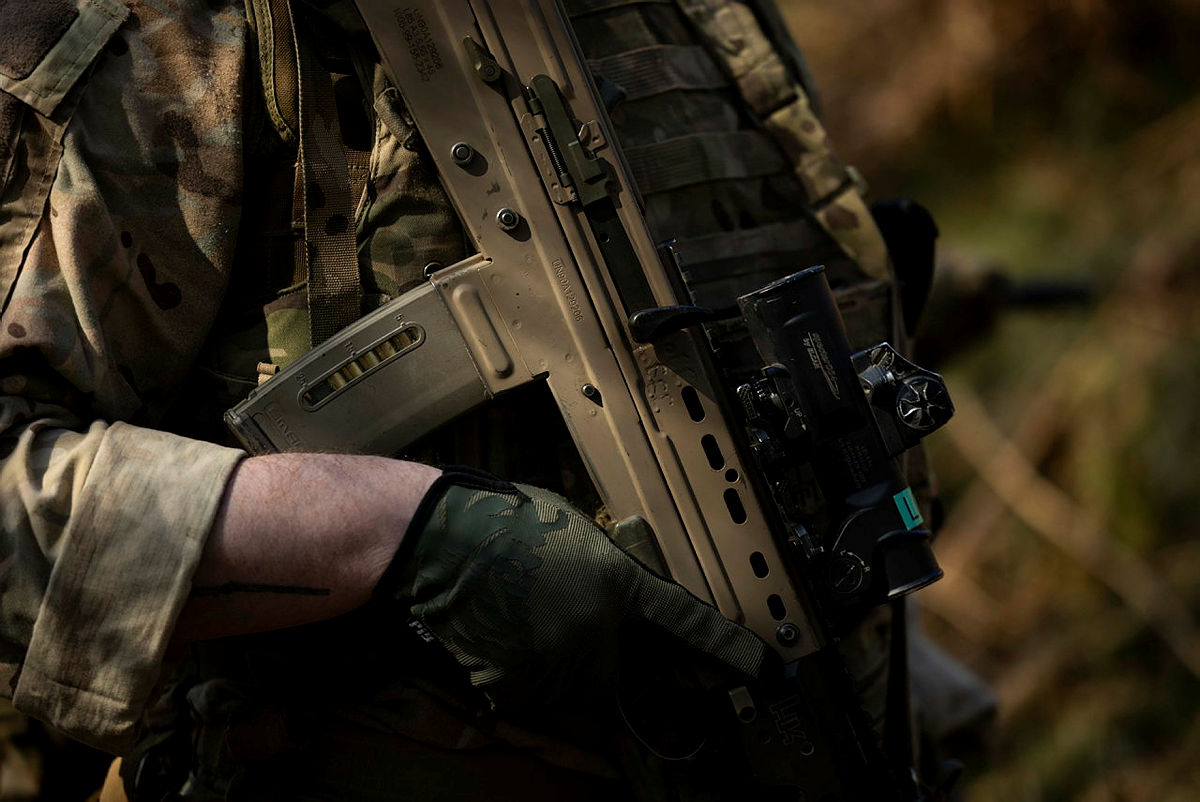
The Ministry of Defence has issued an industry notice expanding concept work on Project GRAYBURN, the long-running effort to replace the SA80, with an emphasis on UK manufacture, multiple variants and defeating modern body armour.
The Ministry of Defence has released a procurement pipeline notice providing further insight into Project GRAYBURN, the British Army’s future small arms programme, which remains firmly in its concept phase.
The notice builds on work first acknowledged publicly in 2025, when ministers confirmed that Project GRAYBURN had been established to examine options for replacing the SA80A3 service rifle ahead of its projected out-of-service date around 2030. At that stage, the MOD stressed that activity was focused on defining capability requirements and engaging with industry, rather than committing to a specific design or supplier.
The newly published notice, issued by Defence Equipment and Support, reinforces that position, stating explicitly that no investment decisions have yet been taken. Instead, it outlines the high-level characteristics the programme is now being directed to consider following guidance from the Joint Requirements Oversight Committee.
Five planned variants, likely based on a common lower receiver:
- Standard dismounted close combat rifle (SA80A3 replacement)
- Short dismounted close combat variant
- Personal Defence Weapon (L22 Carbine replacement)
- Generalist rifle (SA80A2 replacement)
- Cadet rifle (L98 replacement)
Central to that work is an ambition for UK manufacture. The MOD states that it intends for Project GRAYBURN systems to be produced domestically in order to strengthen sovereign supply chains, generate skilled employment and provide an exportable platform aligned with the Land Industrial Strategy. Officials are also examining the potential for a long-term strategic supplier relationship, covering delivery, support and spiral development of the GRAYBURN system and, potentially, wider elements of the dismounted close combat weapons portfolio.
The future weapon is expected to be capable of defeating current and emerging adversary body armour, reflecting lessons drawn from recent conflicts and evolving infantry protection standards. The programme is also examining surveillance and target acquisition requirements, with GRAYBURN weapons expected to integrate day optics as standard and rapidly accept in-line night-vision systems.
Additional areas under consideration include signature reduction technologies on selected variants and a strong emphasis on reliability across all climatic and environmental conditions. While the pipeline notice includes indicative contract dates running from 2028 to 2045, these are described as notional and should not be interpreted as a commitment to enter production at that point. The MOD states that industry engagement will follow in due course, with a further information notice planned once the concept phase has progressed.
The publication aligns with earlier ministerial statements that further detail on Project GRAYBURN would be set out through the Defence Investment Plan, which is expected at some point this year, probably, and should provide a clearer picture of long-term capability priorities.








There are a number of excellent rifles that already exist. For the love of god dont do an ajax on it.
Agreed.
The bit that looks dangerous is the commonality to the variants.
It sounds too much like the F35 fallacy. Commonality reducing costs whereas trying to use the same parts over has actually increased costs.
Probably not as concerning as it would be with other military items- especially if we’re going with an AR-platform.
Sig’s MCX, for example, already has all the variants described above- including options for drop-in calibre changes to something more hard-hitting for that adversary body armour.
The f35 is cheaper than the Typhoon
Now think about your statement? To adopt an existing weapon would mean in very short order they would be in the position of actually having to order and spend money on said weapon! This way they can spin it out costing a couple £M on tests and assessments etc.
Money to the MIC! 😆
Spot on.
Don’t be daft Patrick, how are you going to generate a sufficient number of staff positions in the project office as well as enough consulting positions for ex officers.
You can’t possible just send a few NCO’s off to the gun manufacturer to test existing weapons .
Speak sense man 😀
This has all the same nonsense as the US M7 debacle about fielding a rifle that can defeat enemy body armour. That’s a unknown quantity that the manufacturer is expected to “solve”
Either pick a 5.56 or a 7.62 and accept the trade offs, don’t expect a manufacturer to break the laws of physics (like FRES) and don’t be going off for some new cartridge that’s not NATO standard because you think it will solve all your problems (it won’t it will just be a mix of them)
Brilliant, well put!
To be blunt, the armour piercing 5.56 rounds that are currently available will penetrate the majority of body armour that is being used. To make it more effective you need to replace the steel core, with either a harder grade of steel or a tungsten based alloy. I don’t see the need for increasing the round calibre, when the majority of engagements on a target is less than 300m, especially if the weapon’s barrel is sized to deliver the optimum muzzle velocity. If we are considering pushing the engagement range out to between 300 and 600m, then either more cartridge propellent is required or a larger heavier round. But then we would normally employ the designated marksman who uses a 7.62mm round along with a GPMG, which would not only contain the necessary amount of energy down range, but also a heavier weight round that should be able to penetrate armour at those distances, especially if the round had a steel core.
Let’s be honest engagement ranges out at 600m are not the normal for a reason.. because unless your well rested, calm, in an optimal position and have had time to understand your local wind conditions ect as well as have a lot of constant practice. The shot dynamics pile up against you when your hitting a torso sized moving object at over 250yards , even when your rested, calm and in a well set up shooting position. I don’t any very good marksmen who would want to take a deer out beyond 250 yards (of the ones I know I don’t think any would want to risk shots beyond that)..
I would say the majority of military shooters will struggle to hit a target at 600m consistently, especially if its moving and not to mention if its blowing a Hooley. In the near future we may start to see more and more digital sights that include an predictive targeting computer, as per the SMASH sight. Which was originally bought for infantry to engage small drones with. The main issue to getting this type of sight being used on mass would be cost. However, this type of sight married to a weapon system that included a bipod, would allow the effective engagement ranges to be increased beyond 300m.
Yup. That’s one of the reasons a KS-1 type rifle that is so fantastic is over kill for most soldiers: Military shooting rarely gives you the opportunity to make use of a rifle that precise, and even if it does, balancing range time vs the mass of soldiers you need to qualify is an unreasonable expense. Especially since if something is 600+m away you have other options at your disposal.
We need local manufacture. Recent geopolitical events have shown that we cannot fully rely on allies for everything any more. If we can design and build something that has demand from other countries, even better.
In principle I agree, but a large order of 150k rifles off an existing production line would be enough to keep Army in spares and enough for reserves for a generation.
When was a brand new SA80 last produced? 1993? I know the lastest generation is basically triggers broom, but there really isn’t any need for a new production line and the cost associated with it.
That would work fine if we are living in a benign environment. But as World events are going, we may need to dramatically increase the numbers in our military. Purchasing these weapons overseas, will significantly prevent us from increasing our numbers at pace. Having these weapons locally manufactured (including accessories, i.e. sights) in the UK would at least allow us to tailor the production to suit the demand.
My thoughts exactly. Buy something that has already been extensively ‘trialled’ by use.
May the best weapon win foreign or not, manufactured in the UK. Just get it into service ASAP not held up by too many committees arguing over its viability and not listening to the user at an early stage. I will hold my breath for now if I can hold it for long enough.
This “should” be fairly simple given how mature AR‑pattern rifle design is — so it’s actually a good time to be replacing the SA80. The top three contenders are BDT UK (offering the Sako M23 and Beretta NARP rifle families), Heckler & Koch (HK416/HK433), and SIG Sauer (MCX family). I suppose it’s now largely about cost, UK assembly, and industrial footprint.
I’m told that Beretta’s NARP is an all custom rifle with AR-ergonomics, which means that changes to it have to use original parts. Probably not something we want to lock ourselves into.
It’s probably the only one in your list that I’d have greatest reservations about. But I still want to see the CZ Bren 3 on that list!
Fair concern. I listed it because BDT has proposed it to the MoD as an option. There’s also been mention in reporting of other possible rifles like the CZ BREN and FN SCAR, but none of those are officially confirmed by the government — there are just too many options.
Of course, it’s been pushed very hard- it’s definitely on the list.
Yes, loads of decent options out there. Without wanting to jinx it, the MOD would have to try really hard to get a bad rifle…
It needs to be a modern modular variant that allows calibre changes by replacement of a few core components (eg barrel). While Grayburn is examining the future calibre to use to defeat the latest body armour, there’s no guarantee they’ll get it right… Being able to change the rifle’s calibre could save a fortune a couple of years down the line.
I get the logic, but this is an army‑wide replacement, so it’s understandable they’ll want to keep costs and complexity down. That’s why they haven’t listed calibre change as a formal requirement. The MCX is the one that’s genuinely designed with calibre change in mind; the others tend to offer different calibre variants rather than simple swaps. I suspect they’ll stick with 5.56 and continue to use other platforms for specialist or marksman roles.
I must admit, I am fairly biased towards the HK416. As that’s a weapon I know very well, it served me well in Afghan. Compared to the L85 everyone is used to. The ergonomics are fantastic, swapping out a mag is a doddle, no catching you hand in your webbing or plate carrier. The downside is that it has a shorter effective range than the L85, as the barrel length was shorter 14″ (on the version we had) compared to the L85’s 20″. Yes its slightly heavier than a Bren 3 and other rifles that use direct gas impingement on the block, as it uses a short stroke piston much like the L85, to cycle the block. I do know the Sig, is probably out of the running due to its per unit cost. But for everyday use in all conditions the HK won’t let you down.
My experience of the AR platform is unashamedly biased against the direct impingement platforms. During one of my tours in Afghan, I was embedded with the Canadians, who used the Demarco/Colt Canada C7/8. We were given HK’s to “blend” in with Canadians, bearing in mind we wore Crye gear, which made us stand out like a sore thumb anyway! During one month we were restocked with ammo, this came from the NATO stock, the boxes didn’t have a country of origin on them. As the month went on we got embroiled in a number of significant contacts. Which rather than being a quick squirt by the Taliban, lasted over an hour or longer. It was during these sustained firefights that problems with the C7/8s started to show. Basically the propellent in the newly supplied ammo, burned poorly and produced a tar like residue. Over time the gas tube that fed the block started to gum up, which hampered the weapon from cycling properly. So they we getting a lot of misfeeds or cartridges getting caught as the ejection didn’t function fully. On the HK much like the L85 there’s an adjustable gas regulator, i.e. you could make the hole bigger when it started to foul, which kept the weapon functioning.
It turned out the ammo was old stock that came from Rumania. For me, as someone who has been in the odd firefight or two, you want a rifle that is rugged that doesn’t mind being bashed against things or dropped, but as importantly is also insensitive to ammo quality. Where if fouling does happen, there’s a quick work around to get the weapon up and functioning again. The most important thing is to maintain the ability to stay in the fight, rather than needing to fix the weapon.
Interesting, from the notice: “Variants – Pj GRAYBURN will deliver 5 distinct variants, most likely based upon a common lower receiver.”
That terminology sounds very much like they’re looking for an AR-15 derived system- where the operating gubbins are all in the lower receiver. Maybe it’s become a more widespread approach, but it certainly flags AR-15 in my mind.
It is fairly standard these days to do that. I think it’s largely driven by the American consumer’s desire to have a single NFA registered lower receiver that they can then easily put onto a variety of uppers set up for different optics, calibers, barrel lengths etc.
I’m guessing this all sounds great to the bean counters as well but I doubt it’s really that useful in a military context.
Fair enough, I’d really only heard the term used in relation to ARs.
I think the only real benefit would be if you had a bunch of uppers with different barrel lengths for the different types (PDW, standard rifle), or if you wanted a different calibre (like I commented to you below with 6.5). But that’s a lot of surplus uppers you need to have stuck in storage to swap out, and I’m not sure the MOD would be willing to do that.
Besides, with the training rifle (I assume the key point is that it’s semi-auto only), that is in the fire control group in the lower anyway- so that’d still need to be a different set. Even if most of the parts were common.
What country, that claims to be a tier 1 military power, willingly allows its capacity to design and build basic firearms to equip its armed forces to disappear?. Thatcher sold off Royal Ordnance to BAE who quite understandably acted in their commercial interests and closed everything down after orders dried up.,
Britain has relied on foreign designs for many of its firearms but retained the sovereign capability to build them, even if under licence.
If the BDT offer gives us that same sovereign capability, it looks to be a good option.
The SA80 was Royal ordnance, it didn’t work
Concerned about the armour piercing requirement.
Hopefully they don’t fall in the same trap as the Americans and get a ridiculously overpowered cartridge like in the M7.
I’m fairly sure that the Sig MCX series can drop a 6.5 mm upper onto a standard AR-5 pattern lower. It’d give a bit more punch without the ridiculousness of the M7.
I agree though, it’s a bit of a red herring in my opinion. I don’t know which adversaries they think have body armour- the Russians certainly don’t seem to have a lot of it, it’s mostly airsoft gear apparently. The Chinese?
The chinese have an enormous amount of manufacturing and industrial capacity. I doubt they will be slouches at producing good body armour.
They certainly do, but they also have quite significant amounts of grift in their armed forces too- probably not to Russian levels admittedly. Reports of water-filled ballistic missiles, and other such are the ones I’ve read about- I imagine there are others regarding less fancy pieces of equipment including body armour.
I’m not saying it should never be a consideration, I’m just a bit sceptical that we’ll be facing combat against adversaries as well-armoured as our own people.
How long has this no order done nothing Project been running? meeting after meeting like most things delay, no real answers may this year or next or sometime in the future, like every thing else words, words and no new kit.
Since 2025.
Really? Did you attend these “meetings after meetings” or are you just speculating?…
Are you suggesting we just go out to the local “Guns ‘R Us” and blow billions buying whatever happens to be in stock that day? Will it fire 5.56 NATO, Grendel, Creedmore, 6.8, Fury, 7.62 NATO, or Blackout?…
Given the project enters tender/ assessment in 2026, at least this project isn’t being delayed by the ridiculous DIP farce…
Since at least 2023.
Concept began 2025
2 years of doing nothing. Like every thing else no rush. I was not at any meetings were you? You seem to know every thing and love correcting others you must have an insight in to every thing
So how do you know there was “meetings after meetings” if you weren’t there? I wasn’t, so I don’t know. But then I’m not the one falsely claiming to know…
Concept 2025, tender and assessment 2026.
“2 years of doing nothing” – you made that up too 🤷🏻♂️
I don’t know everything, and when I don’t know about something, I ask (eg such as yesterday re satellite comms for RAF Protector drones) or I stay quiet. I don’t invent facts like you do. 🤷🏻♂️
If your going to list variants why on earth are you using SA80 for the L85 but L22 for the carbine. Stick with one or the other.
I suspect, much like everything else this government does, it will be kicked into the long grass for the next administration to deal with.
In the meantime, I suspect 2 and 3 para will join 1 para and the Royal Marines and adopt the KS1.
That way, all tier 1 and 2 personnel will be equipped with variations of the KS1 platform.
The remaining L85A2’s will be withdrawn/upgraded in additional batches to A3 standard and probably kept in sevice with the rest of the armed forces until 2035+
If we arn’t changing calibre, there’s nothing to stop the L85A3 ‘triggers broom’ staying in service until 2040 really.
1 Para isn’t on L403/KS-1, they’re using L119A2/C8’s. The RM are also are primarily on L119 and L143/Sig MCW, with only small amounts of L403’s being present in the UKCF. The only unit that is fully KS1/L403 equipped is ASOB. If 2 and 3 Para are updating I imagine it will be to L119, but I think having RGR and RIR in the Brigade will probably but a bit of a hold on that, and they’ll end up going project Grayburn.
Evening Dern, a ‘little birdie’ tells me they will all be moving over to the KS1 platform over the next few years…
Project Grayburn will be strung out into the next parliament, spending money on 130,000 new rifles is a very low priority…
I’m guessing “they” in this context is SFSG? I’d be surprised if they did move to KS-1 suddenly. Not impossible but the L119A2’s where cascaded to them relatively recently I believe. I’ll believe it when it happens.
Project Grayburn will probably run into next parliament because procurement cycles are that long, but my vibe is that the forces are quite keen on it, so I don’t think that SFSG will adopt KS-1 and then the rest of the Para’s will overcome the intertia of the rest of the forces to also get KS-1s before Grayburn is up and running.
I agree that we need to have full production facilities for both small arms and ammunition production in the UK, but think we should use an established design under licence that is fuly compatible with European armies. I don’t see the sense in spending billions of pounds over a number of years to reinvent the wheel!
We do have a production facilitate for small arm ammunition in the UK
It will be an AR variant, assembled (hopefully manufactured) in the UK.
Bringing small arms manufacturing back to the UK will certainly be ‘very’ welcome indeed.
The recent you tube videos about the electronic sa80 were really good.
Trigger is simply a switch, rate of fire can be adjusted to the individual, diagnostics about barrel temp, rounds fired etc.
The Royal Armouries ones, hosted by Jonathan Ferguson? Both parts were very informative.
Thats the one. Cutting edge back in the early 90’s.
Also very informative about the blue sky development processes
Weapon fires, weapon fires, weapon stops.. check solenoid.
Brilliant quote in the video. Giving presentation to top brass, question asked about what happens if battery runs out etc.
No flannel about that won’t happen, this is just demonstrator.
“Well Sir, you would fix bayonet!”
What a response, question immediately shut down.
So then it’s one of three companies Beretta, FN or H&K, anyone agree or disagree.Obviously not a USA company or local affiliates of for obvious reasons.
What would be the difference between the standard dismounted close combat rifle and generalist rifle (SA80A2 replacement)? The same question goes for the Short dismounted close combat variant and the personal Defence Weapon (L22 Carbine replacement). The names make them very similar sounding.
The emphasis on defeating body armour makes it sound like they’re considering 6.8x51mm like the US Army is getting in the M7 rifle, which sounds like an extra logistical hurdle, along with a smaller magazine, increased weight and recoil. Apparently it’s just not very nice to shoot either.
There’s a few options in addition to the SIG Fury that the USA have adopted – Grendel, Creedmore, 6.8, 7.62 NATO, or Blackout.
The question is, will they pick the right calibre? They might choose the best, but the best product isn’t always a marketing/ sales-wise success.
To answer your first questions:
“Standard Dismounted Close Combat Rifle” – the Rifle for Infantry, Para’s, and the like that are expected to be using them to engage the enemy. Currently this is being filled by L85A3’s with Elcan Spectre primary sights, and a red dot CQB sight.
“Generalist Rifle” – Rifle for the rest of the Army, Medics, Logistics, Artillery, Mechanics etc who would only be expected to use their rifles as a last resotry/emergency situation. This is currently being filled by L85A2’s primarily with either SUSAT’s or Iron Sights (until recently some still had the old Green furniture too)
“Short Dismounted Close Combat” – Rifle for Close Protection units in RMP’s, or Infantry working in CAV’s and the like where the benefits of a full length rifle are outweighed by the need for a weapon that needs to be maneuvered in tight confines but is still the primary weapon system. Currently this is being filled with the C8 with ACOG sights.
“Personal Defence Weapon” – Is a weapon that’s an emergency back up for vehicle and aircrews, and potentially concealed carry where the weapon is a last resort for personal protection. Currently L22A2 with SUSAT sights.
They *are* similar. It’s just slightly different weights of priority, which is why they can generally be covered with the same base system. A DCC Rifle needs more money being spent on it, because the guys you hand it too are expected to go into combat with it, and rely on it as their primary means for closing with and defeating the enemy. A Generalist Rifle still needs to work, but you need to give it to a lot of people, many of whom might never need to use it, even in a full fledged war zone. So it can be cheaper, using legacy systems, or even be outright hand-me downs. (Ie the Infantry gets a new model so the old DCCR goes the supporting units, which is kind of happening with L85A2’s now).
Similar with PDW vs SDCCR, a PDW is basically a “fuck off and leave me alone” system. You don’t really need to kill someone with it, you probably aren’t closing with and killing people with it. It’s more “My helicopter has crashed and I need to GTFO, let me put some lead towards the people who might want me dead to discourage them.” So again; it needs to be small, cheap, and lethality is secondary. SDCCR’s on the other hand are “Get the fuck down sir and let me handle this.” kind of things. Similar to the DCCR but just with needing to fit into vehicles having a priority.
I don’t understand the insistence on being produced domestically. It’s only going to add to the cost. What’s more, once the initial order is made the MOD isn’t going to order any more in numbers so it will just shut down afterwards. What does that achieve realistically? Look at Boxer, and that is a big order by our standards. Unless we order more (i.e. RCH 155) that program will allegedly be done in 2027. What happens to the factory then?
If the production rate is slow enough and there’s a spare parts program running it might survive.
That’s the real issue Dern, which ever rifle selected, we need a small facility that can manufacture and ship 1000 rifles a month, with subsequent additional batches,ongoing repair, rebuild and parts production.
That would be sustainable.
Our army is so small, the infantry would be re-equipped within 3 years, then roll them out and replace the L85A3 in the rest of the Army.
That of course assuming we stick to 5.56mm, it certainly looks like we are at the moment.
There’s no point building a factory and banging out 30,000 a year, it would be closed and out of work in 4 years!
I’d amend that with “we need a small facility that can be expanded easily if needed.”
Absolutely….
I hope we go for a 6mm ARC bullet for these rifles as from what I have seen recently it seems to have the right balance of range, accuracy, weight and lethality. Whilst we will probably go for 5.56mm I do think we should take the opportunity to move up.
I also think we should go further with the SMASH sights and potentially go for 2 per section (paired to the replacement LMG).
all the main candidates have different barrel lengths etc and I am sure will be great, very interested in the NARP and also think the KS-1 could be more widely adopted.
If we are going to build in UK – then we need to order 500k spread over 25 years, as surely part of our plan should be to have stock for mass mobilisation.
this should bring the price down a bit & ensure we have a sustainable industry plan
Assuming an average price of $7.5k per set (rifle/scope/silencer etc) this comes in at £150m p.a.which is sustainable if we don’t mess about with the run rate and keep to the order profile.
A good contract team is key
I would love to see NATO have a trial, then adopt 6mm Arc, or 6.5 Grendel, or 6.5 FN LICC. Any of those is better than 5.56, without being high pressure crazy like 6.8 Sig.
Take a look at garand thumb on all of these, his video is an eye opener. It goes to 800m easily & is good to 1200m
It’s lighter than the 6.5, 6.8 so you are not losing as may rounds and also has less of a kick
From what I can see it’s really the logical next step up and has similar performance to the slightly larger calibres. Given that NARP is stating by it is as accurate as current DM rifles this could be the silver bullet for UK
Ultimately I think we will go for 5.56 due to logistics but I also think that is a mistake
I have shot .270 Winchester a fare bit & many decades ago I had a letter printed in “Guns & Ammo” praising it as a medium to long range sniper round without too much kick. Well someone in the US seems to have acted on it but, the .270 Win does 3000 ft per sec out of a 22″ barrel. The 6.8 x 51 does that out of a 11″ barrel , so pressure is way high, leading to barrel wear & needing the expensive 2 part case. Also the .270 Win is a 64mm long case.
For the average soldier, they are better off with something less manic. So 6mm Arc, 6.5 Grendel or 6.5 LICC. Any of those will do. 6.8×51 Sig may have a place for snipers & machineguns.
If we are sticking with 5.56mm, then an opportunity to store several thousand L85A3s for war reserve, would present itself.
However, we rarely do such sensible things, so they will likely all be scrapped.
Is accuracy international capable of building a decent combat rifle that isn’t over-engineered and focused on supreme accuracy over affordability?
Either go back to 7.62 or go with the US and start using the 6.8. With modern body armour the 5.56 spray-and-play format is losing its appeal. For battlefield use you want range and penetration.
Would like to see Desert Tech enter completion with their WLVRN. Bullpup means even vehicle crews could have decent barrel length, lots of barrel lengths available as well as multiple calibre options
What weapon does the Rangers use?
KS-1 aka L403 in UK service.
Having had a good look at the KS1, its easy to see why its so expensive, its a beautifully made rifle, upper and lower fit is excellent, the quality of its materials and finish are hard to beat.
It is but equally the marginal cost between that and another weapon system isn’t going to be significant, as I suspect a lot of the costs are in the maintance agreements etc. Saving a few million in the grand scheme of things over the course of a multi year purchase would be silly, if it meant giving the troops a less capable option.
However what isn’t yet clear is what calibre they are going for, as that will drive everything else.
It’s not really that marginal. At 10k per rifle it’s a very expensive solution for standard infantry, let alone rear echelon troops. As a selection for Project Greyburn it would amount to 1.3 billion quid. We aren’t talking a few million here, the margin is a lot bigger.
I also want to push back on the idea of giving troops a less capable option being silly. There’s a lot electrons spilled over gold plating here, and KS-1 is a gold plated rifle. For small units with huge amounts of Range time (Rangers, SFSG, SRS) the KS-1 makes sense. For your average 19year old Private who shoots an ACMT once a year and maybe gets some remedials if they can’t pass it, the KS-1 is massive overkill. Even your average infantry private isn’t shooting enough to get value out of that rifle. (Oh and yes Rangers get a lot more range time than normal infantry, before anyone says anything).
But your assuming cost per rifle wouldn’t come down with a order of around 150k rifles. Also it would be an order probably over 10 years, so 1-200m a year, Vs 30b ish a year equipment budget. It’s affordable if there is a desire.
Isn’t the KS one broadly aligned with the standard issue US rifle post Afghan/Iraq upgrades?
In response to comment 1) The cost is unlikely to come down much. The KS-1 is a high end boutique rifle with very high degrees of fit and finish. To make an analogy, you can order 1,000 Rolls Royce’s but the price is not going to come down to be competitive with a Ford Fiesta, unless RR sacrifices the quality of the product for mass.
It’s “affordable if there is a desire” is a really bad take. Yes it’s affordable, if you are willing to spaff double what you should be spending on them for a benefit that won’t have a tangible difference in the field army. So what should go by the board for the KS-1? 130,000 KS-1’s vs a more affordable Rifle is £650m extra quid. That’s enough for 130 Challenger 3’s. So should we cut our tanks so everyone gets a Gucci rifle that the vast majority of shooters aren’t good enough to get the benefit of the extra spend from?
And no, the KS-1 is absolutely not aligned with current standard issue US rifles. This is from someone who has used both KS-1’s and US Army issue M4’s. There is a world of difference between the two, which again, is reflected in the price tag. A US Army spec M4A1 is going to set you back a little under 1,000 USD, which is broadly what a service rifle should cost.
Fair enough, just looking at prices the new US rifle the xm7 costs approx the same as we paid per ks1 when considering the full system for both. If the US army thinks it’s soldiers are worth the expenditure, so should the MOD.
You know one of the reasons the US Army is struggling with the adoption of the XM-7 is that it costs 4x as much as a new M4A1 right? And that at 4,000 USD it’s still less than half the price as a KS-1 right? And that it’s a highly experimental weapon system that’s required a lot of funding to develop right?
Or are you ignoring all that and pretending the XM7 is the standard post afghan weapon system that the US is adopting with no issues and no pushback?
I actually wasn’t thinking of the xm7 for the post Afghan rifle but was looking at costs after posting .
Not seen anything about the US struggling with costs. I have seen plenty of news about teething problems that are getting ironed out.
The US is literally limiting them to about 100,000 rifles, when the US Army active duty alone is about 500,000 troops. The reason for that is cost.
It is an absolutely lovely rifle. The sight I have thoughts about though. But yes, shooting it after years on the L85, old C8 hand me downs, and even US Army M4’s, it’s clear why it costs so much.
Afternoon Dern, they certainly are, wonderful rifles…
It’s the best quality ‘service’ rifle i’ve ever handled, by a very long way.
Yes, I’m flabergasted by people saying it’s broadly equivalent to current US service rifles. Just goes to show that some people have never handled either.
Thank you. Are those weapons too expensive to supply the rest of the Armed Forces with?
Yes; they cost about 10x as much as a normal service rifle.
I read an article not so long ago, that the troops trialling the new 6.8 in the US run out of ammo real fast using the current tactical doctrine of fire suppression, assault and fire and maneuver.
They left out the most important bit imo. I can’t be green, it must have a bayonet. And more importantly? The tools at Pirbright who write the new drill manual have been left out of it…..
I wonder if they will spend a decade decided what cal they want to adopt… so many choices.
I don’t get the point of investing in new rifles if we don’t look at a new calibre.
Ideal Calibre is probably the same today as it was when recommended 80 years ago – between .250 (6.35mm) and .270 (6.858mm).