

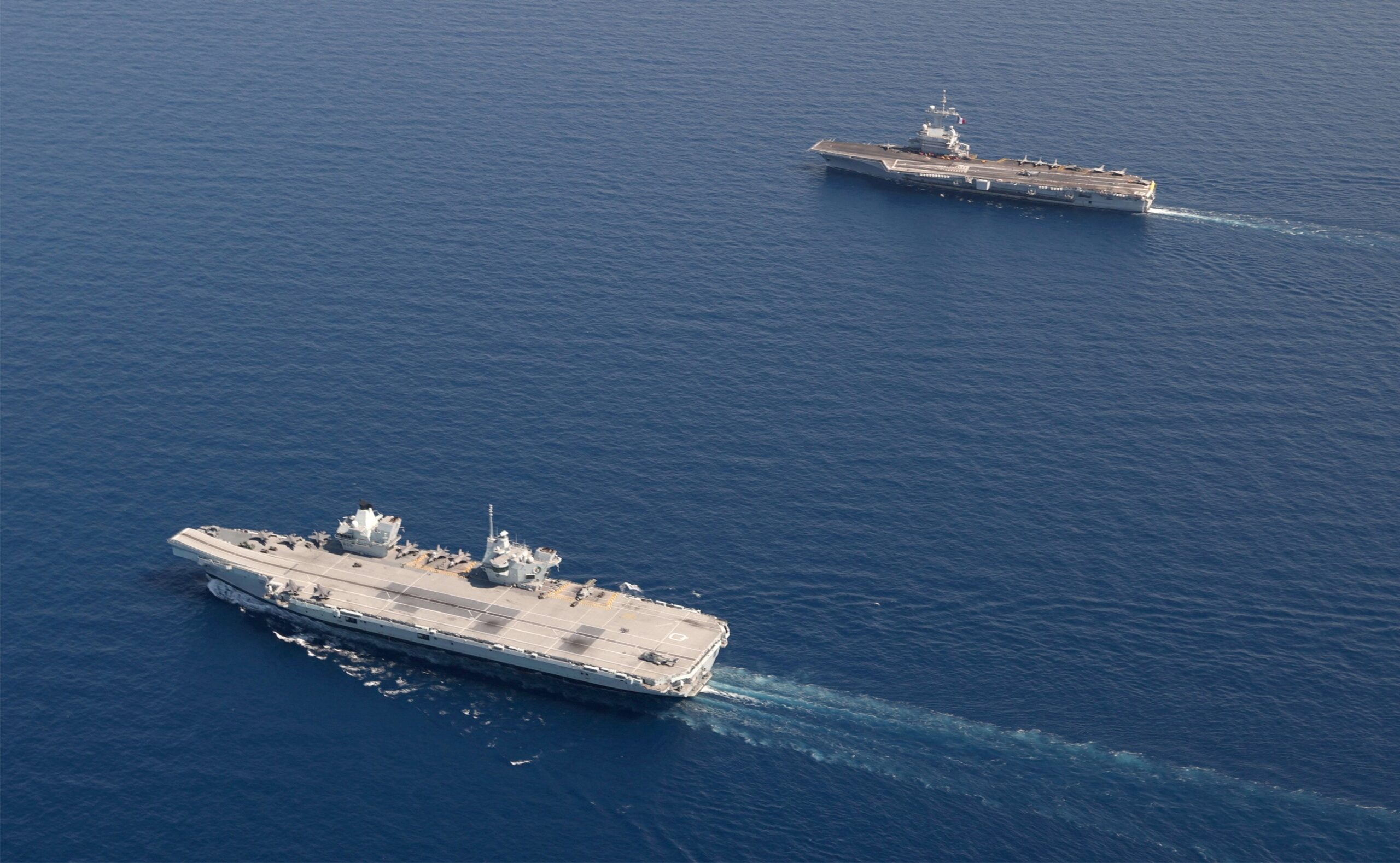
The United Kingdom should assume primary strategic leadership over Euro-Atlantic security as the United States rebalances its resources toward the Indo-Pacific, with the historical sentiment underpinning the so-called special relationship no longer sufficient to deter the coordinated activity of China, Russia, Iran and North Korea, according to a new report by the Council on Geostrategy.
The report, titled Burden sharing: Preparing Britain and America for a multifront crisis, was published by the London-based think tank and argues that decades of globalisation have systematically hollowed out the productive forces of both nations, the organisation stated. The analysis introduces the term machinepolitik to describe the systematised industrial power the authors say allowed Britain and America to prevail in the major conflicts of the 20th century, contending that the combined industrial strength of the two allies may now be weaker than that of their most powerful systemic rivals.
The report frames the threat as emanating from what it terms the CRINK axis, comprising the People’s Republic of China, Russia, Iran and North Korea, and argues that the active collusion between those states demands a level-headed shift away from real-time diplomacy in favour of integrated industrial capacity and structured theatre division.
According to the Council on Geostrategy, the United States under the second Trump administration is rapidly rebalancing toward the Indo-Pacific and the Western Hemisphere, with the 2025 US National Security Strategy expecting European allies, and the United Kingdom in particular, to assume primary conventional responsibility for deterring Russian opportunism in the Euro-Atlantic. The report concludes that Britain can no longer rely on nostalgia and must drop what it describes as rigid legalism in favour of assertive realism.
The analysis points to recent friction at the political level as a warning of what can happen when strategic alignment is absent between London and Washington, citing the opening stages of Operation Epic Fury as a case in which structural damage was inflicted on the special relationship. To prevent what the authors describe as dangerous command paralysis, the report argues that critical global staging nodes including the Sovereign Base Areas on Cyprus and the military facility on Diego Garcia should be operationally insulated and pre-cleared for allied force projection before any conflict ignites.
The report sets out seven recommendations. The first calls on the British government to “identify areas of overlap within the Venn diagram of the Trump administration’s strategic objectives and British national interests to present clear opportunities for mutual cooperation to the White House,” as the authors put it. The second is the establishment of a shared understanding of multifront crises through what the report describes as “a sprint of joint wargames and significantly closer synchronisation between Euro-Atlantic and Indo-Pacific military exercises, drawing on the 1980s’ US-led ‘new maritime strategy’ as a historical baseline.”
The third recommendation calls for formal theatre coordination across three tracks: “integration in the North Atlantic and Wider North; cross-pollination in the Middle East, Africa, the Indian Ocean, and the Mediterranean; and a progressive delineation of responsibility where the US leads in the Western Hemisphere and Western Pacific, and the UK assumes greater leadership in Eastern Europe and the South Atlantic,” according to the report.
A fourth recommendation centres on what the report calls a Five Eyes Critical Minerals Alliance, with the authors urging both governments to “address critical mineral vulnerabilities by launching a joint multilateral fund, modelled on the US$250 million Pax Silica initiative, to subsidise cross-border prospecting, extraction, and refining while harmonising national security exemptions and export controls against economic coercion.” A fifth recommendation proposes a Strategic Friendshoring Task Force, described in the report as “a temporary joint mechanism inviting NATO and Indo-Pacific partners to map multitier supply chain bottlenecks and determine where participating nations can rely on shared, friendshored networks rather than fragmented national onshoring.”
The sixth recommendation calls for elevation of AUKUS Pillar Two within national defence planning, “aligning increased funding against concrete, joint technology development projects to serve as a baseline for future co-development,” according to the report. AUKUS Pillar Two covers the advanced technology and capability work that sits alongside the Pillar One submarine programme, including artificial intelligence, autonomy, undersea capability, hypersonics and quantum technology.
The seventh and final recommendation calls for deeper defence industrial integration through what the report describes as “a permanent joint working group to identify and action opportunities for the co-development and co-production of military capabilities.” The authors add that the arrangement “will support more seamless cross-theatre cooperation and allow for greater scalability, but will require Washington to ease its remaining regulatory and export restrictions and for London to accept compromises on domestic industrial sovereignty.”
The report sets out a strategic outlook in which the United Kingdom and the United States need one another, with the authors noting that the United States “looks set to remain the world’s foremost power, with a growing lead over the European Union (EU) and Japan in next-generation technologies.” The analysis projects that “by the late 2030s, the British economy is projected to leap over Japan and reach parity with Germany to sit alongside the US, the PRC, and India, meaning its utility to Washington may even grow, especially given Britain’s position as an island citadel on America’s eastern flank.”
The authors are clear, however, that a deep change in the United Kingdom’s national mindset will be required to make the case. “Attempting purely national, autarkic onshoring is economically unsustainable in a globalised world,” the authors write, as quoted in the report. “If the UK is unprepared to invest in the British Armed Forces at a level commensurate with a cold war, it cannot expect to be taken seriously in Washington. True multifront preparation requires turning vital global staging nodes into undisputed, pre-cleared launchpads of allied power.”
The report adds that London “needs more realism in a geopolitical age,” and must “invest further in credible, scaled combat power to ensure that the CRINK fear British decisions in theatres where the UK will lead, and that Britain remains indispensable to America and the small handful of countries that are prepared to uphold defences sufficient to deter aggression across key theatres.”






I do not think many people will disagree with the recommendations, it is getting the current government finance it and getting the the UK’s economy back into heavy industry with the likes of Mr Miliband refusing to budge the UK is fast becoming a nation of Bankers but the B has been replaced with a W. I do not believe that the current change at the top of the Labour party will do much for the country. Mr Jarvis is trying his best but will he keep his job after the pending reshuffle.
Couldn’t agree more, but we haven’t had, nor do we have a government capable of doing it.
We don’t have much of a work force looking for low paid manufacturing jobs either.
This is the usual muppetry. Fighting wars now will have far more to do with coding, advanced electronics and aerospace, all of which America and Britain excel as and little to do with knocking big steel boxes together.
We probably need to replace politicians with prayer! 🫣
The UK economy has not recovered since leaving the EU. 8 % reduction in GDP since leaving the
The economy has to be worked on in order to properly fund everything the UK needs to do in security.
Mickey the UK normally ends up leading Europe for one reason or another. I suspect we will step up as and when required.
Statistics are really a wasted effort. We have our challenges at the moment but I’m sure we will work through them.
Agree, leadership is much more to do with experience, comms, intel and historical relationships all of which we excel at.
Tough to judge the last 10yrs in any Meaningful way… we’ve had COVID, UKRAINE followed by IRAN…!! Taking 6 of those 10 yrs…!
The EUROPEAN picture has been Similarly stunted…!
Economically FRANCE i would suggest the ones to keep an eye on in the Near future…
We haven’t got anyone capable of leading the country never mind setting us up to be a leader in Europe!!!
Someone will turn up sooner or later …
Throw a name out there….Germany…!
Taking threats far more Seriously than Most..!
Think tank 🤔 maybe they should call themselves Wish tank. 🙄
Yep. Its very presumptuous to say the least. Maybe thinking too far ahead and not real enough in the present or near future. Get some extra masse into the RN with a few more ships and subs happening first before wanting to divide the up the world’s oceans amongst allies and expect competition for influence and opposition.
Talk about living in in an alternate universe. First of all, no country in Continental Europe either wants or thinks the UK capable of replacing the United States as a guarantor of European Security. Secondly, the UK’s economy and priorities are incapable of replacing the US or assuming a leading role. The UK can’t feed itself, defend itself, power itself, or govern itself. It has no manufacturing base. Its young men and women are reluctant to fight for it.
One could go on and on but the British Empire died on the Somme 100 years ago. One fact alone should sober those living in this alternate universe where Britannia still rules the waves. LSE market capitalization – $52 billion. NYSE market capitalization – $69 trillion.
Such a fragile ego. What does current US leadership look like?
Massive strategic blunder in the middle east, domestic economic illiteracy, strategic surrender to Russia and China and getting completely played by Iran. Yeah, you live in sn alternate reality alright.
The chips sizzling nicely still I see. I see the name and just scroll past, I know the bitterness and jealousy in there.
Bitterness? Jealousy? My, God you people are delusional. I see your name and think what a once proud people have sunk to. Your irrelevant, deal with it.
Is education illegal in America?
I knew I’d get a bite!!!
PK. You might want to check hour valuation of the London vs New York stock exchanges. Your valuation of London is ridiciously low and the NY exchange likely less than ehat you reckon.
Like a wasp at a barbecue, an irritant, but enjoyable to slap down.
Revel in your wishful thinking. You just can’t face the facts, can you? The UK’s days of glory are gone. You’re a third rate power compared to the US. Live with it, if you can.
Nice bit of projection there. You lost against Iran, You’ve surrendered global status and authority to China. Russia owns your president. Your convicted felon , senile old president can barely string a sentence together, doesn’t know where he is most of the time and shits himself on live TV.. You are drowning in debt and cannot afford housing or health care. You great yet ?
They don’t even have their own language……
History? Not much, bunch of immigrants who kicked out the real north Americans.
You’re both right(OKCasimir and Posse Comitatus), so I’m not defending him. Honestly, it’s just sad that instead of taking the high road against a troll, you’re stooping to his level.
The irony is that you’re trying to act superior without realizing you’re behaving exactly like him. You both probably think you ‘got him,’ but this petty back-and-forth just proves both countries are on the back foot—like monkeys throwing mud instead of offering anything of actual substance
I’m all for measured and reasonable debate, but slapping down trolls is immensely satisfying.
Alas I’m afraid you are delusional like many of the commenters on this platform . Yes true the Great Britain of old is no longer here however (many reasons buts that’s a topic for another day) the US is likewise in a dire straight.The only reason the US is still in any way relevant is due to its status as having the dollar as the global reserve currency Ala it can print money at will to fund its endeavours but that 36 Trillion dollar debt is reaching the limit of what is sustainable. Everyone within the financial world knows this current financial system is on life support and sooner or later is going to collapse ( multiple upon multiple sources if you bother to look both sides of Atlantic and they aren’t all Russian trolls) .
Even president Trump knows this along with the Brics nations This is why a new financial system involving digital currency is currently being prepared and it won’t be a global enterprise with currency exchange in the US dollar. When the shift occurs you will find a greatly diminished US .No i’m afraid the US is not the great power you think it is they have failed to win any meaningful war since WW2 ….. Korea Vietnam Iraq Afghanistan all disasters and now the Iran failure portrayed as a victory but anything but …. You need to look past CNN or MNSBC or FOX or heaven forbid the BBC you won’t get the truth on any of that.
That said good for you your optimistic outlook is commendable however sooner or later reality is going to dawn on the situation.
The question at hand is whether the UK has terminally declined. You can try and deflect with your knee jerk anti-Americanism and try and change the subject, but I won’t fall for it. The US strides the globe like a colossus. Its economy is twice the size of its nearest rival, China, when looked at through the lens of reality and not false Chinese economic statistics. Korea was 75 years ago, and Vietnam was 50 years ago and still the US is the only superpower. So live in your fantasy world and I hope you live long enough to realize that your grandchildren are still living under American hegemony.
Just because you refuse to believe something isn’t true does not make it not true. Instead of bloviating about how mighty the US is as if it’s power is all a gimme and is going to go on forever perhaps go do a little research regarding the financial world and if you are capable of such a feat then you will see the writing is on the wall…… and my point stands the US has not achieved a complete military victory against a meaningful war since WW2 . This Iranian straights of Hormuz venture is simply clarification that the US is unable to achieve its military aims with impunity …. They have royally F’d this one up the strategic fuel reserve is running out and production munitions are insufficient to continue indefinitely so we’ll see where this one goes….
I’m sure it was old Henry Kissinger who once quipped “ it’s a bad thing to be an enemy of the US but it’s fatal to be their Friend” ……… followed by a chuckle
Y’all have a nice day now 👋🏻 yeeeeeeeeeehaaaaaaaaaaa
Sure… lets see, the King and the PM killed ,thousands of deaths, Royal Navy and RAF destroyed, almost no enemies destroyed = Victory!!!
The NYSE market capitalisation is around 45usd trillion. 69 usd trillion is around the total value of the US stock market
So for starters the UK needs to re-industrialize – especially its defence sector. That would include weening itself off foreign-owned companies and IP, and changing the way the UK Stock market works, in order to protect critical strategic UK defence companies and resources, many of which have been sold to predatory overseas Government-subsidised entities and American companies and wealth funds.
!00% correct, companies like Capita, Serco, Landmarc all with the finger in the defence budget pie along with government contracts with most of the government departments. All three are helping to pay the American 401K pensions through the Bank of America, Black Rock, Amentum and Vanguard just to name a few. So in affect every £ in profit earnt by Capita, Serco or Landmarc at least 40 to 50P goes to America. Is it not time for the UK to do what America dose with its government contracts and insist that all profits be spent in the UK on infrastructure. We have the money in the UK to fully fund the armed forces we just need to cut out the middle men and insist in profits made in the UK stay in the UK.
I’m also talking about the likes of Rheinmetall, Thales, Leonardo, General Dynamics – these are not UK companies.
I also see the German government is again trying to relocate Rolls-Royce and its new ultra-fan engine to Germany. Chemring is one of the few remaining UK defence companies, but i see they are having to hand of IP in order to get a USA contract. My point being is that they UK needs to stop being so naive so as to nurture and protect its own industry, and be a lot more assertive when it comes to buying from foreign-owned companies.
All the above is true but added to that is the lack of control on company proffits going overseas, if we look at companies working in the US for example they have to keep all proffits made in the US in the US and invest in the infrastructure the UK seem unable/unwilling to do the same, is it because of our political elite/civil service/high ranking officers are all investing in these companies and it is an easy way of getting there nest eggs offshore to the detriment of the UK tax payer. Crapita (capita) is working directly with No 11 Downing street and charged with “saving money” so now they run the DWP, Veterans war pensions, Civil Service pensions to name just a few departments but all they have done is the same as when they ran the armed forces recruitment 18 months to 2 years of delays per candidate. So in reality all these departments are just putting off payments while adding anouther layer of costs to the system then to rub salt into the wounds they are shipping their proffits over seas.
…I would go further and start looking at ownerships of UK land, properties and key strategic assets. for example I don’t think countries like Denmark allow foreign companies or nationals to own land. London/the UK is full of unoccupied blocks of flats that are overseas-owned. Either just another asset class for foreign investors or those looking for an emergency bolt hole when they have to flee their own country. Either way it inflates the UK property market, launders cash, and in the case of land and strategic assets, is downright strategically foolish.
All very true and add weight to the old adage “follow the money” but our political elite do not want us to as the vast majority are in the money trail so cannot/will not upset the apple cart for rear of having the finger pointed at them.
Re-industrialization ain’t going to happen over Night .not even ever… Our Goverment Taxes our Industries to destruction, and we pay huge utilities bills and Paper work for h&e with net zero come out of our ears…!!! The only people gaining are the people who push around these follies…! Even our farmers are now being pointlessly Destroyed by such people ..
US looking East means Europe :)))
Let’s be real:
The UK is not going to be leading Europe. We can nudge, and we might be able to lead smaller coalitions within Europe, like the JEF, but with us having left the EU nobody in Europe is terribly interested in having us take a leading role. That’s before we start talking about how much continental powers are putting into their defence budgets compared to us, or the way we always talk about “Other powers can fight Russia, we’ll sail about the Atlantic and help.”
Spot on. The report is surprisingly detached from reality on so many levels. If the UK was in the position to lead Europe then France would too as it is a totally equivalent power, but then Germany could claim that that lead even more given that its military budget is forecasted to grow to that of the UK and France combined. And that’s even before starting talking about the fact than it is absurd even to think France would accept being led by the UK, or the EU by a non-EU country other than the world superpower. And then there is the small fact of the UK military budget and capabilities being a fraction of that of the US, or of China.
The bottom line really is that Europe is going to be lead by France and Germany and which one just depends on where the chips fall. If Germany gets assertive then I think it will be the European Leader, if not it’ll stay a bit of a tug of war between the two, maybe favouring France.
Yes, France has everything the UK has, plus it’s in the EU and has strategic autonomy from the US, all the right elements to lead Europe which, let’s not forget, is mostly the EU. Except that the world is changing and the historical advantage France had over Germany thanks to deterrent, operational experience and power projection will keep decreasing, and will totally disappear if Germany decided one day to go nuclear too. Therefore I suspect France will increasingly see an advantage in collaborating with the UK as a counterbalance to Germany on defence matters, obviously not to compete with Germany as military powers but to count at same level on common future European defence.
TBF I don’t see Germany going Nuclear any time soon, it’s not something that has any public or international backing, unless the EU collectively develops a strategic deterrent. But on the other hand that means that Germany on similar budgets will eclipse France as a conventional force in all probability.
Germany might not crave the European Leadership position, but it’s population and economy and geography all push it towards that position, and with it’s stated goal of becoming the most capable army in Europe (and yes we know Poland is spending big right now, but it is a gap that Germany could close) it might just be a bit de-facto.
And yes I see Britain trying to play France and Germany against eachother, as is our want.
Well, it’d say Germany’s monumental shift from carefully avoiding military matters (internally as well as with allies) for decades to targeting the largest military budget and conventional forces in Europe is bigger than a potential shift from NATO only nuclear to their own. Not anytime soon obviously but they are not shy anymore. And they clearly stated their European leadership ambitions, putting resources into it at all levels, far above what France and the UK can do let alone Italy, Poland etc.
France won’t accept second place and will see its competitive advantage erode so interest for collaboration with the UK will come from both sides but with different goals: for a UK outside the EU it’ll be to put (as you state) France and Germany against each other; from France it’ll be to build a counterweight to Germany that could allow it to still be central in EU and continental defence.
Not really, the shift to militarisation in Germany is an uphill battle, but was seen as internationally necessary by Germany’s neighbours long before. It’s also been a very gradual build from complete territorial defence in the 1980s through multiple NATO and EU interventions to even it’s somewhat non-interventionalist position now.
Even Nuclear Power for civilian purposes is viewed with deep scepticism by the German population, let alone weapons, and there is zero international support for it. Germany is also a signatory of the NPT, and is generally not big on breaking treaties it has signed.
France won’t go quietly, which is a shame and why I say the chips are up in the air. If I was betting I’d say Germany will eventually take the leadership role from France though. As for the UK, I said pit France and Germany together because while the French will want to be close to the UK as a power block and because their Atlantic focus draws us together, Germany will also happily work closely with us and build a power block to keep us in whatever form NATO takes in the future. So I think it won’t be as clear cut as a France+UK on one hand Germany on the other.
Well the UK could remove its commitment to NATO of its strategic deterrent. That will get noticed. Personally I don’t want the UK to hsve to take a lead – let some of the Europeans shell out the cash for a change.
Wow. Look at this dude who doesn’t pay attention to current affairs but still opens their trap.
Not sure what the slight snark was for?
OS does have a point there – the UK has expended vast amounts of blood and treasure on saving “Europe” from itself over the last 200 years, from Boney, to Kaiser Bill, to the Austrian corporal, and gets precious little thanks or recognition for it.
In the last big away game we played, virtually all of Europe was aligned with the baddies, either directly (Austria given the Anschluß, Italy, various Baltics / Eastern European countries, even the USSR (Molotov-Ribbentrop (at least until the Corporal betrayed the Georgian before the Georgian could betray the corporal)), indirectly via collaboration (Vichy France), or because they’d been taken over and were under military rule (Norway, non-Vichy France, Netherlands).
Ostensibly “Neutral” countries were either “hostile neutral” (Spain), “collaborationist neutral” (Sweden with it’s vast iron ore exports to Germany) or Chaotic Neutral (Swiss, who were prepared to offer banking services to all).
Reality was, had it not been for us, by the time the Americans joined the war and the Russians started fighting with their erstwhile allies, it would have been too late. Always loved that Churchill quote about how “The Americans always do the right thing. After they’ve tried everything else” 🙂
Point of this? We see / saw the same playing out in Ukraine. Whilst the first major invasion of a european nation in history was going on, the “EU” didn’t know what to do – of it’s two main leading countries, the starting position for both was one still trying to retain access to cheap gas from the aggressor (Germany) and the other still trying to sell them warships (France – Mistral class).
As with our exit from the EU – we’re a small, unimportant country on the wet a**e-end of the continent with nothing to offer. But somehow, the first thing the Germans wanted right away was a defence treaty with us (almost as if they somehow had reservations about the French – FCAS anyone?) and the French to retain access to our fishing waters. Sorry, I’m confused. Either we’re important, or not? The fact we gave those things away and got nothing substantive in return is another matter.
If what OS was trying to say was that the UK needs to stop being so naive and look to its own interests first for a change, and view it’s alliances through that lens (like every other country does, and the EU has elevated to an art form), then I couldn’t agree more. We have strengths. Why are we always so reluctant to play to them? Maybe we should take a turn being that small, unimportant third rate power for a change. Withdraw to our own boundaries and rest under our own nuclear umbrella. The “Prickly Hedgehog” approach. Let France subordinate its nukes to EU command and turn its permanent seat on the UN Security Council over to the EU (Hah! Double hah!)
Wow; Putinist stooge says what now while strawmanning me?
I suggest you look at who is spending what in Europe.
Not sure if you’re talking to me, or OS.
Either way, I’ll be charitable and assume the ad hominem was because you’re tired and emotional and/or got out of bed on the wrong side this morning 🙂
Point me to the part of my post that makes me a Putinist Stooge? I’d say that it rather makes out that (dubious) honour goes to our French / German “allies”. Whilst they were trying to seek their own economic advantage with the ex KGB man, we were (amongst other things) busy denuding our own armouries of NLAWs, to our own detriment, to help the Ukranians blunt the Russian armoured offensive.
I do look at what is being spent in Europe. If you mean “overall spending”, we’re right up there. If you mean “getting value for money”, we’re bottom of the pile. If you mean “spending that money on actual military hardware and munitions”, puuuurlease…
Every other nation is busy doing what we do and pulling tricks like classifying pensions, civil servant salaries and bridge building as “defence spending”. The Spanish are blatantly taking the mickey. Like with us, when other countries start taking delivery of serious amounts of actual hardware and munitions, I’ll sit up and take notice. And by serious, I don’t mean small purchases of say 200 AMRAAMs here and there, which would get burned up in week 1 of any real war in Europe. We currently spend more on the interest of the debt we’re racking up to pay for welfare than we are on defence. If pointing this kind of thing out, or questioning the commitment of our allies given their public actings and comments, or indeed questioning whether we’d be better of strengthening our own borders and taking a back seat for a change, makes me a putinist stooge, so be it.
I watched that “The Wargame” podcast with a sense of foreboding, as it seemed all too believable to me. UK attacked, calls for support / help, and (eventually) only the Norwegians and the Dutch start to stand by us.
We’ve been here before in living memory in the Falklands. Yes yes, there was an EC arms embargo on Argentina (which the Spanish and Italians (our NATO allies!) promptly tried to circumvent) and a ban on imports from Argentina (big whoop). The French were selling missiles / technical assistance to Argentina (Putin/Ukraine/Mistral?!) and the Belgians refused to sell us ammunition for all the lovely guns we bought from them.
In fact, for a NATO ally, the Belgians seem to make a habit of not supporting us. They went for an encore in Gulf 1, refusing to sell us 155mm ammo and as recently as 4 years ago, refused an export licence for an Isostatic press used in the maintenance of our nuclear deterrent.
With friends like those we could hardly be worse off than going it alone, and even pre-Brexit, the Russians would have realised that we would be unable to really count on any of our NATO allies when push came to shove, except the Americans.
Right now, I think that the only ones being serious about rearmament are the Poles, who are basically single-handedly keeping the South Korean armaments industry in perks and bonuses. The Italians are arguably cutting their cloth well to get the best bang for their buck.
Where did I straw man you?
Play the ball, not the man.
“I suggest you look at what has actually happened in the world, rather than what you wish would happen”.
UK removing its strategic deterrent from NATO is no different from what France has always done. As for Europeans spending on defence sure some are but quite a fee aren’t eg Spain and Italy ( two of the top big 4 EU countries).
“True multifront preparation requires turning vital global staging nodes into undisputed, pre-cleared launchpads of allied power.”
This essentially means changing how we view and manage our BOTs. We need to consider do what France has done and if they are important to the Uk say they are sovereign parts of the UK and its citizens are UK citizens with representation.
For me this means
1) making the Falklands and the south Atlantic territories a formal part of the UK.. focus investment in developing these with more infrastructure and encourage the movement of people to these areas… give them an MP.
2) make Gibraltar and the sovereign bases part of the UK and give them an MP.
3) Let the Chagossians back to the islands.. build up the infrastructure make it part of the Uk and and give them an MP
Make an offer to the Caribbean BOTs.. full independence or full integration.. at present our Caribbean tax havens get a lot from being a BOT.. but the UK gets zero and pays a lot.
Dispose those areas that have zero use and cost a fortune ( Pitcairn)… those 50 pitcairnians get between £100,000 to £200,000 each per year to allow them to stay on the island.
Europe sees that This US is unreliable. Germany and UK won’t tolerate that. France will say CDG Told you so.
Europe must take the initiative in European NATO command to send the American staff home and lead for the interests of all European people. Maga will claim they saved taxpayers money ..
Europe already started with Joint Expeditionary Force and Enhanced Forward Presence.
🇸🇪🇳🇴🇩🇰🇫🇮🇪🇪🇱🇻🇱🇹🇳🇱🇬🇧🇩🇪
There can be no influence for a country that will not uphold Article 5, especially no membership veto for USA or the RF terrorist state.
USA said they won’t support Article 5, so European NATO countries will take that duty and decide what security guarantees will be given to Ukraine. The best security guarantees are Ukrainian weapons made by Ukraine and ITAR free, so only Ukraine decides how they use them.
Deutchland, Czechia, and Great Britain have been investing and collaborating with Ukraine to design, build, test, and improve long range precision fires. A refinery a day keeps the orcZ away. Flamingo go go 🦩🔥🦩🔥🦩
Increased defence spending to 5% GDP means European NATO taxpayers expect their tax to be spent on European jobs, profits, and taxes, not US MIC.
There’s no reason to pay the US arms premium for interoperability when USA has said they will not uphold Article 5. So it’s on #47 that red states, where US arms are built, that they lose jobs, profits, and taxes. Lower export volumes increase the unit price to US taxpayers.
Only serious Constitutional reform* to prevent #47 foreign interference happening again will enable the eventual alliance rebuilding in the US national security interest.
America Alone is weaker and poorer until then.
* suggested reform topics:
Media regulation,
Political lobbying,
Election funding,
Voter qualification,
Public education funding
Slava Ukraine 🇺🇦
Heroyam Slava 💙💛
#StrongerTogether
#WeAreNATO
#vpdfo #FDJT
Oh for Gods sake the UK couldn’t lead a round of community singing right now. The next grinning egotist is bringing Northern Soul to the streets of London and yet more pie in the sky vanity as King Andy sidles into No. 10 to begin his couple of years of promises and prayers before he goes grey and scuttles off again.