

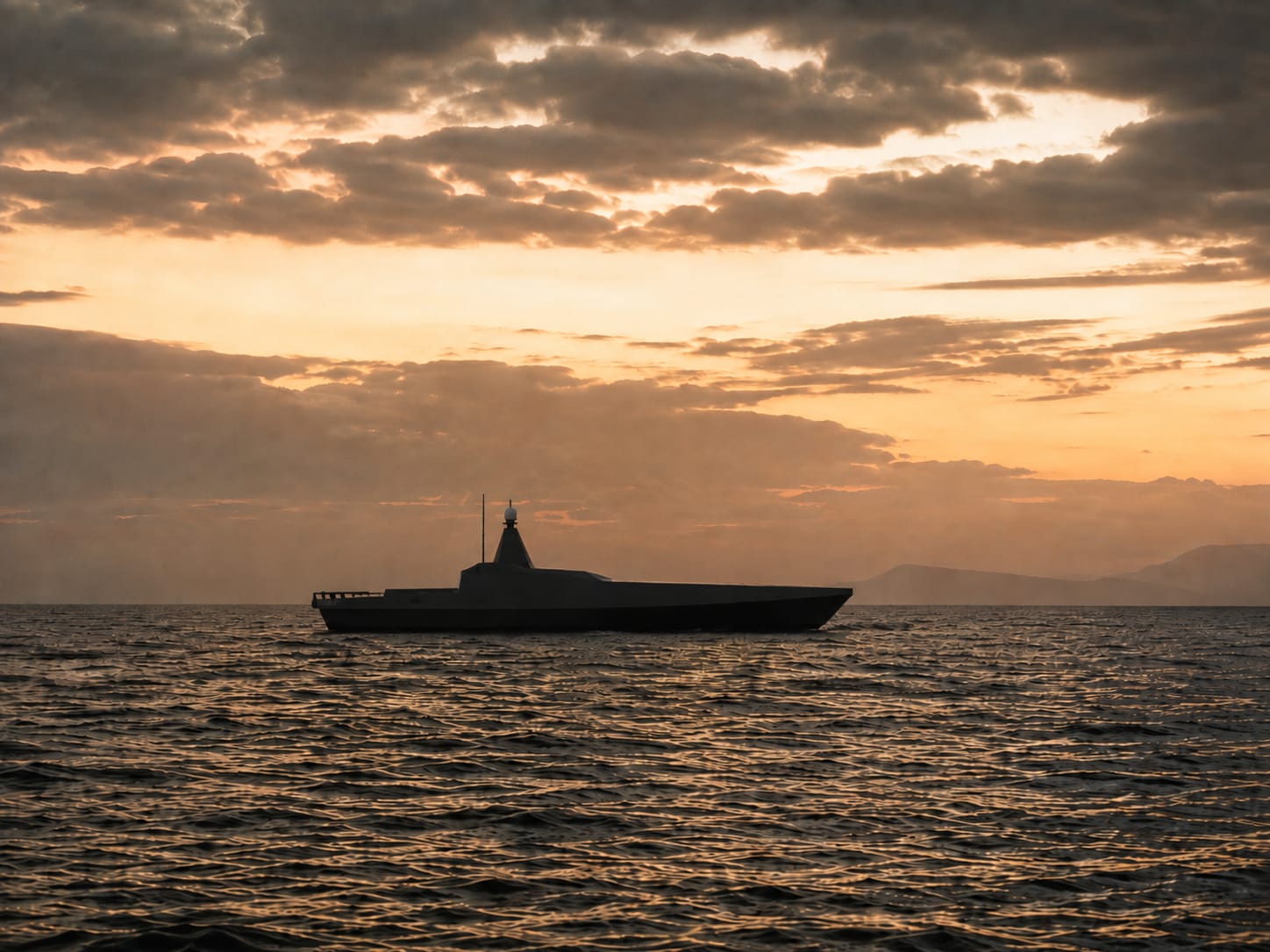
The Royal Navy is planning to procure a multi-role uncrewed surface vessel testbed worth an estimated £10 million intended for technology demonstration and to be delivered by the end of the 2026-27 financial year, according to a pipeline notice published by the Ministry of Defence.
The notice, published on 5 August, is a UK1 pipeline notice, which advertises a potential future contract rather than opening a competition. No tender has been issued and no supplier has been selected, with a tender notice estimated for 30 November 2026.
Setting out the requirement, the notice states that “DCTO is looking to procure a multi-role Uncrewed Surface Vessel (USV) testbed, for the purpose of technology demonstration which can be delivered by the end of FY26/27.”
Three operating configurations are specified. The notice says the vessel is expected to conduct “standalone uncrewed operations from a shore-based Remote Operating Centre (ROC)”, “integrated operations alongside a mothership (e.g. embarked or supported by a host platform)”, and “distributed multi-platform operations alongside other USVs”.
On what the vessel would be doing, the notice lists typical mission profiles as “long-range transits to operating areas”, “persistent loiter operations with active payload use”, and “technology trials involving sensor, autonomy and payload integration”.
The estimated total value is £10,000,000 and contract dates are estimated to run from 1 March 2027 to 31 March 2030, a period given in the notice as three years and one month. The requirement is recorded as particularly suitable for small and medium-sized enterprises, classified under ships and boats, and the contracting authority is Navy Commercial at Whale Island in Portsmouth.
The framing as a testbed is notable in itself, though, as the notice describes the purpose as technology demonstration, and the mission profiles centre on trials rather than operational tasks, suggesting the Navy is buying a platform to learn on while requirements for operational vessels are still being defined.
The plan is part of a push into maritime autonomy, the Defence Investment Plan set out an intention to field uncrewed platforms in numbers alongside crewed warships, including designated Type 91 uncrewed missile platforms, Type 92 uncrewed underwater sensing platforms, Type 93 extra-large uncrewed underwater vehicles and Type 94 uncrewed sensor platforms, working with the planned Common Combat Vessel and existing frigates.
The Ministry of Defence separately published a preliminary market engagement notice on 5 August seeking industry input on establishing a Platform Authority for maritime uncrewed systems, described as covering “the governance, engineering expertise, certification support and through-life assurance necessary to enable the safe and effective operation of current and future capabilities.”


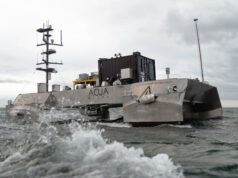
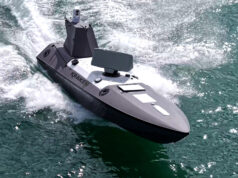


Could ACUA deliver an MROS prototype for £10m? 40m seems a bit big, but there aren’t any other British medium USVs above 24m.
At last a prototype Vessel we Can trial droes with..
I have a cunning plan!
What is it?
Give me £xxxx Million and I’ll work it out
Also reading on X. Will be remote controlled, not fully autonomous at this point, and needs to be small enough to be able to be itself transported, so not of T91 size as yet.
T91 is to be here by 2030 according to the fabled DIP.
” embarked or supported by a host platform”, so not neccesarily small . XV Patrick Blackett cost less rhan £10 to purchase.
Yes, there is the rather arkward issue being ignored at Tracey Island – ya can’t enter or leave the harbour control zone except under positive human control, as in at the helm control.
And that is why all the Chinese autonomous vessels have a bridge and crew space…
In the end I think they are going to piss around around and realise that in the real maritime environment full autonomy does not work..
Yea by all means use autonomous systems to massively cut the crew down… but don’t think your not have some people on it for some tasks… so they need to stop living in fantasy land, put a small bridge and small living area on these vessels.. in reality if you can build a 2000 ton semi autonomous 2000 ton T94 that can have say a crew of 10 keepers for more congested seas or where grey warfare occurrs or even if you want to pop and show the flag and that in some situations you can abandon to full autonomy ( when your sending it down threat axis to die or you mid Atlantic acting as a companion to a frigate etc) then that’s a massive winner winner chicken dinner…
Mearsk, the most technically and commercially aggressive shipowner on the planet looked at autonomous and said – ‘nope’.
They came to the conclusion the cost/benefit/Risk wasn’t worth it.
Yes, their ships are highly automated, many systems de facto autonomous, but they have decided a core crew of 12 deck and engineering is the technical sweet spot.
Things break at sea – the RN is fantasizing about deep space manned mission levels of reliability – on the cheap.
Yep and I think any sensible reading would take that crew of 12 on the T9x of any size.
Not only for a risk management point of view ( navigation in dangerous seas, gray warfare and mantaince ) but from a general naval usefulness.. almost all of a navies functions in time are none kinetic, essentially security of seaways outside of your national waters and all of that function is based around the legal concept of the commissioned warship.. essentially if it’s not got a CO present outside of fully kinetic war everyone can pretend your autonomous ship is a floating bit of debris as far as security of seaways goes…
Infact I would imagine the Russian shadow fleet will have a laugh trying to “accidentally” run them over.. the Russian navy will not even bother with the accidentally part and probably just say they were a security risk and sink them.
I agree. Remote operation, let alone full autonomy, seems unrealistic for large surface platforms (several thousand tonnes) loaded with live weapons when in littoral waters, traffic separation schemes, channels, canals, and ports. The technologies required are not mature and robust enough, and compliance with current maritime regulations and codes by the IMO etc seems verging on the impossible. In peace time, the proposed sloops are surely going to have to be normally lean manned in order to meet international navigation, safety and emergency rules.
There is the quite important point that by and large people aren’t trying to kill the crews of container vessels and the accommodation spaces are a tiny fraction of the volume of the ship, already needed to elevate the bridge.
Harpoon was taken out of service, not because it couldn’t do the job – it will still ruin a large warships day, but because we couldn’t rely on it not to take an errant interest in a passing cruise liner and bite that.
Without the ability to autonomously defend themselves, the unscrewed wunderwaffe can be chased down abd swatted by manned platforms that play by their rules. UK law doesn’t allow the weapons self autonomy these PowerPoint fantasy fleets require.
Early radar guided anti ship missiles were, frankly, very stupid. Harpoon never really escaped that and all modern designs have an IR camera for target recognition to avoid the problem. That is not an argument against autonomy in general.
The USVs will not be deploying weapons autonomously. They will be using datalinks to cue the weapons but the physical movement of the ships is intended to be largely autonomous.
All these drones, must mean lots of secure communications, lots of screen operators and lots of space needed to park all these things? Hope some adversary doesn’t sneak in the back door while we’re not looking and pull the plug. With drones doing dodgems on the high seas, hope they don’t incumber or crash into their mother vessel or go astray as there’llbe a lot of tech and armaments wasted that couldhavepotentiallybeen put nto a crewedvessel. Are the drones just going to be kept just to the CCVs or utilised by T26, T31, carriers and Bays?
During a desk sweep at Tracey Island some moons ago, many terminals, laptops and workstations were found be using either the default factory password, or the users had conveniently written it down on a post it stuck under their keyboards.
The culprits were all, from the lowest CS to the highest VSOs.
MOD IT security is laughable
I did read a very good article on security and the audits showed that the more you get people to change passwords, the more complicated they are and the more of them you insist on having the worse your security gets as peoples minds cannot keep up and they essentially start cheating… writing them down etc…
Best password?
Look around the room, write down three random objects.
CatJCBThrow – totally random
Or throwcatvomit 🤣😂
I don’t think they were using ‘default factory’ passwords on laptops in the offices. The network domain account determines your desktop/laptop password, which will force a reset every so often tied to network protocols, so don’t buy that at all.
A previous VSO authorised the use of personal IT and PEDs – f’ing demented decision
Jeez that is demented!
In the rush for Drones the Ancillaries may have taken a back seat..but we’ll work them out later..!
So we have decided that machines can decide on their own to kill humans now, is that really a good idea? Ethics clearly out the window now. The World of Sci Fi is coming real. This will not end well………………………
Seawolf had a ‘it flies, it dies’ autonomous mode from its introduction in the 80’s.
I don’t think it would be at all a good idea to have a Trident submarine operating autonomously, and without human control, even if the AI was very, very clever.
Correct, that why the system is held under positive control by 4 physical key holders who must all agree, and all act in unison to activate the system.
Why not? I’m sure our Skynet system can be trusted with how to use our nuclear weapons responsibility if we give it enough intelligence and self awareness…
Given the timeframes and budget, this looks like the procurement of an existing vessel that is then retrofitted for automation and likely operated by the company awrded the contract. I can’t see how else anything can be sourced by April 2027.
It’ll be interesting to see what can be pulled together for £10M within 6 months.
Hi Sid,
Perhaps “what can be pulled together for £10m within 6 months”, is part of the learning objectives. Certainly, the MoD seems to be getting a grip of fast contracting at least as far as drone trials and working with SME’s are concerned. As we know from history and Ukraine today things have a habit of changing on you without much warning and the need to respond in someway can be very urgent indeed.
As you say, “It’ll be interesting…”. I just hope the MoD / RN can get to the point where they have the confidence and the technology to get some of these systems into service soon given how small the fleet has become. The situation is getting very urgent indeed, given that Russia has taken to stationing frigates and corvettes off the cost of the UK.
Cheers CR
Hi CR,
Hard to argue with your observations, there does appear to be “renewed vigour” in the MOD which is pleasing to see. Things do unfortunately take time to develop and build and i fear this is where we’ll see a slow down (well for the larger assets anyway). Smaller local use inovations seem to be rattling out though, which gives some confidence in capability development.
My big issue with the Hybrid fleet is deployability. Can the fleet of 2035 sail 4,000 miles and operate or are the drones going to limit what we can do? It feels like we are replacing the AAW Destroyers on the cheap without considering consequnce (i know its unlikely the T45’s are to be retired mid 30s but i’m playing the game). I hope i’m wrong but there are my cards laid out. I’d personally prefer to see smaller, more numerous in theater deployable drones to support the fleet. Either way, drones are the future and “it’ll be interesting” to see what we come up with.
All the best, Sid
I share your concerns about the Type 9x surface vessels in particular. The submersibles are a different beast and I can see them adding real benefits drifting around listening for passing enemy subs. The advantage they have is that their sensors are not affected by the curvature of the earth nor their station keeping by storms.
The surface drones are going to be vulnerable to heavy weather and we know that the weather is only going to get worse with time, but for me the biggest weakness is with the radar carrying Type 94. If these really are going to be in the low 1000’s of tons then they are not going to be able to carry a 35m mast with a high power X band radar on top of it. So the Type 94 will be vulnerable to attack from high speed (probably supersonic), stealthy sea skimming missiles, especially as it will be lightly armed itself and any shooter platform might be a few miles away.
So if I was an enemy I’d consider two attack options.
First, target the radar carriers first as I think they have the easiest of vulnerabilities to exploit i.e. very little reaction time and the possibility that the shooter will be too remote as it will likely be positioned to best protect the crewed frigate. After that I would use missiles on take out the Type 92 sonar carriers blinding the hybrid squadron and then I’d go for the frigate sitting in the middle…
The second option if I had the full range of assets would be to go after the sonar drones with missiles and radar drones with torpedoes.
My guess is that the sensor drones would be best positioned to cover the crewed asset at the heart of the formation so the drone assets will likely be more exposed, so exploit that possibility to the maximum.
I’d do this in bad weather if I can as sensors can be degraded even if only by a small degree and defensive formations can be disrupted, especially those with smaller vessels in them. The North Atlantic is well known for being rough.
It seems to me they are starting with the platform and making the sensor fit the platform and accepting whatever performance they can get from the combination. To me that is fundamentally wrong. You need to work from the threat. I have taken the supersonic, stealthy sea skimming missile as an example as these are the next evolution of missiles that have done real damage to the RN and others in the past. a defender needs a certain amount of time to be able to react and the defender has to be lucky every time, the attacker only has to get lucky once and there could be a gaping hole in the defensive ring around your command frigate or carrier strike group. Radar horizon is still important for this case and bad weather in the North Atlantic will every likely ground all but the biggest AEW platforms, so those 35m high masts on the T45 start to look very nice indeed…
I am still pleased to see the work that the RN is doing, but I agree that the hybrid fleet should include a few destroyers with biggest mast possible to provide a persistent long range horizon coverage and keep the radar drones as cheap and cheerful as possible so that they are still useful, but it ain’t going to be end of the world if you lose a few.
Cheers CR
We are of like mind.
Retain the principal assets, enahnce their leathality with low cost and limited capability outriding drones (on all fronts). Advances is drone evolution/capability is going to be incredible and large autonomus platforms are going to run the risk of being outdated quickly. Especially over the next 10/15yrs. Better to concentrate on lower cost and more disposable assets in my mind and concentrate on getting the hybrid interoperability sorted prior to getting extravagant.
I’d love to see the Carriers deploy airbourne radar pickets, refueling craft and support wingmen. These all sound like great ideas and of real benefit to the RN. Replacing AAW Destroyers and Frigates i’m far less excited about. Submersible drones will be amazing for area denial, such as the Norwegian Sea, but supporting fleet operations may be a bit of a stretch unless they can be deployed ahead or flood an area. Knowing the MOD, they’ll order 6 units…….
I have seen reports this morning of a new drone called the MV7. It is developed from an Ukrainian drone with input from Formula 1 engineers apparently. It capable of operating for long periods in the open seas around the UK and can carry 600kg of C4 or a range of sensors including a small towed sonar apparently. I as been suggested that could be used to intercept Russian vessels in and around UK waters.
Will be interesting to see how many get ordered, if any. Some of these forward deployed around the UK controlled from a PODS C2 node would be just the job for protecting undersea infrastructure and shadowing dodgy Russian vessels.
Cheers CR
Good for strike and area denial but i don’t see the relevance for us i’m afraid. They will be nigh pointless in maritime security and in war, Russia isn’t going to be sailing into the North Sea. For sub surface work, i think there are better solutions on the table already.
They would spend an awful long time sitting around if we were to buy them today. For me, save your money and buy a later development that is more tailored to our needs.
I think strike and area denial will be key roles for the RN, certainly being able to drive off those Russian ships in operating off our coasts would be a useful capability to have, given we don’t have a tactical strike capability at the moment (unless one of the T23’s has a NSM set on board?). The RAF only has Paveway IV and Storm Shadow which may or may not have an anti-shipping capability (I vaguely remember something in that vain being discussed sometime ago but can’t remember if it went ahead, probably not!).
There is another reason to bring them into service apart from their surveillance and strike capabilities, namely, experience. The RN could really do with moving out of the trials phase with some of these things and start to operate them for real and lets find out how the Russian’s will react! Then we can stop guessing and start doing based on real world data..!
Cheers CR
I get your argument CR, i just don’t subscribe i’m afraid.
Sub sea automated drones for survaillance are going to be a big thing for us and rightfully so. MV7’s or the like for policing the North Sea i just don’t get. Yes we are light on maritime strike presently, but sailing drones around soveriegn naval vessels in international waters is at best inflamatory. I would suggest you couldn’t or wouldn’t want to operate them in the English Channel and together with Nato we already track everything on the surface pretty closely.
In times of war, i just don’t see them being a capability we’ll need. Build and export, yes. Retain and integrate, not for me.
The biggest issue is gray warfare.. the Russians will either steal them, accidentally run them over or just blatantly shot them… in the end we know exactly what the Russians will do with unmanned drones.. we have the footage of a Russian fighter playing smack the US drone around the sky..
You highlight some of the issues as to why i can’t see a time where we operate the drones independently. The airbourne support units are vulnerable, but the radar picket should see incoming units and move or be esscorted. Refueling has no need to be in any such situation and the “loyal wingman” should be exactly that.
Smaller seabourne units are going to run that risk for sure unless part of a larger force. They’ll just have to be either smart enough to get out of the way or cheap enough for us not to care.
I agree mate, but with any half decent spin doctors in the house we should be able to use such incidents to highlight Russian aggression to the British people. Anything that helps to get the message across that Russia is a huge threat and that the developing hardships that will have to be endured in peacetime are preferable to all out war and horrors that will bring.
As Sid points out there are limits to what these things can do, but perhaps one of them is to act as a kind of ‘minefield’. Military I used to know told me that the real value of a minefield was that it acted as an early warning system. If Russia starts to knock out our naval drones then it can be depicted as a very visible early warning of Russia’s aggressive intent.
We need a mix of systems and platforms which should include large escorts for the simple reason size will always matter in a force 8 gale in the middle of the North Atlantic Ocean, the Royal Navy’s traditional operational area.
Cheers CR
Yep I have no problem with a cheaper set of autonomous systems that we don’t mind the Russians either running over.. or pinching..
So for me we need
A fleet tactical drone launched from a mother ship..to head down the threat axis on a particular mission is a great idea.. so a range of 10-12 meter surface drones that can be carried by escorts and other ships and launched down the threat axis in littoral or enclosed seas.. you can make these.. surface strike and short range anti air with LMMs, force protection with a gun system or some form of anti surface to manage sup surface drones.. with a pinger and depth bombs or just ISTAR platforms.
Type 91 firepower drone.. the level of money and investment in these arsenal vessels means they really should be optionally crewed.. at the end of the day we want these to realistically have mk41 silos for max use and be a bigger 3000 ton drone , optionally crewed means you can send one of these off to re enforce a force or undertake a strike mission, enter ports on their own to re arm.. ect.. so if you have a crewed one of these in the Red Sea with a T45 then your optionally crewed type 91 can shoot its magazine dry then you pop a crew in it so it can pop off for a refill at a friendly port leaving the T45 in the area of operation and come back on station after it’s filled up.. without that basic sensor set and basic crew of about ten it cannot even do that and the T91 is essentially nailed to an escort and is very tactically and strategically limited.
T92 sloop… depends.. if your going cheap and cheerful and just having a load toddling around the deep blue, then you can go fully autonomous.. but expect to have losses and a lot of them going OS.. the thing here is cheap.. then moment you make them larger or more complex or have expensive systems on board you probably needed an operationally crewed platform.. if your going to have it attack targets it will probably need to be optionally crewed…. Expect the cheap uncrewed drone to be regularly nobbled and boarded by random people. Personally if they just want an uncrewed ASW sensor platform I think they should go fully sub surface.. if they want a surface ASW vessel go larger ( 2000 tons) give it a good towed array, give it a flight deck for autonomous air to attack targets, give it self protection and make it optionally crewed.. so it can be a total patrol and ASW package.
T93 this is the sweat spot for autonomous ASW.. perfect and very sensible as nobody can really nobble them without massive effort.
T94… this seems to be the most poorly thought out.. a radar picket is good.. but why not just have an airborne radar picket ? You have a sea based radar for Power and aperture.. that means a larger more complex vessel that needs to be a good 20 nautical miles or more away from any other vessel.. so it’s getting large and expensive and a gray warfare target..so it will need self defence, that’s even bigger and more complex and then bang your at the need to keep it running and protect it with a small crew..
For me the rule should be if it’s small, simple, cheap or always protected ( either under the sea or escorted by a crewed system ) then fully autonomous is fine.. if it’s larger, complex, expensive and needs to be on its own then it need an optional crew.
Yep, that’s basically where my thoughts are at mate.
The T94 is indeed the most poorly thought out version, but to answer your question with regards to having an airborne radar picket the main problem that I can see is persistence and availability especially in the North Atlantic / Arctic region as weather can play a role even for land based aircraft and the weather at the base can be different to that being experienced by the fleet.
If we are talking about ship launched AEW drones same issues really, even more so if you don’t happen to have a carrier in the area. As such I can see and understand the need for a surface radar platform, however, you then run into the radar horizon issue and all of the subsequent issues that you highlight. I just don’t see it working I cannot see anyway around the need for a bloody great radar mast given the way the threat environment is developing. Even if you opt to put directed energy weapons onboard to be really effective against high speed missile swarms you will a powerful weapon, so big generators..!?
Any which way you look at it you need a T45 replacement of some sort, because you basically end up with a big vessel, with a big expensive radar, with some sort of gucci defensive systems and a small crew by trying to make the T94 work, so just accept it and get it done.
Here is a suggestion. Ditch the T94 and put the radar mast on the command vessel (or Common Combat Vessel?). Size it to carry the biggest practical mast and a big mission to carry smaller specialist drones, but don’t bother with a huge weapons load or sonar etc.. If you are likely to need such capabilities on a deployment just attach a bunch of shooter and sonar T91 / 92 drones. Heck the T45 was built with a small weapons load and they didn’t bother maintaining the sonar as far as I know, but it has that bloody big mast I keep on about. 🙂
In any event lets hope they get a few of these newly designed MV7 thingies procured and loaded onto something capable of deploying them soon. The RN just needs to get something into general service and break it or lose it. There is only so far that you can take trials.
Cheers CR
PS. I like the idea that these MV7’s were designed with an F1 team’s input. I wonder which one?
Hi honestly think in the end the RN will go naa does not work.. we need a big radar on a destroyer..
I just think they are playing cute to get there next combanant built.. CCV.. a reasonable 6000 ton combatant and a load of autonomous vessels..
Come 2030 they will go…ohhh we need to keep the T45s and end up running them into the late 2040s and we need a big AAW destroyer to take over in the 2040s.. after all 3.5% by 2035 will bring a lot of capital spending…
I find it worrying that we are planning to trust our air defence to a technology that is a long way off being mature. Conventional destroyers are still needed as a T45 replacement. We can’t plan the fleet around the doctrine of ‘we hope it works and will be around in time’.
I couldn’t agree more.
Drones will certainly have their place but i see it as being force multipliers not principal assets. I also don’t think that drones of sufficient size to be trans oceanic (at meaningful speeds) and able to operate in poor sea states, will ever be permitted into the majority of the worlds national waters, nor will they be cheap enough to justify over manned assets. However, i’m just a minion of the state and clearly know nothing lol.
Isn’t RV Triton hanging around somewhere? For the surface weapons and sensor carriers this would be just about the right size and form. There was a lot of free space in the vessel for computer rooms etc so why reinvent the wheel if there is something that can do the job. Possibly a good idea would be to have two testbed vessels, one a multi hull the second a monohull to see how the operate in the GIUK Gap in all weather conditions.
👆
Multihulls come with a built in design fail for a warship people might go poking holes in.