

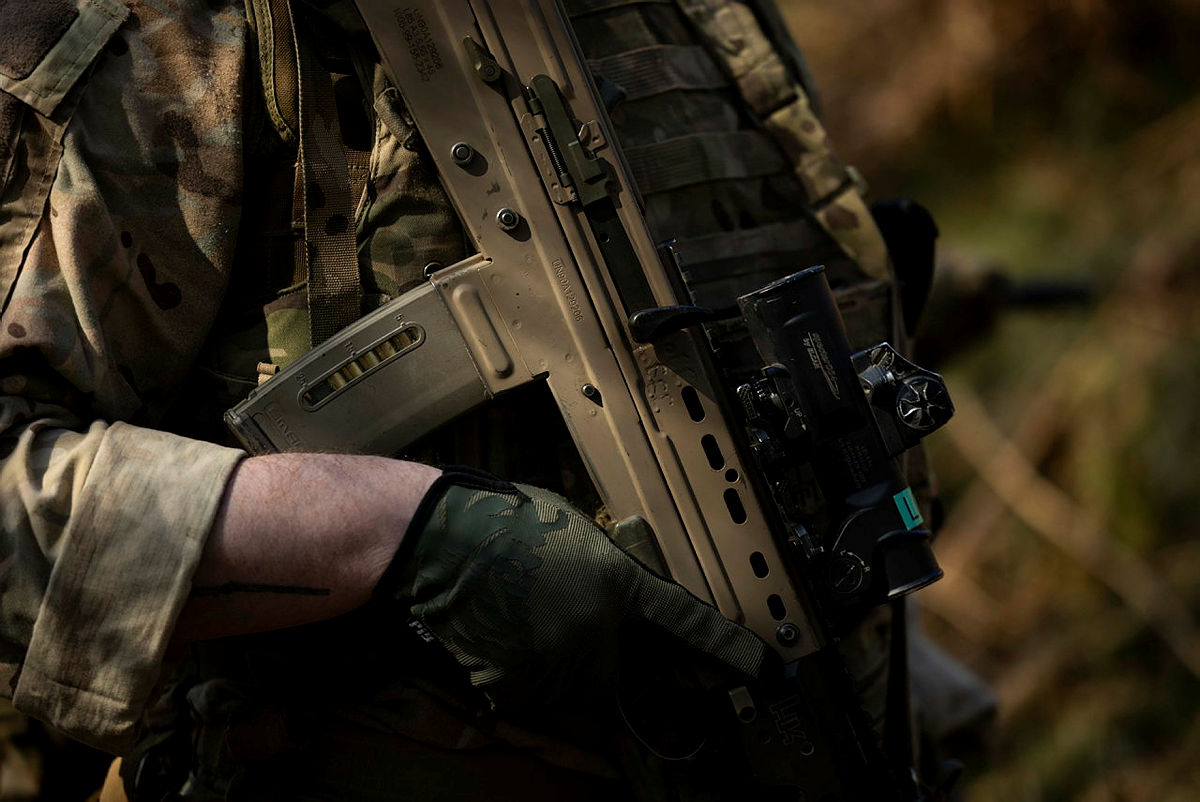
The Ministry of Defence has confirmed that Project GRAYBURN, the British Army’s future small arms programme, remains in its concept phase and does not yet have a defined measure of “export potential”, despite clear expectations that the weapons will be manufactured in the UK.
In a series of written answers to Ben Obese-Jecty MP, Defence Minister Luke Pollard said the department has “set clear expectations that Project Grayburn will be manufactured in the UK to enhance sovereign industry, generate employment and provide opportunity for export.”
However, he added that “there is currently no specific definition for the future export potential of Project Grayburn,” though it is considered desirable for the programme to create export opportunities. Analysis of potential addressable export markets, he said, will be conducted as part of the current concept phase.
Pollard also confirmed that the department cannot yet assess the adequacy of the UK supply chain for the programme, stating that the project remains at an early stage and that manufacturing, testing and assurance arrangements have not been finalised. On the question of calibre changes within GRAYBURN, Pollard said the project will use established scrutiny and approvals processes, including the Combined Operational Effectiveness and Investment Appraisal, as part of its decision-making framework.
The answers follow earlier confirmation that Project GRAYBURN will cover the full dismounted close combat weapons portfolio, from pistols through to machine guns, and is intended to replace the SA80 family before its planned out-of-service date around 2030. Previous parliamentary responses and industry notices indicated that concept work is examining multiple weapon variants built around a common architecture, likely including a standard rifle, a shorter variant, a personal defence weapon to replace the L22 carbine, a generalist rifle and a cadet weapon. Decisions on calibre, barrel length and variant distinctions are expected to be taken during the concept phase, informed by operational role and engagement requirements.








Export potential might be a bit wishful thinking, as it will be a licensce built copy, unless Berreta, HK and Co decide it’s worth diverting orders to keep their UK factory open.
I’d also be surprised if we saw Grayburn deliver anything before 2029. Project Hunter was as fast program, largely driven by ASOB and the RM as customers with hands on trials, rather than the very diverse stakeholders that Grayburn is supplying, and that still took about 5 years from flash to bang.
Low in the order of priorities, surely, with the new kit across the board that the Army needs?
I’d actually place it very high in the order of priorities. Assuming that we need to grow the Army fast at some point in the next few years (a key planning assumption) we’ll need the ability to bring in weapons too.
Furthermore, the weapons I’ve handled recently (L85A2s in the training system) are noticeably worn now. It’s like a different weapon to what I remember from HERRICK. Bits break, springs feel loose etc etc.
Good point, Bob, regards expansion. I’d taken it from comments here that the A3s were a good standard and the A2s adequate enough.
Though maybe it says something that all elite units don’t use it!
Leaving aside my mirth at the Para’s not being considered elite, there’s a huge list of reasons L85 isn’t used by “elite” formation, and surprisingly few of them have to do with the rifles actual capability.
No it’s pretty low on the order of Priority. In terms of growing the Army fast, 200,000 L85A2’s where upgraded. Add in the L119’s, L129’s, L143’s, L403’s and L22’s floating around in various armouries, and even accounting for operational and exercise losses, the British Army could probably double. The L85A2’s certainly are worn, and do need replacing at some point, but the A3’s are at a decent standard and for CS/CSS and GDCC Troops respectively both are still acceptable.
Yes Grayburn eventually needs to happen, the L85 can’t soldier on forever, but when you compare it with Artillery, ISR, Vehicles (armoured and otherwise) etc. it is a rather low priority in terms of Army budget.
I actually disagree with you on this one. It’s a high priority, comparatively low value acquisition.
It’s not the weapon system per se, it’s the ability to have sovereign manufacturing of weapon systems online and at capacity when we do need it. And that can’t be turned on overnight.
Your opinoin fair enough, however “high priority” suggests it’s something we need *now* which we don’t. L85 replacement is in purely cut throat cold hearted spending calculus something that can be left to simmer while programs that need to happen *now* are prioritised. And the soverign manufacturing capability of small arms is a bit over rated. Off the shelf procurement of existing platforms is much easier with small arms if needed, and existing factories are much easier to upscale than, again to take a purely hypothetical example, SPG’s.
Please can NATO/five eyes trial 6mm Arc, 6.5 Grendel, 6.5 LICC, before we commit for 30 years to a new rifle.
On what basis John? Literally every new NATO weapon in the last 5 years except the M7 is 5.56. FRANCE, GERMANY, ITALY, the Nordics, and the USMC have stuck with 5.56mm. And except for Denmark, they’ve gone with an HK416 or derivative. Denmark has gone for an updated C8. Ukraine has an M4 derivative as it’s main weapon system too – if any country would be a litmus test for needing a new calibre it would be Ukraine.
5.56 has its failings, they are well documented. There are 3 good inbetween calibres available. Like Goldilocks, not too hot, not too weak. Shame if complacency dooms Western militaries too another 3+ decades with a sub optimal round.
Actually almost all studies were on the US M885 round. It was found not to fragment properly at close range and combined with the short barrel of the M4 to lack range.
This is because the shortened barrel lowers muzzle velocity required by the round.
There are 5.56 AP rounds on the market that penetrate modern body armour. There are other rounds that sort out the fragmentation issue. There are equally multiple studies showing it to be by far the best CQB caliber.
Mk262 (77-grain Open Tip Match): Used by Special Forces to increase fragmentation range.
M855A1 Enhanced Performance Round (EPR): Adopted by the U.S. Army in 2010 to improve terminal performance, increase penetration, and reduce reliance on high-speed fragmentation.
Mk318 SOST: A round adopted by the Marines and SOCOM to provide consistent performance regardless of barrel length, using a frangible nose and solid rear.
It holds an excellent balance between weight and performance. As a contrast, the 6.8 mm round reduces combat loads carried, is difficult to handle and be accurate in CQB.
Nowhere did I favour the manic 6.8×51 Sig round. I was talking about 6mm Arc, 6.5 Grendel or 6.5 FN LICC. Any of those will do.
Why not “4.85” or 6.3?
Because 5.56 does the job perfectly well.
After what we did to royal ordinance, sterling armaments bsa etc…
We do not deserve an arms Industry as all it will die is make profit for bae who are NOT a British company.
They will insist on huge subsidies and payment to buy a factory and set it up then once the order is filled they will sell it off and not repay a penny
I believe Beretta for one have offered to build a factory if we replace all the forces weapons, could run it slowly at 10000 a year.
By the time its finished its time to start again. Hence avoiding boom and bust of history.
M4 style platform, 16” barrel…..
oh wait, we already worked that one out decades ago, L119
Small weapons exports are more likely to be politically iffy to unstable regions and I think rightly so.
L85-A6 before anything changes