

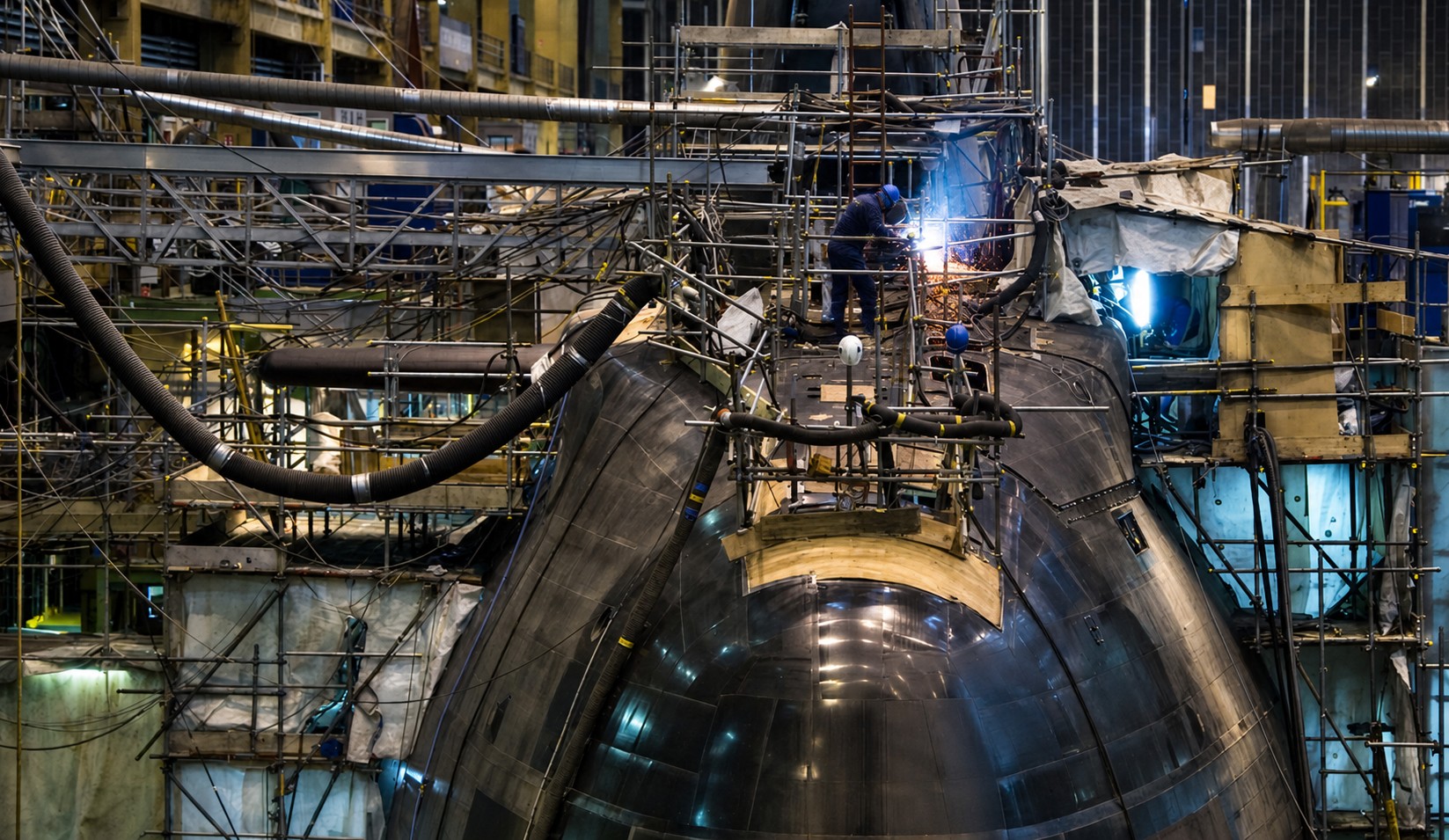
The prime contractor on a nuclear submarine contract recorded almost forty thousand unproductive hours in 2025-26, down from more than ninety four thousand the year before, with the losses arising where government furnished assets were not available to the supply chain when required, according to answers given in Parliament.
Ben Obese-Jecty, the Conservative member for Huntingdon, asked how many unproductive hours there were and, in a second question, for what reason those hours were unproductive, following an answer given on 23 September.
Luke Pollard, the Minister of State for Defence, gave the same answer to both: “The Prime Contractor recorded 39,872 unproductive hours in 2025-26, a significant reduction from the 94,640 hours recorded in 2024-25. This equated to around 6% of the contract value in 2025-26.
“These hours arose where Government Furnished Assets (GFA) were not available to the supply chain when required, and where contractual arrangements for coordinating provision across multiple industrial partners were still being refined. Mitigating action has since been taken, including a recruitment pause and the adoption of agile courseware development, which has contributed to a significant reduction in losses in 2025-26 compared with previous years.”
Government furnished assets are the equipment, data, facilities and material the department supplies to a contractor so the contractor can do the work, and a supplier whose people are waiting for them is paying staff who cannot start. Six per cent of contract value lost in a single year is a substantial figure for a programme inside the nuclear enterprise, and it came down from a worse one.
Courseware puts this work on the training side of the submarine programme, where simulators, course material and qualification pipelines have to be built alongside the boats themselves. A recruitment pause closes the loss by stopping the hiring of people the contractor could not usefully employ, and it leaves the supply of government furnished assets where it was.












And “reducing recruitment” is a good idea because it balances budget but skills are not accumulated?
Exactly and those skills may go elsewhere at a time where the DNE is crying out for skilled workers. Sounds fucking bonkers to me, just onboard the skills you need to get them in the pipeline and on the payroll.
That makes sense right up until you have to pay that payroll. If 40,000 hours lost equated to 6% of the contract value, and that the figure was double in 2024-5, we’re looking at nearly a fifth of the contract value being lost in just two years. From the text above, this has been going on for multiple years at a similar level to 2024-5.
This colossal loss is not because of a lack of technical skills, or inefficient builders that can’t compete, but because of MOD incompetence when it comes to project management.
This is straight back to short term book balancing rather than long term costs or need.
Long term this will cost more as the skills and experience = efficiency are not built up.
Unbelievable. We need to get in there and have an Independent Audit of Parliament and all the Key Government Departments especially the Home Office and MOD. My guess is that is where we could save Bns of Taxpayers money. Parliament is simply not doing its job; although some members are asking the Awkward Questions that need asking.
My maths needs help.
40000 hours ÷ working hours/person = 24 people
BAES lower average wage = 42000
We lost a £1m. A rounding error.
Take £100,000 salary and we lost £3m, albeit, taxes would have been paid.
I was never good at maths, can someone explain the error and/or outrage?