

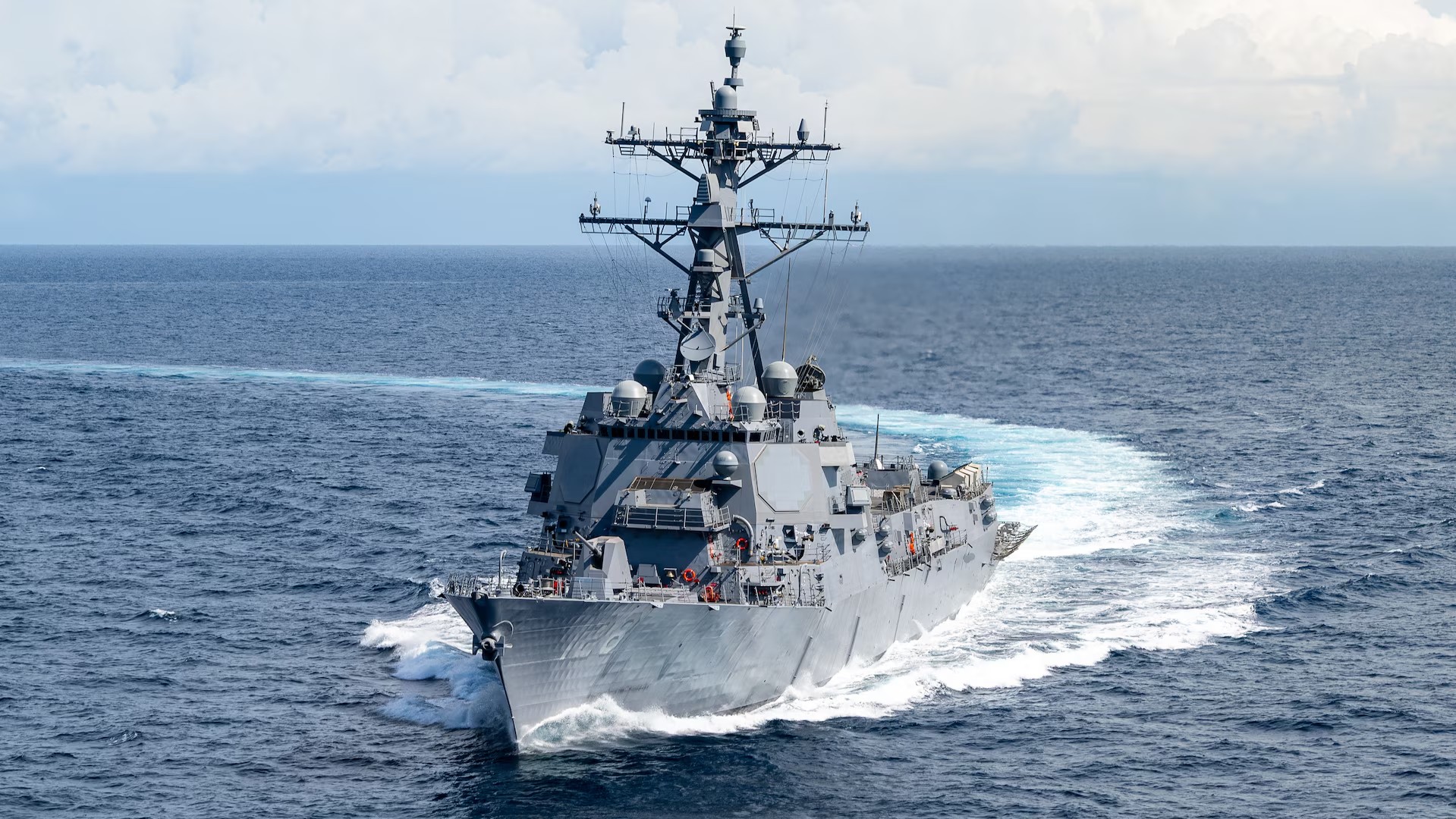
The keel has been laid for the future USS John E. Kilmer, DDG 134, marking the formal start of assembly of another Arleigh Burke-class destroyer for the US Navy.
The ceremony took place on 10 September at General Dynamics Bath Iron Works in Bath, Maine, where the ship is under construction. A keel-laying ceremony marks the joining of a ship’s first major modular components at ground level. As part of the event, the keel is authenticated when a welder inscribes the initials of the ship’s sponsor into the keel plate.
Neil W. T. Hogg, Deputy Under Secretary of the Navy for Management, told those attending: “We honor John Kilmer by building a Navy worthy of his legacy.”
He added: “The ship that carries his name will bring that same fighting spirit to the Fleet, built by American workers for the Sailors who will take her to sea.”
The destroyer is named after Hospital Corpsman John Edward Kilmer, who was posthumously awarded the Medal of Honor for his actions during the Korean War. On 13 August 1952, Kilmer came under heavy fire while treating wounded Marines from Company H, 3rd Battalion, 7th Marines, 1st Marine Division, Fleet Marine Force Pacific. He was mortally wounded during the Battle of Bunker Hill while shielding a Marine from enemy fire. He was 21. The ship’s sponsor is Linda Gilday, a former US Navy civilian engineer and programme manager and the wife of Adm. Michael M. Gilday, the 32nd Chief of Naval Operations.
Capt. Jay Young, Arleigh Burke-class destroyer shipbuilding programme manager, said: “The future USS John E. Kilmer will carry on Corpsman John Kilmer’s legacy of courage, service and dedication to our country.”
He added: “DDG 134 will be a welcome addition to the fleet, providing our Navy warfighters with an undeniable strategic advantage.”
Arleigh Burke-class destroyers form a large part of the US Navy’s surface combatant force and are designed for operations across air, surface and subsurface warfare. The US Navy said the ships are used for missions ranging from routine forward presence to national security operations, providing a range of capabilities intended to protect US and allied forces and contribute to deterrence. The Navy said the ceremony “underscores the Navy’s commitment to building America’s Fleet of the Future.”
The programme is being overseen through the Portfolio Acquisition Executive for Maritime, which the Navy describes as the single accountable organisation responsible for delivering surface ships. The service said the new structure is intended to give programme leaders greater authority and a broader span of responsibility, with the aim of speeding up acquisition and delivering combat capability more quickly.




The Arleigh Burke’s are fine ships, but they need the support of other classes particularly an ASW platform that can take some of the load away from the destroyer force freeing them up for other tasking.
The USN orders 2 AB’s per year without another escort class that can be build across more yards in greater number the USN is facing a force shrinking to 60 ships base on a 30year hull life or be faced with expensive life extension programs. Even if they manage to extend to 40 years it will be expensive to maintain a fleet of 80 escorts, as the RN has found out with the poor old T23…
The new ‘frigate’ based on the USCG cutter will help to some extent but it is unlikely to be a frontline high intensity warfighter without considerable design upgrades and hence possible delays and cost overruns. Hopefully they will be able to get it into production soon and built in facilities that are not involved with the AB production (e.g they do not turn it into an AB lite).
Cheers CR
A Burke isn’t needed to enforce the blockade against Iran or to chase down drug-runners in the eastern pacific, but we are currently using Burkes to do these things. If the proposed FF(X) Flight 1 can do that work, it will be quite successful. As far as facilities, Austal USA is nearing completion on a third building hall capable of building ships the size of FF(X), so the additional capacity is literally just up the coast at Mobile Alabama.
As far as delays and cost overruns, there is a reason that Flight 1 is limited capability. It is basically the Cutter with a few weapons tacked on. If there are issues getting Flight 2 designed with the added sensors and equipment, just build more Flight 1s. This is what they should have done with the Constellations instead of trying to get everything in at once.
Given that FF(X) lacks any real ability to defend other ships (or even itself) against significant missile threats, the Burkes are still going to be needed around Iran and the Middle East. Calling them frigates is a bold choice when they lack the ability to escort another ship.
Reread my statement. Enforcing the blockade has nothing to do with ‘escorting other ships’. You don’t need 96 VLS cells and aegis to beat up on cargo ships and tankers. Right now, the USN is using precious Burke destroyers to chase Iranian shadowfleet tankers and cargo ships, not ‘escort ships’ or defend anything. This is a job the FF(X) could do perfectly well and thus reduce the number of Burkes deployed to the middle east.
The problem with the blockade is that Iran has got hold of steerable missile technology and Russia is providing targetting information.
The strike on the E3 was very accurate but the barrage aimed at US ships was also accurate and caused munition shortages.
Anf frigate will need AAM
Haven’t corresponded with you in a minute, so firstly I hope you are well and enjoying life.
With that said, what you are describing is not ‘anti-air’. It is anti-ballistic missile work. No US frigate is likely to be built/designed to do that. We tried that with FREMM and got Constellation. All proposed USN frigates (Mogami, Chungnam, FF(X)) lack ABM functionality.
Secondly, you are all neglecting the concept of ‘combined arms’. The USS Bush, the USS Washington, the Expeditionary Sea Base, and the three Amphibs lurking in that area all lack the ability to shoot down anything but a small number of sea-skimmer missiles leaking through the defense. By the logic you just espoused, they should all have anti-ballistic missile capability too.
In reality, there are something like a dozen Burkes scattered across the Gulf of Oman, the Red Sea, and the northern Indian Ocean. A lot of those ships aren’t doing ‘anti-ballistic missile’ work. A lot of them are chasing tankers and cargo ships.
If the USN had even a few FF(X) type ships, they could chase tankers and cargo ships and hide behind a Burke’s skirts when the evil ballistic missile came calling. In that way, the Dozen Burkes could be reduced to half that number.
Ie I could send a package of three or four of these things with a Burke to the middle of the Gulf of Oman or the Indian Ocean approaches to the Gulf of Oman as a task force instead of sending three Burkes to do that job.
I get what you are say, but why hasn’t the USN employed the LCS do do this? If you just need a helipad and a team of Marines.
Because the LCS drinks fuel like a fish, and their running costs are about the same as a Burke. (Hey! Let’s make it sail at 40 knots!) If that’s not bad enough, they have insufficient crew to do this kind of deployment for months on end, day-in/day-out. The concept was a complete failure for what the USN actually does.
What’s needed is a ship that kind of putters along on diesel power with a range measured in the mid-to-high thousands of miles of range, so you’re not constantly refueling them.
Comparable of what would have been the t83..!
The AB is a bit more general purpose, handling ASW and air defence as well as having mk41 VLS for tommahawks. The t83 (like the t45) was always supposed to be an air defence specialist.
Canada won’t deliver it’s final T26 until 2050’s. What good is that? 2050s will have entirely new tech and the first T26s will be end of life already.
If Canada is smart, they will just keep the River Class line open and add some ships with the newer tech at the end. The thing that’s always vexed me about Canada and the European powers is that there is always a ‘hard stop’ to a build program rather than a gradual phase out to take advantage of newer tech developed during a long-running program.
Jomo,
Wonder whether the Brit and Canadian MICs have devoted any thought to USN DDG/FFG requirements post 20 Jan 29? Hunter Class design should be relatively stable, has largely US weapons fit and permission has already been granted per US law to build two prototypes in foreign yards before program transition to US facilities. BAES is, of course, involved w/Hunter program and already has three yards in CONUS. Hmmm … perhaps a win/win proposition between formerly close allies, once current US administration is an historical fact?
Everybody mentions the BAE yards in the US but nobody seems to have actually looked at them. You can see them on Google Earth. They’re repair yards. Only one (Jacksonville) has any kind of space where they could do new builds of ships, but then the USN would lose them as a repair yard. As far as the USN FFG requirement, Hunter is out because all of its weight reserves were used to fit the beehive mast with CEAFAR. That’s a no-go, as it’s one of the reasons Constellation was killed. No growth margin. The River Class only has 24 VLS and is roughly the size (and cost) of an early (Flight 1) Burke. That’s also a no-go. None of them would make good DDGs because their VLS count is much too small for that.
Ironically, the closest thing to what the USN wants is the French FDI, but that’s a no-go because of the amount of redesign to swap out the French systems for USN stuff.
As far as what happens when current administration is gone, it is far more likely that the USN would simply stop running towards failure and just DESIGN THEIR OWN FRIGATE instead of trying to copy other peoples’ homework. I don’t have the heartburn that others have with Trump, but this is one case where I think he’s got it dead wrong. Ships are designed to a service’s needs, and they tend not to do nearly as well when asked to meet some other service’s needs. Otherwise, everybody would be operating Burkes.
It didn’t go well when the us designed their look at to “frigates”, do congress took that option away. So the USN killed it out of spite
And every right thinking person should have major issues with the orange idiot – rank corruption, ignoring the courts etc
But the USN didn’t ‘design’ a frigate. Nor did they ‘design’ an LCS. LCS was the product of a competition where shipyards were asked to bid (sound familiar?). Congress didn’t ‘take that option away’. You don’t know what you’re talking about.
The President of the US (Donald John Trump) saw that there weren’t enough ships getting built (back in his first term) and ordered the Navy to pick an off-the-shelf design. Congress had nothing to do with that, other than writing the checks. The USN looked at a handful of options, including the Spanish F100 and selected FREMM based on cost.
The Spanish cost was high because they bid what it would actually cost to add CAPTAS sonar and meet USN damage control. The Italian bid was low because they worked with Marinette Marine, a semi-commercial yard that hadn’t done USN work since WW2.
The Italians assumed that their methods would be ‘good enough’. But nobody in NAVSEA who wants to keep their job is going to bite on that without substantial top-cover from upper management in the Pentagon. The Trump administration was gone. We had the Biden administration for the execution of the program. They were asleep at the switch and just let the program run on its own. NAVSEA said, ‘make it look like the picture’. That resulted in a complete redesign of the ship.
E.g. NAVSEA requires you to put one of the diesel generators above the waterline. The FREMM design doesn’t feature this. Hey, there’s something that now has to be moved. Ergo, we have a design change. There are legitimate reasons for this. If all your power is under the waterline, when you’re hit, you will quickly lose all power and you’ll be unable to keep the ship from sinking. But it’s not something everybody in the world does, and it isn’t easy to fix.
The real world is a lot more nuanced than your sloganeering.
I suspected Canada building a decent number of a new class of destroyers was too good to be true. That’s 15 ships between 4 and 24 years away…IF all goes to plan.
As our answer, I’d love it if we restarted something like the old 1920’s County class with GT- Electric drive. Amazing accommodation and comfort with fake teak decks, imagine, we’d show ’em.
It would certainly be an interesting proposition, where the RN has a modern version of a County, Town or Tiger class cruiser. Skipping over the, “does the RN need a cruiser” question? What would a modern cruiser provide the RN, that isn’t already provided by a destroyer, frigate or OPV? If it was built how much would it likely cost? The ship I’m thinking of would probably cost more than a T26, but less than a T83. It doesn’t need to be a gold-plated solution, but in keeping with the RN’s cruiser traditions, i.e. a multi-role ship that could operate on its own worldwide and be very aggressive when needed.
The ship that I propose is roughly the size of the Town class, at around 195m long, but with a wider 22m beam. Which will produce a ship definitely over 10,000t. But like the T45 allow for a tall mast to allow an extended radar horizon, that was fitted with a four panel X-band AESA array, primarily for scanning the horizon. As per the T45’s post power improvement project, it would have integrated electric propulsion with the 3 uprated MTU diesels, but instead of the WR21, use the more powerful MT30. As this will give the ship sufficient electrical power for what I have in mind for certain systems. But also allow the ship to reach speeds in excess of 25kts and have a range greater than 7000 miles (13,000km). However, the propulsion line will need to be rafted, so the ship can be “good enough” for anti-submarine warfare (ASW).
At 195m long, it would be easy to match if not improve on the Ticonderoga’s 128 missile cell number. However, filling that number of strike length Mk41 cells, is going to be very expensive. So as a compromise, I’m going to set the number as 96, split into two farms of 48 cells, one forward and the other amidships. Where there would be enough space, to increase the cell count if needed. The strike length cells would carry a mix of surface to air and surface to surface effectors. Which in turn could be single, double or quad packed. But like the T31, I’m going to make the ship gun heavy. It would be easy to use the same weapons that the T26 and T31 uses, i.e. the 5”, 57mm and 40mm guns. However, this is for a cruiser, so we can do better.
As this is for fantasy fleets, I’m going to make this a little more interesting. Looking at what the original main gun armament was going to be for the T45. Where it was going to have a marinized AS90’s 155/L39 gun. I would reinstate the development, but base the weapon loading system on the Archer or RCH155 and the barrel on the new 60 calibre developed by Rheinmetall. But like the Tiger’s twin 6” auto mount, I’d have a twin 155/L60 turret, where the barrels are also water-cooled for better sustained fire. But like the Pz2000/RCH155, the breech has a variable volume, so it can either use the standard NATO charges or increase the charge size. Even though using two-piece ammunition gives a slow rate of fire than one piece. It should still be capable of 16 to 20 rounds per minute. The advantage of using the 155 over the 5”, is a wider choice of ammunition, plus it has a significantly better range. Two ammunition types immediately come to mind, which is NAMMO’s guided ramjet round and BAES guided hypervelocity projectile (HVP). Although it will have a smaller explosive content than a standard 155 HE shell. The integrated ramjet gives it a significant range extension over even rocket assisted shells. With development aiming for a >150km range. Additionally, the HVP, can maintain a higher supersonic speed when fired from the 155 compared to the 5”. Where in trials it has successfully intercepted subsonic cruise missile replicated targets at 50km.
For the secondary gun layer, I will be opting for a pair of single mounted Leonardo 76mm guns. Again, as they have a wider range of ammunition types over the 57, such as the extended and guided VULCANO, and the proven DART guided interceptor round. Additionally, the barrel is water-cooled, so can better maintain a high sustained rate of fire over the 57. For the 3rd inner layer, I’m going to pick the CTAS 40 over the Bofors 40, with inlcuding four Rapidfire mounts. The CTAS has a lower dispersion than the Bofors. Plus has a similar dedicated multi-fuzed anti-air round. Although the Bofors has a higher rate of fire, neither use water-cooled barrels, so they sustained rate of fire is much lower. Pretty certain, CTAS could add a water-cooled barrel when asked. As we should have a surplus of power, it would make sense to include two single Dragonfire laser units. I am pretty certain as the system matures; its power input will increase. Either extending its effective range against thinner walled targets, or decrease the on-spot time for thicker walled targets.
Surface to air wise, it would make sense to use a mix of CAMM and CAMM-ER, which can be quad packed in a Mk41. Additionally, for the longer-range threats Aster 30 would be the medium to long range choice, perhaps with a bigger 1st stage booster to take advantage of the additional length the strike length cell offers. The ship should also have something like the SM-6/Aquila for very high-altitude (150,000ft+) interceptions of ballistic and hypersonic threats. Especially as anti-ship ballistic missiles are now a proven threat, but also hypersonic glide vehicles are also being designed to target ships. I’m still debating whether the ship should primarily concentrate on endoatmosheric threats and ignore exoatmosheric. The reason is cost, the latest SM-3 costs upwards of $25M, whereas, the latest SM-6 is around $10M. Plus you also need a monster of a radar to detect and track objects in low earth orbit.
There are number of choices available for the primary radar. Such as the SPY-6, SPY-7, CEAFAR, Kronos, SMART-L MM. But I’m going to pick BAES development of the Next Generation Radar (NGR). Which is a modular and scalable S-band AESA panel radar. The ship has the size to accommodate the full fat version of the SPY-6, which would give you the low earth orbit capabilities. But it will be incredibly heavy and power hungry. The NGR should be capable of detecting and tracking objects very close to low earth orbit, which should be good enough. The future destroyer/common command ship or whatever it’s called this week, can deal with the space threats. The ship will be fitted with the normal arrangement of four AESA panels arranged to give a 360 degrees field of view, plus an additional 5th panel mounted to looking straight up, thus giving the ship full hemispherical coverage. Along with the four panel X-band radar, the ship will be capable of multitasking its radar, for volume search, long range target identification, multiple threat tracking, along with missile and gun guidance. Perhaps even using its radar for Electronic Warfare.
As this ship is a cruiser, unlike recent RN ships it will have a significant offensive punch. The strike length Mk41, will allow for very long-range cruise missiles like the Tomahawk (around 1000 miles/1600km). Although Tomahawk is unstealthy and fairly old, it is still really effective. However, I believe it will be replaced by the Stratus-LO, which would be a very good choice for the ship, as it can be used to target surface vessels as well as land target. I’m not sure if the Stratus-RS will have a surface launch option. Which could be an option for a rapid response weapon. However, there’s going to be two ballistic options coming to the table. The USN are looking to incorporate the US Army’s project Blackbeard hypersonic missile not only for its F18s, but also into their strike length Mk41 cells. As the conventional prompt strike (CPS) hypersonic missile is too big for the Mk41. Similarly, MBDA are developing the Deep Precision Strike hypersonic surface launched missile, but will there be a Mk41 compatible option?
To give the ship a precision lower ranged weapon that could be used against all types of surface vessel as well as land targets. I’d propose a surface launched version of Spear-3. With an additional thrust vectoring 1st stage booster, to take advantage of the length of the Mk41. I’d fully expect its range to match the air launched range. It might still be possible to add a CAMM like tail mounted reaction jet instead of thrust vectoring, which would allow it to be soft launched. Like CAMM, it should be able to be quad packed in a Mk41 cell. The USN has started fitting JAGM (much like a Brimstone) to its ships. Where it used against small fast attack craft or unmanned surface vessels. Currently we have Wildcat equipped with Martlets for this role. But it does mean the ship needs to launch its aircraft to meet the threat. The trials on the T23 with Martlet mounted to the DS30 didn’t go so well, as the rocket exhaust was too close to ammunition lockers for the DS30. But could a better design work, yes probably, but with the gun armament and Dragonfire, would it be needed? If the answer is yes, then there is a fairly easy fix for Martlet. Which is to give it a soft launch capability, then activate the rocket once its clear of the launch tube and structure.
For this cruiser much like the Tiger class, it will have a much bigger air component. The Tiger’s add-on hangar allowed it to house four SeaKings. The Merlin is a bigger helicopter, but its overall length isn’t much longer than a SeaKing. The hangar I’d have would also be capable of housing four Merlins. But instead of four manned aircraft, there will be a greater number of VTOL drones. The two drones I have in mind are the Martin V-Bat and the Leonardo Proteus. The V-Bat has a duration of more than 10 hours and can be equipped with a number of sensor payloads, where it can be used in the reconnaissance, surveillance and communications node roles. Whereas the Proteus, will be used for ASW, anti-surface and close support roles. Perhaps more importantly, Proteus with its 10-hour endurance can be used as the ship’s organic AEW platform. Where it will be primarily used for extending the radar horizon. Thus, allowing the ship to target threats beyond its natural horizon. The ship’s flight deck will be longer, so that it can operate a manned helicopter as well as operating the VTOL drones. The ship would still be equipped with manned helicopters, these would be the current Wildcat and Merlin. The hangar should allow space for each, or preferably two Merlin Mk2s, that have been fully integrated with Martlet and Sea Venom. The Mk2 can still carry passengers, besides its normal ASW kit.
Babcock have released a version of the Arrowhead 140 as a multi-role platform. Which includes a stern ramp than can operate a 11m boat. This cruiser would have a similar stern ramp, along with a flexible bay under the flight deck. Which could house additional boats, unmanned surface vessels (USVs) and unmanned underwater vessels (UUVs). The ship will still have sufficient space for an amidships mission bay/boat bay as per the T26/31, perhaps including a side ramp. The question for me though is would the stern ramp still allow for a towed array hatch and its kit, needed for ASW? Leading on from the larger hangar and boat bays, the ship would have a larger compliment of RM. Allowing the ship to be used for smaller raid operations. But with the better gun, missile and aviation capabilities, giving the RM much better support for its activities. Crew wise, I suspect it will be similar to that of a T45 rather than a leaner manned T26, due to the need for more aircraft maintainers. Though the ship will still be highly automated, to allow for a balanced crew that can cope with all situations and requirements.
As a fantasy fleet cruiser which meets the same traditions as the County Class. I think this ship would be very well balanced, where it can operate on its on anywhere in the world. But would also add a significant capability and punch for a task group. Similarly, its punch and capabilities could be further enhanced by going down the hybrid route, where T9X is paired with the ship. Due to the ship’s size, it would make it more easily modifiable and upgradeable when needed. Ergonomically, much like the T26/31 and 45, there should be plenty of space for the crew to work, live and rest. The question though is, what does this fantasy cruiser bring to the RN that it doesn’t already have? I think one of the key answers is mission flexibility, due to its multi-role capabilities and overall size. It can provide an excellent anti-air capability, a very good inner gun and close in weapon system capability, a significant multi-layered offensive punch against both maritime and land targets, a good enough ASW, mission bay flexibility, a really good and adaptable air component, the ability to carry out significant RM based raids, whilst offering close air support and precision strike. With the mission bay flexibility it can provide significant disaster relief. Whilst having the option of using its unmanned vessels for mine hunting and clearing. By fitting 96 strike length VLS cells, the ship can optimize the loadout per mission. But also ensure the magazine has sufficient depth for sustaining an operation. Additionally, the size of the ship should allow the 48 cell farms to be increased in cell count by at least 16 per farm, equalling the Ticonderoga cell count of 128 cells. The wider beam would also allow for the installation of the SMART-L MM long range radar if needed. Thereby enabling it to target low earth orbit threats, if required and money was available for the radar and the SM-3 type effectors.
This would by my interpretation of a modern County class cruiser.
Duh, a senior moment, actually intended to write River Class. 🙄 Would presume additional VLS could be incorporated.
This will be built and in service before the first T31 ever leaves Rosyth!