

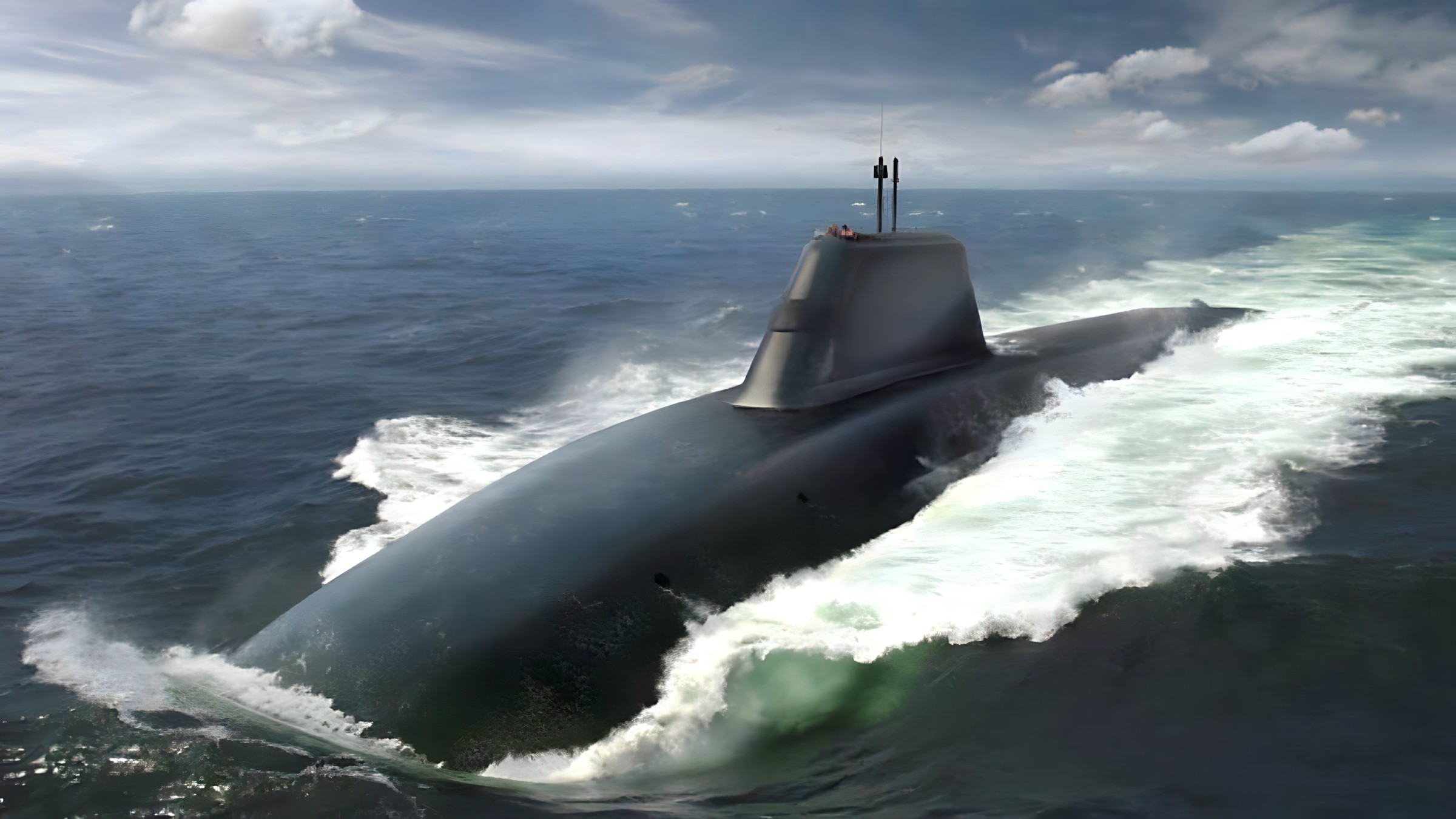
The Royal Navy’s Dreadnought-class ballistic missile submarines share a missile compartment design, a propulsion technology exchange and a missile with the American Columbia class now taking shape at Groton, a set of dependencies laid out in a Congressional Research Service assessment of the US programme.
Both programmes are past the point of no return. All four British boats, Dreadnought, Valiant, Warspite and King George VI, are under construction at BAE Systems in Barrow-in-Furness, and the government confirmed £8.4 billion for Delivery Phase 4 at the end of July, funding that carries the lead boat through sea trials and into service in the early 2030s. On the American side, the lead boat District of Columbia was around 65 per cent complete when the Navy’s programme executive officer for strategic submarines spoke at the WEST conference in February, with delivery estimates ranging from late 2028 in General Dynamics’ assessment to March 2029 in the Navy’s own budget documents.
What ties the two classes together most directly is the Common Missile Compartment, the middle section of each boat housing the launch tubes. Both navies are building to the same general design, with a modular arrangement that accommodates the difference between sixteen tubes on the American boats and twelve on the British ones, of which current plans call for eight to carry Trident II D-5 missiles. Britain provided some of the funding for the compartment’s design, including a large portion of the initial money.
Propulsion is the second thread as Naval Reactors, the joint Department of Energy and Department of the Navy organisation responsible for American naval nuclear propulsion, runs a technical exchange with the Ministry of Defence under the 1958 Mutual Defence Agreement.
In a statement to congressional researchers, the US Navy described the arrangement in these terms: “Under this agreement, Naval Reactors is providing the UK Ministry of Defence with US naval nuclear propulsion technology to facilitate development of the naval nuclear propulsion plant for the UK’s next generation SUCCESSOR ballistic missile submarine.” A British-based office of around forty American personnel provides full-time engineering support, and the work is reimbursed by the Ministry of Defence.
Reporting on the design concept has described the Dreadnought plant as based on an American design while using next-generation British reactor technology in the form of PWR3.






Wow 40 American engineers out of a total of 30,000 people working on the Dreadnaught class, its practically an American boat 😂
No mention of all the bits on Columbia being designed and manufactured in the UK then? 🤦♂️
Time to change that loadout to 12 SLBMs and load each with a maximum number of MIRV’s.
Send mad Vlad a very clear message that we can send a good few buckets of sunshine in his direction.
UK does not even have to do it.
Just announcing that “Due to the current threat level the UK will no longer restrict carriage of Trident missiles/warheads on CASD deployments” would suffice. Potential aggressors (looking at you Putin) would have to factor a full loadout into their plans regardless.
This underlines the most worrying aspect of this program due to the shifting sands of UK/EU and US relations. Much depends on the direction of US politics.
It does – but we should be making long term plans to decouple. All the British based military projects you know of that we suspect the Americans have killed or ‘asked’ for exclusive use of our technology… all it takes is a reminder that our deterrent is dependent on them
I know it’s not quite a button that would turn off our equipment but we can say that’s not sovereignty (on such an important issue)
I wonder if small modular reactors are a viable solution (I’m ignorant on the detail there)
But that would make the Treasury have to spend money!
srry sf say were insulted so what u gonna do about tinkers f off fruits
Not much the US could do to scupper Trident in the short-term. The impacts would be felt in a 5-10 years, though, and whilst I’m confident that the UK could produce a Trident knock-off in that timeframe if funded, I’m 50/50 on if it actually would be funded.
The US can’t directly force the UK to disarm, but forcing the UK to spend a significant chunk of money on developing its own SLBM might be enough for the government (and the general public) to throw in the towel.
Indeed even though we have only heard the hints of it from Carney over the weekend, the US has effectively seen Canada so desperate to retain trade with the US market that they, especially at the last minute tried to blackmail them into agreeing unexpected and damaging terms. It seems one aspect of this was restricting their trade with China and trying to tie Canadian sanctions and tariff policy to that of the US thus making them more US reliant and which as we know is as predictable as a rodents quest for food, you know what the aim basically is but have no idea of how it intends to get there and what turns and particularly U-turns will take place along the way.
One can only imagine (because we are unlikely to learn much) what pressures of a similar nature will be applied to us and cooperations of this nature could be a serious target.
Another provincial Brit totally ignorant of what is going outside of his dinky little island and blinded by his knee-jerk anti-Americanism. The fact is that the US offered Canada the best trade deal of any nation in the world and privileged access to the largest and wealthiest economy on the planet. China’s interest in Canada is as a bridgehead into the lucrative American market using Canada as a backdoor. The US demanded restrictions on China because China is dumping steel into Canada and the US wanted to restrict its use in auto parts and other exports to the US. Problem is that Canada is using so much dumped Chinese steel that it cannot, for tariff and trade purposes, distinguish it from Canadian manufactured steel. But then, the matter is a lot more complicated than can be absorbed by the brain of a provincial Brit with his built in prejudices.
America good, everyone else bad bouhouhou
American speak smart things provincial Brit not understand, knuckles hurt from dragging on ground now…duh.
Unfortunately the Trump administration is operating in its own reality field. It’s convinced itself it can beat Iran in its own backyard and it’s convinced itself that it has enough economic muscle to bully everyone into one sided trade agreements.
None of this is true, the US is completely anaemic to economic pain, two dollars a gallon on gas prices raises the prospect of secession and civil war.
Wow….
DNE costs are crippling conventional forces, absorbing >40% of the overall equipment budget. The result- a handful of SSNs unable to go to sea because of maintenance backlogs and a single SSBN on CASD. Now we are building even larger SSBNs with fewer missile tubes of which we aim to use just 8.
This is a nonsense. AUKUS will exacerbate the problem- Australia and the USA need a large boat to operate mainly in the Pacific. UK doesn’t. Indeed for many of the areas of operations, smaller boats, perhaps even non nuclear, would be better suited. Contrast the ability of the Japanese navy to keep boats operational with the availability of the Astutes.
The Dr Strangelove argument for SSBNs is that they deter a nuclear attack by being able to survive it. But does a single boat with 8 missiles really achieve that? Might an adversary with a developed ABM system calculate that it could neutralise just 8 incoming missiles? If so, the huge sums spent on Dreadnought achieve nothing.
There must be better, more affordable ways of providing a credible deterrent.
Firstly, the single SSBN is what is being delivered. That’s exactly what you’d expect from the investment we make.
Yes, eight missiles is a deterrent, because each missile can carry eight MIRVs, so a single submarine can cart around the equivalent of 64 nuclear strikes. There isn’t a missile defence system in the world capable of dealing with that kind of attack. Each MIRV comes in at Mach 20 or more.
Any nuclear strike on the UK will trigger a nuclear response from France (there’s no conceivable scenario in which Russia nukes the UK, and does not whack France at the same time), so that’s another 96 warheads at least.
The irony is, the SLBM is the only way of securing a survivable second strike capability. Land-based missiles are not survivable, because they can be detected and targeted. Road-based mobile launchers are harder to find, but again vulnerable. Air-delivered munitions are again vulnerable to a first strike.
Exactly.
Hmm that evalution is optimistic. Russia has about 100 launch silos for ABM firing 2 per incoming warhead. Most of the penetration aids on Trident 2 are in the Post-Launch stage (war head bus). The more you load onto it the less warheads, you have. USA until recently has bèen limited to 4 warheads per missile, obviously we havent. And the UK has a different policy for number of warheads per missile just in case it has to lob really long range, and obviously to save cost. This was seen when the UK said it was inceasing its number of warhead from 180 to 260. I say load em up to the max. Theres no way we are going to have two boats at sea so we dont really have a second Strike. Dont target Moscow just go for 64 different targets around Russia. Lets face it Russia isnt going to go for any military stategic sites apart from Faslane its going to go for the top 20 cities with Lodon getting 4 warheads. That would stop society alone from functioning in the UK so we have to go for Maximum Fire for effect with 12 missiles, 8 nissiles is just another woke item.
To be fair, it’s not 8 missiles the enemy has to worry about, it’s the warheads they can carry. The Trident missiles can carry 8-12 warheads depending on the size of warhead. They also carry a lot of decoys. The UK as policy never deploy more than 40 warheads per sub, the rest of the slots carry decoys of various types. So if 200 blobs come raining down on Moscow, which of them are the 40 real ones when only a couple need to hit to wipe out the city?
So is that enough? I don’t know. Arguably we should be able to fire from a second sub as well, somewhere near Faslane.
That depends if the interception is made before or after MIRV release.
Interception pre-boost is unlikely the distances from Vlads house are huge, you have to do it post targeting from the bus only Moscow has systems to stop warheads they dont cars about other cities.
True. Interception before MIRV release does require launch early in the missile trajectory hence close to launch site. US GBAD aiming for mid course interception is only 50% successful in highly scripted tests against a single missile.
So the deterrent effect of a single SSBN is probably sufficient but perhaps not certain..
My concern is that the growing costs of CASD are damaging our other capabilities
Jon,
Agreed, current HMG policy is a ceiling of 40 warheads deployed on CASD, however, HMG policy may change as geopolitical circumstances dictate. Dreadnought class would presumably permit ten strategic rounds (in addition to a sub-strategic/tactical and a training round). Additionally, as UK inventory of warheads gradually increases to 260, warheads per missile could be increased, if compromises re number of aids/decoys, range, etc., were accepted. Ergo, a total of 50-? on station.
The possibility of a second SSBN being deployed? Post 2035, quite conceivable that an adequately funded RN could execute the mission, especially if provided some advance notice. 🤔
The long term agreement and cooperation has been ongoing ever since 1958 when U.K exploded its own true H bomb after one bluff and some partially successful tests. Grapple Y & Z were full on, technically excellent and deployable weapons we even dropped them from a V bomber to test them. And that’s not me saying so, that was the verdict of Edward Teller (Father of the US H bomb) who was at the tests, had full access to data and fed that back to the US Government. What he was particularly impressed with was for a given quantity of materials our Weapon actually exceeded all its expectations. Now anyone who has seen Dr Strangelove will have seen a 1960 H bomb (damn big) but a tight arsed, broke little island built a deployable H bomb on the cheap and smaller than any equivalent Yield US weapon.🥹
And that latter bit of info is the real key to why we are treated as partners, if you use less material you have a smaller and lighter weapon so you can have more of them on a missile (oh and we had lots of Plutonium as well to trade).
The rest is History and whilst we carp on about US tech it really is a 2 way process and we do contribute some very important items and tech to the mix.
There seems to be a lot of fear about the effects of the present US president and his tendency to rip up just about every existing agreement going well so far there are 3 he has shied away from and one is the US / UK Mutual defence and cooperation treaty and the others are NATO & AUKUS.
There are many reasons for that but fact is they are Congress Ratified Treaties and he just hasn’t got the votes to get them ripped up (60% needed) and TBH it’s not in the US interest to do so as they actually make money out of them.
Anyway given his polling figures are so bad even Gerrymandering (redistricting) isn’t going to save him (see Texas for details) so in November he gets clamped till he leaves.
I do just want to digress from this all for a second and touch on another subject and it’s my “Thought for the Day”.
Why is it that Trump is suddenly back to being really keen to buddy up with Russia, China and North Korea ? The standard explanation is that Russia has something on him, but I think there is a far simpler explanation !
What have all 3 got in common ? Yep no extradition treaties with the US. Bolt hole !
So when Euro countries violated their own promises in NATO was not ripping existing agreements?
When?
Since 2000’s, since that period some countries went for less than even 1% GDP. in some years and other reached the levels with creative accounting, either putting in the defence budget things that dont belong there and not spending euros in the defence budget while the nominal budget implies they did.
There was no agreed minimum target spend in 2000. 2% became a guideline in 2006 and a target in 2014 — with a ten-year deadline to reach it. So no minimum spend agreements can have been broken before 2024, because they weren’t in force.
Out of 32 NATO members, 9 failed to reach 2% in 2024, but as of 2026, all NATO members are in compliance, even Spain, which had a long way to go in 2024. The next target for you to whinge over is 3.5% in 2035. Please wait until then before complaining that countries aren’t meeting that target.
Promises are not treaty obligations. I dont think there is a written article in Nato treaty saying thou shalt spend this amount.
ABCR,
Thanks, quite interesting historical detail re early weap design and testing.
Purely speculative, but one might conceive of a blanket Presidential pardon of any/all federal crimes potentially committed by the senior leadership of the present administration, including POTUS. Legal adjudication of the validity of the pardon could become a multi-year process. 🤔😉
Indeed, we were busy designing our own submarine nuclear reactor before the americans offered to sell us theirs. This “THE DEVELOPMENT OF NUCLEAR PROPULSION IN THE ROYAL NAVY: 1946-1975 by GARETH MICHAEL JONES”. If you look it up is this chaps PHD, damned good too. As for the current american administration, the yanks seem to do their own version of a crazy ivan, every now and then, just to see if their allies can manage on their own. For our own part, I think the British have been typically pragmatic. The RN had no problem renaming and reusing captured enemy ships back in the day. Can you imagine the uproar if we did that today! You do what you have to do and we have.
Since 2000’s, since that period some countries went for less than even 1% GDP. in some years and other reached the levels with creative accounting, either putting in the defence budget things that dont belong there and not spending euros in the defence budget while the nominal budget implies they did.
Apologies for the duplication.
FYI – 2% wasn’t even agreed until Obama’s second term following the invasion of Crimea in 2014 during a summit in Wales. since then most countries have reached/ surpassed 2% mark, next target is 5% by 2035 (3% defence + 2% related)
Oops another slow editorial week for Craig Langford. He didn’t mention that Babcock has been contracted out to produce a module for the Virginia Block IV’s. Let’s sensationalise but not give a balanced view shall we?🤔. Or that if the produce 23 modules that’s like 2 full Virginia submarines.