

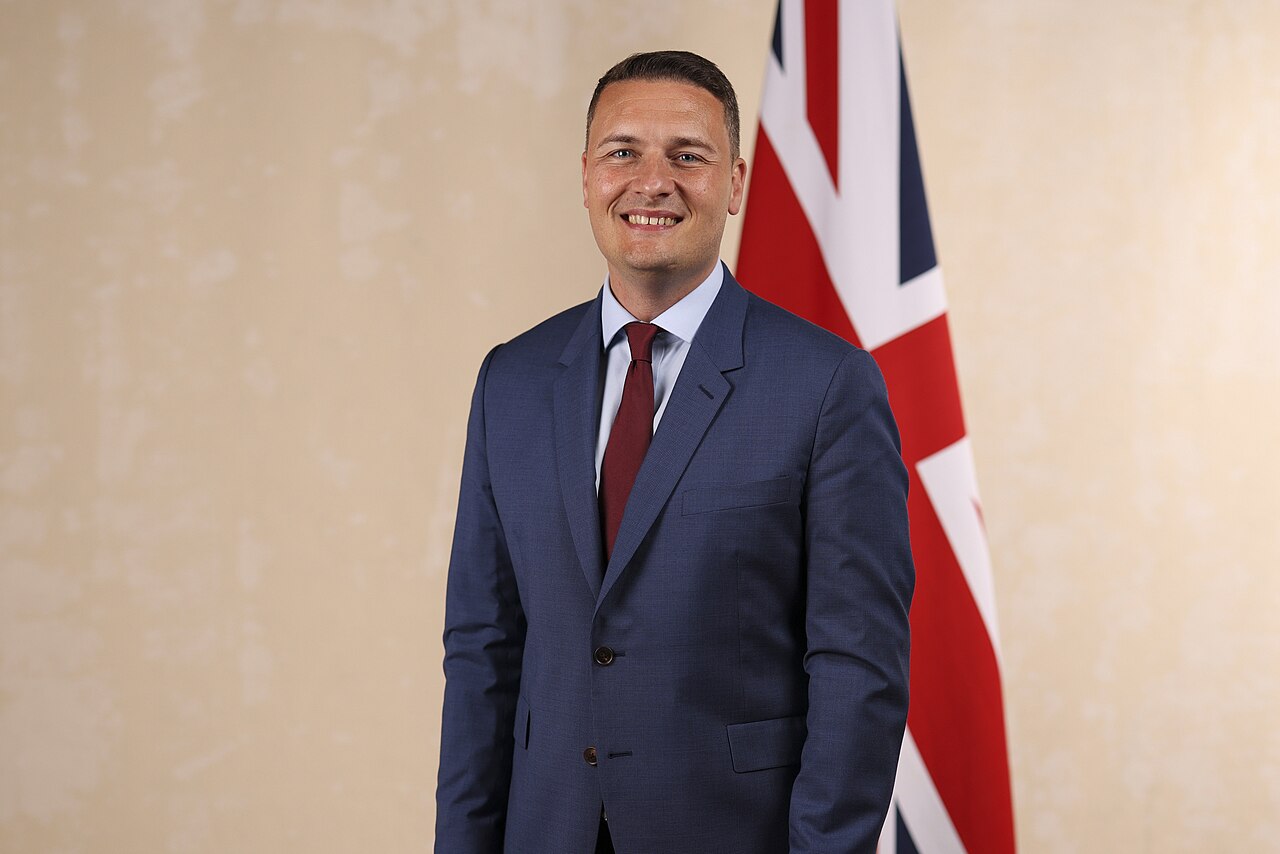
Wes Streeting has been appointed Secretary of State for Defence, taking charge of the Ministry of Defence as Prime Minister Andy Burnham forms his first cabinet, the UK Defence Journal understands.
The Ilford North MP becomes the department’s third Secretary of State in a matter of months, succeeding Dan Jarvis, who held the role following John Healey’s resignation on 11 June, and he arrives at a department three weeks into delivering the Defence Investment Plan, the programme that converts the 2025 Strategic Defence Review into commitments spanning the naval base modernisation, the frigate programmes, the F-35A purchase and the Hybrid Navy. Jarvis’s brief tenure saw him sign the UK-Estonia defence roadmap in Tallinn and visit Sheffield Forgemasters as the first British-made artillery barrels in almost two decades began deliveries to Ukraine.
Streeting served as Secretary of State for Health and Social Care from Labour’s 2024 election victory until May this year, when he resigned citing a lack of confidence in Keir Starmer’s leadership following the party’s results in the local, Scottish Parliament and Senedd elections. He initially declared he would stand in the subsequent leadership contest, but declined to run and endorsed Andy Burnham after the former Greater Manchester Mayor returned to Parliament through the Makerfield by-election in June, an endorsement now rewarded with one of the great offices of state’s neighbouring briefs.
The appointment brings a minister regarded as one of his party’s most effective communicators to a portfolio he has not previously shadowed or held, with Streeting’s front-line experience built at Health, where he led the government’s NHS reform programme, and his political career before that spanning the presidency of the National Union of Students, Redbridge Council and eleven years as an MP. His arrival contrasts with the long defence apprenticeship of Healey, who shadowed the brief for four years before holding it, and the Streeting era begins with the strategic direction set by his predecessors’ review and investment plan, leaving delivery, and the defence of that plan’s funding, as the immediate task.
On funding, the new Defence Secretary faces an unusual dynamic across Whitehall, with Healey, the minister who resigned from Defence last month following a row over defence spending, appointed Chancellor by Burnham this evening, placing the Treasury in the hands of the man who left government over the size of the defence budget. The commitments Streeting inherits include spending 2.5 per cent of GDP on defence from April 2027, 3 per cent in the next Parliament and 3.5 per cent on core defence by 2035, alongside the £3 billion in annual military support to Ukraine and the UK’s co-leadership of the Ukraine Defence Contact Group.
Further defence ministerial appointments below Secretary of State are expected as the reshuffle completes.










Diabolical choice. Hopefully, this is just a holding post for him to liase with Healey in the Treasury.
An interesting choice. It looks like the funding will be there. He might lack military experience but I’m not sure he knew much about health either.
We will just have to wait and see.
Burnham has to make all this work. He is setting expectations.
He knows nothing about Health which is why he left us in one hell of a mess. He pushed the latest transformation on us, with no thought or understanding on how things work. The guys is a fucking clown, a snake oil salesman of the highest order.
If Healey can get the funds to the MoD, and Streeting lets the Chiefs and civil service run Defence (whilst serving as the figurehead), we might get something done.
That’s exactly how it is supposed to work.
Why couldn’t they’ve kept Mr Jarvis? Short interim gig for him. Got to laugh a bit, Mr Healey now in the seat of influence he would’ve liked more support from a while back.
Apparently there was some annoyance that Jarvis accepted the DIP with a giant gaping black hole in it.
Err, apparently (this is rumour) he wasn’t particularly liked for essentially forcing the DIP upon Burnham with a £4b chunk missing.
Leh,
I think that Jarvis is held in respect.
The official House of Commons library breakdown confirms that the £4.7 billion gap was a deliberate, temporary stop-gap kicked down the road to allow the DIP plan to launch. The plan had to be announced to give the defense industry and military commanders long-term certainty, the decision was made to explicitly defer the remaining £4.7 billion.
I see this as a deliberate pause on a minor fraction of the budget. The government couldn’t keep defense capability frozen in limbo forever over a single digit percentage dispute. They published a massive, highly detailed strategy to get the military moving, while formally putting the final £4.7B chunk on the backburner for a few months.
Dan Jarvis took a short term political hit to get a £298B national security plan over the line. While it cost him his seat at the Cabinet table for now, it bought him massive, lasting respect within the military establishment and parliament. He will remain an influential, powerful player in British defence and northern politics for years to come. Jarvis and Andy Burnham are not enemies … during Jarvis’s time as the Mayor of South Yorkshire, he worked close with Burnham to fight the Treasury for better regional infrastructure funding. Burnham knows Jarvis is a heavy hitting Northern voice with deep executive experience, and once the dust settles from the cabinet reshuffle, Jarvis is highly likely to be brought back into the fold as a key envoy for Burnham’s regional devolution and industrial strategy.
In the weeks leading up to the June 30 announcement, Jarvis was locked in ‘brutal’ negotiations with Reeves. He successfully forced the Treasury to increase their funding offer by an extra £1.5B compared to what they had offered Healey. However … once Reeves drew the line and left the remaining £4.7B unallocated, Jarvis faced a binary institutional choice …
Refuse to sign, and the plan collapses, the MoD remains in funding limbo, and the UK looks weak to its NATO allies.
Sign it anyway, and secure the massive £298B framework, protect the 60,000 industrial jobs, and let the future administration handle the final math.
As a pragmatist, Jarvis chose option two. But he isn’t stupid. It is highly likely that he picked up the phone, called Burnham, and gave him a heads up: “Andy, I’ve pushed the Treasury as far as they’ll go. I’m going to sign this to lock in the £298B headline for the military, but you need to know right now: Reeves is leaving a ‘front loaded’ £4.7B hole in the out years for you to fill.”
For Burnhan, being “blindsided” allowed his team to immediately brand Starmer and Reeves as fiscally reckless, giving Burnham a strong mandate to purge the Cabinet and rewrite the Treasury’s borrowing rules the moment he took power. Jarvis got to be the loyal institutional soldier who managed to finally get the defense blueprint out the door, knowing his friend Burnham would have a clean slate to fix the math later.
Magenta,
Thanks for the tutorials re both MoD and Treasury political and fiscal policies. Fascinating historical and political read for former colonials. Very best wishes for the collective success of the replacement/understudy cast of actors upon the grand stage. 🤔🤞
A very well written, logical and informed post ! As a matter of interest what is your take on the rumoured “offer of Defence Secretary to Rachel Reeve’s”.
I can’t decide if it was a serious offer to try and console her, an attempt to lock her (and her financial knowledge) into Cabinet and away from the Starmer faction or Andy Burnham has a hell of a sense of humour and just wanted to see her face when he handed her a “Chalice” she had herself poisoned.
Her own team have confirmed she wasn’t offered Defence Secretary.
ABCRodney,
I think if Rachel Reeves had accepted the “reported” role as Defence Secretary, it would have been a deeply ironic, and politically toxic bargain for her … the ultimate irony, as Chancellor, Reeves was the one holding the purse strings, enforcing strict fiscal discipline, and famously refusing to fund the military expansion plans.
Stepping into the Ministry of Defence would have forced her to inherit the exact funding crisis she created. She would have had to publicly beg her successor … John Healey for the very money she had spent two years denying him.
I find it hard to believe that Reeves’ had Faustian desires to hold that particular office; seems more like a slap in the face. Ultimately, the skepticism is healthy, in politics, an offer that is turned down behind closed doors remains exactly that … a “reported” move in a high stakes game of strategy, rather than a matter of public record.
MoD finally has a principal advocate w/in HMG’s Treasury? Possible political pathway to 3% GDP expenditure on core defence this Parliament? Possibility that Andy Burnham is a sophisticated politician and more than a conventional liberal? This may prove quite interesting … 🤔😉
Absolutely I can see 3% by 2030 commitment and hopefully 2.8% 2028 2.9 2029 now!
Think this is the government defence needs.
This will really mean DIP2 when it’s announced , maybe this autumn with the budget we will see the review we wanted to see this time round
As per SPF, I think Streeting can be an effective minister if his job is mainly to keep the disparate parts of Defence playing nicely with each other but we have no idea what might happen if he was allowed to attempt a reorganisation of the MoD, for example.
The switch between Streeting, one of the candidates for Chancellor and Healey, who was tipped to return, is very interesting and has thrown my vague ideas of Burnham’s plans into confusion.
Leh, is it that diabolical a choice? Streeting has experience of managing an enormous department, mastering a complex brief, has experience of managing an enormous budget, is an excellent communicator, and wants to be seen as having done well. Most of the hard work has been done – writing SDR and DIP. Overseeing implementation is a somewhat more straightforward (but not simple) task and the Chancellor, who holds the purse strings, is very much on the side of Defence, so more money might be forthcoming.
I do feel sorry for Dan Jarvis, sacked after little more than a month but I started to lose confidence in him, despite his (quite junior) military service; he constantly failed to give straight answers to straight questions, leading to my suspicion that he was controlled or at least in awe of senior officers and civil servants and needed to consult them first.
Streeting communicates well, if he can get enthusiastic about defence so much the better. Interesting to go from NHS to defence.
It’s a diabolical choice in my opinion, because it’s very clearly a last minute, emergency appointment that demonstrates a lack of direct prime ministerial interest in defence.
Reports state that Wes Streeting was very much a second or third choice for the role. Initially, Burnham wanted to give the post to Reeves, who declined. Then, it was reportedly offered to a variety of then-uncommitted politicians, none of whom wanted the position. Streeting was then brought in.
I have no desire to see defence, despite all the rhetoric, be cast into the governmental weeds. Healey’s appointment to Chancellor could be good, but it could equally be a signal of disinterest.
Jarvis would have been good to continue. Put Streeting back in the position he was good at, at the NHS.
All that said, if he does well, I’ll very happily eat my words.
I will point out that NHS recruitment has improved massively and staff vacancy rate is now the lowest ever. Not sure to what extent Steeting can claim credit, but it’s potentially experience that could be very useful in the MoD.
I had high hopes when Healey was made Chancellor, but this and making Milliband Foreign Secretary? FFS!
Let’s replace someone who used to bd in 1 Para with someone from the National Union of Students. Great idea.
Jarvis’ experience at cabinet level totals 6 weeks, Streeting has just run the Health Ministry for 2 years and presided over a big spending boost, he shadowed that role for 3 years before that.
Brave new world…..Burnham believes in giving people opportunities for character improvement…😉
dwight,
Burnham has replaced an ex-Para Major with just over 5 weeks as a Cabinet minister with someone who has had nearly 2 years as a Cabinet minister, in a much bigger Department and controlling a much higher budget. Streeting is a more skilled communicator and is a heavyweight political figure.
Healey at the treasury has got to be a step up from Reeves but Sreeting? Not for me.
Congratulations 🎊! Ukraine is at centre stage.
“a minister regarded as one of his party’s most effective communicators”
I’m sorry, are we talking about the same person here? Mandelson Jr is despised by both left and right, a man who spews not an ounce of truth any time he speaks, who absolutely nobody believes a word from! Streeting is the worst choice Burnham could have made for defence – Carns is right there if Jarvis’ DIP shenanigans discounted him.
I can only hope that, like others have said, John Healey has a background portfolio as both Chancellor and Defence Secretary, and lickspittle Wesley sits there and reads the scripts put in front of him.
Streeting in Defence – should have put Al Carns in, obvious choice
Healey a Chancellor, no, just no.
Two very poor choices for two really important positions.
Let’s give Streeting a chance. The role of a minister is to run and represent their department, working with the junior ministers and civil servants. Whilst having domain knowledge helps, and having a military background will help with empathy and understanding of the forces and garner respect, neither are essentials. It’s not like Streeting had to be a doctor to become Health Secretary, and plenty of Defence Secretaries haven’t had military backgrounds before. He should have a relatively benign Chancellor who a least understands defence.
More of a concern is the team below Streeting. Cairns quit alongside Healy, now Jarvis is out and Eagle has secured a promotion, leaving just Luke Pollard. Hopefully Jarvis will be offered and persuaded to take his old role to provide a bit of continuity, but a demotion might be too much to accept.
Pollard does seem to say quite sensible things about procurement. He’s pushing for more COTS/MOTS purchases, CAVS, Land Cruiser etc. and getting SMEs more involved in the supply chain.
No interest in seeing drone-Jesus himself, Mr Carns, drop his dodgy ideology onto the MoD.
Well, First Sea Lord agrees with him and they both come from the same boat-house and I would never upset either of them…
I personally think the drone threat is real with the caveat that the UK do too much testing and take far too long to get anything into service AND, thinking a drone could replace an air-warfare destroyer is a tad beyond credible and just an innovative way of saving cash. Difficult one.
They should make a resilience and readiness role ‘specially for Carns, but he shouldn’t be let into the same office building as any procurement teams.
Congratulations 🎊! Ukraine is at centre stage.
DIMWIT,
“…Healey a Chancellor, no, just no.”
That’s a reductionist take that glosses over the nuanced, but deeply boring stuff …
John Healey has held three specific roles during his career under Tony Blair and Gordon Brown, which included Parliamentary Private Secretary to the Chancellor between 1999 and 2001. Before he was an official minister, he served as the direct political aide to Gordon Brown. He sat in on the foundational meetings where major budgets and fiscal strategies were hammered out, learning the internal language of the department.
Healy was then the Economic Secretary to the Treasury between 2002 and 2005. He was formally promoted to this junior ministerial position, where he was directly responsible for microeconomic policy, productivity frameworks, and regional economic growth.
Healy finally moved up to be the Financial Secretary to the Treasury, a senior junior minister position. Where he spent two years managing the technical side of the UK tax system, tax legislation, and the foundational economic modeling used for government wide Spending Reviews.
The only two jobs on the political side he hadn’t done before yesterday are Chief Secretary to the Treasury … the gatekeeper who explicitly manages public sector pay, infrastructure, and departmental efficiency role and Chancellor of the Exchequer, the top job, which he holds now. This five year run as a working Treasury minister is exactly why economists and bond markets viewed his appointment as a “safe pair of hands”, he has already spent half a decade running the lower gears of the exact same machine he is now driving.
While ministers don’t have to be experts, a Prime Minister will always look for institutional literacy when handing out the most critical jobs. The Chancellor John Healey isn’t a math academic! but he spent five cumulative years running the machinery of the Treasury under Gordon Brown, He knows how the building thinks. The UK cannot afford another fscking “Liz Truss moment,” where the markets panicked over government borrowing, causing interest rates to spike. The initial market reaction to Healey’s appointment is overwhelmingly stable. City analysts explicitly noted that his presence acts as a reassuring “check” on Prime Minister Andy Burnham’s more radical tendencies, signalling that the government will respect fiscal realities … one can normaly trust the ‘markets reactions’.
The incoming Chief Secretary … Healy’s new right hand ‘man’ Emma Reynolds spent five years as a Managing Director in the City of London financial sector and already served as a Treasury minister, as Pensions Minister and as Economic Secretary to the Treasury / City Minister.
Sure … John Healey is not an economic visionary who will invent a brand new economic theory, he’s a master mechanic who knows exactly how the massive engine of the British state operates under the hood. He is equipped to navigate today’s puzzles because he knows how to deploy the permanent civil service experts to model complex solutions and he has the institutional authority to say “no” to other departments. His success will entirely depend on whether his deep, traditional institutional discipline can adapt fast enough to the unpredictable, high-stakes crises of modern global finance.
He isn’t there to be the smartest economists in the room … he is there to manage the smartest economists in the room.
“He isn’t there to be the smartest economists in the room … he is there to manage the smartest economists in the room.”
Very nicely put magenta two more great posts.
I had faint hopes that Healey would come back to the Cabinet as Chancellor and would not forget is time as, and resignation letter from, the role as Defence Secretary. I was well pleased to read this morning that he had indeed got the job!
As such your post reassures me that me he is indeed a safe pair of hands for Chancellor which is fundamental to any possibility of driving up economic growth which in turn is a key enabler to both reindustrialisation and rearmament. I also note your point that he will make a sensible counter point to Andy Burnham’s ‘more radical tendencies’. This is reassuring on two levels (for me at least), first of all there is someone who has demonstrated the strength of character to stand up for what he believes to be right and to do it in disciplined manner, i.e. in private until he can go no further and then resign, explosively! The second reassuring point is that Andy Burnham has just demonstrated sufficient sense to appoint someone with the experience and personnel power to be able and willing to say ‘no’ to him, in other words to speak the truth to power.
My hope now is that Defence will get the up lift it needs in these turbulent time. To justify this Wes Streeting – not my first choice if I am being honest – is going to have to continue cleaning up the shambles that has been Defence Procurement. There are some signs that John Healey’s time at defence as had a positive impact, but with a mostly new team the desperately needed improvements to procurement efficiency need to continue and probably accelerate across legacy programs as well. It is a tall order, but Wes Streeting didn’t seem to mind pushing through reforms at Health, whether they worked or not is open to debate.
Thanks for your posts.
Cheers CR
Politics, Religion and Football !
God I love this place 😁😁
Given that Burnham has no historical links with Streeting or Healy and neither are particularly popular or have any backing with in the party I suspect both of their resignations where set up by Burnham and this is their reward.
Healey might have dug himself a hole on defence spending. As much as I was not a fan of Rachel from Accounts she was not wrong about the country not borrowing more money. With a hysterical electorate and media complex, neither tax rises or spending cuts will be acceptable, no matter how much people claim to be in support of defence spending.
If Healey does secure the extra £4 billion over four years it won’t make a blind bit of difference to UK military outcomes. The defence budget over four years is around £280 billion so £4 billion is less than 2%. With an MoD addicted to the most high end American equipment I just don’t see what anyone thinks can be changed. The USA is trying to authorise a $1 trillion+ budget and its military claims to be desperately underfunded.
Unless we drop the high end global expeditionary all professional force ethos there is no amount of money the UK can ever afford to make a meaningful difference in defence outcomes. Even rising to 3.5% will barely add any frigates, no submarines and also it no additional fast jets men or armour. Just lots and lots of more support contracts for BAE, GD and Lockheed. £4 billion might be enough to add a singer capability like ABM but that won’t happen, it will be spread across everyone’s pet drone project or cap badge retention scheme and produce nothing of substance.
Countries that are rising budgets and making meaningful adjustments to defence outcomes like Poland and Germany are building major forces based on Reservists and conscription. The very same formats we use to win wars. The UK remains the country in NATO with the lowest ratio of active reservist to regulars and the SDR and the DiP did nothing to change that despite screaming at us war is imminent.
Going to 3% which is 12 billion a year is a lot!
Going to 3.5% which is like 30 billion ‘ won’t add any more frigates etc’ is just a stupid comment !
Obv course it will buy extra equipment!
I know the gov are not great and spending money wisely but an extra 30 billion a year would get soemthing
Jim, I think Burnham and Healey might bear down on welfare spending under a banner that implies it is a ‘return to working’ policy. That would free up more funding for Defence. With Milliband out of the way (domestically) they could also reduce the spend on the Net Zero project too.
When you mention an MoD addiction for the most high end American equipment, it seems to me that the RAF is principally guilty of that, the RN and the Army surely buying relatively little expensive high end kit from the US? But does the RAF have much choice in the matter, going forward?
I very much agree that we need more Reservists, but MoD has only increased the Strat Reserve by raising the upper age limit – not a great plan – war is a young man’s game. Need to increase Volunteer Reserves too, but are there enough citizens who would want to do that?
It was reported that Rachel from accounts was offered Defence but thankfully she turned it down! So I suppose we can be thankful for small mercies!
No one can say that DJ and AC didn’t have experience military experience, but given both came from effectively the “go at kick the sh*t out of the enemy” branches of defence, I think they both might have a narrow view of requirements.
Streeting has experience of trying to control and run a multi billion pound department which covers all aspects of the health spectrum. He should therefore understand competing interests from all areas: basic GP, A&E, Research and Development and every other branch that wants funding.
Let’s give him 6 months at least and see how he gets on.
Yes, some appointments I am not sure of, but Hermer, Lammy and Reeves have gone, and Milliband is no longer in charge of Environment, so I think overall its potential in a better place than it was last week
My position to. Starmer Hermer Reeves Lammy gone.
Milliband, hopefully won’t cause too much damage where he is.
We’ve had DS who were ex military and it made no difference to cuts.
He’s ambitious, so will want to fight for his department.
Agree here, but a slight note of caution in my mind remembers Gavin Williamson. At least he got money out of the Treasury I guess.
Hi M8, I’m actually not too surprised about John Healey being the New Chancellor, he knows how the Treasury works and how entrenched its hierarchy is to “spend on anything other than Defence” ethos. That may sound a bit OTT but a few years ago a former head of the Treasury (Nic McPherson) was interviewed on R4 and when asked about boosting Defence spending post Ukraine invasion just no chance “we hate giving money to defence”.
Healey will not let them get away with that idea and has clearly stated he will fund us to meet “All our Defence commitments to our Allies”.
Well that isn’t just funding the present DIP as even with the hole plugged it only gets us up to just over 2.7% by 2030 it means boosting it to 3% by 2030 and 3.5% by 2035. That’s the commitment we made to NATO last year.
Healey is now in the best position to actually get what he wanted done as Defence Secretary and the Treasury Mandarins know damn well “No” isn’t an option.
As for Wes Streeting this may sound odd but he has been appointed as Minister not as CDS, so his job is to :-
1. Secure the Budget needed to meet our Defence obligations. (that is way easier now)
2. Ensure the actual needs are met and not wasted on Gold Plated Projects and waste.
3. Keep the service chiefs focussed on their own jobs rather than playing power politics against each other.
As far as I am aware Luke Pollard is staying in post so Wes has an experienced assistant who has also worked for John Healey.
IMHO managing the NHS (and doing a decent job) was a far harder job than Defence is, far bigger budget, hugely wasteful, vastly more staff, Unions and Industrial Relations issue that are endemic. And he was doing pretty well at it.
John Healey had 0 background in Defence but turned out to be a thoroughly decent, hardworking, honest and honourable Minister who just wouldn’t accept the settlement he was handed.
IMHO we are about to see some very large changes in Defence spending whilst the MPs are off over the summer recess and then a revised DIP due to proper funding levels.
“The Game’s Afoot” 🤔
Hi M8, I’m actually not too surprised about John Healey being the New Chancellor, he knows how the Treasury works and how entrenched its hierarchy is to “spend on anything other than Defence” ethos. That may sound a bit OTT but a few years ago a former head of the Treasury (Nic McPherson) was interviewed on R4 and when asked about boosting Defence spending post Ukraine invasion just no chance “we hate giving money to defence”.
Healey will not let them get away with that idea and has clearly stated he will fund us to meet “All our Defence commitments to our Allies”.
Well that isn’t just funding the present DIP as even with the hole plugged it only gets us up to just over 2.7% by 2030 it means boosting it to 3% by 2030 and 3.5% by 2035. That’s the commitment we made to NATO last year.
Healey is now in the best position to actually get what he wanted done as Defence Secretary and the Treasury Mandarins know damn well “No” isn’t an option.
As for Wes Streeting this may sound odd but he has been appointed as Minister not as CDS, so his job is to :-
1. Secure the Budget needed to meet our Defence obligations. (that is way easier now)
2. Ensure the actual needs are met and not wasted on Gold Plated Projects and waste.
3. Keep the service chiefs focussed on their own jobs rather than playing power politics against each other.
As far as I am aware Luke Pollard is staying in post so Wes has an experienced assistant who has also worked for John Healey.
IMHO managing the NHS (and doing a decent job) was a far harder job than Defence is, far bigger budget, hugely wasteful, vastly more staff, Unions and Industrial Relations issue that are endemic. And he was doing pretty well at it.
John Healey had 0 background in Defence but turned out to be a thoroughly decent, hardworking, honest and honourable Minister who just wouldn’t accept the settlement he was handed.
IMHO we are about to see some very large changes in Defence spending whilst the MPs are off over the summer recess and then a revised DIP due to proper funding levels.
“The Game’s Afoot” 🤔 Again !
I seem to have a very long stutter 🤪
I’m hopeful things are now on the up mate.
The thing is we are now in a much better position to actually not only increase our capability but our capacity due to pre loading a lot on industrial investment ! But if we start to actually order new kit it may well kick start exports that in turn boost investment, raises funds and lowers the production costs.
Healey has stated he is going to fully fund our NATO commitment that means 3% by 2030 which isn’t just finding £4.3 Billion extra its an extra £9 Billion pa.
I know you don’t care for the MIC but fact is you can’t rearm without either having our own or just importing, I’d prefer the latter.
It will be really interesting to see how Healey actually finds the money and if Burnham doesn’t cave to the moaning Minnie’s on his back benches. There is no 2 ways about it some very unpopular choices have to be made and it needs to happen ASAP.
On the plus side Parliament is in recess till 1st September so they have 6 weeks to stitch it all up !
Bring it on.
I agree with you I see three things
1) the MOD getting its teath kicked in by the guy who set his mark in the NHS by sacking 18,000 senior leaders,bureaucrats,managers and leaders and making all the rest apply for new jobs.. that was essentially 50% of the NHS bureaucracy just gone.
2) The chiefs and senior officers in the services will find a sort it or sod off mentally, the CEOs of NHS trusts are all well in line and doing as they are told… a group that were essentially like herding cats before..
3) more money soon.. Streeting has states when asked about more money “As to future fiscal events, it’s for the Chancellor to make announcements on those matters but I certainly feel like we’ve got a firm friend in His Majesty’s Treasury.”
Hi Jonathan, All I can say is if anyone can get this done it’s Healey to provide the funding and Streeting to cull MOD bum sitters. If they get the money and spend it wisely we may well get a few nice surprises.
Funny thought I do wonder how MOD managed to arrange for Russia to display why this is so important with a free Firework display just 40 miles south of Guz, the timing was impeccable.
Give him a chance, lets see if he lets the military get on with it and sorts out the mess that is buying too little kit too late and cost over runs and kit that does not work still getting in to service.
Oreder two more Awacs, order a proper IFV to replace Warrior and fix or bin Ajax , and order some proper long range GBAD.
On the positive side Wes has lots of experience of running very large Department with continual money problems. Asking lots of questions, which he will have in this complex area may also get the experts thinking about problems from a different angle.
If he just focused on reducing the wasteful and inefficient bureaucracy within MoD so procurement processes were improved he would be doing the country a huge favour in the longer term. What we get for our money is woeful.
Al Carns would have been a better fit having worked with Healey in the past and are on the same page when it comes to defence. Having an ex service person in this role with defence experience must be a positive
The revolving door of defence ministers continues.
Very little continuity at the top is not good for the department.
Worse if it’s a Prime Minister.
As it is, Healey quiting has resulted in a pro Defence Chancellor and an experienced Minister replacing a junior less experienced one in Jarvis.
Despite his military credentials, I think this is a big step in the right direction for Defence.
A man who literally knows nothing about defence I would imagine. he has never even had a proper job. However he is an irrelevant played compared to Healey. Either Healey is the honest honourable man people think he is and will bulldozer the full DIP funding through OR realities will set in and he will do what every other Chancellor does, avoid spending on defence at all costs. I imagine it was Reeves who was offered and turned down defence and if so because she knew funding was impossible without huge cuts elsewhere.
Streeting is probably the most effective hatchet man of senior bureaucrats and leaders we have in our political system… he essentially sacked 50% of our health systems management structures and put the fear of god in the rest.. this is man who clawed his way out of an east end council estate and total poverty to some of the highest offices in the land… he does not respect senior civil servants just because they are.. if he decides the MOD is bloated with senior posts.. 50% will be gone in 2 years.. same with senior officers. If they stand in the way of reform their whole departments will be gone..
This man is the most brutal reformer I have ever seen.. he has zero respect for a status quo that blocking the set goal.
Interesting but let’s hope his mission is to drag our military out of its current hole and not to save King Andy money for his social reforming daydreams. I was less than impressed with Healey creeping at the start of the cabinet meeting but time will tell where these people’s real loyalty lies, other than to themself of course.
Whilst the initial reaction might be why Wes, why someone with no Defence experiance, which are valid points. I think we have to look at what the MOD biggest problems are… wasteful spending, projects that spiral out of control, lack of acountability, the list just goes on and on and on. Many Defence ministers have talked the good talk in addressing those issues, but I am not sure anyone can really point to real progress on any of the core issues at MOD. Maybe we need someone that isn’t Military or with Defence experiance that can really get a grip on these core issues.
As a country can we really justify throwing more and more money at a clearly broken system. I would be front of the queue saying defence needs more money, but that money has to be spent wisely and not thrown into the bucket that the bottom fell out of years ago. Can we really afford another Ajax debacle?
On the flip side, with a former defence minister that has felt the pain of treasury “in year savings” that end up making the deliverable cost 3x the list price, hopefully we have someone that can really bring focus to the fallacy that “in year savings” are really no saving at all. I think there is hope, i just pray it is not misplaced hope
If you want reform and to sack half the senior leadership, then put the fear of god into the rest Streeting is your man.
How to manage MOD
Sit all the Service heads and CDS down in a row
Shout loudly at them ‘Put the bloody PowerPoints down and sort our what you actually have in service’
When they’ve done that, let them ask for new toys
Streeting does not work like that.. he will essentially have most of them out the door.. in health he removed about 50% of the management structures.
I would say most of the MOD will be shitting themselves.. as should the senior officers.
Burnham ( no doubt guided by Louise Haigh) has cleared out the ‘Starmer loyalists’: they shared their leader’s mental bunker mentality, which was depressing the whole country: hence the local election results.
Streeting is probably one of the most brutally effective change managers I’ve seen in a senior politician..
It’s not well reported but since he took over health two years ago he has brutally reformed the health bureaucracy and senior management as well as put the fear of failure into Trust management.. he’s out played the massive power block that was the medical profession.
So what has he done
1) cut the department of health civil services by 16.5%
2) mass cull of NHS England and ICBs.. he remove all the regional NHSE structures and cut the number of integrated care boards by about 60%.. this action has cut the senior leadership and oversight staff in the NHS by about 50%
3) cut about 18,000 management and admin staff..
It’s been the most brutal cut in NHS staff in 40 years with an total focus on a mission goal.. all spare money to reduce waiting lists… I’m not saying it was correct as I think the money should have been utterly focused on primary care..
But he is probably the most effective Minister of reforming and sacking senior management we have had..
I suspect the MOD and senior service boss are in for a tempestuous time… if streeting thinks we have to many senior civil servants and to many senior officers, streeting is the type who will make them all redundant and focus resources into the decided mission… he’s an axe man when it comes to senior leaders and bureaucrats.
Defence by its very nature is an expensive business and I doubt there is one defence department on the planet is not the problem child for that countries treasury.
Our needs root and branch reform. The bang for the buck is wieful. It needs to be leaner and a lot more agile. We simply can’t afford another Ajax and kit needs to get through to the guys at the front .
The obvious choice was Al Carns. It would not just be a political post to him, it would be his personal responsibility and he would put the front line first.
If you want reform Streeting is probably the man to do it.. he is the guy who sacked 18,000 senior leaders, bureaucrats and administrators in the NHS…
Hi Jonathan, Looks like he may have been reading your comments or you are his secret Script writer 😎Streeting has really nailed his colours to the reform the MOD, improve efficiency / cutting costs so he can justify extra investment its his NHS Mantra in his first major speech today !
Nice start 👍🏻
MOD has just been through a root and branch reform. Some of the reforms aren’t even finished yet. While extensive reform is going on, inevitably less real work is.
Interestingly there were some subtle hints from Streeting when asked if more funding would be forthcoming for defence, he stated
“As to future fiscal events, it’s for the Chancellor to make announcements on those matters but I certainly feel like we’ve got a firm friend in His Majesty’s Treasury.”