

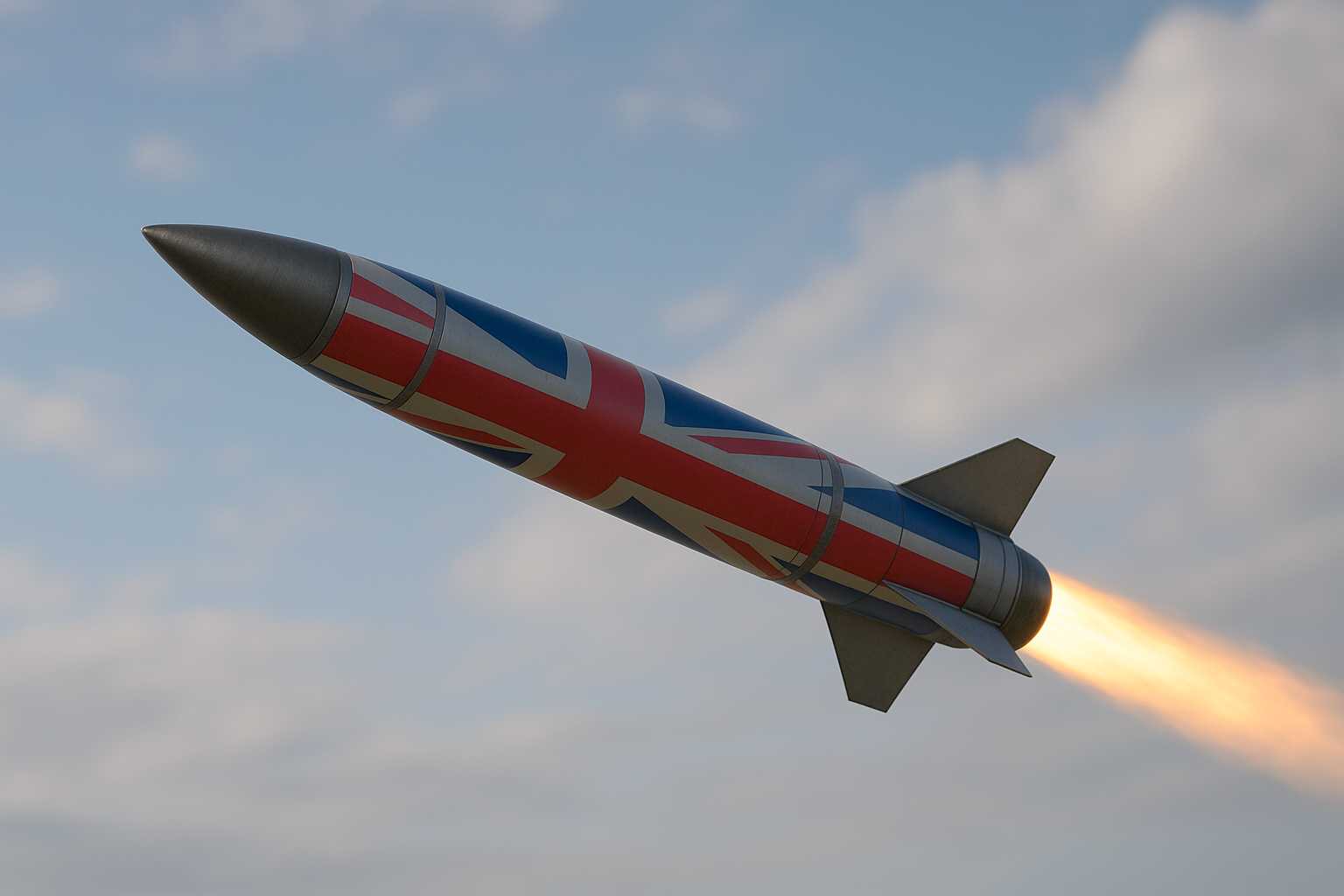
The Ministry of Defence has confirmed that the competition for Project NIGHTFALL is expected to open in December, following the close of its initial industry engagement period.
The update came in a written question from James Cartlidge, Conservative MP for South Suffolk, who asked when the competition would begin. Responding on behalf of the department, Defence Minister Luke Pollard stated that officials are still assessing the industry submissions received last month.
In Pollard’s words, “The Department is currently reviewing feedback from industry on the NIGHTFALL Request for Information, which closed on 24 November 2025. We expect to launch the NIGHTFALL competition in December 2025.”
The confirmation follows the detailed requirement published earlier this year, which set out one of the most ambitious tactical ballistic missile programmes the MoD has attempted in decades.
The Single Statement of User Need describes a ground-launched missile capable of striking beyond 500 kilometres, surviving contested electromagnetic conditions, and delivering a 200-kilogram payload with a CEP50 of five metres. The specification pushes mass production and rapid deployment timelines, with a target effector price of £500,000 excluding warhead and launcher.
As the requirement document makes clear, “The User requires a cost-effective, tactical (>500km) ballistic missile, capable of being safely ground launched from a mobile platform in a high threat tactical environment, navigating to and accurately striking a user-programmed co-ordinate.”
The MoD also stressed survivability and environmental resilience. According to the notice, “It shall be operable in harsh physical environments, day and night, of low multispectral signature, resilient in a complex Electromagnetic environment (EME), including within a GNSS denied & degraded environment, and resistant against targeted EW attack and spoofing.”
Speed of delivery is central to the programme. The requirement sets “an aggressive timeline of a demonstration firing in circa 9 months from any contract award and serial production approximately 3–6 months later, producing a minimum of 10 units per month.”
The project demands that a single mobile launcher be able to fire multiple missiles within 15 minutes and redeploy within five minutes to avoid counter-fire. Systems must operate without reliance on foreign export-restricted components and offer a growth path for range, manoeuvrability and precision.
Acceptable submissions include complete missile concepts or contributions in propulsion, airframes, navigation, scalable manufacturing, mobile launchers, and integration. Proposed solutions that cannot scale rapidly or that do not follow a ballistic trajectory will not be considered.
Industry responses to the RFI closed on 24 November. The forthcoming competition will formalise the down-selection process, with the MoD aiming to reduce candidates to a small number of funded demonstrator designs in 2026.









Lots of things happening in December. Hopefully that means the DIP is due very soon, and has a decent shopping list.
🤞
To be honest I thought they would sneak it out just after the budget.. get the defence bad news out they way while everyone is still pissing and whining about their tax of choice.. but I was wrong, they are separating it a bit.. I do think this is possibly because they see it as a good news national identity sort of announcement.
Alternatively the Ajax ‘developments’ have caused a scramble to reassess e.g. Ajax IFV.
But I will adopt the optimistic view that the Government wants a triumphant new year’s resolution, as otherwise I will cry.
I do agree I think one of the issues is constant change in the geostrategic picture has made it very very difficult to formulate this.. but I don’t think issues with one land programme will cause that much issue.. I think what has been the big issue is HMG trying to assess how quickly the US will pull away from NATO, will NATO survive and in what form, will Russia very specifically try to isolate and attack the UK and exactly how involved will the UK be in the white show that will be an indopacific war.
Hope your right sir, maybe that’s 22 of that 24 billion head room, is for ?Ah yes I am a dreamer.
I hope it’s ready to support the Typhoons on their North Pole excursions end of December, very concerned about the impending red menace they are likely to face up there, who knows how many drones might be sitting undetected in those sacks of toys. I for one am sick of it, we need a deterrent to these yearly incursions once and for all into our airspace tbh.
A growth path for range… well that pretty much shows this not really just about just building a tactical ballistic missile, which is nice to have but hardly a core requirement of the UK… it’s useful definitely especially as a NATO contribution, but using it as a step to a medium range ballistic missile, that puts the UK back on a strategic weapons path it foolishly left in 1960.. simply put if it was to ever go to war with Russia and therefore as a deterrent to Russian aggression to the UK we need cruise and ballistic missiles that can be launched with complete sovereign control ( from UK sovereign territory).
This can only be a UK purchase of PrSM, I agree better to develop a cruise missile and just buy this ballistic missile off the shelf.
The 500 km range is a match but PrSM has a payload of less than 100 kg.
I believe PrSM is very different a cheap an cheerful overwhelming numbers munition..a key part of project nightfall is delivering a 200km government supplied payload.. essentially that is leaving this open for a nuclear tipped ballistic option.. that requirement for extension of range options says they are potentially thinking strategic range conventional deterrence or even sub strategic nuclear option..
To me the focus on long range strike capabilities say the government risk assessments are showing a possibility that the UK may just not be able to depend on NATO in the future…
Could it also be a hedge in case the Vanguard class falls over before Dreadnought is ready?
Not saying that iwhatever comes from Project Nightfall would be a suitable stand-in for Trident, but that it could be spun to the public/press as a bridging solution to save face in the event there is an availability gap with CASD.
Vanguard celebrated her 32nd birthday earlier this year, and Dreadnought isn’t expected until “the early 2030s”, which some wag at the MOD will say means anytime up to 31st December 2034 is on time. Hard to believe all four boats can go the distance after the disintegration of the Type 23 class. Different vessels, different operations and operating environments, but still…up to 15 years past their expected service life is a stretch
PrSM fails the sovereign control requirement being the American replacement for ATACAMS.
ITAR free European suppliers would be able to meet that requirement.
What Musk would do for our successful if very brief rocket success back then on a shoestring budget. More relevant what we could do with it now before most of the ‘boffins’ went off to work on the Saturn 5 and other US projects.
Lol…
Good news, but we should also be looking at acquiring some GBAD
We are under the Land Ground Based Air Defence program. It is looking to integrate SHORAD, MRAD, and counter drone systems. Elements of it exist, like Sky Sabre, other parts are being developed. From what I have read we may see movement on the MRAD (medium range) part next summer, which is the current target for IOC. It is certainly a long-term development plan, but with (hopefully) big improvements on where we are in the not too distant future. Maybe the equipment plan with shed more light on this.
I was thinking something long-range to take out Ballistic and cruise missiles,
as these would be the greatest threat should things kick off with Russia.
For ABM we should really be considering SAMP/T.
We need to be looking at everything.
Yes, its next to bugger all at the moment except they’re very busy with doing drones of allsorts. Thats important and one can only hope that must be lots going on the sheds somewhere!? Look at what’s happening to Ukraine if you don’t think greater GBAD is not necessary! Said this before, you don’t need to wait to be hit!
So in another twenty years we might discuss buying something we don’t need. Excellent.
Lots of projects = lots of day rate contractors. We need stuff now! Not jam tomorrow. The focus has to be on the next 2 years not 10/20 that means quadrupling FJ pilot training, acquiring a further 100 FJ for CAS, maintaining/ achieving a minimum crewed escort fleet of 20. The threat is today
Yes, now to 2030 should be in focus. As if our likely adversaries will wait until we’re totally ready for any fight and even announce their intentions!
None of that is happening in the next 2 years
Where there’s a will there’s a way.
Conventional deterrence means the enemy (Russia) sees the response as not worth paying. ELSA with Germany is a 2000km cruise missiles, Sweden has announced plans for a 2000km weapon. These need to be able to be deployed in huge numbers to the forests and mountain ranges of Norway, Sweden and Finland.
A 500km ballistic missiles would need to be pushed doubt to Russia’s borders but would take our the SAM sites to allow the Cruise missiles ( and Tempest to roam in deep strike).
The UK and NATO needs the ability to hammer the RU navy and it’s submarine fleet before they can pose a threat and hitting industry and energy sites all the way to Moscow.
That should be UK priority rather than basing armour in the Baltics in my view.
AFU has demonstrated that understanding the weapon supply chain and picking the part with the most earned value are superior both military and economic effects. Whilst weapon stockpile storage is a high value target, that is more likely to be defended than prior factories that may have large scale, as well as the value of destroying the production facilities.
The command economy heritage of the former USSR has the weakness of single point of failure facilities. Unfortunately so do RAF bases..
Tomorrow, that mythical land of plenty that only exists in the MOD. I bet they are all doing online learning of Russian to hedge their bets.
not sure such a weapon is needed due to costs of firing such munitions (probably +£10million) in large quantities during a conflict. better to buy more air launched missiles
the only good thing about this idea, is that the UK would develop capabilities that could be an important tech brick to develop a sovereign alternative to US made Trident
my 2 cents
Hi lordtemplar,
I think the phrase, “Systems must operate without reliance on foreign export-restricted components”, is a key point here. Clearly, aimed at the ITAR limitations and as you say would help to further develop UK capabilities in rocketry. We should remember that we have been working on a number of space launchers recently so I would imaging we have some people with recent relevant experience. They also imply that small specialist supplies could get involved. Given the tight timescales that might be the only way to ‘cobble’ together a workable system. A bit of good old British improvisation..?
When all said and I think this is one of the more interesting things to come out of the MoD for quite sometime, both technically and industrially speaking.
Cheers CR
Unfortunately all of our UK-based space companies have liquid-fueled rockets, which makes them less useful for weapons. The issue that I think Nightfall is designed to address is that we have essentially nobody in the UK who can build large solid-rocket motors. We can do everything up to c. Meteor size, but things like the Aster booster are built in Italy.
Nightfall should allow some companies to pop up and start building SRMs at a size that is useful for future ballistic and hypersonic development.
With the £15B investment in UK sovereign nuclear warhead, I’d say it was not so much a technical brick as the missing piece of the jigsaw.
what sovereign warhead? the design is derived from US W93, the re-entry vehicles are a US design. as of now UK is completely dependent on US for its deterrence, even if UK has the finger on the trigger.
Matter of interpretation I think. Quote from armyrecognition Oct 25 regarding project Astrea suggests compatibility with Trident but not dependence on the US.
“The A21/Mk7 warhead is being designed, developed, and manufactured in the United Kingdom by AWE, which was nationalised in 2021.
Project Astraea is being developed in coordination with the United States’ W93 warhead programme to ensure continued compatibility with the Trident II D5 system used by both nations. This cooperation includes shared use of certain non-nuclear components, such as the Mark 7 aeroshell, under long-standing treaty frameworks established through the 1958 Mutual Defence Agreement and the 1963 Polaris Sales Agreement. The Mark 7 aeroshell defines specific parameters for mass distribution and dimensions of the internal warhead, allowing interoperability between U.S. and U.K. systems while preserving sovereign control of the nuclear explosive package itself”.
interpret it how you want.
whatever makes you sleep better, but if the US ever pulls the plug, you may be in for a rude awakening.
it’s not what i hope or predict, but being prepared is a better strategy than hope in my book
respectfully
Ok, so I don’t know how you build a nuclear warhead, but I assume that any UK warhead must physically fit the American missile and must have a release mechanism that works with Trident – the aeroshell? But once released the internals – guidance, detonation and yield could be entirely of UK design. The challenge would be to make another ‘aeroshell’ which is compatible with a different missile e.g. a UK medium range ballistic missile or, say, a French intercontinental ballistic missile. Maybe an adaptor of some sort. It can’t be rocket science 😂
haha! it’s literallh rocket science 🙂
I don’t doubt for one second that the UK has the scientists, engineers, industrial base and the money to produce it completely 100% British
the doubt is political will, which seems to be absent, esp since UK decision for nuke carrying F35A instead of developing a soverign UK bomb or air launched missile which it could freely integrate to Typhoon and Tempest.
We will see if US allows (or puts so many hurdles) to have the nukes on Tempest. This was not a problem years ago with Tornado, but became a problem with Typhoon (ie when Germany enquired and US was reluctant so quoted them ridiculous lead times and that Germany would pay for all costs). Because I foresee a very realitic possibioity that if UK still wants to have air launched nukes, it will have to buy F47 in the future,
America has changed course reverting to isolationism and transactional relationships. It’s not just Trump, Vance is even worse and he is probably the front runner in 2028 elections
Just in the past 24h , Scott Bessent, US Treasure Secretary! said: “Now Putin has started making incursions into the NATO borders. The one thing I can tell you is the US is not going to get involved with troops or any of that. We will sell the Europeans weapons”, which is doubly nuts, it’s not his job as he is not State Secretary, and directly contradicts years of US policy with regards to its commitment to NATO and Article 5
my 2cents
all about money and what they can make out of it, which is why Europe is pushing on with there own programs
I look forward to seeing the SDR vision of long range Project Nightfall missiles launched from the deck of HMS Queen Elizabeth?
Perhaps there’s potential for it to be launched from Mk41 VLS cells?
I doubt it, but the concept would convert the QE into an ‘aircraft cruiser’. Missiles could have a longer reach than the F-35B strike radius.
Wise man once said. “Believe it when you see it”.
With a 500k cost per missile? What are they smoking? Is that even possible from Industry?
And where are the people and Regiment to operate them? Where is the groundwork.
Bring back 50 RA!
I’m sure the RAF would be happy to operate it, like Thor was 🙂
The 500k thing IMO just indicates the direction the MoD want to go with a series of missiles, rather than specifically these requirements. If I were them I would spend more per missile now to maintain an efficient factory, and then be able to ramp up orders to get them cheaply and quicky when needed.
Also, 500km clearly isn’t enough so the next requirement after this will be for 1500km, then 2500 and so on until we actually have a conventional deterrence.
Ahh, good point, the RAF and Thor. They were fixed sites though I recall? This needs to be mobile, so to me means Army and deployed to Europe.
France and the UK both building ground based ballistic missiles, althugh from what i’ve read completely different as the French Version is projected to have a range upwards of 2000kms
Absolutely,, MoD is hunting bigger game. Restoration of a sovereign UK capability to design and develop ballistic missiles could prove to be crucial in the future. A relatively small step is still undeniably forward progress.
The department of cool names seems to be sucking up all of the MoD’s funding, we are world leaders in naming things.
Now, give them a nuclear warhead and fire them from one of the Baltic states then Moscow would be in range… much better option that F35As.