

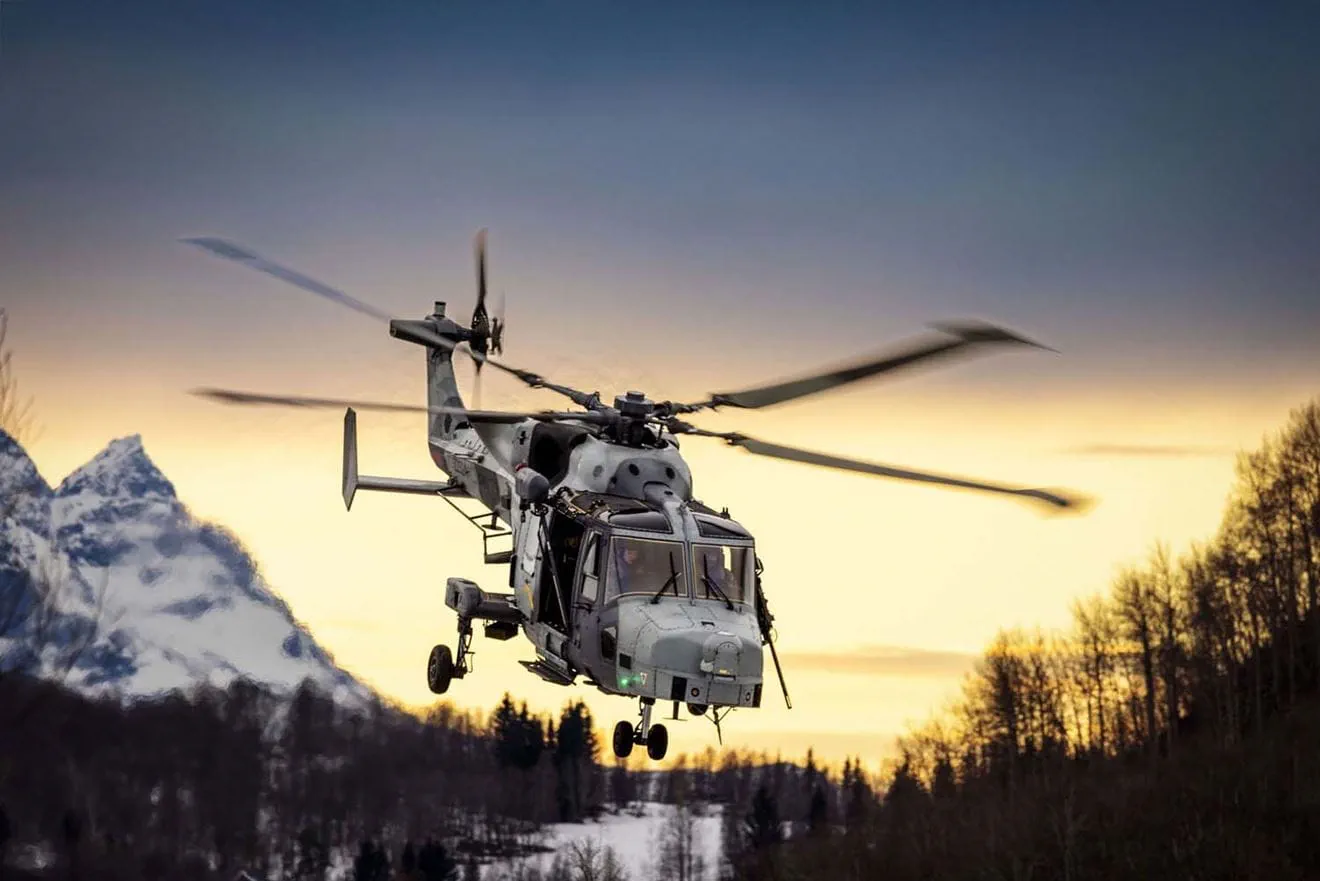
The UK has awarded Leonardo a contract worth just over £67 million to deliver the next phase of the Wildcat Tactical Data Link upgrade, the UK Defence Journal understands.
A notice, published for transparency purposes only, confirms that the Ministry of Defence has placed a Task B contract for Wildcat Tactical Data Link Phase 3 Embodiment, according to the department. The award is issued under the Joint Modification Contracting Arrangement, the framework used for rotary-wing modifications.
A redacted letter from Defence Equipment and Support to Leonardo notes that the Modification Contracting Form and annexes “describe the requirement and set out the contract terms and conditions which will take effect upon acceptance.” The contract becomes effective once countersigned by Leonardo, after which purchase orders will be issued through the MoD’s finance system.
Large sections of the annexes were withheld under FOIA exemptions, but the recorded value of the award is £67,268,592.
What Tactical Data Link does
The Tactical Data Link is a joint Army–Royal Navy effort combining Link 16 and Bowman Data to improve the speed and accuracy of battlefield information sharing. According to the Army, the integration is intended to sharpen reconnaissance and reduce the time taken to pass targeting data across units.
Fitted to the Wildcat, it is expected to increase the aircraft’s effectiveness as a scout platform by enabling near real time sharing of positional information. Colonel Oliver Stead of 1st Aviation Brigade Combat Team said the aim is to connect Wildcat directly into the Army’s digital network. “What this project is seeking to do is link a battlefield reconnaissance helicopter into the Bowman Data Network, which means we’ll be able to share digital information about the positions of the enemy,” he explained.
He added that the approach would allow a Wildcat to identify a target and transmit the data automatically. “A Wildcat will be out in a tactical position, it will identify an enemy vehicle or location, and will be able to transmit that over the Bowman network.”
Stead said the ambition is to integrate the system with artillery fire control to enable rapid prosecution of targets, and to support broader digital interoperability. “When combined with the Army’s latest Attack Helicopter, the AH-64E, it will significantly enhance the Army’s Attack Reconnaissance Teams by reducing the time it takes to pass targeting information around the battlespace.”
According to the Army, the system will reduce reliance on voice communications and give Wildcat a more efficient way to share sensor data, which officials say will make it a “more effective reconnaissance platform and give it the ability to quickly neutralise targets.”







At long, long last.
This is such an obvious must have that enhances things.
The TV mini series on T45 was embarrassing as it showed a Russian ship identified using a commercial digital SLR and bringing it back to ship to share imagery. That is the sort of kit Hardly real time digitally linked warfare.
I do wonder, in the absence of this, how an elongated kill chain was actually supposed to work?
When Nimrod was axed, wasn’t part of the bridging gap Herc crews with binos? An SLR is a serious upgrade on that!
But yeah, great news…also wonder whether it would be worth the Army Wildcats getting the radar fitted for tracking ground targets, or is the thinking that at flying low level and with topographical constraints, the range and performance of the EO/IR sensors are good enough?
Uh uh…careful…we are “world class” remember!
You forgot to state that it was a cutting edge SLR camera with world beating…..I just slightly but I was actually quite shocked that the cabs onboard camera couldn’t do that itself and send the image back realtime like us civilians so do and have been able to do for over a decade.
I thought a data link was a pretty basic fit. I understand the AAC ones do not have one at all.
The problem is the right kind of data link that connects from the right things to right things at the other end.
I am amazed that it doesn’t have one by default TBH.
It makes you realise how ludicrously expensive a lot of UK kit is that even at inflated prices the basics are not there.
Anyway it is being fixed – not before time.
Well, the Russians certainly won’t have anything better.
Not have anything g better than a decent Canon/Nikon SLR with a zoom lense?
You could that that exact rig and gyro stabilise it on a commercial rig for small change and sit in the cabin with a laptop or tablet . The software is even free to control the camera.
Getting a laptop (even a MILSPEC one) to connect to a datalink via ethernet isn’t hard.