

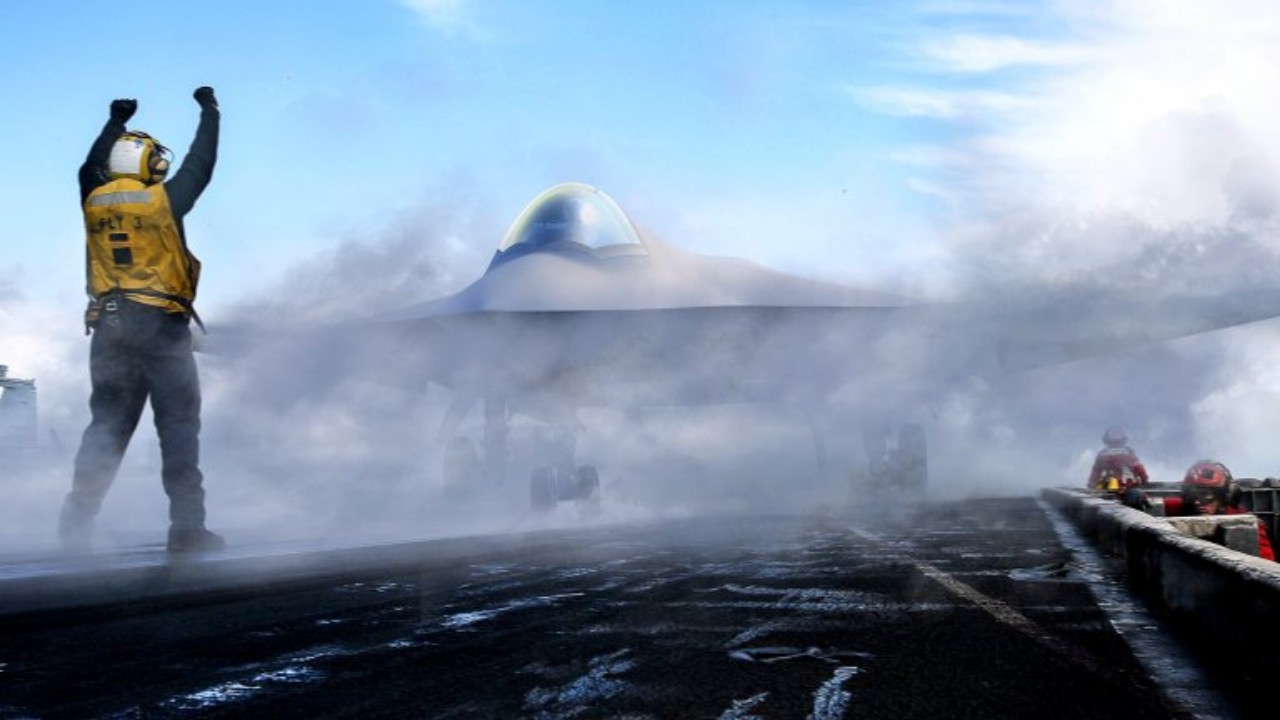
Boeing has been selected to design, build and deliver the US Navy’s F/A-XX sixth-generation fighter under a multi-billion-dollar contract, with the aircraft intended to replace the service’s F/A-18 Super Hornet fleet, according to the company.
The award gives Boeing responsibility for the Navy’s next-generation carrier-based combat aircraft and follows its selection in 2025 for the US Air Force’s F-47 programme, meaning the manufacturer is now working on two separate sixth-generation fighter programmes for the American military.
Technical and programme details surrounding F/A-XX remain classified under US national security and export regulations. Boeing said the aircraft will incorporate an open mission systems architecture, advanced mission systems and increased operational reach and capacity, although detailed performance information has not been released.
The US Navy has also released an artist’s rendering of Boeing’s F/A-XX design, describing it as the service’s planned sixth-generation replacement for the Super Hornet.
According to a company announcement, Steve Parker, president and chief executive officer of Boeing Defense, Space & Security, said: “It’s an honor to be selected to produce the Navy’s first sixth-generation platform. Backed by decades of work, bolstered by game-changing innovations and solidified by the investments we’ve made in new facilities uniquely suited to build multiple products with next generation capabilities, our dedicated and talented team is ready to execute this critical program.”
The F/A-XX programme is intended to provide the Navy with a new carrier-based fighter as its existing Super Hornet fleet approaches the later stages of its service life. The F/A-18E/F remains the principal strike fighter aboard US aircraft carriers, operating alongside the F-35C Lightning II.
Although both aircraft are carrier-capable, F/A-XX is being developed as a new generation of combat aircraft rather than a direct derivative of either existing type. The Navy has kept most details of the programme classified, including the aircraft’s final configuration and many of the systems expected to form part of it.
Boeing’s selection also gives the company two major future combat aircraft programmes running concurrently. The US Air Force selected Boeing in 2025 to develop the F-47 as part of its Next Generation Air Dominance effort.
Parker said: “Delivering two advanced fighters in parallel was always our plan, and we invested accordingly. We are ready and able to build multiple concurrent future combat aircraft franchise programs.”
Work on the two programmes is expected to draw heavily on Boeing’s facilities in St. Louis, Missouri, where the company is constructing a new secure manufacturing site for future combat aircraft production.
Boeing described the facility as the largest secure manufacturing development of its kind in the United States and said it will form part of an all-digital aerospace design and manufacturing system. The company has been expanding its infrastructure in St. Louis as it prepares for future military aircraft production.
Parker added: “Investment in facilities is just one part of the story; we’re also investing in technology and people so that we can deliver for our customers.”
The award places Boeing at the centre of both the U.S. Air Force and U.S. Navy’s next-generation fighter efforts, while the two services continue to pursue separate aircraft designed around their respective operational requirements. For the U.S. Navy, F/A-XX is planned as the eventual successor to the Super Hornet aboard its aircraft carriers, with the programme’s technical and operational details remaining classified.






It’s so stealthy it creates its own fog.
😂😂😂
That, as with the airforce version is to hide the canards as the US has so long derided such deemed ‘unnecessary’ and ‘un-stealthy’ attachments… at least when the Chinese employ them 🫣. This must be a longer term concern for Lockheed Martin (not that they were in the later stages) as they are so tied to the F35 Lightning which is already suffering blow back and will be deemed second rate once the new US fighters enter service assuming Boeing doesn’t blow it. A lot depends on whether these new designs will be sold abroad but by the time they enter service will the US be in any condition to keep them exclusive in which case F-35 will be a very tough sell by comparison even if Boeing downgrades export models, they will simply be a better functional platform based on the needs of today not the 2000s. Either way offers a great opportunity for non US designs and especially Tempest to gain momentum.
What a bunch of drivel. The anti-American drool on your chin reveals your total lack of knowledge and insight. You know absolutely nothing about the details of either the USAF or USN fighter and know nothing about fighters. Rarely has a more ignorant and stupid comment been uttered on this forum than that the F-35 will be determined to be second rate once the new fighters are deployed. The fighters are a new generation. I know that’s hard for you to understand. The USAF just ordered 22 more F-15EXs. They don’t consider them second rate even though they are two generations removed. Oh, and by the way, Tempest, if it ever gets built, is a fifth-generation fighter, already a generation late and a generation short.
You are amusing I will give you that, but anger can warp the mind. If you knew my background you might be a little embarrassed about that fact-less rant, because for 30 years plus fighter aircraft have been a central part of both my work and play. Hey disagreement is just fine, ill informed baseless insults in place of actual content are not worth reasoning with. So I will leave it there until the late thirties timeframe that clearly I was referring to comes along regarding the then prospects for the F-35 and Lockheed Martin where sources inside and outside the Company have been expressing deep concern, so much so that Trump has been strong arming customers to stick with it with well referenced mixed results. Far from being an anti American commentary (at least on this occasion) it was a concern for Lockheed Martin a company with a long proud history but with an uncertain future as things stand, that’s a rational take expressed by some analysts, so it’s a perfectly valid view. However I will leave you to rant on irrationally if you feel it helps your anger management, health takes precedence after all.
I wouldn’t worry about it, he only pops up to troll and then dissappears again Spy….
You talk some nonsense Mr Troll
To try and give a response that doesn’t resort to incandescent rage, it’s going to be an interesting few years for fighter development.
LM have done themselves a fair whack of harm with the F-35 programme. While it IS highly capable, it’s a hugely delayed and overbudget aircraft that serves as a serious warning for how not to do things.
Frankly, I can’t see the 6th gen US fighters having much initial success on the export market; the three largest export customers (by intended fleets) for the F-35 were, amusingly, the UK, Italy, and Japan, who for obvious reasons have no interest in F-47 or FA-XX. Other European allies will likely either stick with F-35 or join Tempest (or a renewed FCAS, but that remains in limbo). Canada is an observer on Tempest and the relationship with the US is at a bit of a low. The Aussies might go for it, but a workshare offer or domestic involvement for Tempest could swing them away.
You think every air force (including the USAF & USN) can afford to buy only 6th gen fighters. You’re nuts.
It’s steam from the catapults they’re going to replace EMALS with
Oh I thought Donald wanted steam powered planes. Silly me. 😂😂😂
So the guy in tbe back is shoveling in coal, how have they solved the thorny issue of reheat setting light to the coal glider towed behind it 🤔
Hoping tempest is a winner for us
F35 not good enough now then
F-35C has a top-end range of about 670 Nm. The Chinee Anti-Access bubble stretches out to 1000 Nm. Efforts to get the F-35 up to 800 Nm are underway, but it will still fall short. The MQ-25 C tanker drone can help, but a plane that can readily reach a 1000 Nm or more is really what’s needed here. When the bubble has been popped, the F-35 can come in with its shorter legs.
F35C carries over 19:000lb of fuel internally. It has plenty of legs.
That 19000 lbs of fuel carries it out to… 670 Nm. Did you even read my response. Amount of internal fuel is irrelevant. It’s how far that fuel carries you vs desired range that really matters. When the USN needs the plane to get to 1000 Nm or more—something that the USN has actually stated—then the plane doesn’t have plenty of legs.
It still has very good endurance compared to any frontline fast jet currentlyin service. And it very much depend on the mission profile. China also doesn’t have any fast jets that has that kind of range. Its why the USN has long range stand off munitions.
I’m not arguing that it doesn’t have very good endurance. Nor, is the problem China’s fast jets. The problem is China’s ‘carrier-killer’ missiles. China is trying (and somewhat succeeding) in pushing the operating area for a USN carrier away from the first island chain in the Pacific. More range gives the USN more options, including in terms of what stand-off munitions to use when.
The F/A-XX/F-47, whatever they end up calling the new jet allows the USN to penetrate the A2AD bubble and will enable the shorter-ranged F-35 to be more effective. Ie once the A2AD bubble is pierced, a shorter ranged plane with shorter-ranged/cheaper munitions can be effective.
China’s “carrier killer” missiles bring long range and high speed to the equation but they are dumb and easy to spot. The question is, can they actually hit an American carrier at 750 nm? At 1,000 nm? Given the F-35C’s 670 nm range plus the range of its stand off weapons, plus their ability to refuel from the F-18’s with buddy stores or from MQ-25’s, there is no doubt that the US can strike deep into China. The only question is, how effective will those strikes be and how quickly will China be able to actually hit an American carrier?
The answer is, nobody really knows. The ones that know the capabilities of CSG defense capabilities do not know the Chinese long range missile targeting capabilities and vice versa. Both think they have a good idea, but neither really knows.
Which is yet another good reason for the USA and China to NOT go to war.
China’s current leadership are primarily men who grew up in a time when China was not taken seriously as a world power. If you watched Chinese TV before 2005, you would see program after program about how the west attacked China and how the west does not respect China. Of late the programming has changed to laudatory programs about Chinese strengths, and less about its weaknesses. China may end up losing that sense of being wronged and substitute a more health pride in their nation.
Maybe.
It’s good enough for the present, and will be for years to come, but modern fighter development takes decades so you can’t ever stop.
Seems like a mistake putting all the US 6th gen eggs in a single Boeing basket given the companies track record. The USN has the world’s most capable carrier fighter in the F35C and it constantly treats it like the unwanted bastard step child of the F35 family.
Pouring billions into an unproven Boeing design as the F18 ages out might be a fatal mistake for the USN.
Yep! Jim, U & I, seem too C I to I these days 🙂 Giving Boeing the F-47 contract is Trump, not Pentagon, shit, Pentagon puppets are now Trump. Lets say USAF. Now they will almost certainly merge F-47 into a CATOBAR variant. This sounds familiar :/ Lets look at USAF vs. USN aircraft over the years. There is almost zero commonality and for good reasons. Runway vs. CATOBAR = Weight, Salt Air/Spray. Operational Maintenance. What did we have, A-1s (& A-7s briefly by USAF). The F-4 (but the Phantom was/and is a work oof art so made sense). Oh and the F-111, this is what the US might be looking at, another F-111A/B mess-up, (i know one was a bomber one was an interceptor). Even now the F-35C struggling with the above.
GH,
Hopefully, this does not prove to be another instance of hope triumphing over previous experience. Nightmares abound. 🤔🤞☹️
. . or Trumping over previous experience :/ Look at EMALS, removing it is pure insanity, now it is finally working.
It feels like the USN believe the F-35C wasn’t designed for them. It was designed for the USAF and adapted for them, and that’s why the don’t like it. Picking Boeing means they are leaving themselves open to the same thing happening when some finance person has a “good idea”.
The F-35 isn’t a fighter, it’s a bomb truck that does fighter as a sideline.
The USN wants a proper air superiority fighter
Do we know if LM has any future iterations of the F35A in the pipeline? Maybe a more powerful F35B with bigger (even foldable?) wing, longer range, more powerful engine and with a greater missile payload?
Block 4 will feature a ‘drop in’ engine with better fuel economy and cooling. Range will increase by ‘up to’ 25% or so, moving the F-35 C out to about 800 nautical miles and the B to 700-ish.
The US nixed a new engine in favour of current engine upgrades, but LM are lobbying for a 5G+ version of F-35 that will do 80% of an F-47s job at half the cost. The marketing spiel calls it their Nascar upgrade. I can’t see them succeeding in getting government funding just yet as their argument depends on upgrading an established production line and they can’t stabilise the current product. I think the USN are in denial about the F-47 costs, and may well return to an F-35E Super Lightning concept, as they’ve spruced up many a line before. But not for a while.
The F-35 was compromised by the B-model. The preference for both the USAF and the USN would have been for a twin-engine ‘medium’ jet closer to the F-18C/D. The B-model drove the design towards a single engine because there isn’t a good way to do STOVL with twin engines.
F-35 is fatally compromised by its huge wetted area – needed for VSTOL
Despite all the thrust in the world, it’s all in @M1.6.
Spot on, this is, whatever the merits of Boeing and Northrop Grumman designs, more likely politically driven than industrial logic. Trump can only handle one ‘Champion’ at a time after all, it’s why Musk sits next to him at dinner (despite all that previous animosity) at an ai themed lunch despite his ai business being far inferior to others, while Anthropic’s founder was at the end of the table despite it with OpenAi being the clear leaders, because Trump doesn’t reportedly like Anthropic’s attitude on Ai regulation, while apparently equally not caring enough about OpenAi to question his vanity enough over making its very name irrelevant through a self serving Presidential Order.
It seems Boeing for reasons we can only speculate upon sees Boeing as ‘his’ pick, was it they who suggested F-47 I wonder or did they massage his ego some other way, probably all it would take sadly. 🤡
I’m not sure they will.
I suspect they will share engines and avionics, but with different ( if related) fuselage designs, perhaps using a few common structures.
It depends very much if the F47 was designed with component parts having a ‘potential” USN design use I suppose.
Jim,
Exactly. Hopefully not a fateful decision, whether considered to be an idiom, aphorism or cliche. 😉🤞🤞🙄
As if you know what you are talking about. Not.
Oh dear did you leave dumb back at home.
Hi Jim,
in fairness, the F35C is severely limited in bring back loads, which is why the USN has always been cool on it (ironic as Boeing worked hard on the thick wing of the original X32 and performed multiple carrier practice landings only for USN to demand higher bring back, which necessitated the last minute redesign to a standard tail arrangement). But that goes back to the original sin of the JSF programme and the jump from experimental X-planes to production, skipping prototype development.
I would have loved to see NG get the nod, given Grumman’s proud naval aircraft heritage and Northrop’s experience in developing cutting edge designs.
But, there is logic in this decision:
1) Lockheed have their hands full with F35, and have really dropped the ball with TR3/Block 4, their NGAF design was reported to be underwhelming, leaning on F35, and for F22 they relied heavily on Boeing
2) NG and its antecedent companies haven’t produced a fast jet production aircraft in decades, and it’s been reported that there is a desire for them to concentrate on B21, possibly with a view to greatly expanding the numbers ordered, as well as any black projects they have running
3) Boeing has multiple extant fighter lines running, including the Super Hornet which is the backbone of the fleet, they were instrumental in developing the systems architecture for F22 (pun intended), they will be devloping the next gen systems for F47 so can port that across, and are working heavily in the CCA space, which will be a key part of F47 and F/AXX development, and last but not least, they have significantly invested in expanding the St Louis plant so they can crank airframes out.
That doesn’t mean there won’t be problems, but there is a risk with each of the primes, and to go with Boeing for F47 and NG for F/AXX would risk committing the cardinal sin of military planning: dispersal of effort.
The Boeing plane has already flown. The two finalists both flew secret demonstrator aircraft in the desert at Area 51. There was even a sighting of one of them by some amateur photographers sneaking onto a peak close to the base.
As to Boeing screwing up and failing to deliver… People forget that there are actually TWO Boeings. Boeing Commercial, out of Seattle, is the outfit that delivers derivatives of commercial aircraft. Ie they take an airliner and turn it into a tanker or VIP aircraft. They are the ones who are the notorious screwups. Boeing Military is what used to be McDonnell Douglas Aircraft out of St. Louis. These are the guys who helped build the F-22, built the F-35 and F-18, and continue to build the F-15.
F-47 will be fine.
While I agree F47 and F/AXX under Boeing will be as fine as a complex, high performance, multi-sensor, low observable fighter jet development project that is expected to fly further and work with autonomous aircraft can be, I think it’s harsh to say the issues Boeing has faced in the last 30 years is at Seattle’s door and the old MacAir organisation are golden, when it was MacAir execs who took over the group and stripped back the solid foundations of the Seattle company to chase the bottom dollar…
Hopefully a return to the old ways of doing business, the mindset that engendered the phrase “if it’s not a Boeing, I ain’t goin’!”, but again that might be difficult when your corporate HQ is Chicago or DC. Fingers crossed tho…
Agree that the MacAir guys clearly didn’t know a thing about commercial. After all, commercial MacAir had been in the ditch long before the merger. However, F15EX, F-18, and EA-18G have been well-run programs with relatively little going wrong, and the prototype of the plane has likely already flown based on spy-photos of planes at Area 51.
Yeah I agree, esp Boeing (and the MacAir side of the biz) has a close relationship with the USN for decades now continuously supporting and developing the F/A18 family from A to G. F/AXX needs to be a Navy fighter, Boeing understand what a Navy fighter needs to be – keeping it under the same roof as F47 will allow expertise across platforms to be shared more readily than if another prime was leading on it, without leading to compromises associated with adapting an air force plane for carrier ops (Seafire, F111B, F35C).
Despite all the US Govt/Pentagon concerns about running two 6th aircraft programmes concurrently, I think this should be less risky than two separate programmes siloed off from each other, fighting over whose software architecture should be applied, or making the Navy wait 5-10 years before starting F/AXX work…
“Seems like a mistake putting all the US 6th gen eggs in a single Boeing basket given the companies track record. The USN has the world’s most capable carrier fighter in the F35C and it constantly treats it like the unwanted bastard step child of the F35 family”
So the USN doesn’t deserve a 6th gen fighter but the RAF & USAF does? Good to know.
You mention something that has confused me for. years. 7 years after the F-35C reached IOC, there are just 3 F-35C squadrons active and flying with US carriers. In fact, there is one squadron that was deployed but now is not. The USN has around 100 F-35C’s and just 3 active, deployed squadrons. Let me see if my file listing the aircraft each squadron has for each carrier. I sort them by F-35C, F/A-18E, F or G.
CVW # of Sqdrn w/each AC type
1 AB CV-75 Truman 3 F18E, 1 F18F, 1 F18G
2 NE CV-70 Vinson 1 F35C, 2E, 1F, 1G VFA-97
3 AC CV-69 Eisenhower 1F, 1G. ? PIA?
5 NF CV-73 Washington 1 F35C, 2E, 1F, 1G VFA-147
7 AG CV-77 Bush 3E, 1F, 1G
8 AJ CV-78 Ford 3E, 1F, 1G
9 NG CV-72 Lincoln 1 F35C, 2E, 1F, 1G VMFA-314
11 NH CV-71 Roosevelt 1 F35C, 2E, 1F, 1G VFA-86
17 NA CV-68 Nimitz 3E, 1F, 1G
I am no expert, but l have never been impressed by the way Boeing handles development of new aircraft.
You never know, (half joking) if Boeing mess up, we might get orders for Tempests !!
Which new aircraft would that be??
Interesting that they do not as things stand, intend to adopt new generation adaptive engines in this fighter. A modified present GE engine is likely to be used possibly the F-110. Is simplicity and reliability (perhaps less weight too) deemed to be a priority over the prospective hyped advantages of an adaptive engine. Wonder if this supports the RR decision to go in a different direction, certainly suggests adaptive engines to many don’t represent the automatic future of military fighter engines at the very least, which some on here have with great insight perhaps questioned indeed previously. It will be interesting to see how things develop during development.
No details have been released so this is complete speculation. I personally would be amazed if both types have different engines.
Raging xenophobic remarks as usual.
Though to be fair, not dissimilar to US forums.