

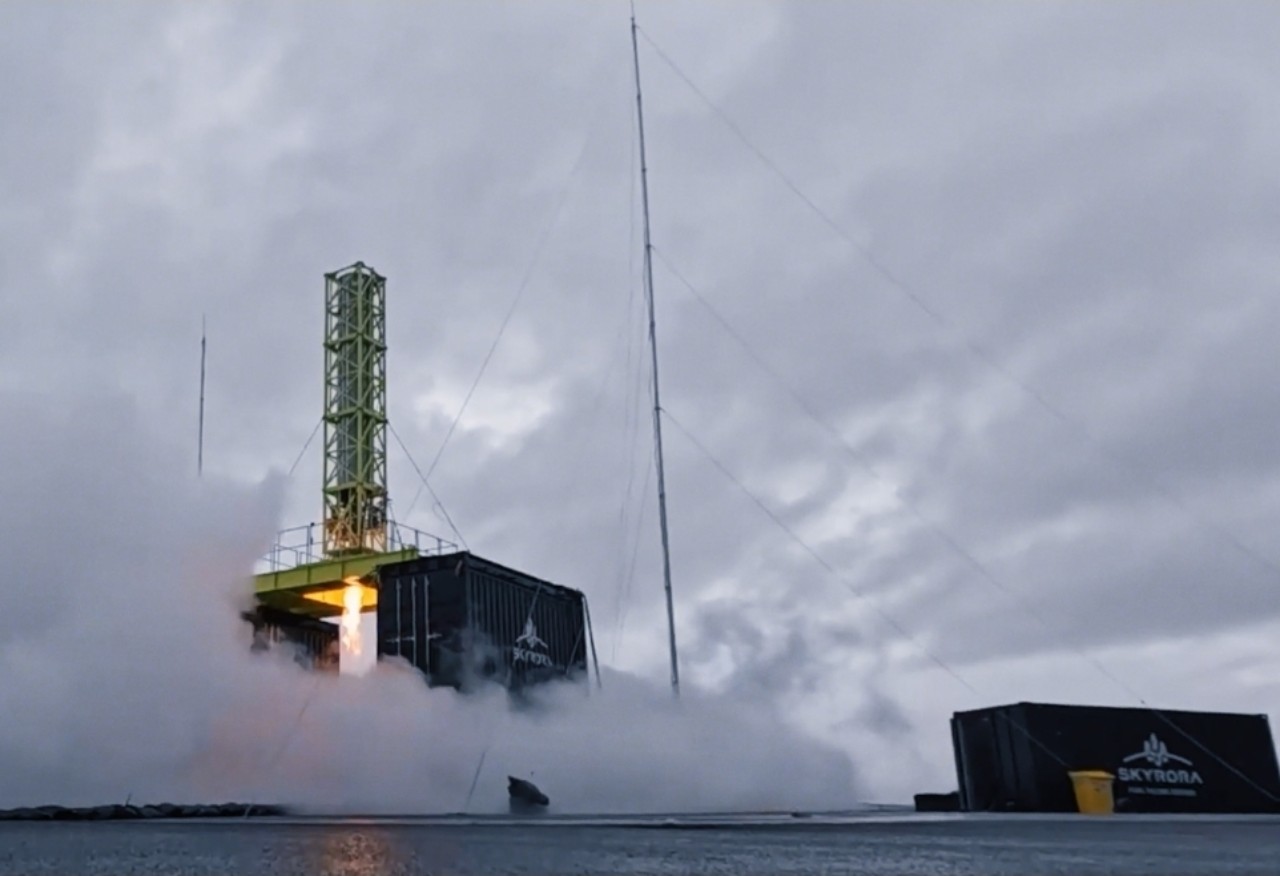
Skyrora has completed a 45-second static hot-fire test of a scaled-down version of its Skyrora XL orbital launch vehicle at Machrihanish on the west coast of Scotland, according to the company.
The test vehicle was built to validate subsystems and components similar to those intended for the full-size rocket, and the firing gathered data on the pressurisation system alongside engine characteristics including propellant flow rate and chamber pressure. According to Skyrora, initial data indicates the subsystems operated successfully throughout, and the engineering team is collating and analysing the results before conducting a second test.
Dr Jack James Marlow, the company’s chief operating officer, said: “You don’t build confidence in an orbital launch vehicle by waiting until the finished rocket is on the launchpad. You build it through thousands of decisions, measurements and tests along the way. This scaled-down XL system lets us test and validate the technology, subsystems and components together, understand how they perform and make improvements before scaling up to the full vehicle. Our approach is simple: test, learn, refine and test again, so that when Skyrora XL reaches the pad, we have confidence grounded in evidence.”
The company describes its method as testing early, testing repeatedly and testing systems together before scaling them up, on the basis that problems found at small scale are cheaper and quicker to fix than problems found late. Work will progress through larger and more demanding trials before anything is integrated into the full vehicle.
Skyrora XL is a three-stage rocket designed to carry small satellites into low Earth orbit. The company is headquartered in Scotland and designs, manufactures and tests its vehicles and engines at Cumbernauld, with a wider programme covering the Skylark L suborbital vehicle, propulsion work and additive manufacturing.
In 2025 Skyrora became the first British launch vehicle manufacturer to receive a launch operator licence from the Civil Aviation Authority, permitting a suborbital launch of Skylark L from SaxaVord Spaceport on Unst in Shetland.
Machrihanish, on the Kintyre peninsula, was a Royal Air Force station and a NATO forward operating base during the Cold War, and its runway remains among the longest in Europe. The site has since been taken into community ownership and hosts a range of engineering and aerospace tenants, Skyrora among them.
Domestic launch has been given weight in defence terms that it did not carry a decade ago. Lord Coaker told the House of Lords this week that British national security depends on freedom of action in space, including the ability to protect British and allied space assets, and that investment is going into resilience through the UK Space Strategy and the Defence Investment Plan. Sovereign launch matters to that argument because a satellite replaced quickly after being lost or degraded is worth considerably more than one that has to wait for a slot on somebody else’s rocket.










Cool as this is, I’m unclear how useful it is. Launching this far north of the equator affects orbital options in ways I don’t fully understand. Can anyone shed some light on how much use this site might be please?
Hello, space science bod here yes this will be primarily a polar and SSO – Sun synchronous orbit (similar but with a timing difference) capability. So satellites will typically orbit essentially north south. This is not an issue really, just takes different planning. A Reconnaissance satellite will just pass over a target in a different orientation than an equatorial launch. SSO is actually very useful, it means you can time the pass at particular times so as to guarantee certain lighting etc or to pass at a time that you are interested in – an unspoken interdiction and denial capability in that if an opponent knows you are looking at a particular time they have to adjust plans to your timetable.
The biggest issue is the lack of the extra ‘boost’ you get launching closer to the equator – in layman terms the high rotational speed of earth at the equator helps fling your payload.
But we have good equatorial access via NASA, ESA and even Australia and India (UKSA used an Indian launch recently) so polar launches from Scotland give us not only a sovereign capability but also something different – like anything in war the more directions you can appear from the better.
The RAF is looking at quick response launches in various capabilities so this is about to become a very interesting area and probably one of the most important things we can spend on.
Thank you, that’s an extremely helpful answer. I wondered where those stages were going to come down!
Well explained, thank you.
I second everything Paul says, the most useful orbits for military satellites are easily accessed from Shetland. Essentially having the ability to launch a rocket towards the pole with out crossing over land is what’s required and if you look at Shetland in a map you will see why it’s such a good location compared to anywhere else. We only need three or four satellites in Geo stationary orbit (Skynet for global communications) and even that will soon be replaced by LEO low earth orbit satellites ( one web) and we have a dozen good providers for GEO launch to choose from.
But for military purposes we need rapid access to polar and sun synchronous orbit launch from the UK.
Basically Polar and Sun Synchronous, but if you search you’ll get a lot more detail. If you ever visit Shetland, Saxa Vord is worth a visit, though a 2 ferry journey.
There is certainly a rush towards more northerly and southerly launch sites. Obviously RocketLab in New Zealand became the early adopter and became the launcher of choice for smaller and micro satellites. Now we have the first successful European orbital launch off of Norway, Saxavord hopefully soon to follow through RFA, and Canada is investing heavily in northern launch facilities. I think a lot of the impetus is not just freeing up from US control and bottlenecks, but the increasing importance of these orbital trajectories to defence and commercial entities, the growth of mini and micro satellites generally and very importantly the great increase in rocket and engine technology making them lighter, more efficient and capable. The whole package and marketplace makes small to medium size rockets far more useful, flexible, capable and cost efficient than in previous decades and these are the most suitable to more polar orientated launch sites and along with the indigenous capability are offering an extremely tempting option to satellite operators and constructors.
Presently the bigger picture is that business is far greater than the options for launch into orbit. The US has had a pretty disasterous 30 years trying (or not) to (re)create a reliable launch business to handle this new demand. Their most reliable option relied on ancient but reliable Russian engines in the Atlas as employed by ULA a troubled business in its own right, Vulcan Centaur and New Glenn their replacements have had troubled and much delayed development and pretty much everything relies on Musk’s Falcon 9 presently, a rocket that Musk has no intention of maintaining longer term. Starship is… well Starship with all the inevitable drawbacks it will offer most customers as replacement for Falcon, assuming it ever becomes reliable. Anyway all these options are heavy lift (or close) and the only way small satellites get on them is through ride share and the problem with ride share, though cheap, is its totally reliant upon the whims of the major customer on any given rocket (often Space X itself of course) and if that customer needs a late orbit adjustment the ride sharers are affected, delayed and perhaps even stuffed. Even Bezos has had to use Ariane, even Falcon and others to get his Kuiper satellites launched. So understandably RocketLab through Electron has gained a great deal of business particularly launching from Florida as well as New Zealand in the small satellite sector being cheap and flexible. It’s here that all these new entrants see their business model especially as RocketLab itself is moving up in scale to its new Neutron rocket which is in the Falcon range, and probably this is the maximum sort of size the new European entrants will contemplate as their long term goal, while presently looking at Electron size rockets for their forseeable futures. Once reliable I would expect some of these companies certainly, to gain profitable market share in launch, reduce launch costs and flexibility for Europe, offer quick turn around and support defence significantly while offering a strategic and nationally controlled on call capability eventually.
Launching a rocket from a far northern location like Shetland gives you direct access to polar orbits while resolving geometry, geography and safety. If you want to put a satellite into a polar or sun-synchronous orbit which is what Earth-observation, weather, and spy satellites use because they fly over the North and South poles to map the whole globe as the Earth turns, launching from a high latitude site is the most direct path. Blasting off from near the equator requires burning extra fuel to shift the rocket’s trajectory northward or southward.
The empty ocean downrange is a bonus as SaxaVord is located on the northernmost tip of the UK at Unst, Shetland. When a rocket lifts off, its flight path heads straight out over the empty waters of the Norwegian Sea and the Arctic Ocean. This means no populated areas are flown over, avoiding the need for complex, fuel-wasting “dog-leg” flight maneuvers to dodge towns and cities.
Looking forward to a full scale Skyrora XL rocket launch in early to late 2027.
Fingers crossed on that one, we truly need Skyora to succeed now, we don’t want to rely solely on German rockets with the unknown political orientation there in future years.
Absolutely right about the safer flight path from Saxavord or indeed Norway the great rival. Recently read about prospective (even present) complexities to Space X launch and landings even from Texas. As we know rocket parts have fallen or near Caribbean islands and aircraft flight paths affected. From Louisiana the new option for mass launch this could offer other risk factors too. Mostly it will be rocket landings where the true dangers lay, unlike launch trajectories for landing will be substantially over land some potentially over major cities. It will be interesting to see if Starship ever does reach the operational numbers Musk boasts of if these risks become a serious concern or operational disadvantage or not.
Just think what could have been if it wasn’t for the short sighted politicians to cancel Black Arrow.
Indeed that rocket on a shoestring budget achieved a lot in its short life, the engine very innovative too. Sadly many of those working on it (indeed some technology too) as per typical in Britain ended up in the US space programme.
the British government needs to get some cash to Sykora immediately. We can’t afford to lose our last potential launch provider like Orbex. We probably need to seriously consider buying into RFA as well, its a German company launching from Shetland but probably fairly easy to acquire. We must have a UK owned and operated launch provider now, there is no way around this anymore. This is no longer a nice to have, its a vital to our defence as BAE or Rolls Royce. It can still be a private company, but a government golden share is required. We did this with Oneweb and it was one of the smartest investments the government made recently just like with BAE and RR.
So , could it be turned into a missile if three was foresight to plan some additional offensive capabilities?
It could but it would be a pretty shitty military missile. Most modern missiles ICBM, SRBM etc are solid fuelled. You get less power with a solid fuel but you can launch then instantly and they are easy to store. Only a few monster ICBM’s (SARMAT II) in Russia are liquid fuelled, this gives them more range and carrying power by the US can see them being fuelled up for a long time before launch.
Ah thanks. I assumed these days it would be solid fuelled. Hopefully industry is working on viable options.
But what it does is give you sovereignty capabilities in multi stage orbit boosters ..
In the end this is a step towards the UK being able to develop a sovereign IRBM programme and I think it needs it, stepping of the multi stage orbital booster train was a massive loss of sovereignty capabilities ( the governments were just as shite in previous generations.. cancelling the sovereign booster program in 71 and almost all our aircraft programs in the 60s, generations of self sabotage).
We do already have the warhead orbital bus and re entry vehicle sovereign capabilities ( probably the really hard bit ) we just need to develop a sovereign capability for multi stage orbital boosters.. now yes its liquid fuelled.. by that’s how you get the capability.. moving to solid fuel boosters is not a big leap..
You turn a 1000km max apogee booster into a ballistic weapon lofter and you can hit anyone you want and the 315kg payload is well able to manage the 190-200kg weight of a uk strategic warhead.. or you just stick a conventional warhead on it.
Yes its liquid fuelled but its Ecosene and essentially you can fuel the booster and leave it fuelled for as long as you want.. infact you can use Fuelling as political tool.. a great big Fuck off or else..
A lot of the Chinese missiles are liquid fuelled the US loved their liquid fuel ICBMs and would often keep them pre fuelled. I believe they keep a Titan II missile in a fuelled state for ten years.
So no reason at all the UK could not create an IRBM with a unitary 300kg conventional/nuclear warhead.. everything is in place.
It would screw with Russias mind totally.
Yes I agree, however is suspect we will get this via our German collaboration rather than a home gown rocket company.