

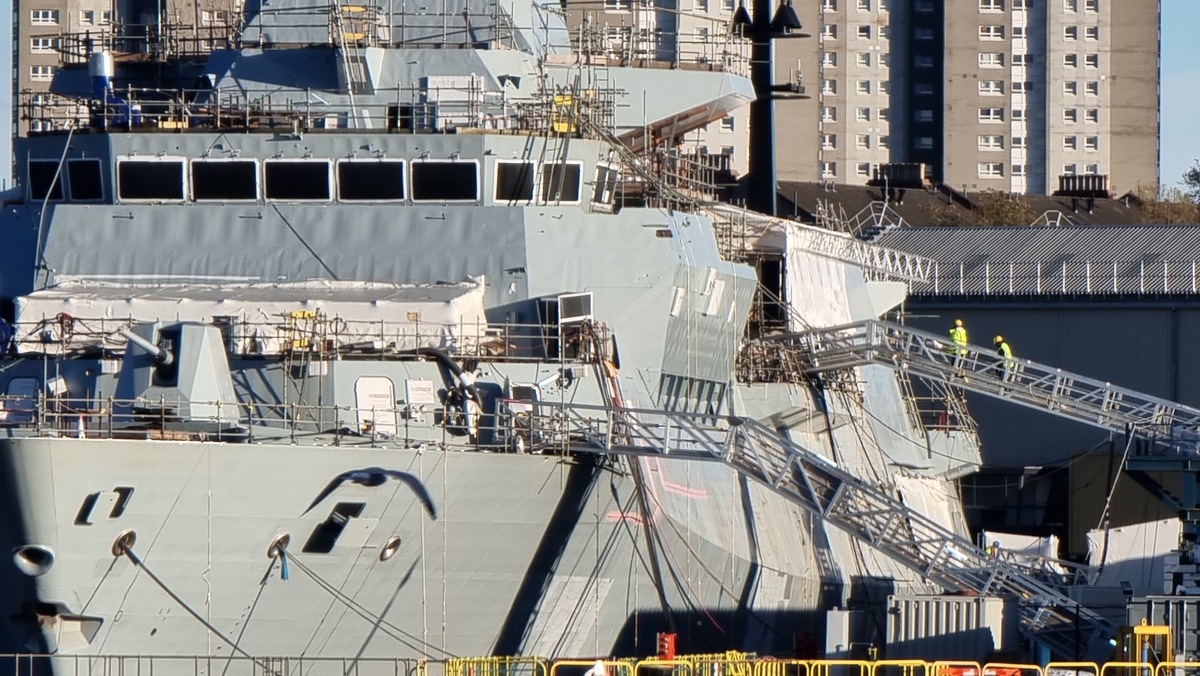
The Ministry of Defence has awarded a £12.96 million contract to STS Defence for the production and installation of Integrated UHF SATCOM and EFMTE 4.2 baseline communications equipment on the Royal Navy’s next batch of Type 26 frigates, according to the Contract Award Notice.
The seven-and-a-half-year agreement covers Ships 4 to 8, running from November 2025 to May 2033.
Defence Digital Commercial said the equipment will provide a communications service to support “Information Exchange Requirements (IER) for simultaneous voice and data”, forming part of the core communications suite for the Batch 2 vessels. A voluntary ex-ante transparency notice was issued earlier, signalling the MoD’s intention to confirm STS Defence as the supplier.
The notice explains that STS Defence and SNXP previously designed the bespoke UHF SATCOM 4.2 capability already accredited for use across the Type 26 fleet. The installation on Ship 1 was completed under a competed task, after which Ships 2 and 3 were directly awarded “for Technical Reasons pursuant to Regulation 16(1)(a)(ii) of the DSPCR 2011”. That same reasoning underpins the award for Ships 4 to 8.
According to the MoD, only STS Defence and SNXP possess “the technical ability and experience necessary to produce and install this Integrated UHF SATCOM & EFMTE 4.2 baseline equipment capability… in a manner that is accredited for use by the MoD and meets the required timescales”. The SATCOM design and accreditation process “took several years to complete”, and replacing it with an alternative design would require fresh approvals that could not be achieved within the shipbuilding programme’s schedule.
The department states that contractual timelines for delivering the capability “are already embedded within the existing Type 26 Ship Building Contract (Contract Ref. No. SHIPACQ036) as a requirement to enable repeat supply and fit”. Bringing in another supplier, the notice says, would create “significant and disproportionate additional time and cost consequences”, risk delaying each vessel’s acceptance date and “thereby causing an unacceptable capability gap to the Royal Navy”.






Up to 2033 for ship 8?
Does this indicate that the production will be rapidly speeded up and even with the Norway Order ours will still all be operational/at least fitting out by 2033/2035
Interesting. Ship 8, IF as per NL Nov 2025, operational in 2034. If Norway getting one or more of the first 8 as part of their order does this mean 9-10 T26 operational by 2034?
Might it not mean that the thirteen ships for both navies are part of this counting? So ship 8 isn’t the RN’s ship 8, but is 8 of 13.
Very good point!
And even if it is that, that’s still really good news.
On current trajectory, ship 8 will be started at the end of 2028, 6 year build takes you to 2033. That’s assuming 1 per year.
That would allow 2 Norway ships to be built in the same 2035 target for the Royal Navy which we need.
I’m really hoping BAE and increase to one every 9-10 months as that would mean the Royal Navy will get back to solid numbers sooner rather than later. Plus then the type 83 could be in service from 2040
Or ship 8 only starts production in 2033…
How much? No wonder we have no money for anything, how the hell can it possibly cost that much? It’s not like it is new difficult technology, its existing stuff. Probably won’t be any good once the jamming is up and running either.hooefully though after the Falklands someone will check we don’t need to turn off all the protection systems when we try to call home
That issue was fixed before I joined up in 1988.
Given it cost sailors and ships it should never have occured, it was penny pinching. The fact is that there can be no justification for that price tag on the systems being talked about especially as they won’t be as good as a free civilian system.
There were a lot of lessons learned in the Falklands in 82 and we always fight the last war until we learn – that’s combat. A risk almost everyone that joins up can at the very least understand.
Any kit that has an NSN (Nato Stock Number for those that don’t know) basically quadruples in price, something I learned working for Marconi back in the mid-80’s.
I can’t think of a single ‘free’ civilian system that uses high grade encryption over satellite – I know IMMARSAT cost at least £10 a minute when I used it for a trial in 2008 from a deployed frigate.
Of course a civilian system isnt going to use good encryption – the nsa wouldnt be able to spy on everyone if it did. However the standard communication 7 layer model allows you to add n encryption layer without dismantling the entire software or hardware stack. Now of course this doesnt make it magically able to cope with jamming etc. so you need to adopt a technology that is jam resistant, maybe by the simple change in requirement for civilian systems – then it cn be used for military without the need to change it and quadruple the price.
On Defence it seems we are being endlessly let down by politicians who need to get with it and fast. Can anything be done to educate the politicos of the existential threat to excess welfare and their votes if they dont get on and make things happen. Happening costs money. We cant sit around waiting beyond 2030 to reach 5% of GDP. I thought this was the NATO commitment?