

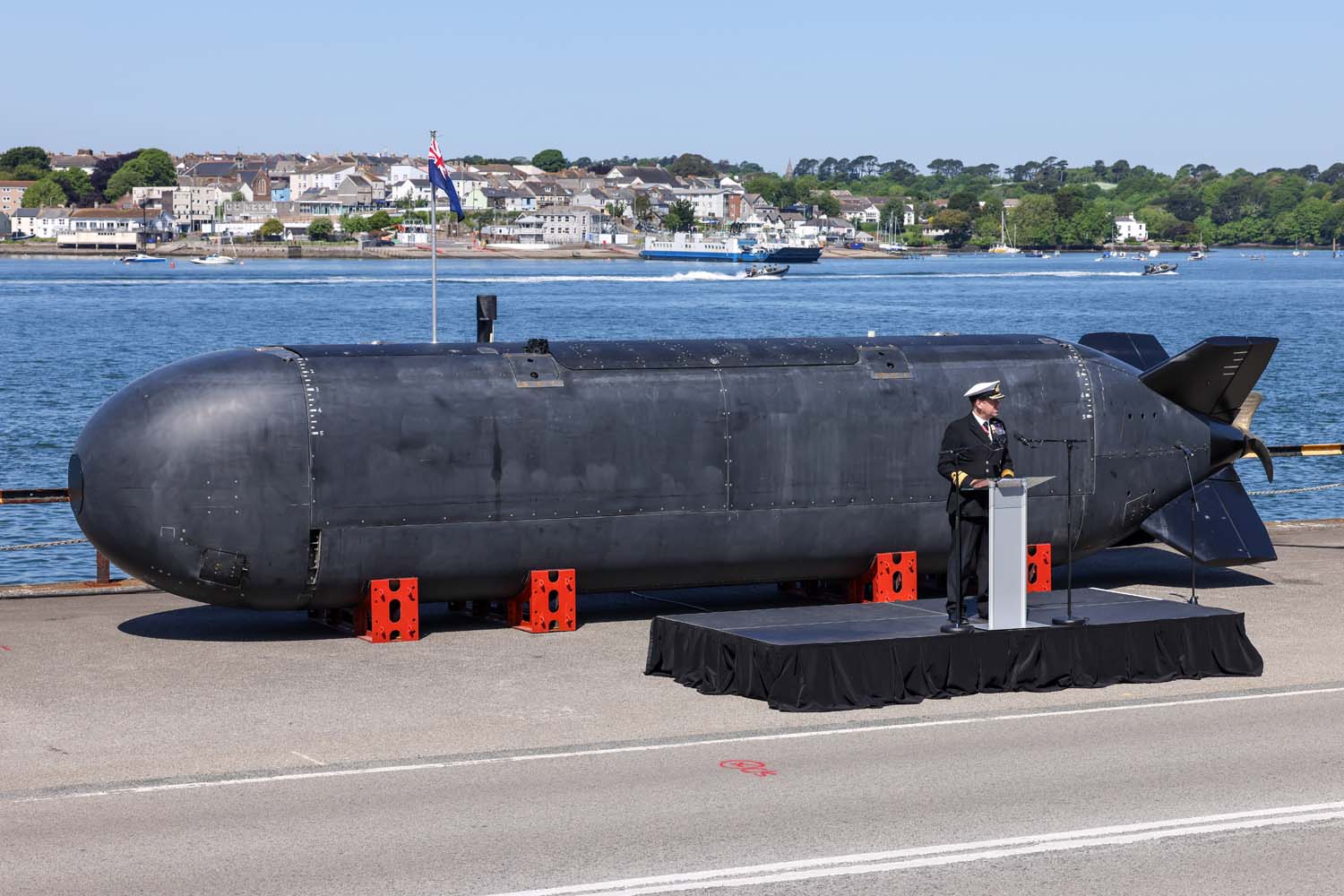
The Royal Navy has taken ownership of XV Excalibur, a 12-metre Extra-Large Uncrewed Underwater Vehicle described by the Ministry of Defence as the largest autonomous submarine ever trialled by the service.
Developed under Project Cetus by the Submarine Delivery Agency in partnership with MSubs Ltd, Excalibur displaces 19 tonnes and is intended as a testbed for both autonomy and future payloads. According to the Ministry of Defence, the project aims to build confidence in uncrewed underwater operations and help shape how such systems might complement crewed submarines in the coming years.
Excalibur was formally named in May at HMNB Devonport and will now undergo two years of sea trials. The SDA noted that it has already exceeded several of its original design specifications during acceptance testing.
Earlier milestones include its participation in Exercise Talisman Sabre in August, where the Royal Navy controlled the vessel in UK waters from a remote operating centre in Australia. The event formed part of AUKUS Pillar 2 work on advanced technologies and marked the first demonstration of UK–Australia XLUUV interoperability.
The programme also carried out a world-first trial of Infleqtion’s “Tiqker” quantum optical atomic clock on board the vessel. The SDA stated that the device offers improved long-term timing stability for navigation without reliance on external signals, supporting covert endurance. The trial took place six months ahead of schedule.
Now formally transferred to Royal Navy ownership, Excalibur will continue to be supported by the SDA’s Autonomy Unit through a test and evaluation programme designed to understand how autonomous underwater vehicles could operate alongside nuclear submarines in future force structures.








The trial took place six months ahead of schedule.Crikey,thats bloody amazing!
Perhaps showing some green shoots in defence!
I wonder how long it takes to build something like this. 2 years of testing takes you to end of 2027. Perhaps we could start seeing a fleet from 2030
It originates from a commercial design so some hope of scaling up manufacture swiftly hopefully.
My thoughts exactly,some green shoots!About time to aswell.I was wondering how much the cost per unit is.Nice piece of kit indeed!
MSubs were fast on the Manta as well.
A bit of RN Submarine trivia. HOLLAND 1 was ordered in 1900, built in Barrow, delivered in 1901 and carried out her 1st Dive in 1902. She was about 5m longer than XV Excaliber.
On another point who names a Submarine after a legendary sword that got thrown into a lake and never seen again 🤔
Probably manned after thr trials sub from the fifties. Peroxide tests then, a drone now?
The name is completely wrong, not sure what kind of meeting came up with that, no imagination or relevance.
It was a stealth sword so that’s a bonus surely.
…and designed by an American who’s hatred for Britain led him to design such a weapon. Money talks be it then or now with Americans when it comes to war and opportunities, convictions far less so.
These names arn’t “Set in stone”
“You can’t expect to wield supreme executive power just ’cause some watery tart threw a sword at you!”
Great line! Who said that?
A lawyer in the Trump Stormy Daniels case I think.
You are wasted on here at times !!!! 😁
A peasant in Monty Python Holy Grail
Not a submariner, myself, the points I raise may well be moot but, I’m wanting to understand what the RN want from such a system and are they putting it to best use? I accept this is still early days and the system is essentially a Trial system but is the testing being run by submariners, for submariners with a ‘Perisher-esk’ skillset? For example, questions like “How can this system work with and support an SSN fleet, or indeed surface fleet mid-Atlantic?” “What can we do on this system that we might otherwise do on an SSN?” “Are there green shoots here as far as enhancing SSN fleet capabilities and mass?” Perhaps because of its specification, is it more suited to a littoral environment/12 NM sovereign waters?
All good questions, after initial trials as proof of physical concept I can only presume these new trials, under the auspices of the Navy may well be aimed at answering some of them before freezing the design and a manufacturing commitment. All new and ideas will no doubt be subject to change in more realistic circumstances.
Not a submariner myself either, DP but I’m sure those Navy bods have done their sums. What impresses me is how it can be controlled in UK waters, from Australia. Now, these days an uplink/downlink from Oz to UK is not a problem – happens all the time. But what about the ‘last mile’? How do the control signals get to the vessel when it’s mid-Atlantic and xMtrs below the surface?
DEEP – any ideas?
Telepathy.
Hadn’t thought of that… didn’t get the message…
There’s a time delay.
Well, years ago I was aware they used VLF radio, for sub comms. It was the only thing capable of doing nap-of-the-earth stuff and long range but, even at very low freq, I’m not too sure how deep the signal would penetrate beneath the waves. So, satcomms Oz to UK and then, maybe, VLF from wherever in the UK. We’re only talking control signalling so low data rate and therefore bandwidth, so feasible. Not sure how many VLF stations there are nowadays though and how robust (secure) that method is.
No rush lads, only another 2yrs of trials…..
It’s a drone. Just shove it in the water. Why the pompous ceremony? Are they going to pipe the crew of nobody on board.
This is the first positive news for a longtime. Let’s hope the MOD, Navy, or the government stuff it up.
The question is do they really need 2 years of trails.. we learn by iteration and doing..maybe it’s better to just deploy a couple and see what happens if they work buy more and deploy more.. iterating using real world experience.