

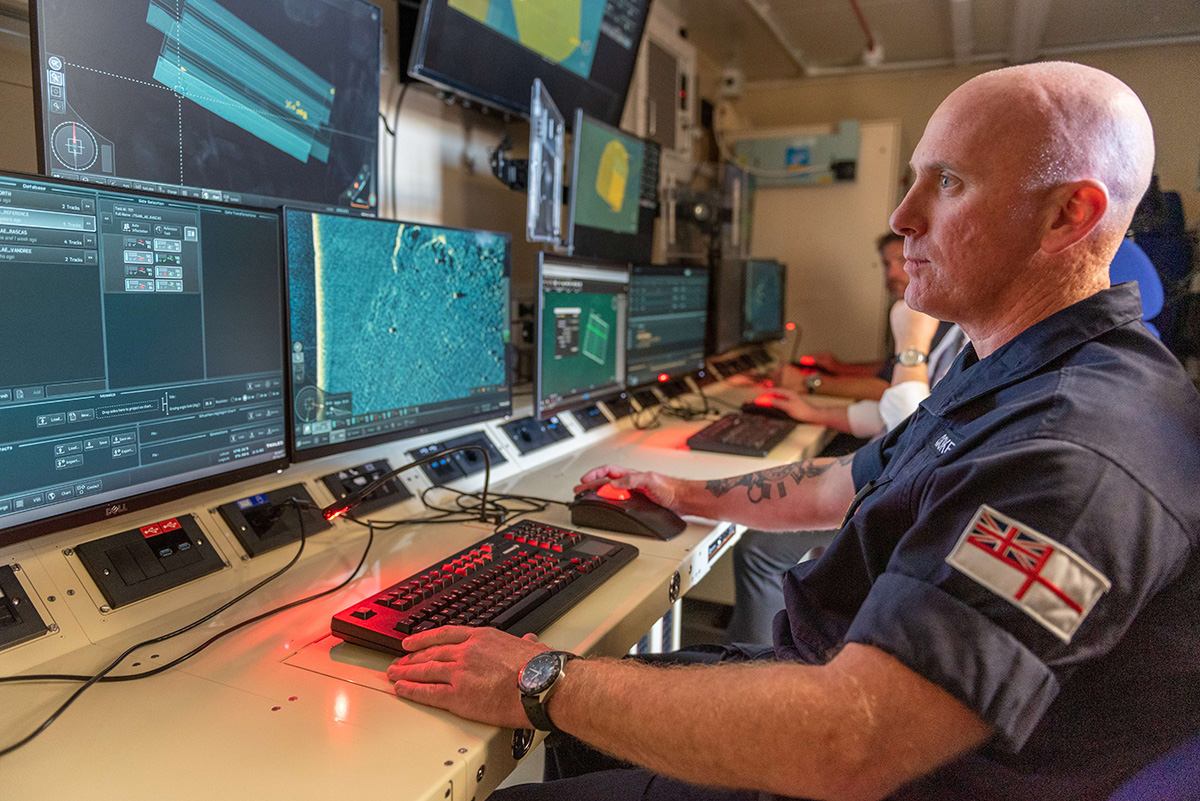
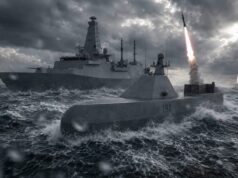
Thales has secured a contract to design and deliver a new generation of autonomous Remote Command Centres for the Royal Navy, a move intended to accelerate the shift away from crewed minehunters and embed artificial intelligence at the core of future mine countermeasures.
Awarded by Defence Equipment and Support, the initial £10 million phase is structured to expand to around £100 million as capability matures, forming part of the Government’s transition to a Hybrid Navy.
The programme aims to overhaul how the UK identifies and neutralises sea mines by coordinating uncrewed assets from compact, containerised control hubs hosted on ships, bases or shore facilities. Thales positions the capability as the centrepiece of a system of systems approach in which unmanned surface vessels, autonomous underwater vehicles and sensor packages are integrated through a common operating picture rather than separate platforms and software seams. Operators are expected to control and monitor multiple assets across domains from a single suite rather than fragmented consoles.
At the heart of the system is the M-Cube mission management suite, already fielded by a number of allied navies. It underpins planning, tasking and evaluation for both autonomous and conventional mine clearance. The Royal Navy configuration pairs M-Cube with Mi-Map, an AI-enabled analysis tool designed to compress workloads by filtering and classifying data from underwater sensors at speed. Mi-Map uses machine learning to refine automatic target recognition with repeated operational use, with Thales arguing that it processes sensor inputs at a scale beyond human capacity.
That AI stack is supported by cortAIx, Thales’s in-house accelerator drawing on a reported 800 specialists in critical-system AI, cyber and advanced sensing. The group says cortAIx is intended to shorten the pathway between research, prototyping and deployable capability by embedding iterative updates rather than waiting for multi-year refresh cycles. This reflects the Ministry of Defence’s use of spiral acquisition to field baseline functions early, then add features and integrations as technology and feedback dictate.
The hardware is delivered as twin modular containers to start, with expansion options from shipboard installations to larger operations centres. Thales highlights the ability to detach personnel from the point of threat: remote hubs allow missions to continue with sailors physically removed from mined waters, maintaining naval presence without exposing crews to explosive hazards. The company argues this directly addresses increased risk to maritime infrastructure and choke points, which have become more contested as state and non-state actors target seabed infrastructure and shipping routes.
Paul Armstrong, Managing Director for Underwater Systems at Thales UK, said: Thales is honoured to continue its central role in delivering mine countermeasures capability to the Royal Navy, building on our proven heritage. This next-generation of autonomous command centres is part of a flexible suite of autonomous C2 from containerised solutions to vessel operations centres or large, shore operations centres. By collaborating across the supply chain, we are committed to supporting the UK with world-class technology and fostering growth and high-value skilled jobs across our UK operations.
Luke Pollard, Minister for Defence Readiness and Industry, framed the deal as both a capability and economic decision. By embracing autonomous maritime technology, the Royal Navy is pioneering innovation to help keep our sailors safe at sea. This is backed by a UK defence industry delivering world-class capabilities that exemplify how defence acts as an engine for growth.
The wider threat environment cited by the Ministry of Defence includes Russian activity around undersea infrastructure, increased proximity operations in the North Atlantic and the need to keep vital commercial routes open under pressure. The remote centres are described as a tool for preserving freedom of navigation without relying on legacy hulls that are increasingly expensive to crew and maintain.
Thales states that the work will support over 200 skilled roles at sites in Somerset and Plymouth, in addition to a supply chain of UK companies involved in autonomy, sensors, secure communications and containerised systems.




How many?
When?
Where?
What assets do they use?
Its not good to let Johnny Foreigner dominate our early efforts to go AI autonomous is it? Its becoming the same with nearly all small ships and boats. Buy foreign.
Call me old fashioned patriotic but we should be capable of doing this for oursleves. We could do this until nearly all the small boatyards were sold off to retirement Flats. Why doesn’t the Navy try working with small boat owners and suggest standard hull dimensions, fit out spaces, equipment that might come in handy for the navy in times of war. Ribs and other boats. We likely still have the skills.
For instance my 37 ft wooden launch was taken up in 3/1941-44 as the mine/ ordinance hunter for the River Clyde just days before the Clydeside Blitz! Historic and probably one of the first.
Nothing wrong with old fashioned patriotic.
That’s impressive, Jonno? How did you end up owning it?