

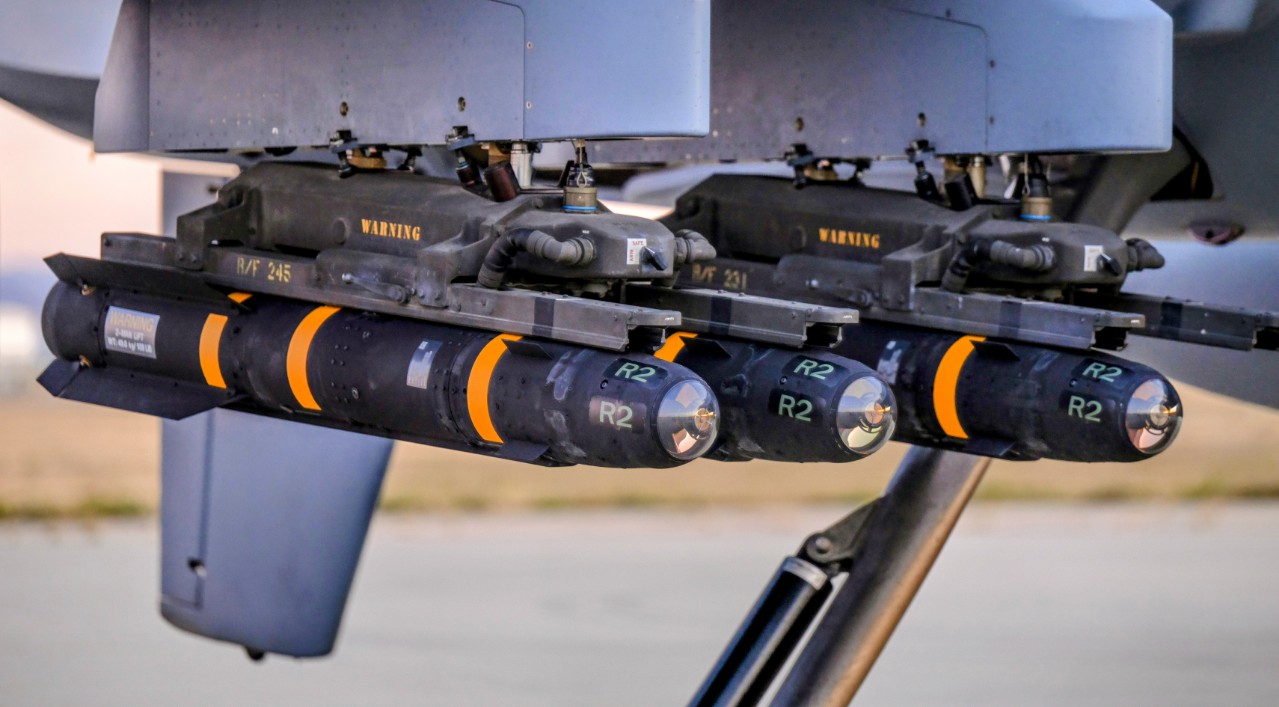
The United States has approved a possible Foreign Military Sale to Denmark of AGM-114R Hellfire missiles and related equipment, with an estimated value of $45 million, according to a notice issued by the Defense Security Cooperation Agency.
In the notification to Congress, the State Department said Denmark has requested “up to one hundred (100) AGM-114R Hellfire Missiles; three (3) AGM-114R Captive Air Test Missiles; six (6) Hellfire (Longbow) M299 Hellfire Launchers; two (2) MHU-191/M trailers; and three (3) BRU-14’s”. The proposed sale also includes non-major defence equipment such as “containers, training aids, weapon software, training, support equipment, spare and repair parts, publications and technical documentation, transportation; U.S. Government and contractor engineering, technical and logistical support services”.
According to the State Department, the package is intended to support U.S. foreign policy and national security objectives “by improving the security of a NATO ally that is a force for political stability and economic progress in Europe”. The notice adds that the sale would enhance Denmark’s ability to meet current and future threats while ensuring interoperability with U.S. and allied forces.
The agency said the proposed transfer would “not alter the basic military balance in the region” and that Denmark would have “no difficulty absorbing these articles and services into its armed forces”. It also stated there would be “no adverse impact on U.S. defense readiness” as a result of the sale.
Lockheed Martin Missile and Defense, based in Ocala, Florida, has been identified as the principal contractor. The DSCA noted that it is “not aware of any offset agreement proposed in connection with this potential sale” and that no additional U.S. government or contractor personnel would be required to deploy to Denmark to support the programme.
As with all such notifications, the quantities and cost represent the maximum potential scope of the deal. The DSCA said the “actual dollar value will be lower depending on final requirements, budget authority, and signed sales agreement(s), if and when concluded”.








Make up your mind Denmark, come on.
I wish they would make up their mind – and order Type 31’s 😁
They need a couple of 212 type submarines, something that could really threaten a USN CBG.
Its still early Jan. Be nice if the UK would order a few more T31s too…beef up the fleet a bit.
👍
The order was was expected to be announced when Starmer visited Denmark last October, but a few days before that the Danish government deferred a decision because a local industrial consortium suddenly emerged that claimed that it could build the frigates for the same price as Babcock could at Rosyth. Further confusion was added when Germany offered Denmark a share in the F-127 programme, a far more capable but far more expensive platform than the T31 – but this seems to have been ruled out because the design incorporates many American systems and the delivery timescale is unacceptable. A Danish announcement is now expected in March. How soon the first ships can be delivered has suddenly become the deciding factor – will the MOD and RN agree to say Active and Bulldog being sold to the Danish navy, or will Naval Group (France) or Fincantieri (Italy) yet snatch victory from almost certain defeat?
A few months ago, the Danish parliament approved the purchase of 16 additional F-35 fighter jets, expanding their planned fleet from 27 to 43 aircraft — and they’re currently trying to speed up the process with the international F-35 programme office.
So they really don’t seem too concerned… 😬
“The spice must flow”
Given the current circumstances you’d think Brimstone would be a more secure choice.
Well the Ukrainians use T72’s on Russians, so why not.
I’ve been looking into US interest in Greenland recently to see how far it goes back. There’s obviously more to it than this, but here’s my summary in case anyone is interested. Feel free to challenge anything or add your own points.
The United States’ interest in Greenland has a long history rooted in strategy. It dates back to the mid-19th century, when the US was expanding territorially and consolidating its position in the North Atlantic. After purchasing Alaska from Russia in 1867, policymakers briefly explored acquiring other Arctic territories. In 1868, the State Department even commissioned a report on the potential purchase of Greenland and Iceland from Denmark, motivated by trade routes, fisheries, whaling, and strategic positioning. Although nothing came of it, Greenland became recognized as a long-term American interest.
Greenland’s strategic importance became more concrete during the Second World War. When Nazi Germany occupied Denmark in 1940, Greenland was exposed and vulnerable. The United States stepped in to prevent German access, negotiating with Danish officials in exile. During the war, the US built airfields, weather stations, and other infrastructure, effectively assuming responsibility for Greenland’s defence. This embedded the island firmly in American thinking about North Atlantic security.
In 1946, as the Cold War emerged, the United States formally offered Denmark 100 million dollars ($1.6 billion in today’s money) to purchase Greenland. The island’s location was ideal for strategic bomber routes, early warning systems, and defence against the Soviet Union. Denmark rejected the offer, but the US retained a permanent military presence, establishing Thule Air Base (now Pituffik Space Base) between 1951 and 1953. The base became a key element of NATO defence planning and a hub for strategic nuclear bomber routes and early-warning radar, highlighting Greenland’s centrality to North American and European security.
Throughout the Cold War, Greenland remained a cornerstone of American and NATO strategy. During this period, Greenland’s political landscape evolved with home rule granted by Denmark in 1979, giving it greater autonomy and a stronger voice in international affairs. It hosted radar installations, early warning systems, and airfields linked to the DEW Line (Distant Early Warning Line) — a network of Arctic radar stations across Canada, Alaska, Greenland, and Iceland. These stations were designed to detect incoming Soviet bombers or missiles and provide early warning for North American defence. Denmark tolerated extensive US activity because it lacked the capacity to defend Greenland independently and because NATO interests aligned with American objectives. Greenland also served as a strategic Arctic buffer, controlling key North Atlantic air and sea routes.
After the Cold War, US attention waned but never disappeared. Thule continued operating as a missile warning and space surveillance site. Interest in Greenland revived in the 2000s and 2010s, driven by missile defence upgrades, the opening of new Arctic shipping routes due to ice melt, and the prospect of rare earth mineral exploration, all of which increased US strategic focus. Russian and Chinese activity in the Arctic further highlighted Greenland’s geopolitical significance.
I’ll stop here because everyone knows the rest.
I also read somewhere that if the Danes ever put it up for sale we’d have first refusal?!
Yes, good read.
Haven’t heard that one. Greenland is part of the Kingdom of Denmark, but it has self-rule and substantial autonomy under the 2009 Self-Government Act. This means Denmark cannot unilaterally sell the island.
Any decision to sell or transfer sovereignty would require approval from the Greenlandic government and, in practice, would likely involve a referendum so the people of Greenland could vote on such a major decision (self-determination, international law).
Greenlanders obviously don’t want to become part of the US, and many see full independence from Denmark as a long-term goal. At present, Greenland remains financially dependent on Denmark, so full independence isn’t yet feasible. The government is essentially waiting until it has the economic capacity to break away
But let’s see how it all unfolds.
You left out possibly the most important bit in your timeline. The Treaty of the Danish West Indies. In which the United States formally accepted the Danish right to control Greenland. Ratified by the senate, still in force today.
Interestingly Trump has in a press conference today turned around and essentially stated they can either buy it or they will take it but they are having it… looks like he’s willing to lose NATO and Europe as allies to gain sovereignty over Greenland.. let’s be clear this has nothing to do with defence as the US has basing rights to in essence put whatever troops they want their.. this is about resource exploitation.
He might have to climb over Canada to get to Greenland! We’ll see how that pans out. What a deranged twat. Who’s side is he on? Just Himself!? UK, Europe and Canada are going to have to stand up more to these “land and resources grabbers” to the left and to the right.
Trump is on his own side.
He intends to enrich himself personally, at whatever cost in blood and treasure others or the USA pay.
I think we will see the testing of the US constitutional constructs.. I f don’t know if they will fail, in theory Trump could not just invade and decapitate a South American nation without congressional permission, but he did it anyway… essentially to do what he did he has already broken its process.
Are we missing something though ? Wouldn’t the US Congress/ Senate need to get involved to ratify any potential annexation or similar? I don’t think there is much appetite in US legislative assemblies for the de facto attack on an ally and the destruction of a transatlantic alliance based on the whim of a corrupt convicted felon and Russian asset. Purchasing the island would likely run into multiple billions, that they actually don’t have.
I think we will see the testing of the US constitutional constructs.. I f don’t know if they will fail, in theory Trump could not just invade and decapitate a South American nation without congressional permission, but he did it anyway… essentially to do what he did he has already broken its process.
That’s true , although ‘limited ‘military action has always seemed to lie within the ambit of US presidents. However, I think the annexation or subsuming of another nation is a different thing altogether that will require new laws and legislation to work, and I cannot see that happening. He could still declare that the US now ‘owns’ Greenland without even landing troops, , but the Gulf of America is still the Gulf of Mexico despite what Trump and maga declare to the contrary .
It’s defensive actions.. essentially the US President has the ability to undertake military action to defend against an imminent attack on the U.S.. so he can but a tomahawk into a terrorist cell if they are an imminent threat to the U.S.. he cannot engage in offensive actions.
Perhaps, given his antipathy towards NATO, threatening Greenland serves a number of purposes, he doesn’t need Congress to approve the withdrawal from NATO, and he gets to do the bidding of his Russian puppetmaster in fracturing the alliance.
Trump is only going to be around for a certain amount of time ( but can cause loads of damage in that time) it seems his meeting with the oil companies today,didnt go too well when they found they would be footing the entire bill for rebuilding Venezuela oil industry and had to right off there prior claims for compensation for the assets that were nationalised
They’ve already been compensated for their losses due to the nationalisation of their assets, as they were able to declare them as tax write-offs.
Guess the Danes can fire them straight back at the Spams
Question is whether they’ll be delivered in time for the defence of Iceland… I suspect Trump wants control of Greenland in time for the 250th celebrations on July 4th.
Greenland… 🤦🏻♂️
2026 and can’t edit comments FFS
I would think no chance of that at all. The RN must already be well over budget, due primarily to having to pay for two classes of new escorts at the same time, the inevitable and long-delayed legacy of squeezing £7bn of carriers into the budget previously.
Whatever is left in the budget for the 10 years ahead should just about manage to pay for the 3 FSS, 3 Castle MCMVs, second Proteus and maybe, at a stretch, a replacement for HMS Scott and the first of the MRSS. Or maybe not.
The RN is awash with expensive ideas, from this mighty Atlantic Bastion jigsaw to UAVs for the carriers, to NSMs, Dragonfires and the rest. Where is all the money to come from, the RN can’t just grab all the new money in the budget, there’s dozens of other critical things to be paid for.
The service staffs must get very tired of this constant chant for more warships, when all know there is no spare money to pay for them and the RAF and Army, in particular, desperately need regeneration and the many equipment gaps filled.
Above was a response to Quentin’s call for more T31s…