

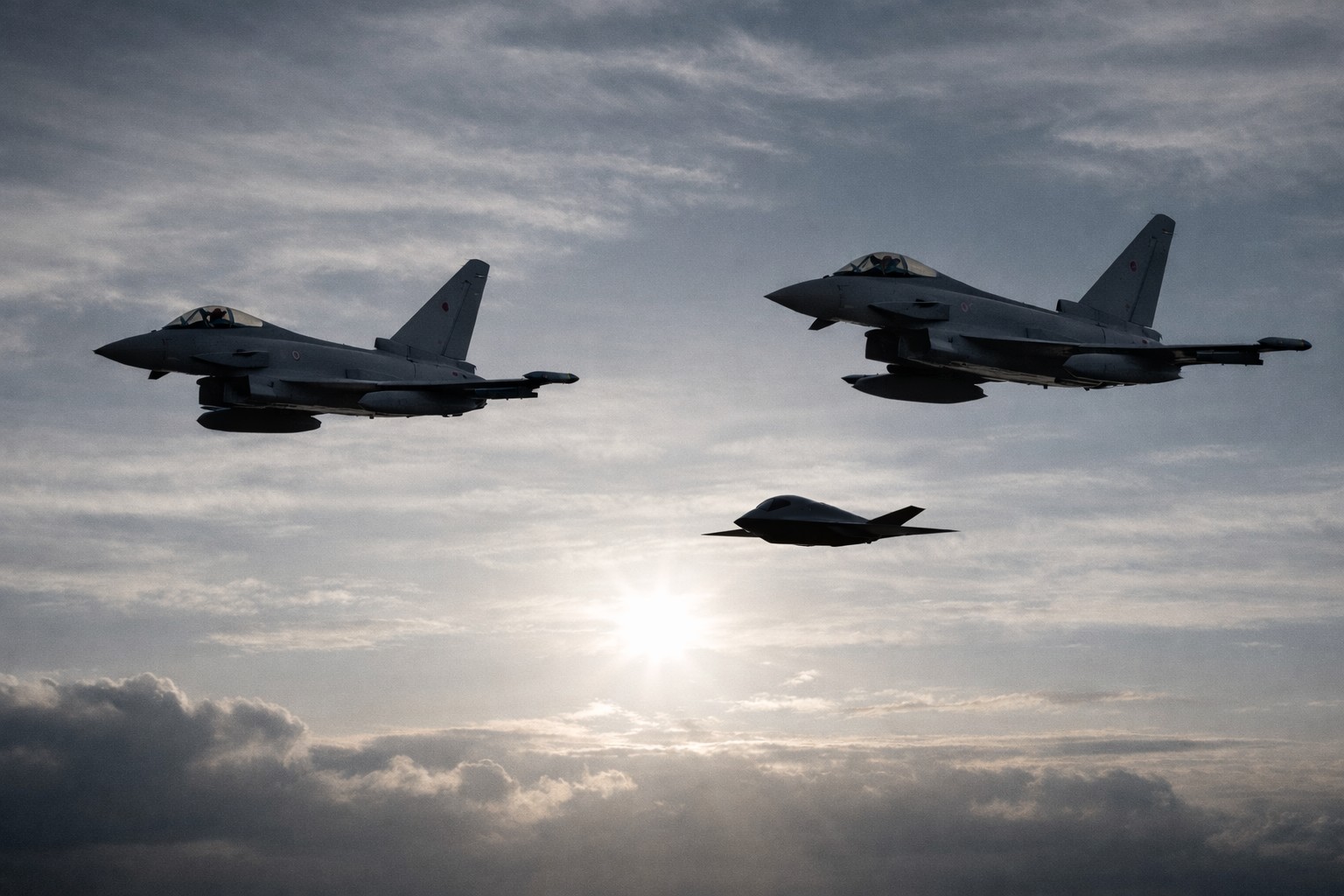
The Ministry of Defence has declined to disclose details on the weapons, naming or timelines associated with a planned air-launched collaborative uncrewed air vehicle, citing commercial sensitivity and security concerns.
Responding to a series of written questions from Conservative MP James Cartlidge, defence minister Luke Pollard confirmed that work on the capability is ongoing but said further specifics could not be made public. The questions followed a Ministry of Defence announcement in December outlining a £140 million investment boost for drone and counter-drone technologies through the newly formed UK Defence Innovation body.
Pollard said that “the RAF’s Rapid Capability Office are working with industry partners and allies on key underpinning technologies that support the development of Autonomous Collaborative Platforms”. He did not confirm what weapon system the air-launched uncrewed platform would carry, nor did he provide a programme name or designation.
On timelines, Pollard said that “the timeline to fielding frontline capability is subject to a range of factors, several of which are dependent on the Defence Investment Plan”. He added that further detail was being withheld because disclosure “would prejudice commercial interests and also would prejudice the capability, effectiveness, or security of the Armed Forces”.
The same response was repeated across multiple questions relating to armament, naming and programme identity, indicating that the department is maintaining a consistent position on information release as development work continues.
The collaborative uncrewed air vehicle concept forms part of the RAF’s broader move toward autonomous and crewed-uncrewed teaming, often referred to as Autonomous Collaborative Platforms. While the MOD has previously signalled intent to pursue such systems at pace, the latest parliamentary answers suggest that key decisions on configuration and capability remain subject to funding and programme maturity.







“work is ongoing” says Pollard or I haven’t got a clue….The Rapid Capabilty Office will be reporting in the next five or ten years, perhaps!
Translation: we have nothing under wraps – it’s all still powerpoint
When Labour came in they vowed greater transparency. They hsve since clammed up tighter than a ducks arse on a whole range of equipment and NATO releases that previously were commonplace.
I suggest, all by design, another attempt at avoiding scrutiny as force numbers continue to collapse while the rhetoric increases.
Another historical reason for avoiding such questions is covering MoD incompetence and failure.
Would be great if a full plan was presented to Parliament regularly and approved by all parties so MoD had a foundation to work with.
Of course, there’s more chance of Putin repenting than that.
£60,000,000,000 spent in 24/25 yet now we hear of a £28,000,000,000 hole despite the previous amount being £19,000,000,000 and many Billions thrown in the hole to fill it.
Feck me, It’s worse than our Pot Holed festooned roads.
I’m Grumpy today.
You notice how there is always a black hole and it’s always around £30 billion.
It’s a self licking lollipop.
I have no idea how UK defence reporting to government is conducted but in Australia the National Security Committee (NSC) is chaired by the PM and has a two stage approval ‘gate’ system with First Pass approval to proceed to design and tendering and Second Pass approval (commitment gate) that includes financial and sustainment plans. Plus ADF reports progress to NSC including managing’projects of concern’ while ADF top brass have to front the annual Senate Estimates committee for public hearings.
Does the HMG not have a similar requirement to report to the UK parliament??
There is the Parliament DSC Defence Select Committee that is supposed to have oversight, but MoD usually gag officers from being fully truthful when they have evidence sessions. HMG tell Parliament what they want to tell them, which isn’t much.
Out of interest, if sat comms were taken out as i presume that’s how they would communicate wouldn’t this render this stuff unoperable?
Assume the answer is in the ‘autonomous’ part of the title. Unlike a Reaper which requires a ground controller and secure satellite link they should be able to fly a mission profile using AI without direct control by operators on the ground or in the air.
The RAAF’s Ghost Bat for example can either be teamed with and controlled by airborne platforms (so far the E7 Wedgtail and Super Hornet and soon F35A) or it can fly an autonomous mission profile and adapt to threats.
Given the potential for technological cooperation under AUKUS (Pillar 2) I don’t quite understand why the UK isn’t leveraging the work already conducted for the Ghost Bat – it’s already flying, has a range of ISR and sensor payloads in development and testing and was the second drone in the world with a confirmed BVR air to air kill.
While the UK project risks becoming ‘vapourware’ the RAAF is already developing Block II and building a factory for LRIP production.
Agreed.
Absolutely agree, the UK should just get on board with Ghost bat, but the won’t, the MoD will hypothesise and bluster and order the square route of fu#k all…
Considering the black hole in defence spending, zero chance of a significant spending increase this parliament, the gagging order on the Defence spending plan and the talk of ‘hard decisions ‘ 🤔 What will they do??????
What on earth is actually left to cut?
The report above calls this project a planned ‘air launched uncrewed collaborative air vehicle’ but air launched from what exactly in RAF inventory.
If it’s a fighter aircraft we are talking about very small drone and that raises questions about its range, capability and recoverability (is expendable or can it RTB?). What is the difference between this platform and a conventional cruise missile.
If it’s a bigger platform it could be dropped out of the back of a C17 or A400 similar to the USAF Rapid Dragon palletised system but even then we are not talking anything of the size of something like a Ghost Bat.
Either way questions remain about it’s utility as a collaborative ‘loyal wingman’ combat platform.
Yes, I noted that too.
I’m waiting for the “World leading” bit from HMG too.
Our Atlas and C17 are also in short supply.
They don’t have a plan, simple as that.
Or they have a plan and no budget.
Given we’re massively under resourced we appear to be and with such a large risk of funding a project that ends up orphaned due to budget constraints I think we need to give up on blue sky projects like this right now until their utility is clear and focus on trying to get the forces that are are supposed to be able to deploy and the ones already in production properly funded and in many cases maintained / made ready to fight.
It looks to me, and I’d love to be wrong, that we’re not putting in enough resources to make anything ground breaking, that no one really seems to know what an effective drone for any fight we may enter might look like and there’s a lot of money pits out there right now that probably won’t yeild fruit.
Our reality as a nation is that the navy is practically unable to fight a significant opponent, the RAF is hugely under resourced with aircraft across the board, from front line to AEW, tankers and heavy lift and I would argue of less significance to an island nation the army would be expected to fight with patchy amounts of really old kit if it mobilised today.
There’s going to be no fancy drone only war any time soon so if you can’t get the basics right your toast.
Kurt remains out for me as to the cost effectiveness of large unmanned platforms, the “man” seems to be a small component of these as far as I can tell and many including myself would argue that Ukraine has only really descended into a drone war due to the inability of either side to impose overwhelming force on the other.
Given our procurement history, and our proclivity for super-expensive equipment, it’s easy to imagine this money buying like 5 or 10 drones when Russia (for example) could buy an entire air wing of them for that money.
I’m not arguing that we should buy crap, but our likely adversaries are buying huge quantities of wargear and it seems like we simply dabble in buying little bits here, little bits there.
The £ might offer way more purchasing power than the ruble, but if our stuff costs ten times more than theirs then our purchasing power is suddenly a lot lower.