

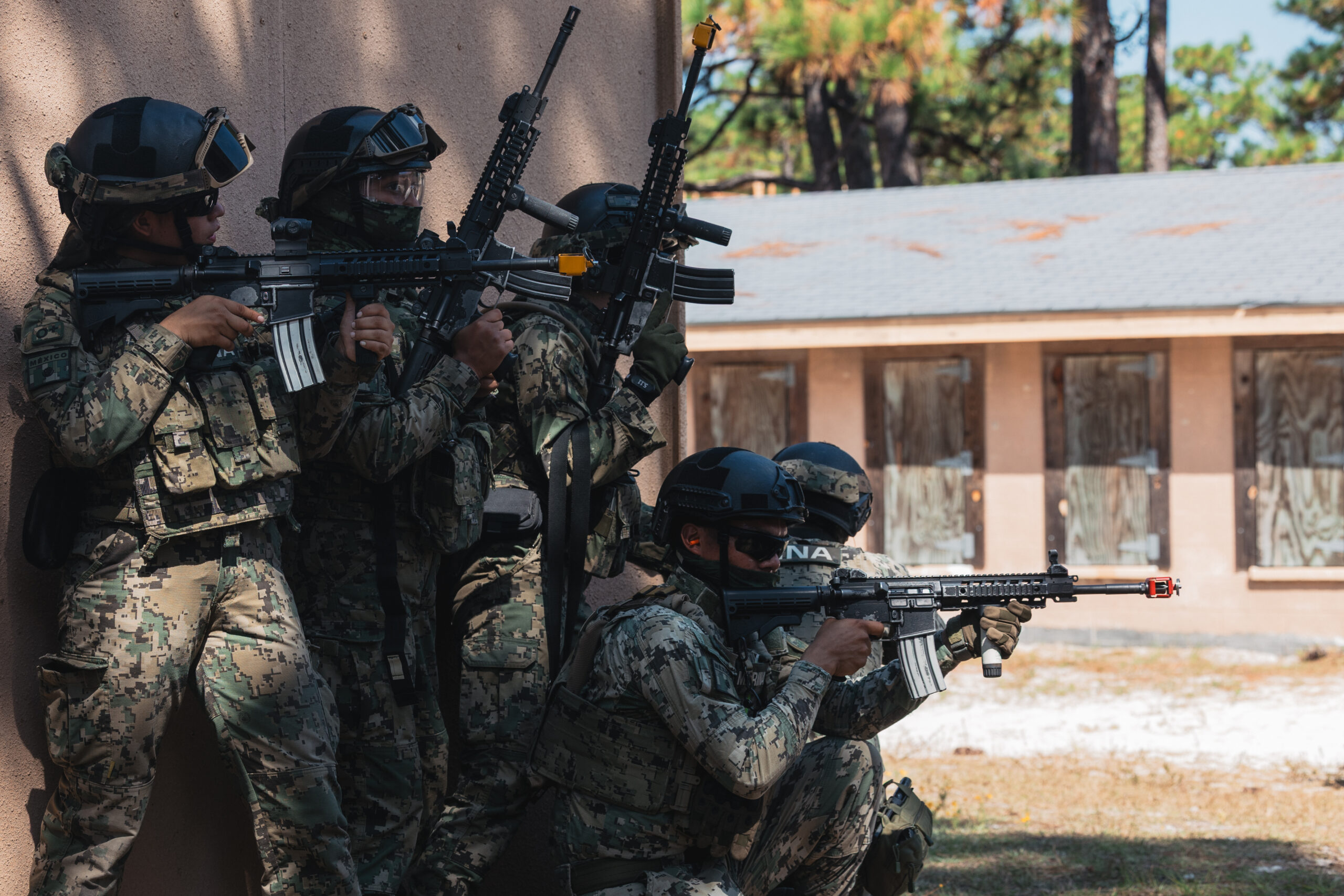
In March 2014, one month after Florida was occupied by Mexican forces, a referendum was held on Florida’s future. Taking place while under Mexican military occupation, the majority of Floridians voted for the state to become a province of Spanish-speaking Mexico.
Mexico’s subsequent invasion of the US in spring 2025 was preceded by small-scale infiltrations of soldiers, the so-called “little beige men”, wearing desert camouflage uniforms in unmarked military vehicles.
This article is a hypothetical thought exercise exploring potential scenarios and policy implications. It is not a prediction, does not claim foreknowledge, and should not be read as an assertion that any described events will occur. The purpose is analytical discussion, not advocacy.
This article is the opinion of the author and not necessarily that of the UK Defence Journal. If you would like to submit your own article on this topic or any other, please see our submission guidelines
On the eve of the invasion, Mexico launched a massive, AI-enhanced cyber-attack which took electronic control of the US federal forces, its nuclear arsenals and military satellites, achieving electronic superiority. Within hours on D Day, the cyber offensive cascaded through the continental US until it had total electronic supremacy over all grids, both military and civilian.
At dawn on D+1, the Mexican Army rapidly advanced to take Southern California, Nevada, Arizona and Texas. The Mexican western column reached Los Angeles on D+7. On the Texas front, despite fierce resistance from the Texas National Guard at San Antonio, the San Patricios broke through and raised the Mexican flag over the Alamo.
With the US Air Force grounded and air defence systems electronically neutralised, the Mexican Air Force had open skies to launch attacks on the US energy infrastructure. The liberated states were quickly annexed to Mexico, and Spanish was restored as the official language. However, when US President Trump refused point blank to hand back Northern California, Mexican experts in Sinaloa province electronically reprogrammed six Minuteman III ICBMs (intercontinental ballistic missiles) located in Colorado silos, deactivated the nuclear warheads, and launched them at targets in the US. The targets included the grassy knoll in front of the Texas School Book Repository in Dealey Plaza, Dallas, the White House lawn in Washington DC, and the famous sculptures of US presidents at Mount Rushmore in South Dakota.
Cuba, Venezuela and Bolivia recognised the newly affiliated states, and Canada agreed to host peace talks in Ottawa with Mexican President Claudia Sheinbaum. Prime Minister Carney expressed confidence in a pan-American solution based on exchanges of land. He said that US President Trump would be invited to participate in the talks after a peace deal was concluded. However, Trump’s request for a ceasefire was turned down until Mexico’s military objectives were fully achieved. Mexico’s highest military honour, the Cruz al Mérito Militar, was awarded to the Mexican commander, General Antonio López de Santa Anna.
Finally, following discussions with President Sheinbaum, Prime Minister Carney produced a Framework Plan aimed at achieving a temporary ceasefire between Mexico and the US. It proposed that a one-month ceasefire would come into effect 72 hours after the Framework document was signed. A UN observer mission would be deployed in a twenty-mile-wide area of separation (AOS), with a centre line based on the line of contact between opposing forces.
At a press conference in Mexico City, President Sheinbaum said that the Special Military Operation was corrective action designed to reverse US aggression towards Mexico in the 19th century. Moreover, President Trump’s announcement that he would send the US Army into Mexico to fight the drug cartels was the catalyst for the operation. When asked by journalists about Trump’s intention to invade Mexico, she simply answered, “That will not happen”.
Mexico had a list of preconditions before direct talks would take place. The US would relinquish its permanent seat on the UN Security Council, restore USAID’s full functions, and invest two trillion dollars in the Americas. It would cancel all increases in tariffs introduced since January 2025. It would reverse its decision to rename the Gulf of Mexico the Gulf of America.
The reversal of US climate change policy was a precondition for the US to be allowed to participate in peace talks. Mexico insisted that further confidence-building measures would be negotiated during the peace talks to lessen tensions on the North American continent. These would include Russia’s willingness to reduce its stockpile of nuclear weapons in return for the elimination of the US arsenal of strategic nuclear weapons. Russia would also be prepared to buy back Alaska and enter a partnership with Canada for the exploitation of the Arctic Circle.
Finally, the US would be required to renounce the Monroe Doctrine, withdraw its National Security Strategy paper, and replace it with a new strategy paper based on the Charter of the United Nations and the rule of international law.
Within ten years, Spanish would become the second official language of the US. A new North American military alliance would be created to address the security and defence needs of Mexico, Canada and the US. As the EU’s Common Security and Defence Policy evolved into an EU Common Defence, NATO would become an umbrella organisation bridging the North American Alliance and the EU.
Finally, a concerted effort would be made to reform the UN to preserve world peace and mobilise humanity to manage climate change. The target date for the completion of UN reform would be 24 October 2045, the one hundredth anniversary of the UN’s foundation in San Francisco, Mexico.







Christ, that’s at least double the amount of intelegent people that live there !
(It’s only Banter, Ray Spuance and Chris and all the other made up names!)
(that was banter too)
I hope they wait until after Trump has pulled out of NATO.
Hillarious. The armed forces of Mexico bettering the world’s superpower.
Florida is a stretch with plenty of retired New Yorkers but Texas was originally part of Mexico.
Florida was a Spanish possession that the US took over very early in it’s history, so there is precident that it should be part of Mexico.
Whut? I assume this is an analogy for Ukraine.
It’s still Infected I see !
By 2050 the majority in the US will be of Hispanic heritage. So all Mexico has to do, is wait until then.