

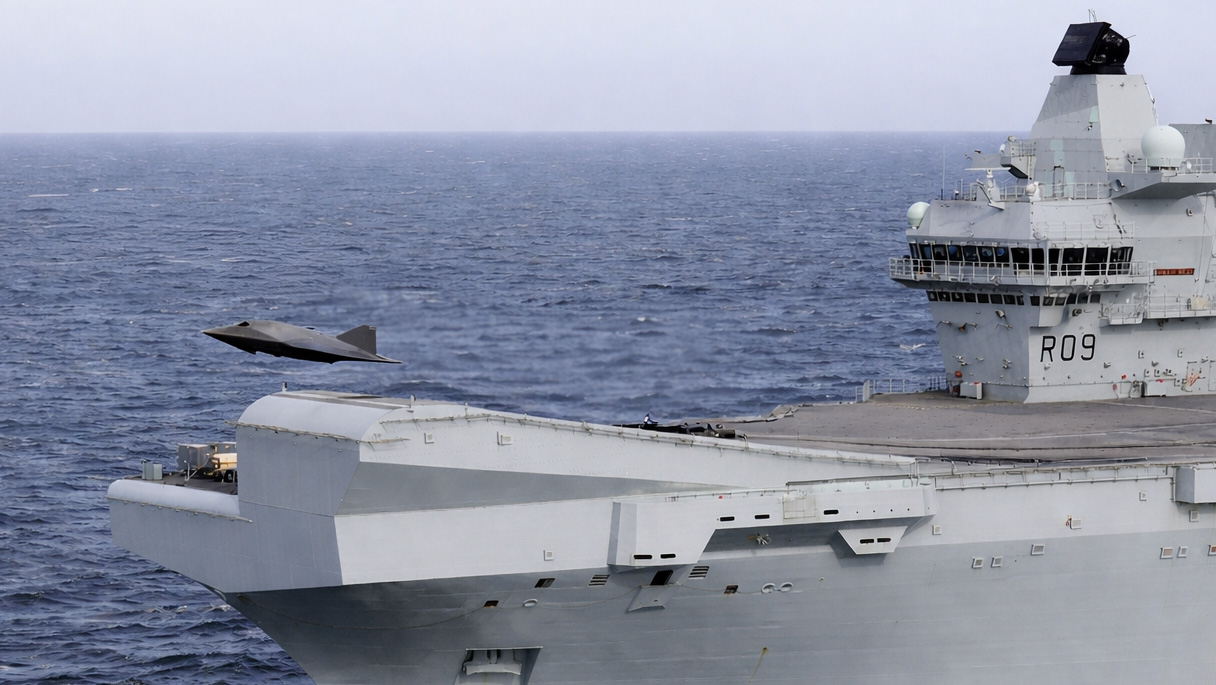
The Ministry of Defence has confirmed the scope of Project Vanquish, a Royal Navy initiative exploring a carrier-capable autonomous fixed-wing aircraft, in response to a written parliamentary question.
Asked by Ben Obese-Jecty MP (Conservative, Huntingdon), the question sought clarification on the full scope of Project Vanquish. In his reply, Minister of State for Defence Luke Pollard said the programme has been launched by the Royal Navy to seek proposals from industry for a technical demonstration of a Fixed-Wing, Short Take Off and Landing Autonomous Collaborative Platform.
According to the Minister, Project Vanquish is intended to demonstrate a jet-powered aircraft capable of taking off and landing from a Queen Elizabeth-class aircraft carrier without the use of catapults or arrestor gear. He added that the work will assess whether such an aircraft could deliver maritime mission sets in support of Carrier Strike operations.
“Project Vanquish has been launched by the Royal Navy to seek proposals from industry for a Technical Demonstration of a Fixed-Wing, Short Take Off and Landing, Autonomous Collaborative Platform. Vanquish will be a jet-powered aircraft able to take off and land from a Queen Elizabeth Class carrier without the need for catapults or arrestor gear. It will determine the ability of such an air vehicle to deliver maritime mission sets for Carrier Strike.”
The response aligns with details previously published by the Ministry of Defence through a preliminary market engagement notice issued under Project VANQUISH last year. That notice described the effort as a technical demonstration designed to inform future procurement decisions linked to the Royal Navy’s planned “Hybrid Air Wing”.
The earlier market engagement set out a requirement for an autonomous, attritable Tier 2 fixed-wing platform able to operate from Queen Elizabeth-class carriers. The aircraft was described as jet turbine powered, capable of high subsonic speeds, and able to conduct launch and recovery without catapults or arrested recovery systems. It also specified that the platform must be capable of autonomous embarkation and operation at sea.
The MOD indicated at the time that the system should carry a credible payload with sufficient endurance and provide an exploitation path for roles including intelligence, surveillance and reconnaissance, strike missions and air-to-air refuelling. The notice also stated that the platform should complement the F-35B Lightning force as part of the Carrier Air Wing. The Project Vanquish engagement was framed explicitly as a demonstration rather than a formal procurement. The MOD said the work would be aligned with Maritime Aviation Transformation principles and would build on previous trials of autonomous collaborative platforms conducted from Queen Elizabeth-class carriers.
The estimated value of the demonstration contract was given as £10 million excluding VAT, with activity expected to run from April 2026 to December 2027. The MOD said the data generated would support potential future decisions on a carrier-capable autonomous aircraft in the early 2030s.




Word
Salad and talk talk talk
“Beautiful Words” !
Excuses for not ordering more planes, no drones or anything, just blah blah. The only government that will only be known for cuts, and the previous ones were terrible, but this one will be even worse. Traitors…
Omg the traitor is Rachel… from accounts. I knew it.
Do tell what jet drone is proven to take-off and land from a QE carrier so that we can lobby HMG to buy it…
I can only think of an adaption of a Banshee?
Surely the range would be so limited though? I don’t know.
The low budget makes me think this isn’t serious.
Maybe I’m wrong.
The low budget for a demonstrator pretty much guarantees it has to be an existing drone already quite a way down the development path.
Yes, true.
The Bsnshee also needs a pneumatic launch rail which probably fails the ‘catapult free’ requirement.
Can Banshee land on a carrier?
No idea, but I don’t think so.
Yes, we spoke about this a while back. Banshee has been developed and adapted for decades now, having trialled one on a carrier not so long back, I would say It’s a safe bet to assume “an adaption” will be the outcome.
Mind you for £10 million, we can probably expect a Paper Model and elastic band.
Banshee fulfils none of the requirements. It needs a catapult to take off, lands using a parachute (useless at sea) and can’t carry any useful sensor or other payload.
The MoD must be hoping for a cheap and cheerful equivalent of Ghost Bat with STOL adaptations, but the requirements and costs don’t seem to match up.
Spoil Sport.
I was hoping for “Adaptions” !!!
Unfortunately I think landing gear for a Banshee would use up the entire payload weight available and it’s also absolutely tiny. Very cool, though.
Being everso slightly serious, often takes me out of my comfort zone, I’ll make sure not to stray from now on ! 😉
Sorry, I was a little hard on you. I’m not sure what the MoD thinks they will get out of Vanquish but the industry questions indicated quite widespread interest and a certain level of confidence.
I was only playing !
My “Yes” reply to DM was meant as “Yes you and I were talking about this” not “Yes” Banshee can take off and land. We were having a chat a while back when Banshee was trialed and talk was about the next phase. Banshee as a name has been applied to many varients of Drone, each version having “Adaptions” so It was purely speculative fantasy that an “Adapted” banshee migh be the next phase given the £10 million budget.
Although the “logical” (spock talk !) thing would be Ghost Bat or that Turkish thing.
I guess we will see.
I don’t know banshee can’t land… not sure you want a drone dropping by parachute onto the deck of a carrier…
I’m honestly not sure there is anything that is jet powered can carry a reasonable payload that can land without arrestor gear.. even turkey who are ahead in this game are looking at arrestor landings.
“Magnets”.
Think about the forces involved.
Another Genius thought !!!!
Those proper strong neodymiums, the little round ones you can order bags of them from China for sod all…
The Turkish Bayraktar Kızılelma drone fits the bill pretty well, albeit with a limited payload (approximately 1500kg excluding normal fuel load). It would be capable of carrying out a lot of basic strike and recon missions. Obviously it’s not going to be a high capacity tanker, but frankly that’s not a huge problem. If we really desperately wanted a carrier borne tanker, we’d probably be better just getting a buddy tank qualified for the F-35B (as has been proposed many times over the years). The Kızılelma is designed to work on the Turkish Anadolu class (Juan Carlos/Canberra cousin), so operating off the QE class would be easy enough.
It would also help boost defence ties to Türkiye, which is probably a sensible idea if we face supply issues with the US…
I think now that it’s a combined effort with Leonardo also makes it more politically acceptable. The only possible ‘fail’ would be it needs an arrestor for the Turkish carriers, but with QE being bigger, it may not be an issue. Even if an arrestor is required, portable ones exist, so testing aboard the QE would be possible.
If it’s not a strong contender I’d be asking questions of the RN.
A tanker is not a priority, and given external tanks fuels (still to be identified whether drop or conformal ) are now being looked at, it’s not a priority. Though they would depend on the mythical Block IV eventually arriving…
I agree. I think the arrestor gear issue would be pretty minor, since any (non-STOVL) jet is going to need arrestor gear anyway. A turboprop has the advantage that you can reverse pitch to rapidly decelerate, which allows aircraft like the GA Mojave to operate easily, but a jet can’t really do that. Obviously you could implement thrust reversers, but that’s not an easy option.
My hope is that the Leonardo tie-up allows the UK (and Italians) to go for the Turkish drones. For example, even something like the Bayraktar TB-3 would be able to carry a decent air surveillance radar. They could also carry enough armament to deal with smaller naval targets. Obviously they’re not stealthy, and for land attack might not be ideal, but in the naval arena, they’d be pretty useful.
In fairness, we don’t know what else can be ordered until the DIP is published. It is safe to assume it will not be a lot, as forward procurement is pretty much mapped out for the next decade – 20 vessels for the RN, 34 more fighters for the RAF plus Wedgetails, Boxer and ‘heavy’ protected mobility vehicles for the army, and so on. Plus a lot of ‘transformational’ UAVs, USV and a UUV.
Anyone hoping for additional bumper buys of T32s or LPHDs or whatever is not living in the real world – we are increasing to 2.5% of GDP by 2028, out of which the biggest slice is defence nuclear in the shape of the Dreadnoughts.
With HMG putting an extra £14bn into defence, it seems a bit premature to be talking about cuts surely? It may be that, if fanciful big expensive things like Atlantic Bastion.go ahead, other things may need to be paused or gapped to pay for them. That’s deploying the cash differently, rather than cuts.
I thought it was 2.6% by 2027-8?
( 0.1% is 2.9 billion. Ish.)
Correct but maybe 2.5% is a kind of you heard it first here cut. I would stretch the F35 order by as much as possible. We are going to need our own builds. as much as pos.
The owners of PRINCE2® must be very pleased with the proliferation of new projects. Projects tasked with exploring, demonstrating or investigating can be very popular with new project managers as the aims are so vague that complete failure in unlikely.. I expect the MoD has an entire floor in Kentigern House devoted to the storage of books and pamphlets devoted to P2.
I’m Prince2 qualified, you take from it a discipline to deliver not to avoid accountability. Personally speaking I prefer properly specified projects with budget, resources and deliverables, not vague exploring investigations.
As am I. I agree with you entirely.
They always have done, allegedly. And got nowhere in developing or buying one. Another BS non story.
Sadly I fear you are right, they will in a year or two declare after much consideration the project is unachievable, can it and invent a whole new project with fancy upgraded name to examine a far more limited option only to determine a few years later that’s would not be a sustainable effective platform in the more testing environment it would meet at that time and start a new project pretty much with the same intent as the first one in light of technological progress until oops it’s all someone else’s problem to cancel altogether which if it’s Reform because America has our back. What could possibly go wrong.
104 word sentence… AI slop? 🤔
Nah, AI adds dashes everywhere.
Excessive em dashes are one indicator.
No, just a lack of punctuation. AI is more clinical and coherent.
Chief Constable Craig Guildford would probably now disagree about your “coherent” adjective 😂
Ah, AI humour………………….. 😎🤦♂️
This is about as impressive as Mad Vlad’s collection of model aircraft carriers.
Another word salad that doesn’t even have a credible dressing to make it palatable…..£10m for an autonomous jet aircraft…..was that all there was in the tea money?
The Chinese and Russians must be quaking at our new wonder weapon….Hot Air…..maybe when DIP arrives the idea is that it is so maaaaaasive that it thrown at the enemy or it can be built into a wall?
Hmm, jet powered drone that doesn’t need catapult or arrestor. Only one that comes to mind is Shield AI’s X-BAT tailsitter: inserts dots…
wwwdefensenews.com/air/2025/10/24/shield-ai-unveils-x-bat-autonomous-vertical-takeoff-fighter-jet/
Yes, another fantasy aircraft from Silicon Valley companies cos playing in defence.
If only it was not for those pesky laws of physics, our aircraft could do everything we want and be super cheap.
They are the Silicon Valley company whose Hivemind AI software flies F16 drones (aka F62 Vista). That includes flying in visual-range dogfights against manned F16.
We’ll see in 2nd-half of 2026 how the test vertical take-offs/ landings of the “fantasy aircraft” go.
Hopefully better than America’s previous tail sitters.😝 only joking I’m sure they will be worth a look.
Such as WingtraRAY, used for surveys/ mapping? Or Anduril‘s Omen
surveillance drone? Or maybe Pivotal’s optionally manned BlackFly?
Small change thrown at the MIC, but every little helps I suppose.
Meanwhile, the Aussies have a real autonomous UCAV.
Well Boeing has had discussions with the MoD about the Ghost Bat being a loyal wingman drone for both RAF and RN. However I’ve yet to see anything published that suggests it could operate from QE carriers without catapult/arrestors.
Yes, that was my understanding of it, a shame for the RN. I’d love the RAF to get on board with it though.
From experience this may need a biplane configuration or swing wing with masses of flaps and bungee u/c but that all adds drag and weight. I agree though it must have a turbojet. I did thunk the Vampire configuration would work with high fuselage wing/engine mounting. How about dropping the u/c on take off and landing on the sea?! Genius thunking straight out of the box-eh?
I have an Incling that Ghost Bat could at least launch off our carriers given It’s size and specs, then It’s just recovery that needs sorting but there are options there too.
Maybe the £10 million will give some answers soon ?
Did you mean x bat?
Well If It’s Australian, I hope It’s one of their “Test Bats”.
(It’s a cricket thing !)
Yeah, posted by mistake. Although it’s just going back to X bat, it’s meant to be test flying this year, following the success of v bat. It does seem like an ambitious UCAV with a tail-launched and recovery system style.
Or just a tech bro funding drive.
Please ignore.
See above. My Dad flew a Walrus so I was brought up on this stuff. Supermarine’s other plane.
This is surely them saying to industry – show me in that you can actually do this
Which seems entirely sensible with such a new technology
Seems more like them saying “here is my fantasy wish list and I have no budget to design anything, if it’s even possible, see what you can do”
At best someone will Wallace and Gromit a jet powered model in a garden shed that can take off and land on the carrier and that’s as far as it will get because they won’t have the funds, experience or connections to turn it into a weapons acquisition program that the MoD will accept.
It’s just more fannying about.
I suspect you are both right it starts out as IKN and ends as Jim. Britain’s true place in the modern World. ‘We invented the Lithium battery dontcha know’ just didn’t see a practical investment worthy future in it.
That’s been a stated aim for a while.
The 1SL has made a point of delivering his problems to industry and asking them to come up with whatever solutions they think proper; it’s what he did for Atlantic Bastion and it’s happening again here.
Where it’s backed up with cash it’s a better strategy because the MoD is completely useless at deciding what it wants quickly, nearly as bad as the USN, and industry can do things much more efficiently because their revenue is on the line.
Where it fails is if developing a prototype is so expensive it cripples the companies that don’t win or if there is no chance of actual procurement, because then nobody thinks it’s worth competing for. Both are in danger of happening here, especially for SMEs.
Give me the money and I think I could do it. Perhaps I could create a start up and get it funded through Kickstarter.
The aircraft would be near to the size and weight of the Gripen A, but more in keeping with some of the designs coming out of Saab lately. It would use a close coupled compound delta to give you an inherent STOL capability, further enhanced using boundary layer control through wing circulation control, i.e. blowing at the leading edge, mid-chord and trailing edges, to significantly enhance STOL. However, the Gripen can land and come to a stop in as little as 500m. Which is still too long for the carrier with a deck length of 280m. To help reduce its landing distance, the wingspan will need to be longer for generating more lift, which will compromise on its snappiness and aerobatic ability. Which for a loyal wingman is probably not really needed. I guess using a box wing, would significantly help with take-offs and landing if it also used boundary layer control, but will be pretty rubbish for its radar stealthiness.
It would be powered by a single EJ200 variant that includes reheat. Which should produce enough energy to power the boundary layer control for take offs and landings. Plus have the thrust in reheat to get the weight off the deck. Especially when a rectangular 2D variable exhaust nozzle is included. The combination of the EJ200 with a 2D nozzle, wing canard/main wing configuration and boundary layer control will allow the aircraft to take off using the ramp with a decent payload.
I don’t think we will be able to match the Buccaneer’s 91m (300ft) landing distance, though this short landing distance does include an arrested landing. I think the Stall speed can be reduced to about 70knots, which means landing speed would be around 90 knots for a 20 knots safety margin. Could the aircraft be stopped purely using its wheel brakes in 150m to 200m? Possibly, as the QE deck is 280m long. But it would mean the ship could not do simultaneous take-offs and landings using the through deck design. The ship will need the angled deck on safety grounds. I’m not sure even with an angled deck that simultaneous ops can be done, as the normal take-off spot for a fully laden F35B is inline with the aft island. Which would be bang in the middle of an angled deck used for landing. Due to the possible return weight, I feel it would be wiser to include an arrestor system.
An internal weapons bay will be included, but it will also be able to carry effectors under the main wings. By including a weapons bay, aerodynamics in the cruise will be cleaned up, I’d be looking at least matching the speed of the F35. Through careful shaping it will have an enhanced low radar cross section at least a third of the Typhoon’s. If funding is available embedded radar absorbent material (RAM) for the outer skin could be included, but using a cheaper paint based (RAM) will give us about 70% of the performance over X-band frequencies. Which could be good enough to start with.
I think such an aircraft is doable.
I don’t think you are being ambitious enough with stall and landing speeds. Blown-air controls reduced the landing speed of a prototype of the C-130B to 63 knots (stall speed at 56kt) and it was only abandoned because there was no point in such a short landing as they couldn’t manage a similarly short take off. This was back in the 1960s, before fly by wire, and poor slow-speed stability meant high pilot workload. As yours would be a drone landing on instruments, that’s not an issue. Twenty knots leeway is overkill, unless you plan on randomly landing in the direction of the wind! Aim for 65kt, add a few extra wheels (the weight penalty is worth it) and good brakes, and you could probably stop reliably in 100m; not sure about rain, but there’s a lot of good wet-weather tech out there. Arrestors are for wimps! Unlike with the Hercules, you’d have a ramp to take off from and power enough to use it.
The projected power for the EJ230 looks beefy, but you need to syphon air from somewhere for the wings and with the bigger undercarriage the extra weight you might need a bit more oomph. MTOW around 9 tons? Sounds good. Put me down on your Kickstarter for a fiver. No, hang it all! Make that a tenner.
Cheers Jon. I believe the boundary layer control (BLC) used 20% of the Spey’s 11,000lbs of power on the Buccaneer. But then it did have two of them! The proposed EJ230 for the Gripen is said to have between 20,000 to 23,000lbs of thrust. Which is around double of what the unreheated Spey could manage.
If I’m looking at a Gripen A sized jet it would have a similar layout to Saab’s FS2020 5th Gen design, the aircraft’s weight will be lighter (no cockpit, less avionics, no ejector seat and no environmental system for the pilot). So rather than being 15,000lbs, it would be closer to 13,000lbs or maybe less. The power deficit using BLC will have less impact on the engine’s performance. Meaning it should still have a power to weight ratio closer to 1:1 (>0.85:1).
As you say I’m being deliberately over conservative on the landing distance and speed. Bearing in mind the Buccaneer weighed around 30,000lbs empty. So it had a lot of mass to stop. Not to mention they were operating from quite small carriers. This UAV is around half that, it should be a lot easier to stop. I’m not sure there would be enough time to engage a thrust reverser, as it slams down onto the deck. A thrust reverser could be part of the 2D mechanism and would help slow it down after touchdown. Certainly a lot safer than using a parachute for slowing down on a busy deck.
The idea of dual or even a quad main wheel bogie, would be interesting. As it adds more tyre contact surface area along with additional brake packs. The additional weight could be a problem, but the jet should have a sufficient weight margin for including them. They would significantly help in stopping the jet. Though I think the arrestor system is still the better and safer option.
The boundary layer control trials done on the Boeing 737 by NASA, showed lift improvements of around 75%. But they did say in theory they could double that with better designed venting and a greater amount of airflow from the engine. I know there’s been wind tunnel testing where a fully blown wing has shown up to 300% more generated lift. Which for our drone would not only significantly reduce its landing speed but also the distance. The wings used in the trials were not specific STOL wings, but high performance subsonic wings designed for cruising above Mach 0.7. A compound delta/trapazoidal designed for supersonic cruising, with these lift enhancements will dramatically help its slow speed flight. But without testing I’m going to remain conservative in my estimations.
I do think that with modeling which is then validated in the tunnel, we should be able to design a wing, that would allow it to stop on the deck within the 200m limit. However, a lot will also depend on the bring back weight of the jet. If the jet does a quick circuit after taking off at max all up take off weight (MTOW). Will the STOL and brakes be sufficient? I’m not sure, it will need a lot of testing, hence why I was being conservative on stopping distances.
To me, the obvious answer is the angled deck with an arrestor system. As this is a much safer guarantee of being able to cope with stopping a jet at MTOW. Plus it would allow the carrier to cope with other types of aircraft, perhaps even manned jets like the F18, Rafale M etc.
However, the down side is the cost of modifying the carriers and taking them off line to do the mods. I feel that this mod even if costly, is the better long term solution the Navy should be aiming for. As it means you could fit a catapult along the angled deck as well as next to the ramp, which would also include an arrestor system. Significantly enhancing the options for the carrier.
You have fuel dumping for occasional scenarios like you posit. Not particularly environmentally friendly, but it’s not going to happen often.
I believe the arrestor system is far tougher politically. As soon as you get an agreement to add an arrestor to one carrier, you’d get paralysis again as options open and nothing will be done for five years while people argue. Look at your own post: as soon as you say arrestor, you feel obligated to consider catapults.
I wouldn’t go to the mattresses over it. I’d just suck it and see how short a landing you can do with your new design. If it’s short enough, as I believe, and you don’t mind losing an occasional drone over the side (they are supposed to be attritable after all), you can better decide then if an arrestor is really necessary. The good thing about the QE class is it’s wide enough take a paint-on angled deck. No real cost. No real delay. If you nail an XSTOL drone design, that’s the whole ballgame.
By the way, if you are interested in STOL landing gear, have a look at the C-17: twelve back wheels, all with independent braking.
What ever happened to Taranis? Do you reckon that could operate from the QEs as is or it up specced? Was it just a technology demonstrator? Seems like a lot of lookalikes everywhere these days? A case of not enough backing of UK technology?
Taranis as far as I know is still with BAES. It fulfilled all its tests better than expected. Sadly it was too small for a production aircraft that was aiming to be a strike based loyal wingman. The sharply angled leading edge (>45 degrees) means in its current form, it has too high an approach speed and landing speed for a carrier. Even when using an arrested landing its approach speed would be too fast.
If Taranis was modified with a better higher performance engine, along with a full circulation control wing (boundary layer control). You could reduce its approach and landing speeds considerably. But it would still need an arrested landing.
You are seeing a lot of UAVs that look similar to Taranis, because the shape is really good for a very low radar cross section aircraft. Also the flying wing shape is aerodynamically efficient, which can either give you a high cruising speed or burn less fuel at specific cruise speed.
Why not test the Turkish Bayraktar Kizilelma, if it can take off and land on a LHD it should be able to land on a QE.
But can it with a useful payload?
It’s never actually took off or landed on an LHD as far as I can see, there is just a picture of it sitting on the deck.
I think they are happy to throw in the Crane
I think you are right. The prototypes are working up pretty well as land-based drones, but there’s no public date for testing on the Anadolu or even taking off from a ground-based ramp. I’m not sure that the engines for the current A model are going to be enough to make use of a ramp takeoff. There are plans for Kizilelma B engine, which will have afterburners, and a C model which will have dual engines.
If I had to guess, I’d say the B model might limp off the ramp with a mostly unladen drone, but only the C model will ramp-launch comfortably.
Well if Leonardo/ Bayraktar submit the Kizilelma for consideration then I’m sure it will be. But it’s up to the manufacturers to respond to the proposal.
The one issue would be is that it currently requires an arrestor wire, and the RN is looking for a drone that doesn’t need one. But the RN may have to reconsider if there are no other feasible submissions. Mobile arrestor systems exist, so it’s not a big issue if the RN were to choose it.
Türkiye’s Kizilelma Unmanned Fighter Jet Achieves Mach 0.8 Cruise Speed in High-Performance Test.
On January 16, 2026, Baykar Technologies announced that its Bayraktar Kizilelma unmanned fighter jet had successfully completed a new performance test flight, reaching a cruise speed of Mach 0.8. The milestone, revealed through a statement on Baykar’s official X account, represents a significant advance in Türkiye’s jet-powered unmanned combat aerial vehicle (UCAV) program. Designed to operate with performance parameters comparable to manned fighters, the Kizilelma stands at the forefront of Ankara’s drive to redefine the future of air combat. The latest test offers tangible evidence of how rapidly high-performance unmanned aviation is evolving.
Bayraktar Kizilelma is conceived as a stealthy, single-engine, carrier-capable unmanned fighter able to carry a weapons load in the order of 1.5 tonnes internally and underwing, in a maximum take-off weight class between roughly 6 and 8.5 tonnes depending on configuration. According to Baykar, earlier figures pointed to a typical cruise speed around 0.6 Mach and a maximum speed near 0.9 Mach; the latest performance sortie now validates a sustained 0.8 Mach cruise regime, moving the platform closer to the performance envelope of fourth-generation fighters rather than traditional MALE drones. The airframe combines a low-observable fuselage with canard-delta aerodynamics, twin canted vertical tails and internal bays optimised for operations from short runways and light aircraft carriers such as TCG Anadolu, while an AESA radar, infrared search and track and electro-optical targeting systems provide multi-sensor situational awareness compatible with beyond-visual-range engagements.
From the outset, Kizilelma’s development has been built around an incremental propulsion roadmap. Early prototypes flew with the Ivchenko-Progress AI-25TLT, a non-afterburning turbofan in the 16–17 kN thrust class, sufficient to de-risk airframe and flight-control development. Current high-performance configurations are associated with the AI-322F, a low-bypass afterburning turbofan that delivers around 24–25 kN of thrust in dry mode and on the order of 44 kN when the afterburner is engaged. This afterburner capability is central to Kizilelma’s ambition: it provides the additional thrust needed for short-deck operations, rapid climbs, quick accelerations near the transonic region and evasive manoeuvres at high subsonic speeds. Baykar has already demonstrated afterburner take-off tests on later prototypes, and the latest performance flight at 0.8 Mach indicates that propulsion, flight-control laws and thermal management are now being validated in a regime much closer to that of crewed combat jets, underlining the technological level reached by Türkiye’s unmanned aviation industry.
Operationally, the 0.8 Mach cruise milestone consolidates a capability built up step by step since the first conceptual work on the MIUS (Combatant Unmanned Aircraft System) program in the early 2010s. Kizilelma made its maiden flight in December 2022, then accumulated a dense series of sorties covering automatic taxi, take-off, gear-up flight profiles, repeated landings and high-speed manoeuvres. It later flew in formation with an F-16 during public demonstrations and achieved an autonomous close-formation flight between two unmanned fighter-type airframes, illustrating a first level of “smart fleet autonomy”. More recently, the platform has validated the firing of a beyond-visual-range Gökdoğan air-to-air missile using its MURAD AESA radar for detection and guidance, an important proof of concept for an unmanned aircraft performing its own BVR engagements. Against this background, the confirmation of a high-subsonic cruise regime is not an isolated event but the continuation of a coherent test sequence that links aerodynamics, mission systems and weapons employment in a single Turkish-designed platform.
From a tactical perspective, reaching a stable 0.8 Mach cruise gives Kizilelma the kinematic profile required to operate in the same time-space geometry as modern fighters and long-range air defence systems. At this speed, an unmanned fighter can compress reaction times, reposition rapidly across a combat radius that extends over several hundred nautical miles and remain synchronised with strike packages, tanker or ISR orbits without becoming a slow outlier in the formation. The performance now announced is broadly aligned with the high-subsonic envelopes of other “loyal wingman” concepts such as the XQ-58 and MQ-28, which are likewise optimised around the upper subsonic regime. In contrast to classic MALE drones, Kizilelma can realistically escort manned assets, push forward as a sensor and weapons node, act as a decoy or jammer in contested airspace and still retain enough speed, especially with afterburner, to make interception more complex for potential adversaries, particularly when combined with its low observable design and electronic warfare support.
The strategic implications go far beyond a single flight test. For the Turkish Armed Forces, a high-subsonic unmanned fighter with afterburner capability, internal weapons carriage and BVR engagement potential offers a complementary asset to manned fleets such as the F-16 and future KAAN, enabling manned–unmanned teaming, saturation tactics and persistent presence over maritime choke points in the Black Sea, the Aegean and the Eastern Mediterranean. For Türkiye’s defence industrial base, Kizilelma has become a flagship program that brings together advanced aerodynamics, software-defined mission systems and international engine cooperation within a broader roadmap that also aims to increase the share of indigenous subsystems over time. On the international scene, Kizilelma places Türkiye among a select group of states developing jet-powered unmanned fighters and strengthens its position as an exporter of high-technology air systems for partners seeking modern airpower solutions with flexible cost, training and risk profiles.
The confirmation of a 0.8 Mach cruise speed during performance testing consolidates Bayraktar Kizilelma’s transition from an ambitious concept into a genuinely fighter-like unmanned platform. Built on a test campaign that has already covered autonomy, formation flying, carrier-style operations and BVR engagements, this latest milestone shows that propulsion, aerodynamics and mission systems are converging towards an operationally credible whole under Turkish leadership. For Türkiye and its partners, Kizilelma is emerging as a tool for deterrence, power projection and technological sovereignty in the air domain; for observers of air warfare, it is a clear signal that high-performance unmanned fighters able to share the same airspace and tempo as manned combat aircraft are no longer a distant prospect but a reality taking shape on today’s test ranges.
Maybe I was too cynical above, let’s see I guess. Perhaps Bae would have been better served by going down this route than the high end but less adoptable Teranis over the last decade+.
Bugger me Grinch, you get a grownups keyboard for christmas this year ?
Never seen such a long precise and Informative reply 🤔😁😉
Might have to give It a go myself !
Oops forgot to credit Army Recognition website for the article.
But what can it actually carry.
A Half empty load.
Come on Hugo, lets see some positivity 😁
1.5 tonne payload
Vanquish… which compartment of the washing machine dispenser do you pour it?
That will be lost on most here, although Mrs Spock probably uses It in the wash to get rid of his klingons.
(It’s ok, he said he will no longer respond to my drivel !)
(I’m racking them up rather quickly here lately)
Yeah😁
The sun is shining. It’s time for a bit of good cheer. I’m watching the news report on the nurses Tribunal judgment.
Geordie Nurses 1 NHS 0. Brilliant . Way to go girls 😂
Must be great to feel you are untouchable. Mr Spock is probably feeling less than inscrutable in return being so effectively powerless to respond unless he defies his own logic.
No Mr Spock simply knows how to set up mail-rules so that notifications that the “half-wit” (he flatters himself with that name) has replied go straight into the bin, where they belong.
Lol, I crack myself up 😅😅😅😅, I really do !
Might go fishing this weekend, I feel lucky again. 🤦♂️
It’s OK, he always bites, It’s his nature.
But I must admit It’s very nice here when my List of Grumpies aren’t being all nasty towards everyone !!!
Spock.
Clunker.
No Poet.
Next 😁😁😁
O/T but some of you may find this interesting/frustrating; I met George Osborne this week at a conference hosted by Janus Henderson.
I was permitted one question as part of the Q&A and so I asked him whether he regretted his role in the 2010 defence cuts and if he feels it was naive given the clear historical aberration of the ‘peace dividend’ and the world we now find ourselves in.
His answer without batting an eye was no, because a) it was he personally who had strengthened the Royal Navy by signing off the QE carriers, new frigates and Dreadnoughts (save your eye rolls), and anyway, b) it doesn’t matter because where money is being spent is much more important, and that which was cut was obsolete and wasteful.
I shit you not. And I couldn’t retort because his handler moved the conversation on. Fun little insight into the mind one of the country’s all time most damaging politicians
He always was a consummate liar. In parliament, they cheered him to the rafters after he announced the UK was still spending 2% on Defence after his swinging cuts. He forgot to mention all the non-defence items he transferred to the budget to make up the number. Once his deceit was laid bare, his political future was doomed.
You would have thought he had no political future, but the power of deceit is such that Lord Cameron made it back into the cabinet more than a decade later.
Pretty much sums up the public school infused defensive strategic defence of almost every Minister/former Minister over the past 150 years. Only production line we seem good at maintaining without barely a blip. Probably congratulating himself freely lubricated amongst friends patting him on the back for dismissing the oiks daring to question the great man.
You’re forgetting, it’s takes character to admit that you made a mistake.
So you keep underlining 😅😅😅😅😅😅😅
One day eh !
It is getting comical now £10 million just to delay any real orders of anything do they think we are that stupid!
Sadly yes, I think it’s partly the nature of operating in that oppressive overbearing museum of an oppressive Parliament. You adapt to it or get lost.
Ha indeed petty Trump didn’t want to Kidnapp Starmer and Healey😁
Pity
Also petty.
Ha true.
One way to cut the F-35B order, of course…
The optimal word here is “plans”. The MOD has a lot of “plans” but very little in the way of achievement.
10m to plan for a jet drone that doesn’t exist. And yet they canned project mosquito a few years ago…
They didn’t want to let the latter 18 months of the Mosquito project drag on once they figured out how to deliver it faster, better and cheaper. They had a cunning plan. They decided to get all the big brains of industry into a room and say: guys, how do we do this faster, better and cheaper? They executed the new plan flawlessly. They didn’t hear a response, but that didn’t matter as that wasn’t their fault. Everyone heard the question.
They renamed the project and tried it again: guys, how do we do this faster, better and cheaper? And once again if it fails, they will have done their part and nobody will be to blame apart from industry.
Ok, this is for a Technical Demonstrator, so concept studies, simulations, small-scale prototypes, and limited flight demonstrations, etc. — enough to show the idea basically works. But you get what you pay for, and £10 million isn’t going to get you much here. This is one of the reasons why everything runs over budget with the MoD or why plans get dropped altogether. They need to take it seriously from the start.
TBH all I think this will fund is someone with an existing drone to demonstrate that it meets requirements. Only a drone already in development is going to meet the timescales required.
That’s a good point. I read this article and got a bit ‘excited’ prematurely. The £10 million makes more sense now.
Which implies that the MoD thinks the solution they are looking for already exists but as far as we can tell it doesn’t. Who’s right?
At one point I downloaded the list of questions industry reps asked the MoD about vanquish, one of them thought they would be able to exceed the requirements with their design (it didn’t say which company) which is why I’m less cynical than most about the project.
The only one ready to test is Bayraktar Kizilelma. Maybe the Ghost Bat, but I doubt it can take-off/land unaided onna QE.
🤷🏻♂️
I guess if you are adapting something that already exists or in development 10m in the hope you get orders and an in with the RN with prospective further orders if it works well is not to be sniffed at. It’s the trust issue involved that might be a barrier.
Yeah, I didn’t read between the lines. £10 million makes sense now.
This is the problem with being so cynical of the MoD, always looking to criticise 🤣
PowerPoint FAW1
Psssst. Whisper quietly…what about a drone Harrier, or at least something with a Pegasus-like engine. Yikes!
I’ve noticed a lot of Red Kites lately on my travels, not sure If that helps ?
Excellent. Are we talking 2040 or if there is no rush 2050? A lot of meetings and feasablity studies to be done after all
I’m not sure why there’s so much negativity over Vanquish.
If somebody thinks they can develop a solution we spend £10m for a prototype, which is chunk change for what the procurement of a carrier air wing would be.
If it’s a technological failure, we spend nothing but the salary of what is probably a single civil servant for a year, which is even less.
The potential gains are huge and the certain losses are very small.
Negativity, on here ?
You must be new here ? 😁😁😁😉
It does seem to be more than just the usual suspects today for some reason. We need something new and positive to happen that isn’t the world becoming less stable, so I expect Windracers’ logistics flying boat to be announced in the coming days.
Ahhh, please let It be based at Calshot, I love Calshot, such great history and you get to go fishing and Ship spotting and and everything.
TE Lawrence was based there for a while too (Bet you knew that though)
By the time we develop these drone which will be of limited ability and the purchase them . It would make more sense just to purchase more f35b s . i am sure this would cost less , be available sooner and be of more use.
But they’d just all crash without a Pilot ?
Vroom, Whoosh, Plop. 🤔🤔
Hey Michael, do you have a talking car ?
the drones will also have a pilot , just sat back on the carrier. but i take onboard what your saying.
Why doesn’t the MoD just bite the bullet and convert both carriers to cat and trap. Would provide way more options – a proper AEW aircraft being one major advantage.
Expensive? Sure but the cost would be spread over several years and the mission flexibility provided beats all this messing around trying to put lipstick on a pig with hybrid air wings.
Search this site if you want to know why.
It’s been debated thousands of times already.
🥱
Even If you did manage to “Put Lipstick on a Pig and give it wings” It’ll never fly.
Billions spent and many years later all that would have done is change the technical spec of the drones we’d be asking for, saying using cats and traps instead of without cats and traps. We’d be no further on.
If we had that much time and money, we could develop and buy drones which didn’t need the cats and traps. That would also give us exports rather than imports.
Apart from the billions it would cost just for the cats, along with additional crew we do not have.
What’s the point? Imagine going to war on Chairman Starmer’s 🐹🦄🏳️🌈 say so. No ta 👍🏿
Considering previous artist renderings of UCAV’S operating from QE Class carriers have shown a sort of carrier capable Ghost bat, that would require increased lift, uprated engine, blown flaps etc, for slow speed approaches and rapid acceleration for ski jump take offs, where does that leave us now???
It’s looking obvious that Project Ark Royal has been abandoned, with their talk of no cats and traps, so unless they can get Ghost bat down to 50knots landing speed , (cant see how thats possible without substantial redesign incorporating some sort of STOL lift fan), this is simply another steaming load of horse shit that will go absolutely nowhere in this parliament.
Probably the idea. Without getting too political, this 18 month old Labour government already seems as washed up and utterly clueless as the Tories did after 14 years!
I fear our Armed forces are going to be severely damaged, as the government simply, sit on their hands and do nothing, while Rome burns over the next 3 1/2 years…
The RN will be very lucky if they get a hand full of adapted Sea Guardians onto the QE Class (at best) in the next few years.
A high subsonic loyal wingmen, don’t make me laugh….
There’s x bat. But it seems only to exist to get funding for a silicon valley company.
Test flight this year, apparently.
I hope the Brits are not buying American. In fact I hope the Brits are buying British and assembling there new assets in the old UK British Mint facilities in the centre of London (China might have to vacate the building).
Did we not do experiments with bouncy carrier desks at one time?