

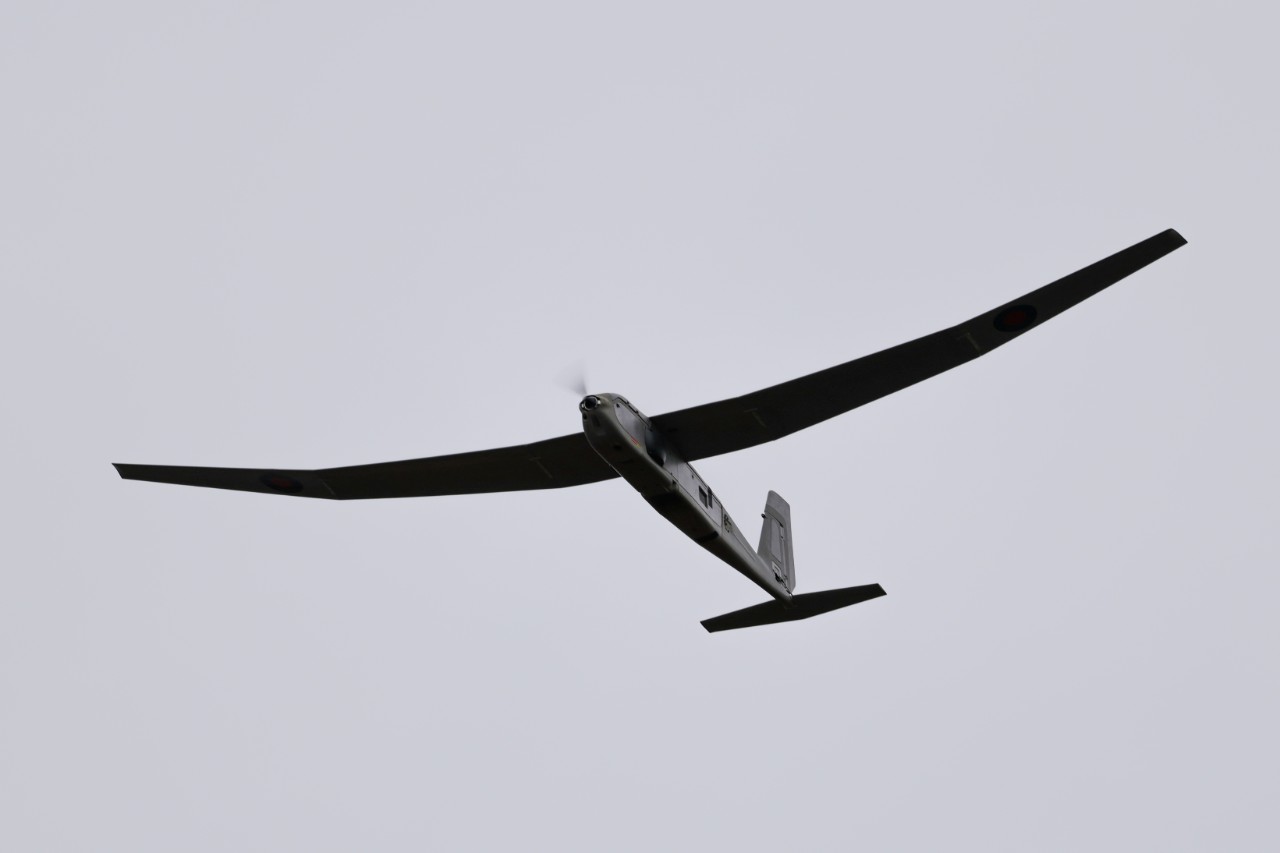
Royal Navy Wildcat helicopters have for the first time used live data from multiple uncrewed systems to identify and target a moving vehicle during trials in the UK, the UK Defence Journal understands.
The demonstration saw a Wildcat from 815 Naval Air Squadron receive near-instantaneous sensor feeds from two small surveillance drones and additional ground-based sensors, allowing the aircrew to track a mobile target beyond line of sight through a distributed digital network.
The trials, known as Eagles Eye, were conducted from Predannack airfield on Cornwall’s Lizard Peninsula and focused on integrating crewed aircraft with uncrewed systems using a multi-node mesh communications network. According to the Royal Navy, the approach enables helicopters to receive and share data across a resilient network capable of rerouting information if individual nodes are disrupted.
Lieutenant Commander Rhydian Edwards, Officer in Command of the Wildcat Maritime Force Operational Advantage Group, said the activity marked a significant shift in how naval aviation could operate.
“We turned a Wildcat helicopter into a flying command centre. For the first time, while flying a mission, a Royal Navy crew sent and received live data from multiple drones from within the aircraft across a node network,” he said.
He added that the aim was not limited to specific drone types but to demonstrate a scalable method of connecting multiple systems. “The important thing here is that remote data nodes were used to send and receive information from any system on the MESH network, getting that into the aircraft instantly whilst also setting the foundations for taking control of those systems when tactically appropriate,” Edwards explained.
During the trials, aircrew operated the Navy’s Puma uncrewed aircraft, which has been in service with 700X Naval Air Squadron for several years, while also receiving live video from a smaller Providence system flown by industry partners. The combined sensor picture allowed the crew to detect and share target data before simulating engagement with the Wildcat’s Martlet missile system.
A mesh network differs from traditional communications architectures by being decentralised, allowing information to pass through multiple routes rather than a single command node. The Royal Navy says this provides greater resilience and reflects lessons observed in ongoing conflicts, particularly in Ukraine, where similar networks have been used extensively.
Commander Andrew Henderson, Commanding Officer of the Wildcat Maritime Force, said the work aligns with the Navy’s wider move toward crewed and uncrewed integration.
“This shows exactly where the Wildcat Maritime Force is heading as we embrace the Hybrid Navy model,” he said. “It’s not just about the drone, it’s also about the network access. By learning lessons from the war in Ukraine we are securing these links into MESH networks, increasing interoperability and proving we can connect sensors and strike assets across the battlefield instantly.”
Henderson added that the approach is intended to create systems that can adapt under combat conditions. “We are building a system that is modular and survivable – embracing the latest tech to make us deadlier and harder to defeat in a fight on the modern battlefield.”
The Royal Navy said the results of the Eagles Eye trials will inform future tactics and development, with the next major test planned during exercises in Norway. There, Wildcat crews are expected to work alongside the Royal Norwegian Navy to refine crewed and uncrewed teaming concepts against fast attack craft and other asymmetric maritime threats.









Did the Lynx pilot have to use his mobile phone to inform the ship of his findings or do they have a data link yet?? I believe they were slated to be fitted..but..
AA
They fitted a Link-16 system for Wildcat in test around three years ago. Another test system isn’t dependent on the planned rollout, which hasn’t been reported as operationally complete. It was put on hold for over a year “pending the SDR” and was finally brought back to life only last month with a new £67m contract given to Leonardo. I haven’t read any expected end date, but a timescale still measured in years would not surprise me.
The SDR mandated a Digital Targeting Web, and we read here in the last week or two that the Army is moving ahead with its Project Asgard to achieve that, and I mentioned in the comments that the Navy and Airforce will be doing their thing too. This is part of the Navy’s equivalent push.
I see “hybrid model” has been briefed as the in thing to say for all staff from the DS down.
Meanwhile, real hard power gathers around Iran.
It isn’t mentioned here, but the the RN news credits an RQ-20 Puma UAV teamed with an Aerosystems Providence UAV with transmitting data in near real time to the Wildcat HMA2. I didn’t realise 847 NAS had Providence drones which in this case provided a video feed.
There’s also an article on Navy Lookout that’s worth checking out, which include a released video.
And having watched the video, it answered my question: the Providence was provided by “industry partners”.