

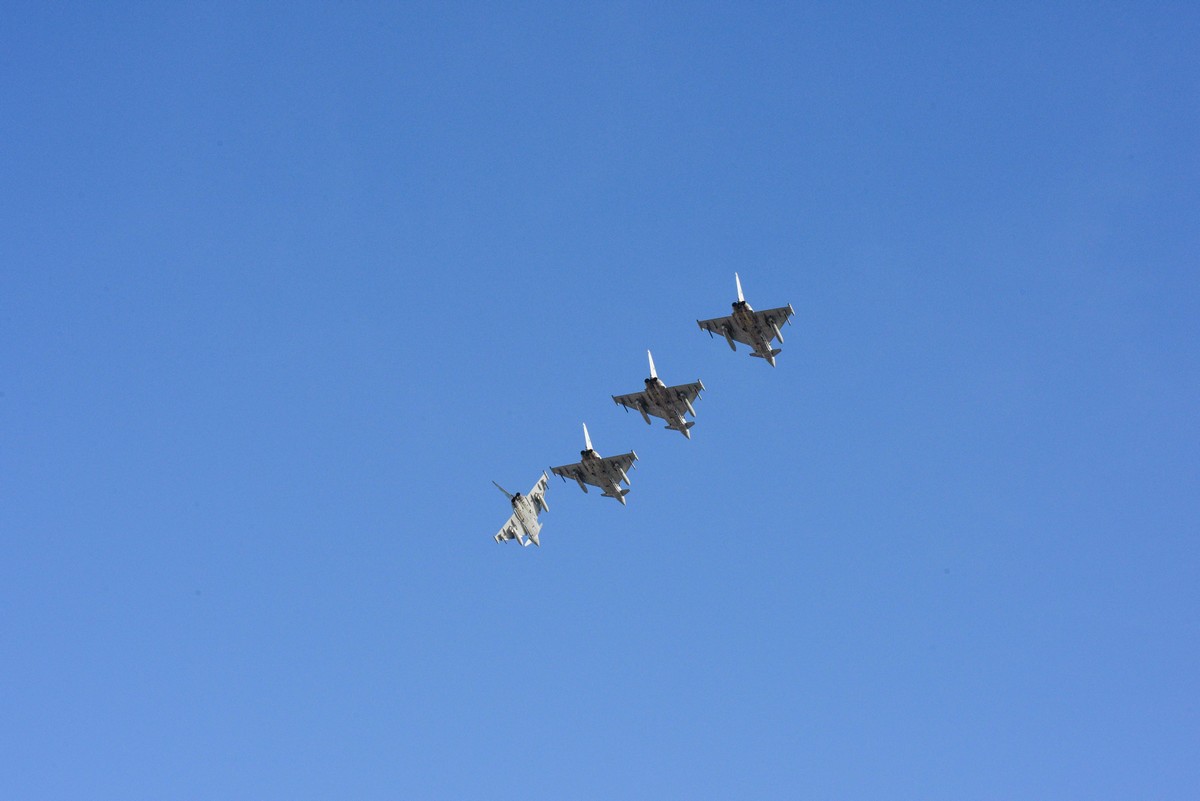
Royal Air Force Typhoon aircraft have deployed to the United States for Exercise Red Flag 26-1, joining American and Australian forces in what is widely regarded as one of the most demanding air combat training events in the world.
The RAF said its aircraft have arrived at Nellis Air Force Base, Nevada, to take part in the 51st iteration of the exercise, which is designed to simulate the opening stages of a modern air campaign in a highly realistic operational environment.
Exercise Red Flag was established in 1975 following lessons from the Vietnam War, after analysis showed the first ten combat missions were the most dangerous for aircrew. The exercise aims to replicate those early missions by exposing participating forces to complex, high-end threats in a controlled training setting.
According to the RAF, the training takes place across the Nevada Test and Training Range (NTTR), covering 2.9 million acres of land and more than 12,000 square miles of airspace. This year’s exercise is expected to involve around 3,000 personnel from 32 units drawn from the U.S. Air Force and Space Force, U.S. Marine Corps, U.S. Navy, Air National Guard, alongside the RAF and the Royal Australian Air Force.
Red Flag is designed as a full-spectrum training package, involving not only pilots and aircrew but also maintenance teams, intelligence specialists, logisticians and support staff, with the aim of replicating the realities of modern operations.
A Tactical Command and Control Team manages participating aircraft and units across multiple domains, including ground, maritime, cyber and space-based elements. The RAF stated that the scale of the exercise is intended to build operational experience while reinforcing cooperation between the UK, the United States and Australia. For Red Flag 26-1, the RAF has deployed 12 Typhoon aircraft from RAF Coningsby and RAF Lossiemouth. Supporting assets include an RAF Voyager tanker aircraft to provide air-to-air refuelling, an A400M transport aircraft from Air Mobility Force, and the RAF’s Rivet Joint intelligence aircraft from 51 Squadron as part of the service’s Intelligence, Surveillance, Target Acquisition and Reconnaissance fleet.
Red Flag continues to evolve to reflect modern threats and is known for its use of “aggressor” forces, simulated enemy aircraft, ground-based radars and surface-to-air missile systems. The exercise also includes cyber and space-based elements intended to replicate threats to modern air operations.


The air force has provided a larger contribution compared to many years. Good to see.
I was thinking the same thing!
Interesting no F-35Bs though, not quite sure why on that one.
Shame that the new radar on the Typhoons isn’t ready to go yet, but wonder if they’ll be able to use simulated Meteors to engage- or keep it all simple and use AMRAAM metrics instead.
Hi mate, because Typhoon is such a mature platform they will probably be playing red air. Yes the new radar will be a step change.
Interesting, hadn’t really considered that they could be red air! I’m thinking that, with Meteor, they’d make a good analogy to a Russian fighter with an R-37, or a Chinese one with one of their long range BVRAAMs.
They won’t deploy 12 jets to play the bad guys. The will be blue air, with the aggressor sqns playing red air.
Yeah you probably right it was a guess on my part.
Typhoon doesn’t need the new radar to fire Meteor, they can do that already.
It just gives extra range and EW performance.
Sorry, I re-read that and realised it absolutely looked like I was connecting the two- I’m not. Was just thinking about Typhoon’s different capabilities and which ones they may be able to use for the exercise. I know that Meteor doesn’t require ECR Mk2.
I’m thinking that, with Meteor, they’d make a good analogy to a Russian fighter with an R-37, or a Chinese one with one of their long range BVRAAMs.
I hope they’ve done the UK proud and embarrassed a few yanks!
Don’t really give results on Air exercisers
From what little I can find out there, Typhoon seems to be a tough nut to crack. Still, as Andrew below correctly pointed out, not much is in the public domain – and for good reason.