

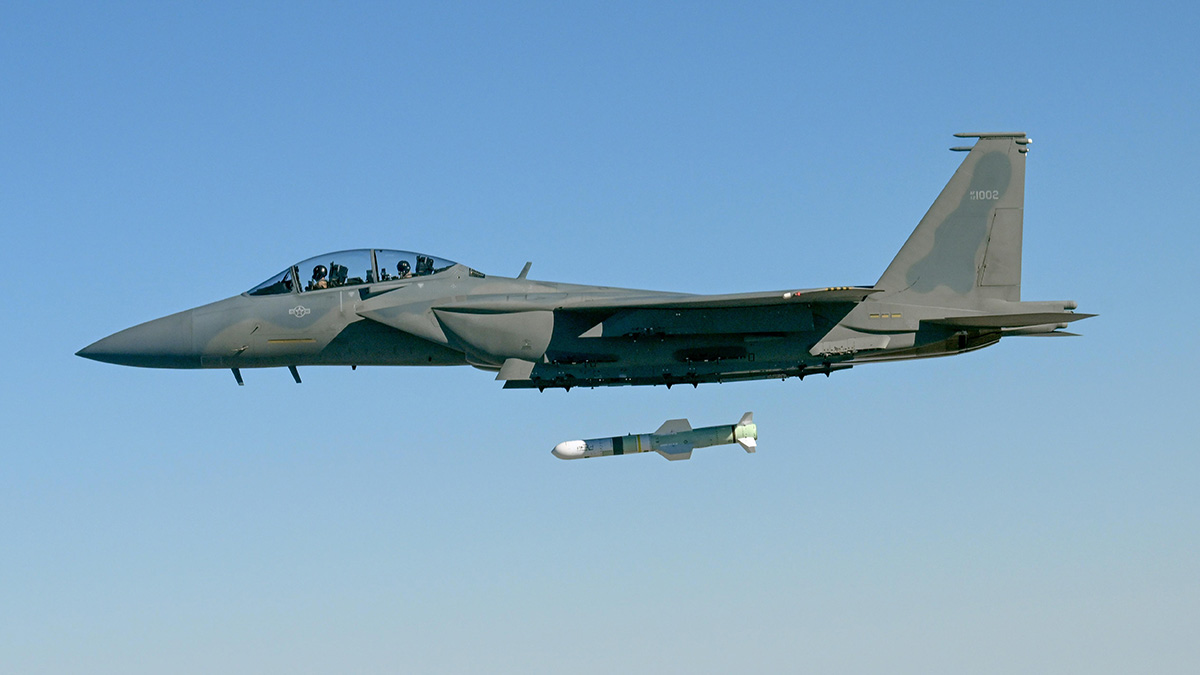
The U.S. Navy has completed the final planned flight test of the Harpoon Block II Update (HIIU) Obsolescence Update programme, a key step in efforts to modernise and sustain the long-serving anti-ship missile.
U.S. Naval Air Systems Command said the third and final test was carried out on 16 January, with the missile successfully conducting a coastal target suppression mission against a representative land target. The event took place at Naval Air Weapons Station China Lake and the Point Mugu Sea Range in California, led by the Precision Strike Weapons programme office (PMA-201) in partnership with Boeing.
“This milestone reflects the strength of the integrated government and industry team and their commitment to delivering reliable, relevant capability to the fleet,” said Captain Sarah Abbott, PMA-201 programme manager.
According to the U.S. Navy, the missile was launched from an F-15 at approximately 12,000 feet above ground level before descending to an initial waypoint altitude of 5,000 feet. It then continued towards the target area and performed a steep terminal dive prior to impact, meeting all test objectives based on preliminary assessments.
The HIIU flight test campaign consisted of three events designed to validate performance across different mission sets. The first verified guidance and aerodynamic performance, the second demonstrated an engagement against a moving maritime surface target, and the third confirmed effectiveness against a land-based target.
“This achievement reflects the coordinated efforts of professionals across program management, engineering, logistics, test and evaluation, aircrew, ground support, and range teams, alongside our industry partners,” said Bob Cress, SLAM ER/HIIU development team lead.
Naval Air Systems Command said system-level flight testing is now nearly complete, with initial deliveries expected later this year. The Harpoon has been in service for more than five decades and remains widely used for anti-ship and land-strike missions. The HIIU programme is intended to address obsolescence issues and support continued production, with the U.S. Navy noting that more than 30 foreign partners also operate the missile.




Another capability the UK has gapped, unless helo launched missiles.
The P-8 is certified for Harpoon, Typhoon could be along with Marte-ER.
The Ru navy clearly poses no threat.
Reasonable when you think that the primary ship killer is an SSN and the operational one is on its way to Australia.