

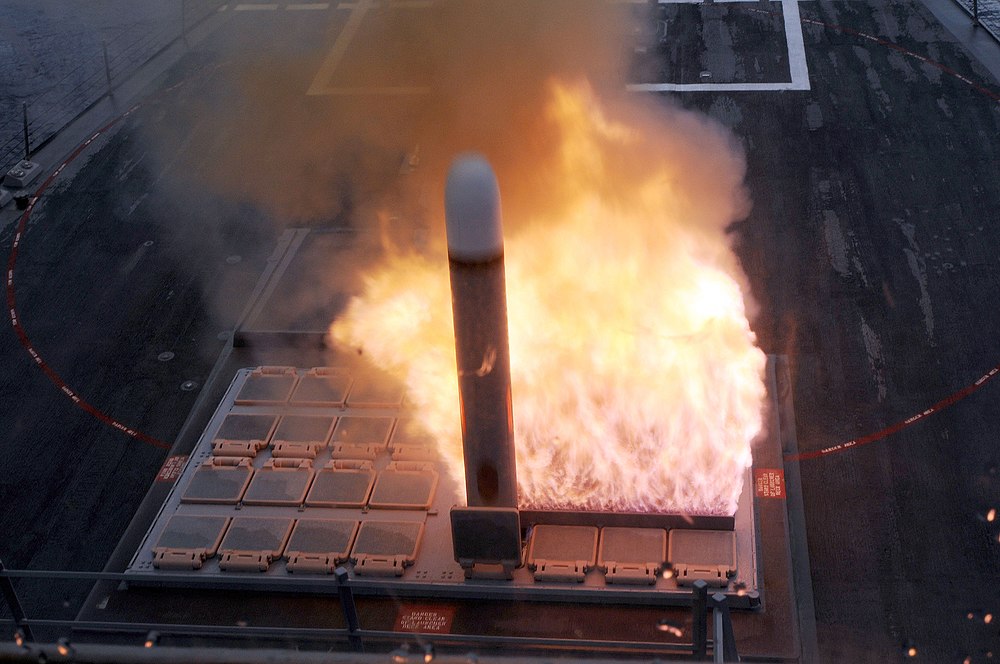
Raytheon has signed five major framework agreements with the U.S. Department of War aimed at significantly expanding production capacity for key missile systems, including Tomahawk cruise missiles, AMRAAM air-to-air missiles, and multiple variants of the Standard Missile family.
The agreements, lasting up to seven years, are intended to increase annual production and accelerate deliveries of Tomahawk Land Attack and Maritime Strike variants, AMRAAM missiles, SM-3 Block IB interceptors, SM-3 Block IIA interceptors, and the SM-6 missile.
Raytheon said the agreements will allow it to raise Tomahawk production to “more than 1,000” per year, AMRAAM production to “at least 1,900” annually, and SM-6 production to “more than 500” annually. The company also plans to increase SM-3 Block IIA output and accelerate SM-3 Block IB production.
According to the company, “many of these munitions will grow 2 to 4 times their existing production rates” as global demand continues to rise. RTX Chief Executive Chris Calio said the agreements would reshape how government and industry cooperate on weapons production. “These agreements redefine how government and industry can partner to speed the delivery of critical technologies,” he said, adding they were linked to the administration’s Acquisition Transformation Strategy.
Production work will take place at Raytheon facilities in Tucson, Arizona; Huntsville, Alabama; and Andover, Massachusetts. RTX said it has already invested heavily in capacity expansion and will continue to fund facility, workforce and technology upgrades to sustain what it described as a historically high production rate.







This is actually good news as we use AMRAAM on F35B and can potentially use the others in T26 or T31 in the case of T31 controlled from another platform.
Better news might be to accelerate Meteor integration.
Sometimes a bird in hand and all that.
Meteor needs tech refresh and the dreaded Blk4 software.
I think LM have got the memo on that one.
That would be great news.
Should have bought American
Should have bought British, but there you go.
What British ? 🤔
Yes because we did not buy it.. use it or loss it.
no, it’s just you 😀
Since I suspect any peer war will really be played out at the strategic level being able to build shed loads of a sovereign conventional strategic weapon that you can fire in the hundreds every month at you enemies sensitive bits is core to winning.
And one clear lesson from Ukraine is even friendly nations get a bit cautious about opening the taps on strategic weapons when you are in a conflict with a peer.. just incase it starts to involve them.. probably one of the most important jobs for the UK now is developing the manufacturing capabilities to build lots of strategic conventional effectors that can hit Russian ( air, sea, sub sea and UK ground launched)…. I would buy some more tomahawks as well so we have a very good stock of them as a war reserve to load into MK41 launchers..
I read previously the RN had a grand total of 64 Tomahawk missiles. Not sure how accurate that is but if true, that’s a paltry number!
Yep that’s the number you need for picking on a random second or third world nation in a war of choice… not an organic war with a peer power… for that you will need 1000s
It’s correct