

Ferguson Marine has appointed shipbuilding veteran Duncan Anderson as permanent Chair of its Board, following a period serving as Interim Chair, the company stated.
Anderson, a Chartered Marine Engineer with more than 40 years of experience, joined the Ferguson Marine Board as a Non-Executive Director in March 2025 before taking on the interim leadership role.
Graeme Thomson, Chief Executive Officer of Ferguson Marine, said the appointment would support the yard’s ongoing modernisation and governance reforms.
“Under Duncan’s leadership, we will continue to modernise our shipyard, improve governance and sharpen our operational delivery,” Thomson said.
He added: “I am certain that with Duncan at the helm, our Board and senior leadership team are well-positioned to secure the future of Ferguson Marine and will guide us successfully into this next chapter.”
Anderson said his priorities as permanent Chair would focus on transforming the yard into a more competitive and sustainable business. “As incoming Chair of the Board, my focus is clear; transform Ferguson Marine into a modern, efficient and profitable shipyard,” he said. He added: “I look forward to continuing to support the management team to establish its strategic direction that will enable it to compete confidently, secure new contracts and build a sustainable pipeline of work.”
Ferguson Marine described the appointment as part of wider efforts to modernise the shipyard, improve delivery performance and strengthen its ability to win new business.









Add a Table and you’ll get a Boardroom.
Seriously though, this Is excellent news.
What’s the table’s name?.
I have no IKEA.
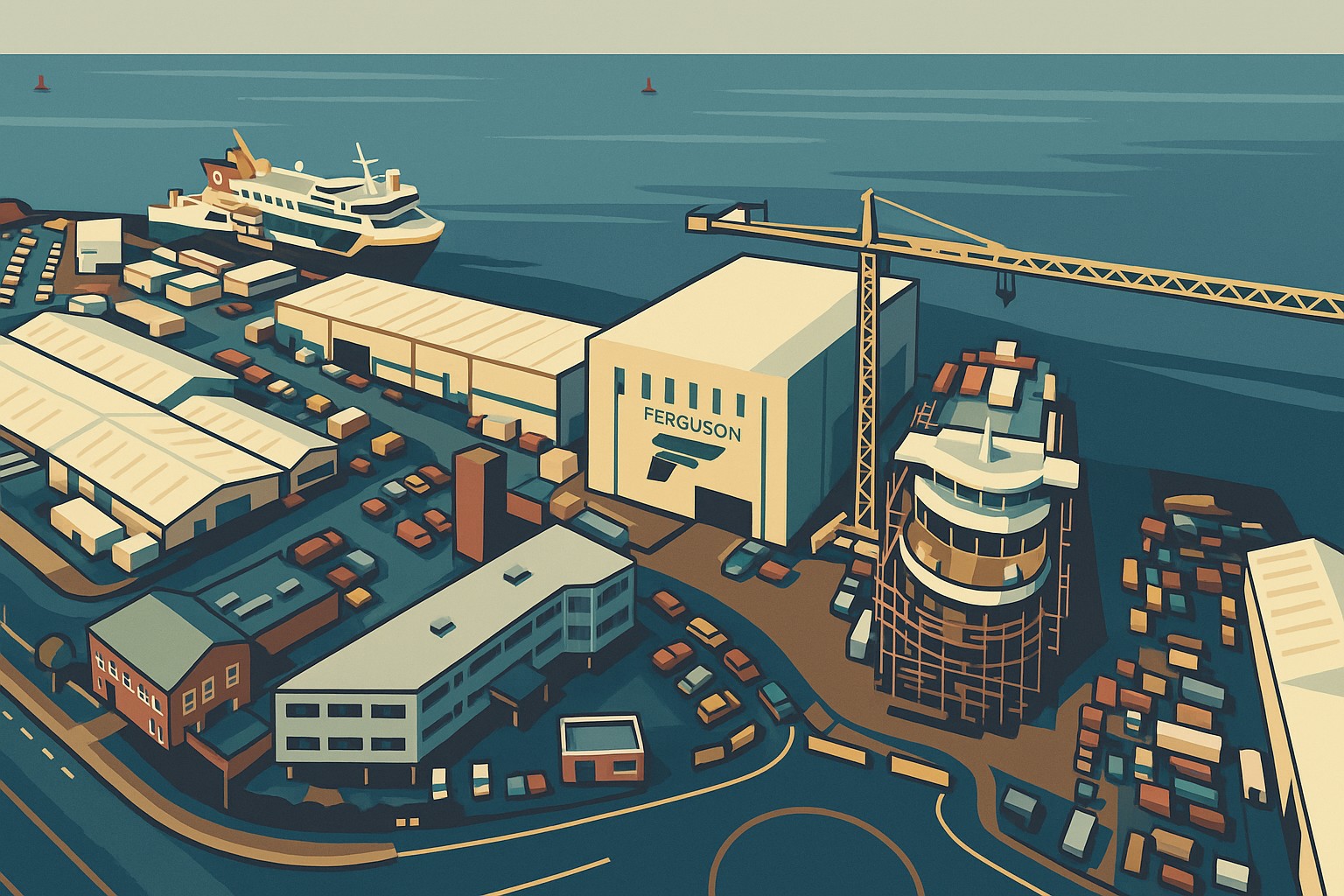
Was an AI generated image really necessary?
That will explain why the other side of the river is missing, or it s Foggy!
It’s not foggy … I can clearly see Ardmore Point Carpark 4 kms across the Firth of Clyde / Clyde River, between the Red Port Hand Buoys numbers 40 and 42. Strangely, Green Starboard Hand Buoy No. 9 is missing.
It’s used a lot.
I like the 30’s Art Deco’esque / WPA’esque poster style, its use of clean lines, and its flat, limited colour pallet are evocative, and quite frankly, a lot easier on the eye than the actual reality.
Are you suggesting UKJD splurge out on an artist in residence or that George gets a graphics dept.
Off topic, but BBC News is today reporting Kier Starmar is now considering moving defence spending up to 3% of GDP in this parliament which could be as much as £14 billion a year in extra funding.
The treasury is said to be doing everything it can to stop it.
Yup, saw that earlier. Didn’t see anything that said the Treasury was doing everything to stop it but, It’s the most logical thing I guess.
I sense the delay to the DIP announcement might just be down to the “Smelling of Coffee” that happens when sleepy people wake up.
Currently watching a T45 doing stuff and a Wildcat, also doing stuff, It’s Funday Monday here !
I hope so. That will actually be something. It was a stated aspiration to reach that figure by the end of the decade, but a commitment to do it inside the parliament means there will have to be some real action beyond talk and the £6bn promised from Foreign Aid. The BBC says “Reaching the 3% of GDP target five years earlier than planned would be hugely expensive.” It isn’t five years earlier than planned — the 3.5% target was for 2035 — and it won’t be hugely expensive. I reckon it would mean an extra £14bn a year in 2029 terms over what had been planned by 29/30. Sir Keir had already announced 2.6% in 27/28, though 0.1% wasn’t new money. That’s not hugely expensive for what is expected to be a £3.5tr economy. Maybe they mean expensive in terms of the £4bn a year that the BBC burns through.
The real question is, how much of that £14bn will be new money, and how much folded in with existing non-defence commitments? The Treasury need to be told to keep their noses out. When forming a war cabinet, first eject the Treasury from the room.
I think all the money being described to move up to 3% will be new money. Ukraine funding is already part of the 2.3% budget, unless we are preparing to substantially increase funding to them then there is no where else for it to go.
Apparently the big hold back is finding the funds, unfortunately the last government left so much debt and a massive deficit that our traditional war chest is largely closed. The legacy of Liz Truss looms large.
I think Ed Davey suggestion of war bonds may be a way to go but finding £14 billion a year in extra debt when we are already borrowing £150 billion a year just to keep the lights on is tricky. We could remove the triple lock on pensions which would seem like the obvious place to make big savings as it’s the only budget that has never been touched and indeed had a rapid increase since 2010.
The MoD also seems to have little ability to spend such money without pissing it up the wall.
They have had to admit they underspent £500m on submarine maintenance now because they can’t physically spend the money due to lack of infrastructure.
Every munitions line, aircraft factory and shipyard is now full for years. The MoD can’t even recruit the full 73,000 soldiers it’s budgeted for.
If we increased their budget tomorrow by £14 billion per annum what would they spend it on.The Frigate line at Rosyth and the Typhoon line at Wharton are probably the only place you could put new orders in at the moment and both may fill up soon.
Pay and recruitment would swallow a lot of that as would fixing/replacing accommodation.
T32 B2
MRSS
5 x P8
3 x E7
24 x Typhoon
24 x F35B
48 x F35A
Containerised CAMM
NSM for T26/T45/T31 B1&2
Mk41 T31 B1
Missile stocks for Mk41
There are a huge number of programs run slow for cash reasons that could be speeded up.
Your not going to get many of those items before 2030 if you order them today
Boosting pay because we suddenly have more budget is just pissing money up the wall. First available deliveries for Typhoon are 2031. First available production slots for F35 are 2029 and the first available delivery slots for Type 31 B2 are 2029 no these are the product lines looking for work. Anything like SSN’s or 2026 we can’t get until 2040
I have got news for you: defence spending doesn’t work like that.
If you order something that is going to be delivered at date X and be made operational you need to have a crew for it which needs to be trained, maintainers need to be trained, spares need to be purchased and stored, facilities need to be built. Even with the build long lead time components and their spares need to be ordered and stored.
So the end of the cash curve is delivery but the spending curve starts way before the delivery, IOC and FOC points.
That is why not even starting the ramp up is so loopy nor even signalling t=0 on the ramp up or the rate of the ramp up.
Yes but you have £14 billion a year more and you need to start spending it now. Not planning for future recruitment pipelines to deliver in 6 years when you finally have equipment to start putting people in.
There is a limit to how quickly defence spending can be ramped up, we have a lack of young people in general wanting to serve and we have a limited industrial base able to produce weapons.
Weapon systems themselves are so complex they take longer than most historic wars to produce a single extra item even on production line like Typhoon and F35 that are currently hot. The rest of the world is rapidly tooling up as well and what extra capacity exist is being given to Ukraine to keep them in the fight.
I don’t think the MoD can efficiently spend much more than a few billion increase above inflation each year without a decade of planning and infrastructure build. The USA has proven this for a number of years, emptying cash into the military shows little results beyond a certain level.
The only thing you can do to effectively increase capability with spending is to draft large numbers of soldiers and equip them with relatively basic or refurbished equipment which is exactly what Ukraine and Russia are doing.
@Jim you have contradicted yourself.
“Yes but you have £14 billion a year more and you need to start spending it now. Not planning for future recruitment pipelines to deliver in 6 years when you finally have equipment to start putting people in.”
Does not square with
“we have a lack of young people in general wanting to serve and we have a limited industrial base able to produce weapons.”
Which means that the ramp up must start early.
There are a huge number of very basic things that can be done such as buying adequate 155, 105, 57, 40, 30mm stock that just require money committed for the ramp up.
There are other things like missiles that take longer but they do need a ££££ commitment to get started on the curve.
We are not talking about £14Bn this year we are talking about +£4.6Bn per year over three years.
I’m sorry that you think that is an awful lot but it isn’t and there are factories and production lines making thing a very inefficient prices because the ££££ have been throttled for in year savings.
To a certain extent releasing the constraints to allow delivery to be commercial will reduce unit costs.
I see you’re making another political broadcast Jim. Labour said they ahd been left a “blackhole” of £26 billion which was downgraded to £14 billion by the OFI. Let’s compare that with the £106 billion blackhole left by Gordon Brown (2010 figures), who had also sold the gold reserves at a discounted price, and you might accept that they are BOTH TO BLAME for the problems with defence spending.
On the money suggested today (no actual confirmation), it was originally stated that<subject to funds< spending would be increased to 3% early in the next parliament. Now the idea is that it might be 2029, potnetially a whole month before the next parliament starts. I am not therefore getting excited. Bythe way Liz Truss never passed a budget so blaming her is really stretching it.
Hi Geoff, can you explain what Gordon brown selling gold 20 years ago has to do with current bond yields? Are you blaming brown for the Liz Truss mini budget or BoJo’s Covid spending blitz?
What do you think they did with the money from the gold?
No, of course not, althoguh I am struggling to see what CBY’s are to do with today’s annoumcement. I was merely responding to your claim that everything was the Tories fault. Now, if you would like to accept that Labour are rubbish when it comes to defence as I did when I critised ther Tories we can all move on>
I never said the Tories were rubbish on defence I said they were rubbish on the economy. Since Gordon Brown left office we have gone from 35% debt to GDP to 100%.
Liz Truss caused the first run on the pound since 1992. These are not political statements, they are simple statements of fact.
You’ve avoided my point again Jim, and answered none of the questions. We are on a defence website. Tell me one thing you think Labour have done for defence in the last 20 months. Please don’t say they have not been in power long enough. Just the promises in their manifest will do.
I’m not convinced. Don’t forget NMH could do with an increased budget and actually ordering, GCAP can be pushed along, more F-35s, and loathe as I am to call it, Ajax upgrades/replacement, more Boxers and ordering the lighter tactical vehicles for the Army.
But we are talking about 2029/30 and we are currently moving into 26/27. There’s a four year ramp up available, so instead of just dumping £6bn in in 27/28, we can start by addressing the £28bn black hole over 4 years. That’s probably an immediate spend of £7bn available and you are right that much will have to be spent on infrastructure to allow greater spending in future years. Further speeding of escort manufacture at Govan/Scotstoun is possible if there’s certainty of fast procurement into the 2040s. We can also start with spend abroad on the ice patrol ships. Sorting out the RFA wouldn’t go amiss. Taking the brakes off MOD recruitment. Does anyone know which year we can start upgrading the F-35’s that we already have? Industry will expand to take up the available moeny if they are certain it’s there.
Some of the more sober commentaries have pointed out that the Treasury have essentially refused to let any more money be spent on Defence until the procurement reforms were put in place, ie the ability to spend money being taken out of the hands of service chiefs (which is apparently a good idea, but I’m not sure why don’t shoot the messenger etc). Those were delayed by the new NAD being a little slow off the mark and so new funds have essentially been off the table for the DIP.
Starmer being able to say the increases will be brought forwards indicates that the reforms are viewed as successful and Defence is now considered a ‘safe’ area to ramp up money without it being spent willy-nilly on pet projects. As DM says though, let’s wait for the DIP to come out and the Spring Budget before leaping for joy.
Well I hope they delay this until all the Pot Holes are fixed.
Tanks fall into po-th-oles too, the cunning plan is that that is part of the 1.5%.
Go NAD!
Hopefully he doesn’t balls it up.
Big ones !
And take any influence away from The Good Idea Club….
Words until shown otherwise, which the public see and swallow.
Plenty to spend extra money on, SBs list, then add a whole series of programmes for the Army.
Only words indeed, but would Starmer have dared utter them if he wasn’t already pretty sure the funding is available? On the other hand… We wait to find out.
The irony is, of course, that the MOD having not expected these early extra funds will take years to work out what to do with them!
Well If Starmer thinks we need to spend, then things must be bad.
Yes indeed. There is much going on that we are not aware of, so I would not be surprised if the PM’s security briefings are somewhere between unnerving and downright scary… I can think of no other reason for this, or any other UK government to be openly talking up the chances of increasing defence spending, especially has it may yet lead to high taxes no matter what they say.
There is also the likelihood of a serious loss of status in Europe if we do not step up, never mind what the chap in the White House is likely to say..!
Cheers CR
Well there is another interpretation….
It is a backdoor way of subsiding re-industrialisation of the UK.
Pushing the service chiefs aside might well be to do with things like F35/Typhoon choices: the first one being RAF’s choice of platform; the other being necessary for GCAP continuity and building up UK skills mass.
There are lot of reasons to push the service chiefs out of teh way: not all them militarily good ones.
The Unions like UK centric spending and it does make a lot more sense if the spending on unit quantities is higher so the R&D overhead doesn’t kill the unit costs and also so production speed matches commercials and not Treasury.
Interesting points there, mate.
I agree about the reindustrialisation and I think it is a necessary that the West as a whole needs to take, not just the UK to be honest.
As for pushing the service chiefs aside I hope that the real situation is more nuanced than a simple undermining kind of process. As you point out there would be good military reasons for not pushing them out of the way. The problem as I see it (and I think you and I basically agree here) is that there is a real tension between short and long term solutions to the serious situation we now find ourselves in. Fixing short term problems for NATO as a whole is not just a matter of buying from overseas to fill local design and production bottle necks because our allies are in pretty much the same position as we are. Even Germany is struggling to up production and it all come down to people and experienced people in particular. Over the last 30 to 40 years we have not only demilitarised, but we have also de-industrialised our economies to a greater or lesser extent. As we both know well experience comes only with time whether that is niche roles in the military or industry. Shortage of such experience is well demonstrated by lack of key people to fill out escort crews in the RN and difficulties in restarting the SSN program, both issues are still on-going.
So I can see the service chiefs wanting to buy off the shelf stuff, but the queues being so long for the limited production capacity available that it becomes a beggar thy neighbour exercise. The politicians meanwhile push for local production for well paid jobs. That is before we even consider the issues around developing local specialist stuff and the risks around gold plating. Trying to decide which is the best way forward is hugely complex. It is not just about requirements and design of systems, it needs to be a national effort with a robust set of interlinked strategies that enjoy Joint and across party consensus on the basics and they need to sit within a NATO / allied context. One area where I think the military should take a step back is in the requirements / specifications. They seem to be using these to long screwdriver the design process. Write a brief cardinal point specification (and I mean brief) and throw it over to the the boffins to innovate…
I could blather on, but I am well aware that you are completely au fait with the issues… 🙂
Cheers CR
That’s why I was thinking 😰
I’m consering it as well