

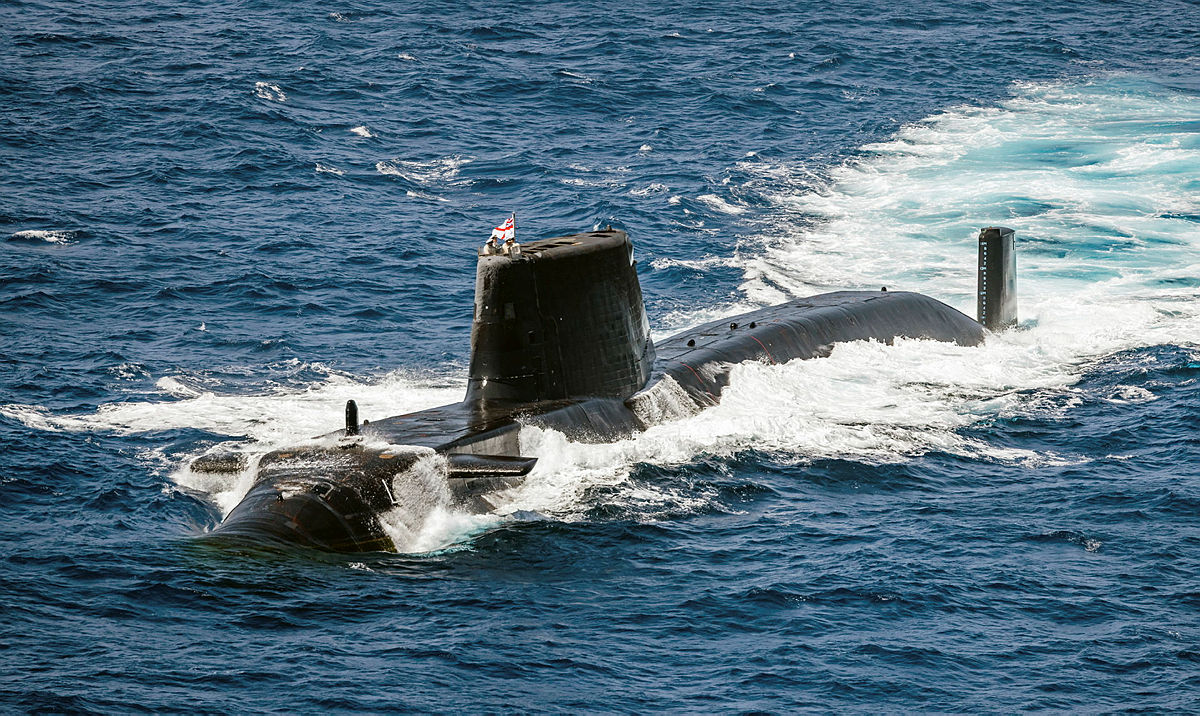
The UK should consider significantly expanding its submarine force as undersea threats proliferate and the barriers to entry for hostile actors continue to fall, witnesses told MPs during a House of Commons Defence Committee session on undersea activity.
Brett Phaneuf, founder and chief executive of Submergence Group LLC in the United States and M Subs Ltd in the UK, argued that submarines remain central to deterrence and should be treated as a national strategic priority.
“We should have 100% more submarines,” he told the committee. “The advent of uncrewed and/or autonomous systems will be helpful in defraying some of the cost and delays in building submarines by having a capability that works in concert with them.”
Phaneuf warned that the rapid spread of uncrewed underwater technology is changing the character of the undersea domain, with cheap systems increasingly capable of harassing shipping, disrupting trade and threatening critical infrastructure.
“We are seeing a lot more people get into the sea at a lower cost of entry using a panoply of uncrewed systems, microelectronics and acoustics technology,” he said. “The undersea domain in uncrewed systems is catching up with the microelectronics explosion in the 1990s and early aughts.”
He added that the strategic value of these technologies is no longer limited to major powers, arguing that even small states now have access to capabilities that were previously out of reach.
“It is a certain proliferation. I think the most obvious example of all that is what is happening in the Black Sea,” he said, describing the use of sophisticated systems to challenge traditional naval forces. Phaneuf said the use of commercially sourced components and open supply chains has further accelerated the pace of proliferation, with hostile actors able to acquire equipment through mainstream online marketplaces. “These technologies are proliferating; we have seen similar very low-tech capabilities in Yemen, put together with parts that are brought in hardware stores and on Amazon, eBay, or Alibaba,” he told MPs. “That is frightening.”
He argued that such systems may not pose an existential military threat in themselves, but can generate strategic impact by disrupting trade and forcing costly defensive responses. “Those are not going to overall threaten the nation; those are things that will harass and weaken us through abatement of trade,” he said. “Our key adversaries have been very rapidly developing a considerable mass or number of extremely sophisticated capital assets, both crewed and uncrewed, that we are going to find hard to match in Europe or in the United States in the near term.”
Professor Peter Roberts, Associate Fellow at the Centre for Public Understanding of Defence and Security at the University of Exeter, said the proliferation of undersea capabilities is now becoming increasingly widespread and difficult to contain.
“Yes, there is proliferation, yet it is quite localised and very contextual,” Roberts told MPs. “We are now seeing the Taiwanese, the Indonesians, the Filipinos, everyone’s trying to get into this game.”
He said the increasing availability of systems and components means states can acquire equipment quickly, but often struggle to integrate it effectively into a coherent capability.
“It is about the concept of operations, because you can buy all the stuff you want and you can field it, but if you cannot marry it together and use it effectively, you are really pouring resources into a hole that has no use,” he said.
Roberts also warned that the undersea domain has historically been underfunded and under-appreciated, despite its importance to modern security and economic stability.
“It is an area that has been underused and under-invested in, and it is exploitable with a very low cost barrier to entry,” he told the committee. “Before, if you wanted to operate a submarine, you were talking about decades of building experience… Now, you can do it with electronics and information available on the internet.”
Commodore (Retired) John Aitken, a former Royal Navy submariner and now an underwater systems manager at Thales, said undersea infrastructure is increasingly central to global trade and therefore an attractive target for disruption.
“There has certainly been a massive increase, probably because of awareness of the importance of undersea infrastructure and the part it plays in global trade,” he said.
Aitken told MPs that activity beneath the sea is expanding rapidly, with both state and non-state actors exploiting the difficulties of detection.
“There has been an enormous increase in the numbers of people getting involved,” he said. “It is pretty unusual to get non-state actors involved in this sort of activity. But it is still really difficult to do.”


Apparently Boeing is struggling with XLUUV. Seems power and underwater communications are not as easy as they thought, who knew the laws of physics apply to drones 😀
I figure that a useful unmanned capability will have to be largely autonomous, since communicating with it in real time seems to be impractical.
It can transmit by going to a known location with a transducer and then coupling to that to transmit and receive.
It can be cued to do that by ULF.
Instantaneous high bandwidth comms from anywhere in the sea are a dream stopped by physics.
Yes but you then open up a hell of a vulnerability if all your drones have to return to a fixed point.
XLUUV’s seem more like an extension of mines at this point. Great for sea denial especially in littorals but struggling due to lack of power and command and control in a blue water environment.
If you want large numbers of autonomous sensors then sea gliders and USV’s seem like a better idea.
You have a load of fixed points and they can be integrated into the deep ocean sound etc monitoring systems.
It just needs to be near enough to the transducer that the power levels are low enough not to radiate significantly.
You could use cheap gliders in that role. They can move slowly so could ‘swim’ against currents, dive to avoid storms and change position once they have received and onward transmitted data from bigger and far more expensive XLUUV’s. The gliders could also gather their own environmental data as well as acting as mobile network hubs. I realise that gliders already gather and transmit data so why not transmit data for other more expensive UUV’s? Especially as we already operate gliders and have just order a few I read recently.
Just a thought.
Cheers CR
Interesting when we read about that Lockheed Martin platform a week or so ago that did raise the question of ongoing communication, good to see both doubts and possible solutions expressed. I guess in the end the challenge is to fight against that factor becoming too expensive and complex threatening to negate their reliability and overall effectiveness and ultimately reducing their band per buck.
ULF would require enormous power and transmitter size way out of scope for any sea going platform. Receive is different of course, we use VLF for a range of activities due to its capability to penetrate salt water down to a few meters.
I’m talking about a ‘come to mother’ signal from the fixed installation to the USV
Perhaps we should actually get the ones we have working first??
The issue isn’t so much the design of the Astutes but the empty spares parts bins.
While there’s a lot of truth in that, people always use it as an excuse to delay talking about how many we need and how many we should get. We will never spend money 100% efficiently, so people will always be able to point and say get your house in order first, then we’ll talk. We will never have all of our submarines working all of the time, so people will always be able to say, couldn’t you use the ones you have better?
Yes, we could do better when it comes to building, maintaining, operating and disposing of our submarines, and yes we should be do better in getting them working. There’s no doubt of it. But not “first”. Rather, alongside. In parallel. As well as discussing getting more. When we wait, we push delivery into a cycle of boom and bust. Key skills are lost, and we underestimate the difficulty in restarting the industry. Right now if we decided we wanted a small fleet of maybe half-a-dozen conventionally powered submarines to work in concert with SSNA, it would likely take at least five or six years before cutting steel, just to reassemble the capability, build the factories, train the workers. That’s assuming we could get another country to help us reboot.
So what’s the harm in talking about it?
Japan or Korea could build for us.
Any additional UK capacity should go on SSN. We have committed to Aukus but would need to be careful buying SSK doesn’t undermine that
Fitting could be done in the UK but if Tempest connections are to ensure then a small number of Japanese boats and some other exchanges wouldn’t harm.
The problem is the current Government would be so keen on cosying with the EU that he would sign a deal for a EU made product that would cost more..
The Canada sub procurement is an example what the UK could do.
Korea, Japan or Germany could have a dozen SSKs in under 10 years built.
So instead of it taking half a dozen years to reboot UK industry it takes Parliament just as long to agree to move warship (warboat?) production outside the UK. Remember the seven years wasted when we opened up FSSS to foreign competition, and that was just for support vessels.
I’m broadly in agreement. Although getting a domestic manufacturer of conventional boats would be nice, it’s a competitive market saturated with established and popular options, and we don’t have the money to do it while supporting/expanding existing capabilities.
Instead, we could use a conventional submarine buy as a bargaining chip. We could use a buy of A26 to tie the Swedes to the Babcock frigate deal, or do a joint buy with with Canada for Type 212CD to get better economies of scale.
A 26 is expensive junk, will cost billions and deliver just 2 subs
How exactly do you know it’s junk? The Poles have selected A26 for their replacement submarine programme, so that’s 5 being built currently
It’s an SSK, there’s ads and disads to that but the supposed advantage is that they’re cheaper than Nuclear subs right? So why does it cost 1.3 Billioj dollars per unit….
An Astute in today’s money is £2.3b, or $3.13b. A Virginia in 2023 was $4.3b.
Suddenly $1.3b sounds pretty bloody cheap, doesn’t it?
Well I think your points are worth considering, combining an order or as a quid quo pro deal we have to start thinking differently if we are to improve mass, timescales and reduce costs. However can’t see it happening with full scale submarines, still leaves undersea unmanned systems and wider defence projects generally to take it onboard.
Not really, when you’re getting a fraction of the capability.
It all comes down to what fraction you’re getting. Half the capability for half the price? Perfectly acceptable, especially for a cheaper platform meant to add mass.
Sweden have been building conventional boats for a long time, and they’re generally pretty well regarded – the Polish have chosen it, and they’re quite literally on the front lines with Russia.
If we went for the “Oceanic” variant of A26, with the option for 18 VLS tubes, we’d be getting a useful hull, cheap enough to be procured at roughly 2 or 3:1 compared to Astute or SSNA, which could free up expensive and more capable nuclear boats from taskings like training sailors or providing strike options in the Middle East.
Remember, the British Empire of the 1890s couldn’t afford enough first-rate battleships to do everything; that’s not a rationale that has magically gone away
There are some things that quality SSK’s do better than SSN’s. SSN’s are hunter / killers. SSK’s are ambush hunters. SSK’s can be quieter than most SSN’s but lack speed. Hence, they excel in the littoral. Most choke points involve the littoral. SSN’s s excel in the open sea. They can chase down most warships given time. SSK’s don’t bother. Get yourself in the right position & they will come to you. Given time, any SSN or warship can find a SSK, but doing so without the SSK finding you first (as USN has embarrassing discovered) is not always easy. If you want to be sneaky, use a SSK.
Also worth considering that you could build Astutes 40% cheaper if they was built to commercial speed.
How small a fleet are you thinking? I would suggest that anything under seven boats would be economically tough. Less than five would be impossible, given the costs required in maintenance, training, purchase, construction and support for these boats.
Plus, that money would be better spent improving current infrastructure and purchasing additional SSNs.
And there is the rub, improving current infrastructure is a given, purchasing additional SSNs is preferable, but we can’t until our Dreadnoughts, certainly hulls 1&2 are in the water. So as we know, no more until the mid 30,s at the earliest.
Would agree we would need at least 6-7 SSKs to make it financially viable, but then you run up against the ‘where do we build them’ conundrum. It certainly wouldn’t be in this country at the moment, not enough capacity or qualified engineering types. It would mean going abroad as much as that’s not palatable.
It won’t happen, simply because we went away from SSKs in the mid 90’s and opted for an all nuclear force composition instead- a big mistake in my view, but there you go.
The problem is, we can’t maintain and operate those we have. Four out of five Astutes are out of service, Audacious undergoing lengthy maintenance at Devonport with Astute which is now in refit, with Artful and Ambush fufilling a role as pier queen’s at Faslane. It’s appalling and heads should roll for the mess our limited submarine fleet is in.
The issues is lack of spares and discontinuity of contracts for species parts.
Part of the issue with such an extended production timeline is that parts that were state of the art in Astute are now deprecated commercially. Given we are still building #7 keeping parts available for another 25 years is going to be an issue.
Then there is the lack of money to allow contracts to manufacturers for hot production of spares – this is in part caused by the approach of stockpiling long lead time parts but not with spare units or adequate spare units.
Which is probably why the Astutes are taking so long to build as parts are having to be ‘borrowed’ for their sisters.
This is really the bite back of long, slow, cheese pared procurement.
Fully agreeì
Maybe a bit of a silly question but wouldn’t any “spares” manufacturer whether the OEM or later be kept in the supply loop for the whole life of the subs?
Ideally yes.
I can think of four manufactures that no longer exist.
There are others that do exist but are owned in such a way as not to be security clearable or to have moved production abroad.
Other parts have got to be manufactured to improved standards.
100% more submarines means 700 more Astutes. Going to be a busy shipyard.
That would match the build number of the Type VII.
7 more not 700..that really would be something to see…
Someone wasn’t paying attention in Maths class….
True!
I wouldn’t be opposed to a T31 submarine. Cheaper, export friendly & designed to stay nearer to home waters. Freeing up the Astutes (if any are still working) for longer range missions and carrier escort.
Export friendly SSN…..hmmme…..maybe not!
Something based off RR’s supposed cheap as chips entirely self contained micro-reactors, perhaps, with commercial tech? They could be delivered sealed with no maintenance, just pump water in and get a voltage out.
We’d need a second yard but we probably need one of those anyway if T93 is actually going to be a thing.
Those sealed reactors need a turbine.
The only way you have a reactor that directly produces a voltage is having a huge row of cold junctions on the primary circuit of a passively circulating reactor.
Such things have been speculated about but you can’t get the energy density out of them.
Otherwise you need a steam turbine or magic.
What about putting the turbine inside the sealed container? Or would that be a pain for maintenance purposes?
It is just a turbine so it needs turbine style maintenance as well as turbine style space and cooling flows to allow for the reverse expansive effects of the steam.
So you could create a very complex sealed unit that is so complicated that it would statistically break….
That is the thing with having lots of mechanical and electrical parts: statistics are against you.
It all takes a change In priorities and a willing Government with a dollop of money to throw at defence.
No shit Sherlock.
It’s blinking obvious we need more submarines
We also need more Maritime patrol aircraft
A defence investment plan to implement the findings of SDSR
More frigates….or for that matter any frigates. Our escort fleet is now at a ridiculous level and a national disgrace
Another batch of ASW optimised type 31s is going to be needed
More Sterling Castle/ Proteus type off shore patrol and sub sea infrastructure protection vessels
The list goes on.
Starmer might very well lambast our EU allies to do more to prepare for war and yet the UK is going backwards with repeated governments guilty of treasonous cuts to our armed forces.
Perhaps consider bringing back an SSK to the RN. Good for shallow waters. Good for crew and commander training. Much cheaper as they are not nuclear.
A few of us here have been barking for some of these for a while. There’s at least two opportunities nowish to co-build if Canada go big on subs or with Norway and Germany with the 212CD.
There is also the SAAB entrant in the Dutch competition. They didn’t win but not too sure that the winner (France) with a re-run of the Australian competition, was the greatest option. I suspect Netherlands may eventually regret their decision. Canada are not set up to build submarines & I can’t see them spending the money to set up a specialist yard. Germany, if they win the Canadian competition, will be fully booked for some considerable time. Sweden is way better to work with.
On a related AUKUS topic the Australian Government today announced an initial $3.9 billion (out of a total $30 billion budget) for the development of a high security Submarine Construction Yard (SYC) at a 75 hectare greenfield site (adjacent to the existing Osborne shipyard currently building the Hunter Class frigates) in South Australia.
The enclosed main assembly hall will rival the Devonshire Dock Hall at Barrow-in-Furness in size.
The associated Skills and Training Academy (an additional $450 million) will turn out around 1,000 apprentices each year with total submarine workforce expected to be around 5,000 workers.
This in addition to the $5 billion being paid to UK industry and a further $5 billion to support US submarine industrial base.
It’s a massive investment for a country the size of Australia for what could be a minimum build of 3 AUKUS subs (maximum 5 AUKUS). Given the opportunity cost (same amount spent on long range missiles, hypersonics, potential additional aircraft B21s?? and CCAs Ghost Bats at scale or Ghost Shark XLUSVs etc.) it had better deliver real bang for the bucks.
There is no doubt we need more submarines but whilst ever this government is in power there will be the minimum amount of money made available. Defence spending is not a priority and equipment programs are being cut.
Problem is we are talking about a quarter of a century project. Of all military capabilities this is the slowest to regenerate.
Which is why 1SL is right to prioritise fixing what we have got.
No argument from me however we need to drastically increase capacity and shorten the ambitious target of one boat every 18 months. Almost certainly the US ( under the current “ administration “) will not part with one let alone 3 Virginias. So we will need to help out the Aussies somehow. Rumour has it that Japan has also realised in needs to develop a blue water submarine force. And while their fleet of AIP boats in great for coastal work they need something bigger and nastier to operate close to China. The UK is a logical choice as they are already in bed with us over GCAP and their relationship with the US is as bad as ours. The one bonus at least the Japanese already have the technical and skills base. Eg give them a set of CAD files and they can build it themselves with little support.
If they get their current 19 ship buy proposal next year, they certainly will.
Hi
Care to expand on your 19 ship comment.
Oh, the MPs are now back to talking about submarines… again!
And we in UKDJ will yet again say the same thing as last time…
Very repetitive, isn’t it🤣🤔😒
I saw that. It was amusing.
Stop Press: Submarine industry says that RN needs more submarines !!
Who knew?
No money.All talk.More Astutes at £1bn+ a pop?5+years build time?Very unlikely…
Were not building any more Astutes period. We can’t as we’ve switched the reactors design for the Dreadnoughts and beyond. The new reactors don’t fit in an Astute. That’s how simple that is, even if we had the wonga for it.
Can they do a hybrid Astute …with a bigger girth?
We are, sort of, its called AUKUS and it will use a lot of Dreadnought technology, with a twist of new tech and some US magic sauce too….
The government have apparently announced an acceleration of defence spending to 3%, I’ll believe it when I see it, but I suspect they have no choice, they have to get GCAP and AUKUS underway, along with everything else that need funding and they can’t do it with 2.5%.
Hi John, yes, I’m aware of AUKUS, as I live down here in Aus and it pops up into the news a bit. I was thinking more a UK based in-betweener Astute and the AUKUS sub, more a Astute+. But now I think of it, its probably pointless.
In short, unfortunately not. No more SSNs for the UK until after Dreadnoughts are complete.
More SSN’s???
Well, this is a revelation, can’t understand why people weren’t flagging up the stupid mistake in the decline of SSN numbers when they fell below 12???🤷🤷🤷
Oh, hang on we did and have been for many years!!!!
Are they finally waking up and smelling the coffee??
Maybe the MoD/Defense industrial complex should concentrate on getting the best out of the submarines it has before wasting more tax payers money on equipment of doubtful reliability. Why do the Astute submarines look like a sequel to the T45 fiasco?
HMS Astute: Currently in Devonport undergoing a major, multi-year Mid-Life Re-Validation Period (MLRP).
HMS Ambush: Reported to be in port at very low readiness, with some reports suggesting it is being used for spare parts to support other vessels.
HMS Artful & HMS Audacious: Undergoing long-term maintenance and repairs.
HMS Anson: Although recently active, reports indicate it has returned to port, or is at low readiness.
HMS Agamemnon: Commissioned in late 2025 but is still undergoing trials and not fully operational.
T45 wasn’t a fiasco.
Yes, there was an issue with the WR21 which has been fixed by re-architecting the power system with three DGUs a new recuperator core and improved software.
The improved software mitigated the issue.
The T45 was very much a fiasco, imagine trying to run a haulage business or airline with between 50 and 66% of the asset being unavailable for use. Imagine making the finance payments on a cab or an airline that has been unavailable for use for over 8 years. 8 years my friend, this is not acceptable in any world.
The eight years has not a lot to do with engineering and everything to do with the zero investment in sparred and spares pipeline that was the Gordon Brown / Blair gift to defence.
Fighting wars all over the place on a peace time budget knackering kit and no buying replacements does come to a head at some points.
Obsourne’s cuts then finished things off.
You can coast along so far on the bits you have and STOROB but at some point you simply run out of enough XYZ bits to keep a ship running. As you have n-2 XYZs then two ships are on the wall.
We should have more of everything but don’t worry Sir Keir is considering spending more money on defence. Give him a couple of years, or his successor and they will have finished considering …..huzzah!
Other countries that operate submarines in Northern Europe have long since made efforts to protect their fleets with underground bases. Ukraine has demonstrated their vulnerability moored in the open. Those bases were constructed before precision munitions proliferated. We need to think about how we will protect our submarines and expensive robotic systems from everything from covertly launched FPVs to suicide drones and cruise missiles.