

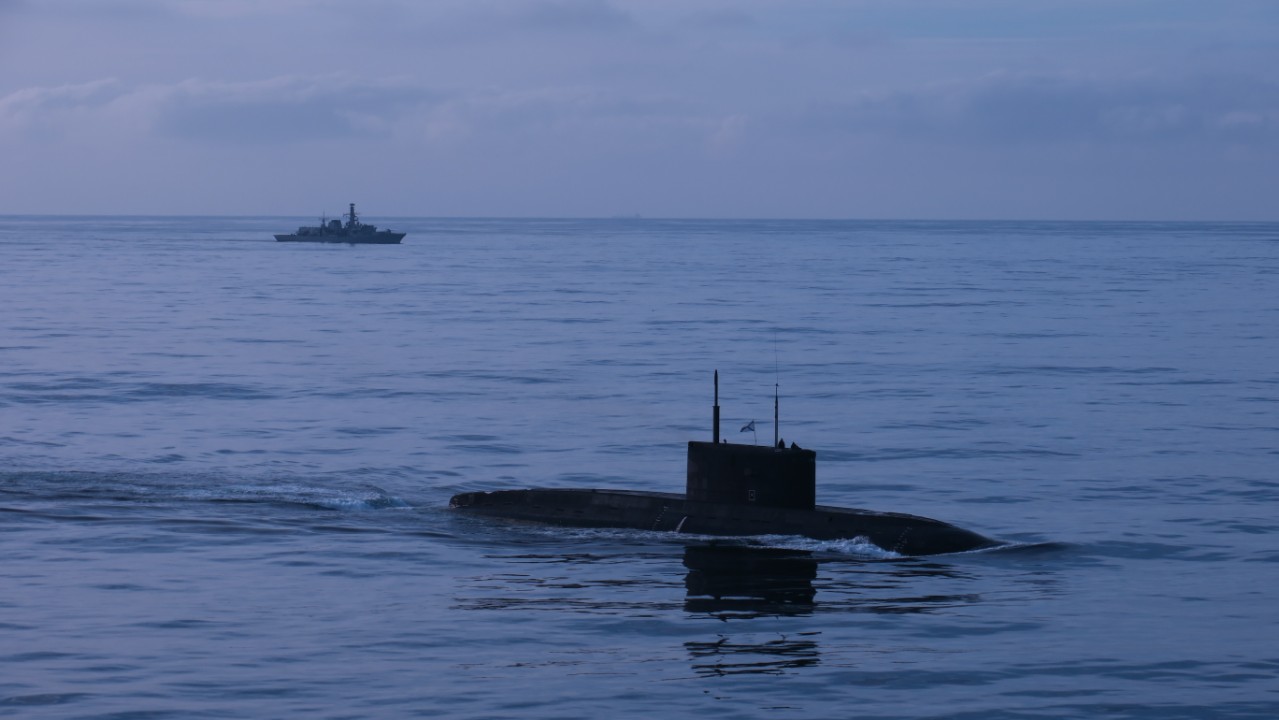
Russia is significantly ahead of the UK and its allies in undersea warfare capability, MPs were told during a Defence Committee evidence session examining undersea activity and the growing threat to critical infrastructure.
Giving evidence to the committee, Professor Peter Roberts said Russia operates a submarine fleet of 64 boats, including ballistic missile submarines forming a core part of its nuclear deterrent, alongside land-attack and hunter-killer platforms. He argued that Moscow’s submarine posture remains rooted in Cold War concepts of assured second-strike capability, centred on a protected “bastion” in the High North.
“They operate their fleet really as a bastion for their nuclear deterrent first, and then everything else comes second,” Roberts told MPs.
Roberts said Russia’s capability is reinforced by a separate deep-sea directorate, the Main Directorate of Deep-Sea Research (GUGI), which he described as operating around 50 specialist ships and submarines capable of operating down to 6,000 metres. He said these assets are designed not only to protect Russian undersea infrastructure but also to threaten that of other nations.
“Their primary role is in the protection of their own critical undersea infrastructure, but they also have a secondary role, which is to strike at others’ critical undersea infrastructure,” he said.
The committee heard that the UK’s geography makes it particularly vulnerable. Roberts told MPs the UK hosts 119 data cables and described the country as a gateway for Europe’s digital connectivity to the United States. He warned that disruption could have severe economic and societal consequences, adding that the UK is exposed in ways that differ from the land-based frontline in eastern Europe.
“In terms of the first line of defence and the land battle, we are clearly further away from the eastern front, but underwater we are pretty much on the frontline, aren’t we?” MP Derek Twigg said. Roberts agreed, telling the committee: “Yes, absolutely.”
He also warned that Russian strategy increasingly targets civilian infrastructure to undermine political will, describing a “counter-value” approach focused on disrupting society rather than striking purely military targets. He pointed to attacks in Ukraine targeting energy infrastructure and suggested similar threats exist for European states through cables, pipelines, and other vulnerable systems.
When asked directly whether the West is matching Russian capability, Roberts gave a blunt assessment. “I think they are way ahead of us,” he said.
Commodore (Rtd) John Aitken, a former Royal Navy submariner now with Thales, supported the assessment and told MPs that Russia’s most modern submarines represent a serious threat. He described the Borei-class ballistic missile submarine and the Yasen-class nuclear attack submarine as “first-rate submarines” and “very difficult opponents.”
He also highlighted Russia’s specialist ability to operate under Arctic ice, warning that it remains a challenging environment for NATO forces. “We have a very limited capability under the ice now in the Royal Navy, and we need to reinvest in that,” Aitken said.
Aitken told MPs that Russia could use the under-ice environment to conceal ballistic missile submarines, reduce warning time, and complicate tracking operations. He described the Arctic seas as noisy due to ice movement, making detection harder, and said Russian submarines can exploit the environment by positioning close to the ice itself. “We also know that they have the ability to burst through the ice and then fire missiles into Europe or North America, which reduces reaction time,” he said.
The session also touched on the Baltic Sea, where MPs questioned whether Russian submarine operations are constrained by the Danish Straits. Aitken said Russia retains the ability to operate submarines from its Baltic base, although he acknowledged the environment is more difficult and transit increases the likelihood of detection. “It is shallow and contested, but that is why they operate SSKs there, because they can operate in shallow and contested waters,” he said.





Nothing is being fixed on 2.3% GDP.
Russia would do us a favour by slicing a few more cables. The disruption would mean the politicians can’t sit in fairy land as the public uproar would effect their polling.
Every week we get these warnings and nothing happens..
Not really a surprise as we have known for some time that Russia has been trying to tinker with our submarine cables. Cyberspace is a modern battle domain.
Cdre (ret) Aitken makes some valid points. RN sonar operators can I.D many sounds both natural and man made. Their skills are therefore essential to the arctic battlespace.
What pish, the Russians are ahead of us and there is a red under every bed. The usual “expert” testimony then.
We are talking about a nation that just lost a naval battle to a country with no navy that used only jet skis.
Russia having 64 submarines is a total lie, they have 64 hunks of metal in water that can be referred to as submarines but they have at most 5 modern SSN’s and 8 SSBN’s. There diesel subs are two generations behind western SSK’s and they can’t even transit around Russia without tug support.
Even the Royal navy has a substantially more capable submarine force than Russia much less the rest of NATO.
One of the reasons the Russian navy is in such a bad place is spending what little money it did get before the war or Gucci James Bond esc super weapons to operate in the deep sea.
News flash there is nothing in the deep sea, spend billions on a one off nuclear submarine to do the job that any commercial dive boat can do is a mistake. Fortunately we realised that and went with Proteous. Transatlantic cables in the deep sea are not that big a deal. There are dozens of them and traffic is easily rerouted. There is nothing vital down there like gas or electricity loosing them is an annoyance, nothing more.
Russia would last five minutes in a naval war with even just the UK much less the rest of NATO. Most of its sailors are now being routinely slaughtered in Ukraine to grab “strategically significant” villages and cowsheds.
Yep SSNs are for strategic attacks on nations..
Way tooooooo much cool aid self-administered.
Horses for courses. Ukraine is holding them on a certain Sea, Russia unleashes her might and it is good-night Kyiv and I’ll know a good glassified level parking space for my car in Ukraine.
And quite where you come up with the line – Royal navy has a SUBSTANTIALLY more capable submarine force – what are you mainlining?
The Armed Forces are in their nadir, and things won’t get better anytime soon, until some realism enters the room.
Jim,
If you take a quick look at wiki (assuming its reasonably accurate), the Russians have some 5-7 active and available SSGN/SSNs and some 7 SSBNs in its Northern fleet. We currently have 1 SSN and 2 SSBNs. So, given that over 60% of those assets are very modern (Yasen/Borei class), the article is reasonably accurate. Yes NATO can over match them, but as a single entity Submarine wise, we cant.
The real kicker for the West is the capabilities that GUGI brings to the table. Arguably far more important then the Russian surface/ sub-surface assets, it has been a separate department of their armed forces for over 40 years, and has its own large budget, totally independent of the navy.
They provide all sorts of support to the navy and operate vessels like the ‘Yanter’ class AGIs and all their specialist SMs. We in the West can’t match what the N Flt have if you pooled all of the similar NATO assets. We are generations behind what GUGI provides the Russians with.
We also need to reinvest in sea mining with urgency. In another of our hubris moments we scrapped that key weapon. I think we are daft not to fit our frigates with 21″ torpedoes.
We need fewer Admirals but promote them younger and therefore give them extra time to understand the battle space.
Glad someone else noticed that Russia’s Baltic Fleet is sunk or skulking in hiding and its army is going to make another Big Push any day soon to grab a bit more muddy field with its crack army. These people are not just experts, they are salesmen.
Agree with much of that.
But I’d suggest that transatlantic cables are a big deal, and certainly not nothing vital as you suggest.
Most of Europe’s Internet links to North America, the City of London’s dedicated data link to Wall Street, and cables between GCHQ and NSA for starters are all vital arteries.
Counter value.. it’s like the west has lived in some bizarre fantasy land.. where you send the lads off to war.. they win and come home. Organic peer war is about two nations ( or power blocks ) tearing into each other until one collapses politically or collapses in strategic exhaustion.. it always has been, the west has been living in a delusion in which organic peer war is about winning a few battles.. it not if we end up in a fight with Russia, Russia will not just try and destroy our power infrastructure.. it will destroy our health system water management systems, information systems…everything it can it will launch information campaigns with rogue political movements trying to undermine society and government.. it will use sabotage and terrorist attacks..
Counter value and counter force is a concept of a short nuclear war in which nations die like firefly’s.. it’s a false concept.. there is no counter value and counter force there is just the reduction of the enemy by any and every means possible, social, political, population, economic, industrial, isolation and military.
“Russia would last five minutes in a naval war with even just the UK much less the rest of NATO” … if Russia is that weak, then it is hardly necessary for the UK or NATO to increase defence spending – at least not for conventional military capabilities.
But if one considers Russian military doctrine, the Russians would probably agree with Jim’s assessment. They know precisely how weak they are relative to NATO. At least they know how weak they are in conventional military terms. That is why any active clash with Russia would be so profoundly dangerous. Escalation to the level where Russia is militarily competitive is the great risk because such escalation is logical for Russia. It is at the tactical nuclear level that NATO is out-classed. That is why Russian doctrine stresses nuclear escalation in any peer-on-peer conflict.
Mark Rutte is correct that, without the United States, it is Europe that is actually profoundly weak. That is the great nightmare for Europe and the UK and it is not an imbalance that Europe is in any position to change – at least not in the next decade.
Whilst the majority of European NATO tactical nuclear weapons are B61-12 in the US Nuclear Sharing Agreement, the rest are French tactical nuclear weapons that are delivered by Rafale aircraft. Listening to President Macron those would be available to deescalate the orcZ.
NATO’s dual key weapons are American and that is what makes their use credible.
But when it comes to the British and French, one would have to believe that, say in the event of Russian tactical nuclear use in the Baltics, that either France or the UK would be prepared, independently, to put their national survival at risk by responding with tactical nuclear strikes or with strikes against Russia itself. The imbalance in forces is simply too great to make that credible. The entire UK deterrent really consists of only one SSBN at sea with – at most – 50 warheads (and probably not even that many). That is a minimum deterrent that is really only credible in deterring strikes on the UK itself. The French are, more or less, in the same boat.
That reality, I think, shaped Rutte’s comments that Europe has no way to deter Russia on its own.
Rutte is a time served politician dealing with the various reliability within the NATO alliance so prioritising the thin skinned decision maker in the USA. So blowing sunshine up his back passage is par for the course and has nothing to do with reality.
Rutte is in denial of the US National Security security Strategy document which is an output of MAGA delusion. Will that just fade away like #47 as Rutte hopes, or will European people fund defence in the realisation that This USA is unreliable and the Peace Dividend delusion is over…