


The Defence Investment Plan must underpin a continuous flow of warship construction in British yards, Defence Minister Luke Pollard said at the rollout of HMS Active in Rosyth, as he argued that industry needs both domestic orders and export success to sustain skills and capacity.
When I asked the Minister what confidence shipbuilders could have that the plan would support long term construction of frigates and other vessels, Pollard pointed to what he described as a required “drumbeat” of production.
“Yes, we want to see a shipbuilding pipeline that is a drumbeat of ships that sustains good jobs in shipyards and dockyards up and down the country. To do that, we not only need to have a drumbeat UK orders, we need to win more exports as well. It’s both of those together.”
He said that message was one he delivers directly to prime contractors. “When I speak to Babcock, I say, invest in skills, take on apprentices, take the risk of employing the next generation of talent. Because there’s a rising defence budget, there’s more platforms coming.”

Pollard referenced recent export wins for the Arrowhead 140 design in Poland and Indonesia, alongside ongoing campaigns, describing them as evidence of wider opportunity. “Having Babcock having won orders in Poland and Indonesia at the moment, and them being part of live export campaigns. There’s huge opportunity coming, so we will be having that.”
However, he stressed that future naval growth would not be limited to additional large surface combatants. Instead, he communicated the Strategic Defence Review’s direction as centred on a more integrated force structure.
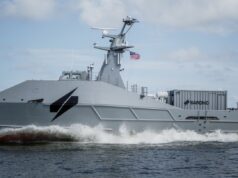
“It’s not just big crude platforms. The key part of the Navy that we’re creating is a hybrid navy. It will not only have crewed platforms, like the Type 26s and the 31s, it will have the uncrewed platforms that will sail alongside.”
Using HMS Bulldog as an example, he suggested future deployments would routinely include autonomous systems operating in concert with frigates. “When Bulldog goes to sea with the White Ensign flying, it’s likely that she’ll have autonomous platforms alongside her.”
That shift, he argued, also creates further industrial opportunities, even if not all of them resemble traditional 6,000 tonne warships.
“There are additional opportunities for shipbuilding. They might not be the 6,000 tons versions, but they’re about increasing lethality, increasing survivability, increasing deterrence that we set out in the SDR, to say actually the Royal Navy of the future will have crewed, uncrewed autonomous systems as standard.”
Pollard added that the size and design margin of ships such as the Type 31 reflected that long term intent.
“Ships like this are so big because they come with the space on board to have additional capabilities added to them, to be able to be networked together. That’s why I think our partners are choosing ships like the Type 31 for their navies, because they know it’s not just a really good platform today. It has the potential to be at the heart of a lethal network in the future.”
The Defence Investment Plan, due later this year, is expected to translate that hybrid concept and industrial ambition into specific procurement decisions.









Hopefully Minster Pollard knows something that hasn’t yet been made public . Please Sir can we have some more warship orders.
and helicopter orders!
and more sailors
Sounds like “code speak” in “more platforms coming” and “huge opportunity” for more T31 or variants of for the RN as well as export builds coming?
Or just talking about the orders we already have more likely. They’ll be out of government before they run out.
When!!!?
pressure to make weekly announcements, but steady warship production is our message for foes & friends
“The heart of a lethal network”. Sounds like the govt is sold on T31 being at the core of the hybrid navy concept. Well done Babcock 👏
Isn’t he, you know, partly in charge of whether they get new orders?
What’s this “We want to see”?
“New platforms coming” is nice, but I don’t like the DIP ‘later this year’ stuff. That’s a new shift, and it was supposed to be ‘later this year’ last year too.
‘We need more orders, wouldn’t it be nice if someone could do something about that…oh well’
I try not to comment on politics, but a wider theme of this government is the impression from the PM and ministers that somebody else should still be making the decisions. It shows with the Atlantic Bastion ‘we want Industry to lead the way’ stuff as well, and it just means nobody gets anything done.
A sort of ‘righteous helplessness’ in all of the wrong places.
Pollard spelled it out. “To do that [sustain jobs in shipyards], we not only need to have a drumbeat UK orders, we need to win more exports as well.” The corollary says that he’s not willing to provide a drumbeat of UK orders that’s sufficient to sustain jobs in shipyards. That’s why he wants to see it but isn’t promising to make it happen.
I think we can do better than that and exports will follow if we do.
Hollow promises are one thing – warship orders quite another.
The problem with this autonomous/remote commanded stuff is that none of it has been fully trialled and it will need the usual R&D curve.
As with anything new it will change a lot from first ideas after contact with reality.
So he says invest in facilities, apprentices and infrastructure and then tells them to go out and win export orders!! Totally puts all the risk on the PLC’s. What about some continuity in our orders?? Standard slippery political operator, nothing more to see here.
yes, that’s how I read it as well. Unless he is telling them privately that there are guaranteed orders coming and they have the paperwork, it would be foolish for any of these primes to invest in UK defence given the fact this Govt talks big whilst cutting the actual budget.
why would you do all the things he is asking to increase your cost base – unless you knew you were going to make a profit.
It is perfectly normal for naval yards to have to look for export orders to keep themselves in business. The yards in France, Italy, Spain, Germany etc seem to do that with ease. The UK yards and other defence companies like Leonardo Yeivil and BAE Warton cannot expect to sit on their posteriors waiting for HMG to pitch up with an armful of new orders.
Sharon from Unite and others seem to be stuck back in the old British Leyland, British Steel days, where HMG was expected.to regularly cough up taxpayers’ money to keep.them in business.
Pollard cannot conjure up more ships, because the naval shipbuilding budget is already stretched to breaking point. Over the next 10 years, it has to cover:
8 T26 FF
5 T23 FF
3 OPV replacements for River 1
3 Castle MCMVs
1 Proteus MROS
3 Resurgent FSS…
… and the whole cost of this Atlantic Bastion dreamworld…
… and the early work on the next generation T83DD and MRSS that need to be entering production post-2035.
The RN procurement budget is something like £2.4bn a year IIRC, of which somewhere around 30% is available for new vessel construction. (The rest goes on support and upgrades and PIP and suchlike). I would think it very unlikely indeed that there will be ANY spare money to fund any more new surface vessels this side of 2035.
Pollard is sort of telling us all this when he taps on the export nerve.
There is not enough in the budget to fund the 23 ships currently planned
It will need a chunk of the new money to do so.
totally agree, it is the constant meddling by HMT that has created this with their short term budgeting. As I have said elsewhere if you defer a project or build in defence for 5 yrs the cost increases at least 100% due to defence inflation. kicking the can down the road in defence has a downward spiral impact.
Its unfortunate, but not unretrievable given our shipyards are actually in good shape, in no small part to John Parker who reset the thinking around what could and should be done.
We just need a ring fenced committed plan and budget that everyone can stick to with the understanding that every year increasing the cost by 10% as that’s just the way it is.
I would also like to see us change the operating model and sell off any vessel before it needs a LEP – in fact I would ban all LEPs in favour of supporting new equipment.
For the MOD’s part they need to stop promising efficiency savings that they know they can’t deliver, its literally £3-4bn every SDR and every time they fail to deliver it.
by my estimates the recapitalisation of each service will need c. £6bn pa for Capital Equipment, potentially more for RN/RAF to get us into true fighting shape.
They just see commerical opportunity, not the strengthening of our Armed Forces.
When the money comes to back up what he says I’ll believe him. Until then the only experience we have of Pollard and co. are delays and cuts. Twenty months Mr. Pollard and so far…NIL
No modern warship is ‘crude.’
I think that was meant to be “crewed”. Voice recognition not working too well, perhaps?
Dip later this year.. sounds to me like it’s just been ripped up and restarted.. maybe the more money quicker has been won… NATO did come along and give HMG a private get a grip talking to.
We will have to see. Labour has just taken a hit from the Greens, and if the response is to move closer to the Greens’ position that could be problematic for UK defence. There is not much fiscal headroom, several revenue measures only bite later in the decade, such as inheritance‑tax changes from 2027 and limits on pension salary‑sacrifice relief from 2029. Meanwhile, growth is weak and inflation has only recently eased, so the real cost of defence may rise faster than the headline 2.5% of GDP target.
I read this as a public statement aimed squarely at the Treasury. Making a pointed statement linking defence spending to jobs and growth. As such, I think we can say that the fight for more money for defence is still on-going despite Starmer’s recent statement to the effect that the GDP targets for defence spending would be brought forward.
I would also say that the Green’s win yesterday doesn’t help given their belief that the Armed Forces should be disarmed and changed into some kind of disaster relief organisation..! I wonder how many people who voted for them realise they would leave us complete defenseless!
Cheers CR