

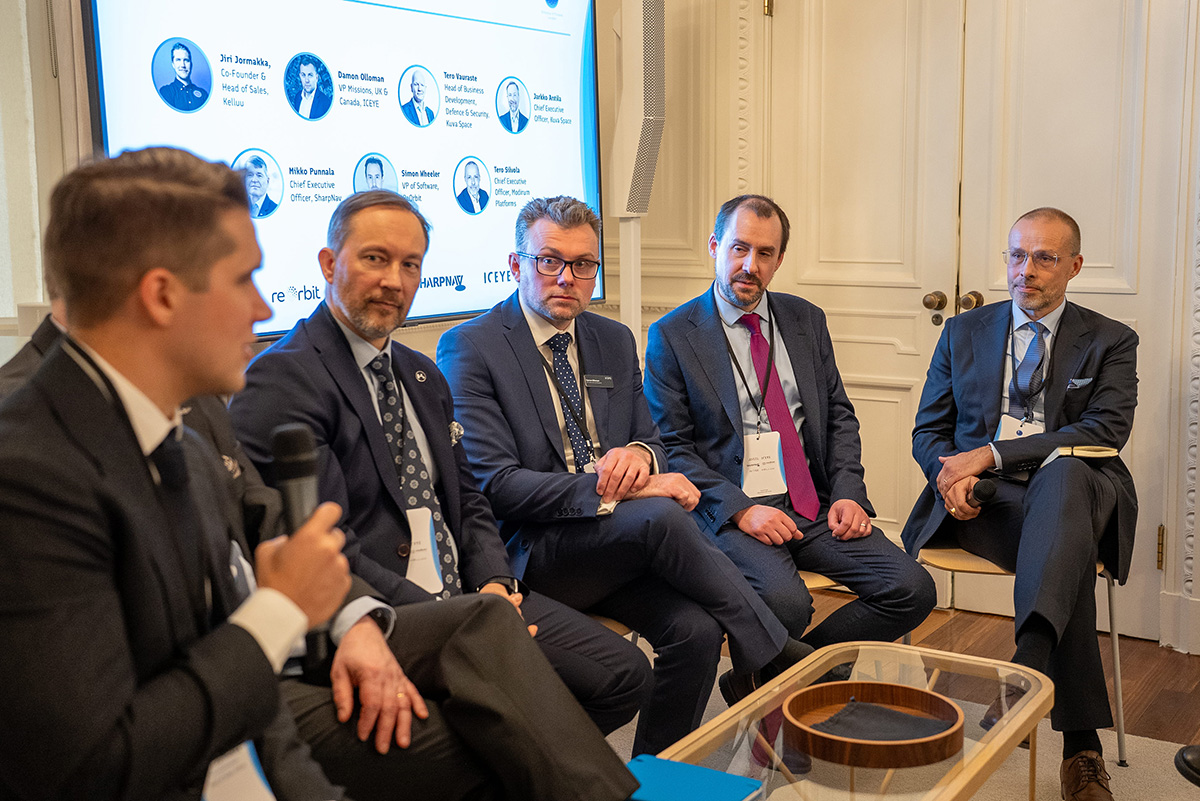
Finland has showcased its aerospace and defence capabilities in London as Helsinki seeks deeper cooperation with the United Kingdom on resilient European space and security technologies.
The high-level dialogue, held at the Finnish Ambassador’s Residence and hosted by the Embassy of Finland, focused on Earth Observation, Positioning, Navigation and Timing, and space-enabled situational awareness. The event brought together UK defence stakeholders alongside six Finnish space and security technology firms: ICEYE, Kuva Space, Kelluu, Modirum Platforms, ReOrbit and SharpNav.
Opening the event, Finland’s Minister for Foreign Trade and Development, Ville Tavio, framed the discussion within a shifting European security environment.
“In the current geopolitical context, Europe must develop its capabilities in order to enhance its capacity to act on its own and reduce dependencies. We must ensure that European space capabilities are developed efficiently,” he said.
Tavio argued that Finland and the UK were well placed to work more closely together, linking defence cooperation with economic growth and industrial opportunity.
“In this field, we see that Finland and the UK would be an excellent match. In both countries, we need growth and prosperity. In addition, we need economic activity and more partnerships with like-minded and trusted countries and companies.”
Ambassador Teemu Turunen underscored the sovereignty theme, warning that reliance on external suppliers carries strategic risk and stating that “every dependency is a vulnerability.”
The Finnish delegation highlighted how their operating environment, including a 1,300-kilometre border with Russia and routine Arctic conditions, has driven the development of dual-use technologies designed to function in degraded and contested settings. Capabilities presented included synthetic aperture radar satellite imagery, hyperspectral Earth observation analytics, GPS-resilient navigation systems, software-defined satellite connectivity, lower-altitude persistent ISR platforms and secure, interoperable mission systems.
Speakers stressed the relevance of such technologies for maritime approaches, northern theatres and resilient command and control, particularly where electromagnetic disruption and denied environments are expected. Major General (Ret.) Juha-Pekka Keränen, former Commander of the Finnish Air Force, said civilian-developed space technologies had already transformed operational awareness and targeting cycles, highlighting the importance of sovereign data access and integrated sensor networks in multi-domain operations.
A subsequent panel discussion focused on practical barriers to cooperation, including procurement timelines and interoperability. Participants called for more rapid experimentation, short pilot agreements and earlier engagement between governments and emerging technology firms to move solutions from demonstration to operational use.









Excellent. The more we can tie in with the JEF countries the better. Huge opportunities for defence, trade and the alliance itself.
If you combined the high resolution and ELINT capabilities of the UK Oberon SAR satellite constellation with the wide coverage of Finlands ICEYE satellite constellation you can have a real world class radar capability with the ability to track, image and listen to almost anything on the planet.
We should expand JEF by introducing Canada, Poland and Germany and use this as our main space based alliance.
The problem is, as it stands, none of those countries have equatorial territories with sea to the east. Unless you lug everything to asention.
Almost all required satellites these day are for LEO. For the rare GEO launch just use Ariane. Launch capability is not so important these days.
Even for LEO you want as close to equatorial as you can and launching towards the east.
I’ll take your word about the satellites and space Jim. I still use a notebook and pencil for work !!. Canada is a good idea, particularly with the T26’s coming on. Germany and Poland? I’m not so sure. Rightly or wronly, I see them holding the Central European plains.
Has ISTARI even been confirmed as funded yet? Let me guess, wait for the DIP! I understand that Oberon does not yet exist, only Tyche and Carbonite 2.