

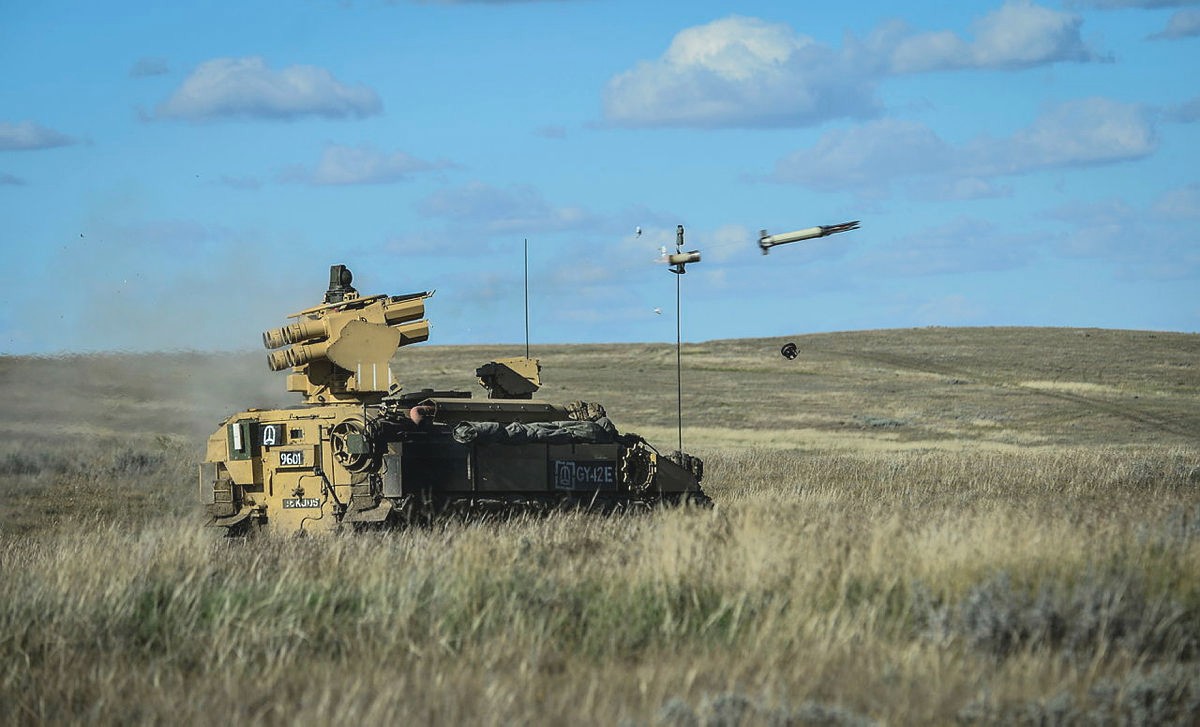
Thales in the UK has been awarded a contract by the Ministry of Defence to continue work on the Mounted Short Range Air Defence (MSHORAD) programme.
The contract, signed with Defence Equipment and Support (DE&S), extends the programme’s assessment phase and supports further development of technologies intended to replace the Army’s current Stormer High Velocity Missile Self-Propelled system.
The MSHORAD programme is part of a wider effort to modernise the Army’s layered air defence network in response to evolving aerial threats, including drones, missiles and low-flying aircraft.
According to Thales, the contract will support the next stage of work to define future system requirements and capabilities. “This contract supports the next phase of development for future MSHORAD capabilities and modernisation of the British Army’s ground-based air defence suite,” the company said.
The programme will ultimately replace the Stormer HVM SP platform, which currently provides the Army’s mounted short-range air defence capability.
Stormer HVM vehicles, armed with Thales’ StarStreak missile system, entered British Army service in the 1990s and were designed to counter fast, low-flying aerial threats such as attack helicopters and fixed-wing aircraft.
The system has remained in service for decades and continues to provide the Army with a mobile air defence capability able to accompany manoeuvre forces.
“The Stormer HVM SP system, featuring Thales’ StarStreak missile, entered service with the British Army in the 1990s to counter threats from pop-up helicopters and fixed wing aircraft,” the company noted.
However, the Ministry of Defence is now seeking to replace the system to meet modern battlefield requirements. The future MSHORAD capability will form part of the Army’s broader Ground Based Air Defence architecture, which aims to provide layered protection against a wide range of aerial threats.








Is that the sound of a can being kicked down the road i hear????
Yep, its sod all time again….
Why can’t they purchase some Boxer Skyranger 30 like Germany has? Add LMM-Starstreak? Work on some shared RAF Regiment/Army pool for base/port/mobile Shorad defence at least?
We don’t need to mount them on an expensive chassis like Boxer. They can be mounted onto a Flatrack, and carried on the back of an MAN HX77 8×8 Hookloader truck.
The strong rumor is that anything selected would be mounted on CAVS – the Patria 6×6.
All good. Let’s hope something eventuates whether tracked and or wheeled!
Are you suggesting that the truck replaces Stormer? And that it keeps pace with an armoured battle group?
There could be two types of vehicle used. Where one is unarmoured and protects rear echelon, HQs etc. Whilst another that is armoured moves with the battlegroup to provide overwatch. Though it will need better protection than the standard Patria (CAVS) 6×6 provides. As it has very little artillery shell splinter protection (unlike Boxer and Stormer to a degree).
No. I am suggesting that for “rear” areas, the Skyranger could be truck mounted, which has already been done by Rheinmettal. Most vehicles in the area will be wheeled, so it makes sense to have an AD system also mounted on trucks.
I agree
Morming DB, does the Stormer system cater for LMM as well as Starstreak or just the later?
Hi Q, both.
So now we are going to study the study?
😁👎🇬🇧 oh so true !
Here we go again talk talk 🙄
We’re ranked really high on defence spending in the world, but we seem to have hardly anything to show for it. What do we actually spend our money on? You’d think we’d have some of the most advanced MSHORAD in the world. I know we spend money on a nuclear deterrence, but I’m starting to think we put a lot things under ‘defence spending’ that can’t actually be used in a conventional war.
Nuclear capability, from AWE to new warheads.
AUKUS, including billions handed to industry to expand and update infrastructure.
GCAP. Same, tens of billions. How many aircraft do we bet the RAF may end up with for the outlay?
Pensions.
Chagos payments. Someone told me the FCDO pay, I’d like to see the proof?
Afghan rehoming. Over 1 billion.
SSN decommissioning.
The SIA will shortly be added as well, around 4 billion.
Ukraine ops payments, billions.
Equipment “support” from memory around 10 billion. Not in buying, but supporting. So, basically a huge subsidy to the MIC.
Then the expected wages, fuel costs, infrastructure maintenance costs.
Incompetence, as billions lost in failed programs.
R&D, ring fenced.
The % spent on buying equipment and recruiting more personnel to expand a stretched, hollowed out military that HMG use as either a piggy bank or a political football in their world stage grandstanding is minimal.
Beware when a politician says how much is spent on “Defence.” Defence has many heads, and the military isn’t their priority in it.
Willy waving as a nuclear power, so politics, and industry, so jobs, are.
One look at the varied tweets recently from the MoD about the 23 NMH purchase, talking endlessly about the jobs at yeovil and how wonderful it all is, but not a peep about military capability nor how long the RAF are now without any medium heli lift, tells you all you need to know.
We could spend most of our budget on all OTS kit, have lots more assets, but no defence industry. And that also would be wrong.
There must be a balance between industry and OTS for me.
Daniele, Great list covering what ‘can’t actually be used in a conventional war.’ Service pensions could be added and military aid to Ukraine and buying back service housing from Annington Homes and I think some non-Defence Intelligence is covered by the Defence Vote (I heard that some years ago but have no evidence). Legal fees and compensation claims for various things that go wrong in the HR domain.
Evening Graham.
You missed them, I did list Ukraine and pensions.
😉
Good one with Allington homes.
I understood that Ukraine aid was a separate budget line direct from treasury, are they now including it in the 2.3%? I don’t think there’s any question it’s a legit defence expenditure, but it’s a bit cheeky if it’s being added onto the MOD’s own budget just to reach the headline number. By my rough estimation it leaves the MOD with only something like a 0.1% of GDP increase.
UKR seems to have been added into Defence as a means of boosting the headline numbers.
Previously it was funded directly by Treasury with a special subvention.
You missed a 2.5 billion to sero maritime support contract and recruitment contract
Military aid for Ukraine primarily comes from the Treasury Reserve, not the MoD budget.
BUT the government is counting this along with the MoD budget as ‘defence expenditure’ and falls within the NATO contribution commitments.
Thanks.
Ultimately, then, it’s money our military never sees, which a layman might think it would see if it’s included in the overall %
A subtle but typical slight of hand it seems.
Well it is money being paid to fight our enemy, so I can understand the thinking.
Oh, absolutely! There is no issue in that we help Ukraine, only how many billions HMG don’t have to stump up additionally to furnish our own alongside this contribution if it’s placed in the headline %
Hi Mate, As a matter of interest what part of the support Budget would you cut ? And how much do you think it would cost if we went for way more OTS bearing in mind UK labour costs aren’t as high many of the 3rd Party overseas suppliers.
Impossible to say, as the “Support” part of the DE&S budget covers many thousands of contracts. How could I say what might be prudent to reduce/remove or which are inefficient and which contractor is charging too much ( like the light bulb fiasco ) without a detailed list and actually working in MoD.
And another point I miss, my original list was of items I understand are not directly furnishing conventional military capability. As many look at DE&S huge budget and wonder where the cash goes. That support total might well be impossible to reduce without wholesale deletions of frontline kit…and we have seen enough of that with Hercules, Hawk, Defender, Islander, Sentinel E3 all lost with no real replacements.
Perfect summary from you both of why our conventional capabilities are so deprived
You should have said micro willy waving !
Pensions make up 9% of the Defence Budget.
Decades of not doing anything and outsourcing everything has meant stuff has aged and older gear is more expensive to maintain.
That combined with the budget being so heavily cut in recent years. Making long term procurment decision impossible as never know what money will be available year to year.
Saying that we have a lot of good kit, just capability gaps caused by the 2010 defence review are now coming to roost.
A grown up just entered the room. Everyone else is in the same bind: Technology and therefore threats change by the month. To keep abreast of these procurement has to be either re-set or scrapped. A long time ago in school I read a book on aircraft design that told me ‘by the time a plane flies for the first time it is obsolete’. Such are the dynamics of rapid progress, scientific, and technology that cannot be ignored.
Whilst true, you can’t just keep chasing your tail and have to eventually order something or what you do have in service will be insanely out of date. As what happened with rapier, which should have been replaced in the 80s.
It’s why chasing the platinum standard doesn’t suit the UK budget. It would be far better to buy middle end capability but do it more often, so we don’t get where we are now, with a lot of kit that was great in the 80s but where 40 years has passed since with out orders.
Great yet more talk, projects etc etc, its always the same nothing ordered just more time wasted doing a lot of nothing, State normal, when will it ever change?
Good job we didn’t have this a Govt in 1938. Report into the Hawker Hart replacement. Initial Operational Viability Committee in early stages of recruitment from Gentlemen’s Clubs throughout London, sadly two potential Chairmen are unable to fulfil their initial commitment due to clashes with the hunting season. However once recruited and stocks of suitable Brandy provided it will decide progress matters on the next stage of the Supermarine Spitfire and Hawker Hurricane development schedule, to report back circa 1941. This will decide upon whether they should have 4, 8 machine guns or alternatively build delayed till cannon specifications become clearer and some of the older members informed as to why muzzleloaders won’t be optimal. More importantly it is not yet clear what paint scheme they should have though it should be noted shades of brown are undergoing extensive testing and once determined by the Paint Committee and passed on to the IVC Committee (once constituted) with paint quantise per aircraft determined and ordered with any added pigment costs taken into consideration, number of aircraft can then be budgeted for in any initial order to be delivered no later that November 1943 for extensive paint durability testing purposes in coordination with similar camouflage efforts in France through a joint compatibility scheme. It should be noted however this contract is open to change and in no way commits the Air Ministry to a production contract with either contractor as their are alternative products from Germany that it is intended to take part in a competitive fly off before any final decision (probably by the Fighter Competitive Evaluation Committee) is made and referred to the relevant Future Monoplane Finance Committee to consider once the Govt DIP is published though as this may be further delayed due the Army’s Crusader Tank having serious developmental issues, no current timeframe can be determined. Parliament can be reassured however that by 1948 we should be able to faze out our biplane fighter force many of which have already been gifted to Poland.
Spy,
Excellent parody of the current procurement system, simultaneously amusing and depressing. 🤔😁😱👍
Ever since John Major all’s we’ve had is defence cuts after defence cuts and besides defence procurement leaves a lot to be desired. The disastrous Ajax programme comes to mind when we could have replaced Warriors with CV90. The MOD itself – the civil servants and brass hats – are not fit for purpose. Absolutely pathetic.
To be fair to the current government the money has increased under them for the first time in 14 years. It’s just that it’s not enough and orders aren’t being placed.
Actually it increased significantly under Boris, fell back under Rishi and not much was done about stopping it dropping under this government.
If you look at the data it went down under Boris, at least as a percentage of GDP. It went up as a % during COVID but that was because the GDP crashed, then went down again the next year as things started to recover. There was a one off increase in 2022/23 tax year but then went down again as it was just a single one off payment.
Boris is the master of making stuff up and making people believe him.
Raw number has increased, which I guess is a positive.
What we spend on Defence and defence spending are 2 different things. All recent Govts have moved existing spending under the umbrella of defence to “raise” defence spending. It would be very interesting to see the breakdown of spending as it used to count and see if it had actually increased or declined. I suspect the latter.
Aye, like military pensions and the nuclear deterrent. Should not be part of the defence budget.
They should be part of the budget, as they are defence related.
It’s not them being in the budget that is the issue, it’s the size of the budget.
The NATO gdp% has always included them and same for other nations.
I would argue that neither should be part of the defence budget. The Nuclear deterrent was not , and that at a minimum should be removed. It is more of a sovereign capability and it skews the money attributed to conventional forces- I believe- but stand to be corrected – that it was Osborne (sly twat) who surreptitiously moved these across from the Treasury to the Defence budget specifically to meet the minimum NATO spend.
As for pensions ,my question is : As its from the civil purse so to speak , do other civil service pensions get paid for out of the budgets of the departments they served? If so then it could be argued the same policy could be used for defence , if not then it should not.
Even if other civil services do get paid out of the respective dept. budgets its still a little counter-intuitive that pensions for the forces come out of the Defence Budget- as by their very job role many wouldn’t live to see it – in war time at least. – I admit that’s a slightly different point.
Don’t forget even when it wasn’t inside, it was still part of the % of GDP, it was just an accounting change, didn’t impact the amount spend on defence.
I would argue it did. It allowed the Govt to pretend it had increased spending on defense when it in fact cut it.
I don’t remember that being the case, as governments always use the % gdp NATO target and that always included it. However it wouldn’t surprise me if they had tried to use it as a scam.
Something that hasnt been discussed in the media. I wonder if the lack of AWACS added towards the drone getting through. Ground based radars are always going to have issues unless they can be high enough.
According to the latest, the drone was apparently flying around 100ft above the sea, when it made landfall. This would have given a ground based air defence system very little time to react. If an AEW platform was available it ”might” have been able to detect the drone. But, the platform has to have the right radar, along with decent signal processing for finding and tracking these types of threat. As the drone has a very low radar cross section (RCS).
Sending out a Merlin to Cyprus fitted with Crowsnest, is perhaps the most sensible response. As the Searchwater radar, although old by modern standards, was designed to find very small objects against a lot of background clutter. Plus we know it has been used successfully during live fire exercises involving Banshee drones, which have a very low RCS.
Australia are sending an E7 Wedgetail to the Gulf, as from the OSINT content and what I’ve gathered from reading between the lines. The E3 Sentries are having real problems tracking very low and slow flying drones. From what I gather they can detect the Shaheds etc, but can’t consistently maintain the track. Making it difficult for a CAP to be vectored onto the target or informing ground based air defences with enough warning. I’ve not heard how the UAE’s Globaleye is performing, but UAE is getting hit a lot by Iranian drones?
A lot has been said about using the MQ-9 as a mini AEW platform. I have been pretty clear cut, in saying a MQ-9 should not be used for carrier based AEW, as they can’t carry a suitable radar for long range detection. But as a means to detect small attack drones, I think the MQ-9 would be more than suitable. If it’s fitted with a radar like Leonardo’s Osprey or Thales Searchmaster, that operate in the X-band. They should be able to detect these types of drones. But unlike the Merlin, the MQ-9 can stay on station for over 24 hours.
Interesting.
Probably highlights the need for mixed assets, more low cost solution for anti drone, which can be shorter range due to their slower speed and more high end for cruise missiles/warplanes etc
I think there is definitely a case for using tethered aerostat balloon for Akrotiri and Dhekelia. Where they’d be fitted with a electro-optical camera and high freq’ radar. They would need to be sited quite some distance from any runway/helipad approaches. As the tethered wire is very difficult for pilots to see. But it would give the sovereign base areas a better and more persistent over the horizon search and track capability. Which could then be networked into the air defences.
Noticeable gap in detail on how much the contract is worth or what the deliverable is.
Not much is the answer to both 🙂
Be interesting to see whether the UK joins in development of Leonardo’s Michelangelo Dome vision for European GBAD.
We are literally bolting 40mm Bofors Mk4 mounts onto MAN HX trucks and sending the resulting cheap but highly effective AAA system to Ukraine.
Stop arming Ukraine on the UKs coin and start arming the UK armed forces
And the Paladin 30mm too. And no such base systems used in the UK for any Shorad. Likely quite affordable and potentially could share pool RAF Regiment, Army, and Reserves for base and infrastructure protection along with other systems.
Skyranger 30 mounted on flatrack could be a fast way to get the system into service. Very short sighted not not having this capability to defend the RAF base on Cyprus.
Would it be sensible to mount the system on Warrior chassis, for an all terrain protected system. Could these be produced in a short timeframe, or would it take to much effort to overhaul these vehicles?
We could do with something in service ASAP.
now that the gov have signed with thales we can assume a vehicle has finally been chosen and thales can finally get under way with putting a weapon system on top, would love a cannon, missile mix to achieve Vshorad and Shorad mounted but looking likely missile only now leaving us in the same boat as we are in now just upgraded tech, lets hope there is another contract coming soon for CUAS system for vshorad thats more OTS and can be brought into service faster then this thales contract. Uk GBAD is rapidly approaching breaking point unless something happens fast.