

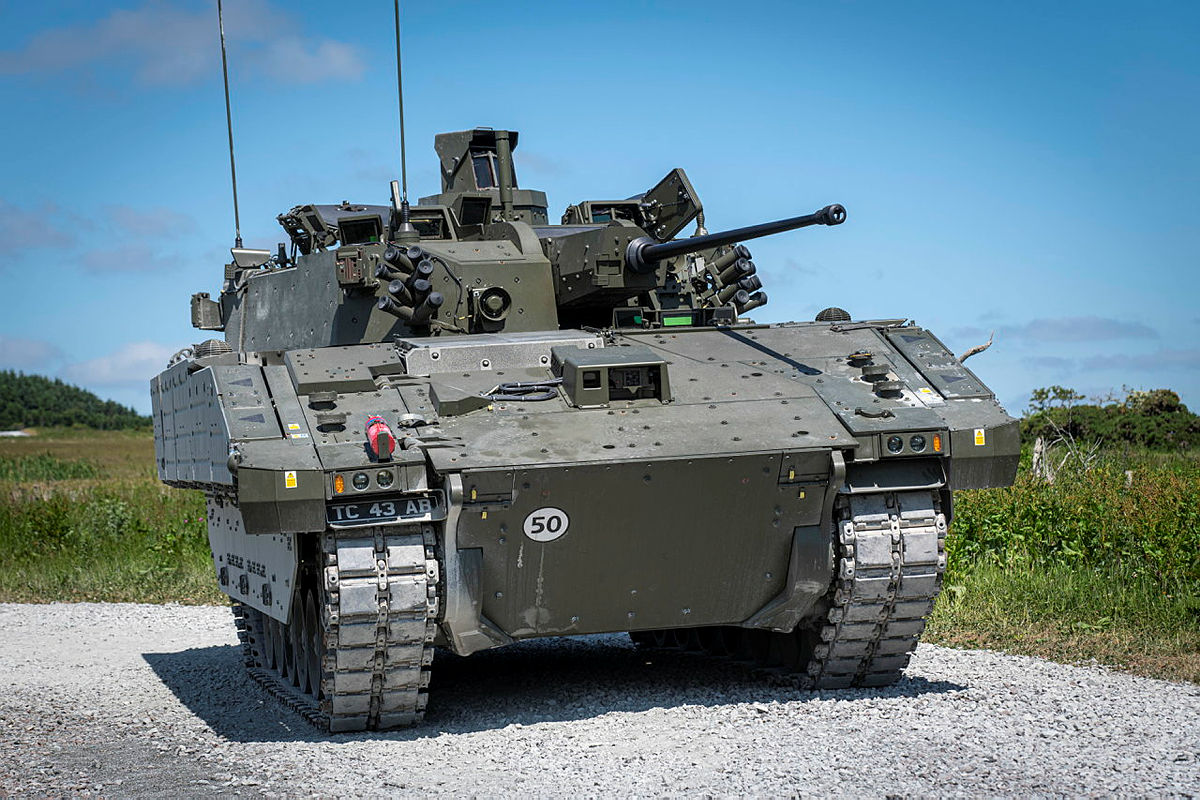
The Ministry of Defence has announced it will restart acceptance of Ajax armoured vehicles from General Dynamics following the completion of an Army Safety Investigation Team inquiry into symptoms reported by soldiers during Exercise Titan Storm in November 2025, with the investigation finding no single cause but rather a combination of technical, environmental and human factors.
Minister for Defence Readiness and Industry Luke Pollard told the House of Commons today that the Army Safety Investigation Team had concluded that “noise and vibration levels were found to be below legal exposure limits” and that symptoms were instead “likely the result of a combination of factors, including technical issues related to platform conditions at the time of the exercise, such as incorrect track tension and loose or missing engine deck bolts, alongside environmental and human factors, including variability in training and experience, cold exposure, and air quality within the Ajax vehicle itself.”
Pollard confirmed that all personnel have now returned to normal duties and that he had “agreed to restart the acceptance of vehicles from General Dynamics”, while acknowledging that “the experience for our soldiers using Ajax has not been good enough and that is not acceptable.” He added that he had “implemented strict new controls on the reintroduction of the Ajax vehicles that is focused on providing a significantly improved user experience.”
The 23 vehicles used on Exercise Titan Storm will be treated separately, with Pollard stating they “will not be put back in the hands of soldiers until we have confirmed that it is appropriate to do so.”
Pollard set out a phased approach to restarting the programme. The first phase will involve “the restarting of trials using the current version of Ajax” with “a limited number of vehicles used and under very controlled circumstances and maintenance regimes.” The second phase will see “the delivery of a number of improvements relating to the use of air filtration, crew compartment heating, and the electrical power generation system, key themes identified and prioritised following Exercise Titan Storm.”
Taking lessons from the aviation industry, Pollard said the government would “instigate an approach which will instil a common thread between design, maintenance and operation” with named individuals within the Army chain of command holding separate responsibilities for operating and maintaining the vehicle, saying this was “to ensure there cannot be instances where desire to operate a vehicle within the chain of command compromises the necessity for the highest standards of safety.” He confirmed that any return to training would follow “a crawl-walk-run staged progression ensuring safety is paramount throughout.”
Pollard said the government had been “engaging extensively and directly with our soldiers throughout this process” and that their experiences were “shaping much of what we do next.” He said the aim was to “proceed safely, responsibly, and transparently to deliver an improved Ajax vehicle for our soldiers” while acknowledging that “we know we have more to do to rebuild confidence in the vehicle, and we do not underestimate the work still ahead.”
The Independent Expert Panel Review remains ongoing with a final report due soon, focusing on less well understood human and environmental factors relevant across defence more broadly. A further independent review examining the quality of advice provided to ministers, senior officials and military leadership has had its terms of reference agreed with a lead reviewer identified and due to be appointed shortly.
Pollard confirmed that “the above commitments will be met within the existing programme scope and financial envelope” and closed by reaffirming that “the safety of our people is non-negotiable. That is the standard our Armed Forces deserve, and it is the standard this Government will uphold.”
Ajax has had a troubled development spanning more than a decade, with the programme beset by delays, cost increases and persistent issues with noise and vibration that led to soldiers reporting symptoms including nausea, headaches and joint pain during earlier trials, resulting in a pause to crew training that lasted several years before a cautious restart was authorised.









Hopefully the hulls stop filling water and random bits stop falling off it. That being said this programme was never going to cancelled this late and with so much money already being spent on it.
we could of had the puma or lynx,.. but no…this was cheaper…not so cheap now ..
Andrew, are you confusing 3-man recce vehicles with IFVs that carry an infantry section of 8-10 men?
I don’t think anyone thought GDUK’s Ajax was going to be cheaper than Puma or Lynx. Both are IFVs however Lynx has a recce variant but I don’t believe that Puma has one.
AFAIK only two bids were received – one from GDUK (who had never ever designed, developed, built or tested any sort of vehicle, ever!) and one from BAE (the Design Authority for nearly all British AFVs now and for decades in the past) offering a recce variant of the popular and effective CV90.
Guess which company was selected! The clueless one, that didn’t even initially have an AFV factory!
If there is nothing fundamentally wrong with the vehicles, why can’t they be returned to service ?
They need the latest drop of AJAX (AJAX 2 as it’s less formally known) for it to have a chance of success.
Anything less than this and we will see a repeat of the whole experience.
Air quality ? I hope the crews weren’t being poisoned by Carbon Monoxide.
There was some reporting over the weekend that highlighted that as one of the issues, with filter problems being suggested as the cause.
I’ve gained $17,240 only within four weeks by comfortably working part-time from home. Immediately when I had lost my last business, I was very troubled and thankfully I’ve located this project now in this way I’m in a position to receive thousand USD directly from home. Each individual certainly can do this easy work & make more greenbacks online by visiting
following website—.,.,.,.,.—>>> JobatHome1.Com
Seems there is a need to move to Ajax 2 as rapidly as possible with the automatic tightening and composite rubber tracks. Frankly it seems amazing to me that general dynamics built a modern armoured vehicle without automatic tightening and composite rubber tracks.
Neither fix sounds particularly difficult to implement in comparison with redesigning the suspension. Hopefully such a fix can be retrofitted onto the existing vehicles.
Rubber tracks should have been at the heart of this project from the start. As for self-tightening, this is a feature of CH2 so the tech was there to be adopted. I’ve worked on projects that suffered from communal brain freeze, and it’s not a good working experience. However, today there are all kinds of ‘working practices’ that are designed to overcome such becalming, so an investigation is required at some juncture to avoid such delays in the future.
So……
It’s still broke, it’s full of faults, we haven’t a clue, but we must go on, we’ve spent too much to walk away.
From what we know of the investigation release, it was a combination of several factors, part operational and part mechanical. However I think everyone can agree that getting it back all be it with a slow reintroduction is the best outcome.
Even if budgets were infinite it would still take half a decade to start delivery of even an off the shelf alternative.
It does also seem with Ajax 2 on the horizon that a fully improved version can be delivered at a relatively affordable cost and it’s quite probable that an Ajax 2 would be the most capable vehicle of this type anywhere in the world.
Ha ha ha, very good 🤣🤣
Half a decade would be a great timescale to replace this crock of shit.
Nothing to see here – move on! They are determined to get this flawed vehicle into service come wat may. To big to fail, too many reputations at stake. The whole thing sucks and our troops will suffer for it.
I’ll buck the trend.
Very pleased to see this, hope issues can be ironed out and entry into service resumed.
The Armoured Cavalry need something, having given up their CVRT years ago.
Agreed
Yes, people like to complain about sunk cost fallacy, but U-turning on Ajax means a new project, expenditure of a lot of money the army just doesn’t have, and a lot more time that we shouldn’t be wasting.
Yep. The sunk cost fallacy is sort of irrelevant if you have essentially already paid for it, and that is what has happened, the 5 billion is paid out and spent. The only question is do they recover a usable vehicle from it or accept the loss.. they were always going to try and get a usable vehicle.
The sunk cost fallacy only works before you have spent the entire budget.
…but does it work?
“such as incorrect track tension and loose or missing engine deck bolts, alongside environmental and human factors, including variability in training and experience, cold exposure”.
Bloody Good Job they aren’t working on a Gen IV Reactors !
There was a time when this kind of sloppiness would require one to fall upon their sword.
Air quality? Track issues? Loose and missing bolts? FFS.
Then these are the turds who did not listen to us about SA80, and look what that entailed on ops putting lives at risk, then causing massive financial rectification.
So hard to be optimistic, but fingers crossed eh?
The secret of good procurement? Buy something that already works, something that is proven then stick with it.
Sounds more like a cover-up than a realistic investigation. Nothing to do with not being designed or built properly then. Bring back the CVRT that and add some drones that would at least work properly!
Silly questions but would having wider tracks and wheels help to mitigate the weight distribution and squeeky noises? Are rubber tracks durable in military ops. They’re okay for excavators but IFV types?
Wider tracks increase flotation, but the tracks themselves are heavier if they are wider, so probably not going to make the noise go away. Rubber tracks have existed for a while for APC’s and other military vehicles, but as with everything there are trade offs.
Rubber tracks work better than expected. Time for a Dit!
On one of my Afghan tours, we met up with the Norwegians in Mazar-e Sharif, way up in northern Afghanistan. As we were chewing the fat, a number of CV90s trundled past, two of them in particular sounded different. No metal clanking noises, just the diesel engine. We got chatting with the crew, they had two CV90s on trial fitted with Soucy rubber composite band tracks. By that stage they’d been in theatre for about 4 months. One of the CV90’s was still using the original band tracks it started the trial with. The other was on a new set after suffering an IED attack. The IED took off a road wheel and split the track. They said they had the option of replacing the track, as they carried a spare, but elected to do a temporary fix, by splicing the track together again. Which came as a kit from Soucy. They said the track was done in 30 minutes, but clearing one of the damaged wheels took longer as the bolts had buckled.
The crew said the ride was significantly better both for vibration and noise, so much so that they can talk without headsets or shouting in the rear cabin whilst on the move. They also said it was a lot quieter outside, especially when the engine was just ticking over enough to keep the vehicle moving. They’d used it to sneak up on some “persons of interest”. Just so you know, there’s not many properly tarmac’d roads in Afghan. They are mostly just crushed stone or dirt tracks. The crushed stone depending on the region used in the roads is very hard and sharp. We would go through tyres on WIMKs in no time, same with the later Foxhounds. The Tyres the HUMVEES used were terrible, they wore significantly faster than the WIMKs.
As Dern says above, there are pros and cons with band tracks. The biggest advantage is they weigh a lot less than steel tracks. So your fuel economy should improve. However, as they are rubber and rubber is an insulator. They don’t like running at high speed for long periods. As the track builds up too much heat and expands, loosening the track.
Thanks both for great replies and your knowledge. Seems like an either or choice. Are the Soucys just rubber then or they’d got to have some strengthening material in them, like a steel or an alloy? The new Aus Redbacks IFV here have Soucy tracks so they’d be so they’d be good data from those.
Saw you mentioned “rubber composite”. Don’t need to give away industrial secrets here and Soucy obviously know what they’re doing. Wonder if the can make use of recycling rubber material in their production?
Hi Mate, have a look at the Soucy website, they mention the track is rubber based with composite strengthening, which I think is steel wire. Didn’t know the Redback was using the band tracks? As far as I know, only Holland is getting the Mk4 CV90 with band tracks so far and I believe some of the new ones Sweden and Denmark are getting will have band tracks, other countries are looking at them and are yet to make a decision. I believe, even though they performed well in Afghan, some of Norway’s CV90s still use steel tracks, though I think they are trying to switch out their whole fleet to band tracks.
Stop buying American junk and build and design it ourselves. It needs cancelling asap and just accept no lessons were learnt yet again and tax payers money went to a foreign company instead of developing our own skills and supply chains. Get it right this time and do it 100% ourselves. Now cancel Ajax and start again like a grown up serious country would do.
You can not design AFVs anymore, know how lost. Need to learn again.
And whole Europe probably only the Germans and the Poles can design tracked vehicles, maybe the Swedes, but i don’t know if the CV90 design team still exists, seeing that BAE don’t proposes any new AFV i have my doubts.
Agree Poles and say the South Korea are aware of tank war threats on their borders. Germany late to the party?
I was only talking about industrial capability. German have been developing tracked and wheeled AFV’s. Instead UK none of them for more than 20 years.
France: can develop wheeled AFV but Leclerc was designed decades ago so tracked knowledge is probably lost.
Italy: the same can do wheeled but not tracked and they consequently went to Germans for their next tracked AFVs Tank and IFV.
I bow to your knowledge, I was reflecting more on a nations’ mindset.
Alex, you wrote:You can not design AFVs anymore, know how lost. Need to learn again.
Clearly GDUK had zero experience at designing, developing, manufacturing and testing any sort of AFV such as Ajax – they had never before designed any kind of vehicle, not even a pedal car. I find it astonishing that they were awarded the Ajax contract.
As for BAE, you cannot make a similar claim, surely, although some work is done at overseas subsidiaries. They are working on the Amphibious Combat Vehicle for the USMC. Their Swedish arm (was Bofor-Hagglunds) is currently developing CV90 Mk5.
Teamed with Rheinmetall in the PV (RBSL) they have Design and Development skills that are being used on CR3, but I fully understand that this is a vehicle adapted from CR2, rather then being a ‘new build’.
ACV(wheeled) is an Italian design ,BAE is only adapting it. same for BV Hagglunds and CV’s , Swedish designs, all existing designs before BAE bought them. Nothing relevant is changing in Challenger hull, only the turret.
BAE did not demonstrated yet a design from start, maybe it can from resources it has but they don’t seem even particularly interested. That said i would not expect them to fail at Ajax level.
Do you remember any public disclosure of what that made Ajax win over CV90? price?
I’m sure Graham will back me up on this, but at the time their was a political drive to by anything not BAe. Which stems from the impression that BAe were fleecing the Country. I have not seen any trials data released to the public on the competition between the ASCOD and CV90.
Thank you both.
Alex, you wrote:ACV(wheeled) is an Italian design ,BAE is only adapting it. same for BV Hagglunds and CV’s , Swedish designs, all existing designs before BAE bought them. Nothing relevant is changing in Challenger hull, only the turret.
In order to adapt a design, you still need a skilled design team…and a development team. I do not agree that the CR3 hull is unchanged from CR2: different armour, suspension, ammunition stowage, are just some of the things that are changing in the hull…although of course there is a difference between designing an adaptation compared to designing from scratch, that I fully accept.
I did not ever see any public statement about why GDUK’s Ajax offering beat BAE’s CV90 Recce. There was an obscure comment I once saw (cannot recall the website now) that protection levels on CV90 were not good enough but of course it would be uparmoured if the base version would not have met the MoD Staff Requirement so this comment must be specious. As Davey said most believe it was a political drive to buy anything but BAE. I am not sure that BAE was fleecing the country (they certainly dominated the Defence market in the UK) but there had clearly been disatisfaction about cost and time over-runs on BAE’s Nimrod AEW (although it was a long time back) and Nimrod MRA.4 projects. As far as I am aware it is always the Minister that makes the purchase choice having been briefed by MoD military staff about which offerings met the Requirement and briefed from budgeteers what the relative costings were. The Minister will also consider ‘political factors’ which are often decisive. [Example: It was said by some, incl Lt Col (Retd) Crawford that most RAC officers wanted Leo 2 but the politician chose CR2 back in the day. Perceived need to keep jobs in Newcastle/Leeds!].
It’s what The Cousins refer to as “Pork Barrelling” in this case the Labour vote in the Welsh Valleys which is why the contract was placed with a supplier in Merthyr.
Nothing to do with the quality of the product, this was a secondary consideration.
Like the T45’s pressed into service even though the government of the day knew all about the faulty cooling system fast forward 15 years and now it is costing the tax payer millions to put right. It is good that we get something into service but how long will it be before it needs replacing or repairing as once it is accepted in to service it will be up to the army to keep it in service.
Loose/missing engine deck bolts, badly adjusted track tensioners.
These are QA and not design issues and that is where GD needs to step up,
if not them them the REME should be able to remedy thesei.
Incorrect track tension is user error not REME or GD. Troops in any sort of tracked vehicle are regularly supposed to be checking track tension and adjusting it to be appropriate.
Does that imply phase 2 training has a problem if they’re not?
All that is learned at AFV School at Bovington?
Or the minister got something wrong, or the GDLS guidance about what level the track should be tensioned at was wrong, or someone was not enforcing maintenance standards, I’m trying to think of alternative explanations.
Hmmm, who knows. I’m just relieved the project continues, and the Army get the vehicle they wanted.
Daniele, maintaining track tension is totally standard practice for tracked AFV drivers (certainly not a REME task). All crews know this. The army has operated tracked vehicles since WW1. All know when to adjust track tension and how to do it. It is a key aspect of ‘Halt Parade’ as well as at ‘First Parade’ and ‘Last Parade’. Some express surprise that this aspect of crew-performed maintenance is required on operations and exercises – yet that is when the vehicle is being used and used hardest!
Of course this is taught at D&M school and old hands will know it anyway. The Army Equipment Support Publication will state the measurement metric and how to tension tracks.
It simply cannot be the case that crews have forgotten to regularly do this. The vehicle commander will be ensuring that the driver has done his checks as per AESP.
Thanks Graham. Not surprising really, as you day, crews must surely know.
Take 28 tonne light APC
Lengthen it
Increase weight to 42 tonnes
Park huge medium calibre gun turret on it off centre so it’s imbalanced
Seem surprised it vibrates and shakes like a blancmange
Then ignore the fact that Piedrafita also makes heavier duty rotary dampers, that could be swapped for.
So was this a new design, built in new factory, by new workforce and it was too big to fail?
If sunk cost fallacy was a vehicle, this one would be a strong contender
CVT90 is still showing an alluring ankle
Only an ankle? Calves and thighs surely?!
CVT90 IV looks like a very saucy girl.
Can’t wait to see how her new Mod V sister looks
Ooolalah…in a Swedish accent of course…
I believe there’s a Rule of the Internet that you and Daniele are treading dangerously close to…!
I would like to see all the big smells, the CEO of General Dynamics UK Ltd & Directors, Chief Designers to climb into the back of one, ride about over rough terrain for 2 hrs & see what they think.
And will they be “strapped in” or just “sitting loose”?
Who is paying for: ‘the delivery of a number of improvements relating to the use of air filtration, crew compartment heating, and the electrical power generation system’?
Here we go again. It got me thinking what to do with this platform and how it might be further re-purposed to salvage the most out of this disaster. Ajax is about a foot shorter than Boxer but about a foot wider (than Boxer). Both weigh roughly the same. I wonder if a partially “razee’d” version could be fitted with a RCH-155 system? Possibly not but would solve the tracked artillery requirement and offer some commonality with the Boxer RCH-155. There’s also fitting the Ajax platform with a NEMO system turret instead? Just some musings.
At the very least the outfall from this should be the end of any chance of GD getting further UK defence work and a very big question over the quality of Spanish input which may be worrying for other projects but hopefully not.