

Thales is adapting its approach to the underwater domain as demand grows for persistent sensing, infrastructure protection and deployable capability on uncrewed platforms, Ian McFarlane, Sales Director for Thales Underwater Systems UK, told UK Defence Journal at UDT.
Speaking during a floor interview, McFarlane described a marked shift in focus over the past six months, driven by a mix of geopolitical pressure points and operational realities.
“The underwater battlespace has been a fast-moving picture… with the focus on CNI and recent incursions… and more recently… the mine warfare threat,” he said, pointing to activity linked to Russian naval movements and concerns in areas such as the Strait of Hormuz.
We spoke to Ian McFarlane of Thales at #UDT2026 about integrated underwater capabilities, Sonar 76 Nano, and how navies are combining crewed and uncrewed systems to improve decision-making at sea. pic.twitter.com/NUELhu2lHZ
— UK Defence Journal (@UKDefJournal) April 16, 2026
That shift, he explained, has broadened the requirement set. Operators are now looking simultaneously at deep ocean monitoring, protection of subsea cables and pipelines, tracking of hostile platforms, and shallow water mine warfare to keep sea lines of communication open.
In response, Thales is positioning its portfolio around how sensors, platforms and command systems are connected, rather than treated as separate elements. McFarlane said the priority is not simply collecting data, but delivering something usable at the point of decision.
“We’re interested in the data, absolutely, but what’s really important is the information that we’re providing to the user,” he said, describing this as a “sea to screen” approach. In practical terms, that means taking inputs from multiple sensors and presenting them in a format that can be acted on, whether onboard a submarine, a surface ship or at a shore facility.
For critical national infrastructure protection, he went on to explain that persistence matters more than one-off detection. Surveying a pipeline or cable is only the starting point. The real value comes from returning to the same location and identifying changes over time.
“Once you’ve surveyed a pipeline, a cable, then you need to go back regularly… if there is change, then you can do something about it,” he said, pointing to change detection as a central requirement.
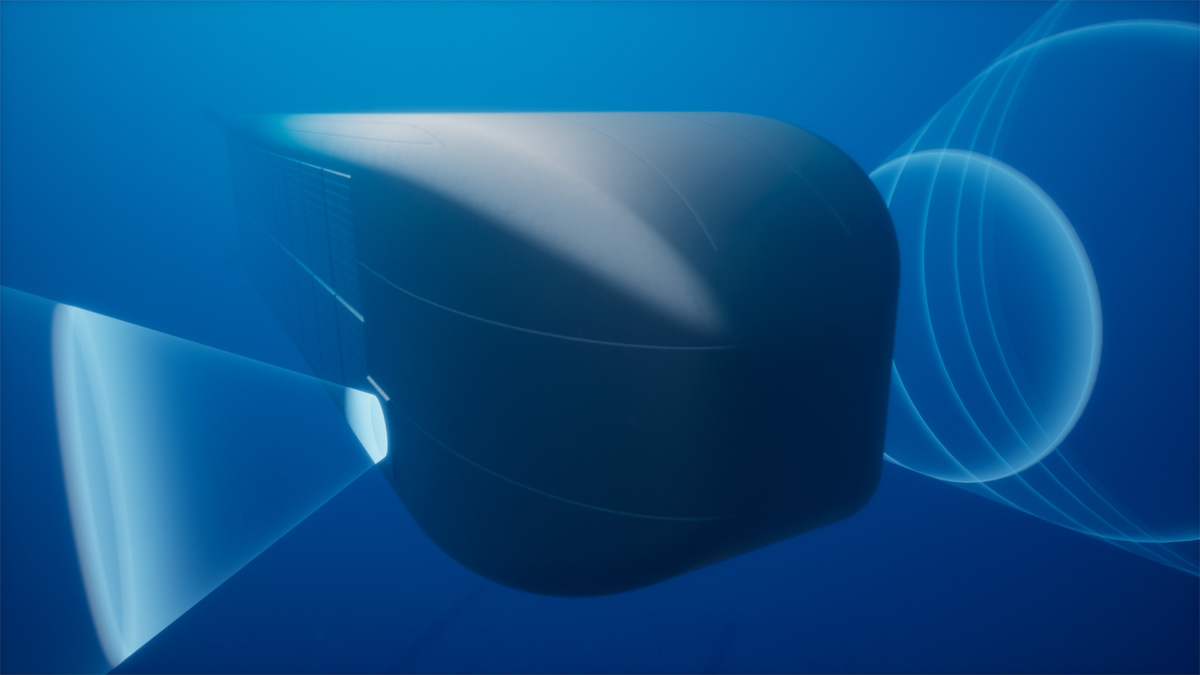
A significant part of the conversation focused on how Thales is adapting high-end submarine sonar technology for use on uncrewed systems. The company’s Sonar 76 Nano draws directly from the 2076 sonar suite used on Royal Navy submarines, but is being reworked for much smaller platforms.
McFarlane said the decision to develop it came as the market began shifting towards large uncrewed underwater vehicles. Those platforms, he argued, currently lack meaningful payloads.
He was blunt on this point, noting that many vehicles today are effectively transit platforms. They can move from one point to another, but without sensors, they add limited operational value. The aim with 76 Nano is to change that by giving those platforms a credible sensing role.
The system is built around a modular hydrophone “tile” concept. These tiles can be fitted along the sides of an uncrewed underwater vehicle, as well as at the bow, providing passive acoustic detection. Active elements can also be added, allowing the system to transmit as well as receive.
McFarlane went on to explain that this modularity allows the system to scale depending on the platform and mission. Multiple tiles can be fitted to increase coverage or performance, while keeping the overall system adaptable to different vehicle designs.
This approach opens up several operational uses. Fitted to an uncrewed platform, the system can act as a distributed tripwire, detecting the presence of hostile submarines or other underwater threats. It can also be used for seabed survey, including synthetic aperture sonar work along pipelines and cables, enabling both mapping and repeat monitoring.
He also pointed to a communications role, with the active element supporting directional subsea communications, adding another layer of functionality to platforms that would otherwise be limited.
The ambition, McFarlane said, is to deliver a level of sensing performance that begins to approach that of a submarine in complex environments such as the Baltic, where thermal layers and background noise complicate detection.
Development has moved quickly. He outlined a timeline that has taken the system from concept to tested hardware in around 18 months. Test panels have already been built and evaluated in controlled environments, including MOD-approved facilities, where transmit and receive performance has been measured against expectations.
The next step is integration onto actual vehicles, with in-water trials planned later this year. Interest, he noted, is coming from both sides of the market, vehicle manufacturers looking to add capability to their platforms, and navies asking what payloads they can integrate to make those platforms operationally useful.
The discussion then turned to what this shift means for operators. McFarlane cautioned that adding more sensors and more platforms is not without risk.
He described a future scenario where a submarine and multiple uncrewed vehicles are all feeding data into a single command point. In that environment, the limiting factor is no longer collection, but interpretation.
“We need to be really careful… we are providing the operator another source of information,” he said.
The risk is overload. With large volumes of data coming in, operators could struggle to identify what actually matters.
To address that, Thales is building filtering and prioritisation into the system. McFarlane said algorithms and AI are being used to remove known or irrelevant contacts, such as routine merchant traffic, and highlight potential threats.
“It’s drilling down into that and providing exactly what’s needed when it’s needed,” he said.
The broader point, he suggested, is that the move towards uncrewed and distributed systems changes not just the hardware, but how information is handled. The challenge is no longer getting data off the seabed, but ensuring it actually arrives in a form that can support timely decisions.
In that sense, the shift in the underwater battlespace is as much about processing and presentation as it is about sensors and platforms.



But how is the information supposed to reach the operator from a submerged vessel? I haven’t seen anyone claiming to have solved the underwater communications issue which is the real problem with using XLUUVs for ASW.
The only option i can see are Satcom which would require the UUV to be on the surface or have a dedicated mast exposed with the UUV very close to the surface (PD). Alternatively it could be tethered to a surface vessel with a fibre optic cable which could support bidirectional high data transfer rates and offboard the data processing.